
Parking the Bus in Football Explained: How Teams Drive It
This post contains affiliate links. As an Amazon Associate, we earn from qualifying purchases.
Parking the bus in football means a team defends with almost all of its players behind the ball in a deep, compact shape, showing little ambition to attack. The term is most associated with defensive, results-first football. It was popularized by Jose Mourinho in September 2004, ironically to criticize a rival team’s tactics, and later became a label for his own Chelsea and Inter Milan sides.
That specific date — 19 September 2004 — matters because it changed how we talk about defending. Mourinho didn’t invent sitting deep, but he gave it a name that stuck, one that instantly paints a picture of a team so defensive it might as well have a literal vehicle blocking its goal. The phrase often carries a negative charge, as in Mourinho’s original criticism, but the tactic itself is a pragmatic, cold-blooded calculation. The Cambridge Dictionary, however, defines it neutrally, and a search for parking the bus in football explained would reflect this tactical reality.
What follows is a breakdown of what it looks like on the pitch, why teams use it, and the surprising evidence from data on when it works and when it backfires in a parking the bus in football explained. The original quote, the famous practitioners, and the tactical mechanics that separate parking the bus from simply defending well are covered here.
Key Takeaways
- The phrase “parking the bus” was first used in English football by Jose Mourinho on 19 September 2004 to criticize Tottenham’s defensive approach in a 0-0 draw against his Chelsea.
- Teams execute it by sitting in a deep, compact shape with nine field players behind the ball, often in a 5-4-1 or 4-5-1 formation.
- An academic study analyzing n = 1792 shots found that an extremely defensive style, proxied by a compact convex-hull area, may raise the probability the trailing team scores next.
- Famous teams associated with the tactic include Mourinho’s Chelsea and Inter Milan, Atlético Madrid, and Sean Dyche’s Burnley.
- It is distinct from a proactive low block; parking the bus is typically a reactive, containment-focused strategy with minimal attacking intent.
What Is ‘Parking the Bus’ in Football?
The Cambridge Dictionary park the bus entry defines it neutrally: a team “defends without trying to attack, with almost all of the players… staying deep inside their own half.” That’s the textbook version. On the grass, it looks like a human wall.
You’ll see three centre-backs, four midfielders in two tight lines, and full-backs who rarely cross the halfway line. One isolated forward waits for a hopeful clearance. The entire unit moves across the pitch as one compact block, squeezing the space between the defensive and midfield lines until there’s no room for the opponent to play a penetrating pass. The goal isn’t to win the ball high up the pitch; it’s to make your own goal as difficult to find as a specific book in a library with no lights.
Common mistake: Thinking a parked bus is just a deep defensive line. The difference is in intent and compactness. A low block can be a platform to counter-attack from; a parked bus is primarily about containment, often with no plan to ever get the ball back in a dangerous area.
The clearest visual cue is nine field players behind the ball. If you count the outfield players and only one or two are ahead of it, the bus is parked. The team is willingly surrendering territory and possession, betting that the opponent’s frustration will lead to mistakes or that the sheer mass of bodies will block every route to goal.
The Origin Story & Mourinho’s Famous Quote
Minute 90, Stamford Bridge, 19 September 2004. The whistle blows on a 0-0 draw between Chelsea and Tottenham. Jose Mourinho, unbeaten in his first five league games but now frustrated by a second consecutive goalless result, faces the media. His quote entered the lexicon: “As we say in Portugal, they brought the bus and they left the bus in front of the goal.”
He added, “I would have been frustrated if I had been a supporter who paid £50 to watch this game because Spurs came to defend.” The phrase was born as an accusation, not a badge of honour. Mourinho was the attacking manager complaining about a rival’s negativity. The irony, which would deepen over the next decade, was palpable even then.
What’s fascinating is how the phrase’s ownership flipped. Mourinho’s Chelsea side of the 2004-05 season, which kept 15 clean sheets, became the very epitome of the term he invented to criticise others. His teams were disciplined, organised, and prioritised defensive solidity above all else. The insult became a signature.
“We didn’t park the bus, we parked the plane.”
This was Mourinho’s legendary correction after his 10-man Inter Milan beat Barcelona in the 2010 Champions League semi-final. He argued the extreme circumstances — a red card and a first-leg lead — justified an even more extreme defensive posture. The metaphor evolved, but the core idea of massed, deep defence remained.
The Tactical Mechanics: How a Team ‘Drives’ the Bus
Executing this tactic well is harder than it looks. It’s not just telling eleven players to stand near their own box. It’s a coordinated, spatially-aware operation.
First, the formation. While you can park the bus from many shapes, some are more effective. The 5-4-1 is a classic, providing three central defenders, a flat bank of four midfielders, and wing-backs who stay deep. The 4-5-1 is another common choice, often morphing into a 4-1-4-1 when the team is under sustained pressure. The key is two tight banks of four or five players, with minimal gaps between the lines.
This is where the principle of compactness is essential. The distance between your forward line and your defensive line is kept very small to maintain compactness. Every player understands their zone and the trigger to shift as a unit. The aim is to make the area you’re defending so small that the opponent has no space to operate in. Johan Cruyff once compared it to defending a small corner of a garden versus the whole thing.
| Aspect | Requirement | Why It Matters |
|---|---|---|
| Vertical Compactness | Small gap (20-35 yards) between forwardmost & rearmost defender | Denies space between the lines for playmakers. |
| Horizontal Compactness | Narrow defensive block, especially in central zones | Forces opposition wide, into less dangerous crossing positions. |
| Player Discipline | Minimal pressing triggers; hold shape | Prevents being pulled apart, which creates gaps. |
| Rest Defence | All players behind the ball are in a structured, organised shape | Ensures the team is ready to defend immediately if possession is lost. |
The team often doesn’t want the ball. This is a critical, counterintuitive point. Actively trying to win it back can drag your shape out of position, opening the very gaps you’ve worked so hard to close. Mourinho’s Inter against Barcelona in 2010 exemplified this: they were happy to let Barcelona pass sideways in front of them, focusing only on blocking the path to goal.
Famous Practitioners and Modern Examples
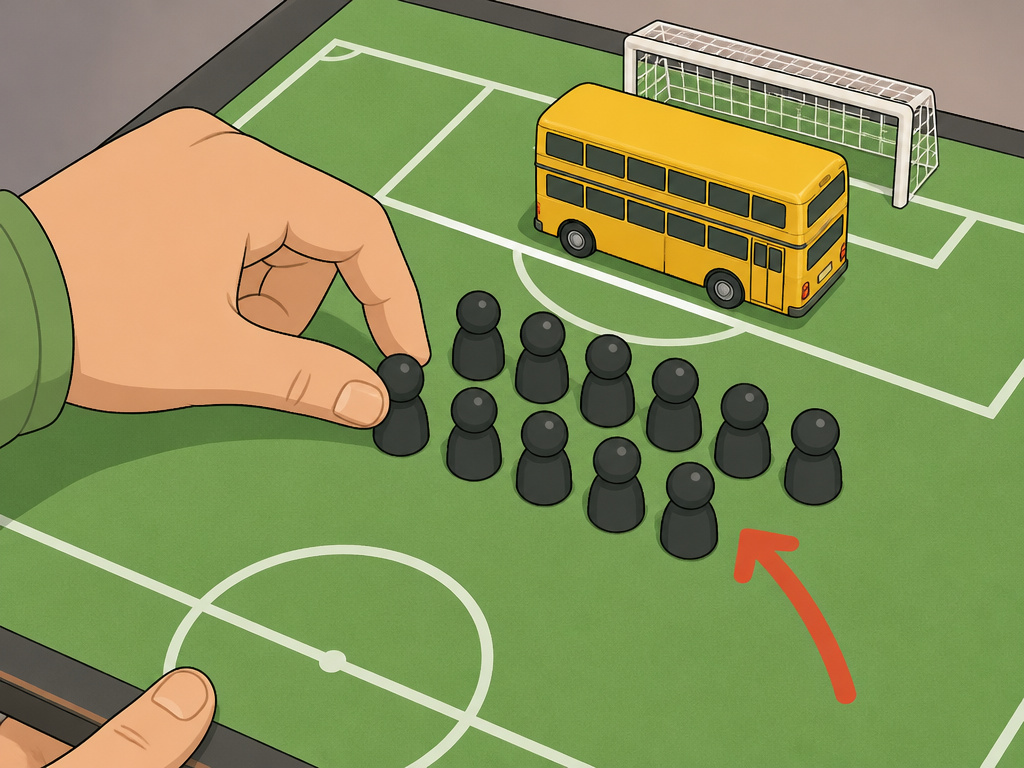
Mourinho’s Chelsea are the archetype, but they are far from alone. The tactic has been a tool for underdogs and pragmatists for decades.
- Atlético Madrid under Diego Simeone. Their 4-4-2 is famously rigid and compact, masters of the “suffer and counter” philosophy. They turn parking the bus into an art form and a point of pride.
- Sean Dyche’s Burnley. For years, their 4-4-2 low block was the Premier League’s most defined parked bus. They were organised, physical, and incredibly difficult to break down, even with limited talent.
- Brendan Rodgers’ Complaint. In 2014, after a defeat to Mourinho’s Chelsea, Rodgers said, “They parked two buses, rather than one. From the first minute, they had 10 men behind the ball.” The student had become the master, and the master was not pleased.
The association with Italian football is also strong—Inter Milan, Juventus, and AC Milan have all employed famously stingy defences. The historical precursor is catenaccio, a Italian system built around a libero and man-marking, which shared the same defensive-first soul if not the exact modern shape.
The thread connecting all these examples in a parking the bus in football explained is context. You don’t park the bus for 90 minutes every week unless it’s your entire identity (like Atletico or old Burnley). More often, it’s a situational tool: protecting a one-goal lead in the final 20 minutes, playing away at a much stronger opponent, or seeing out a first-leg advantage with ten men, as Inter did.
The Strategic Pros, Cons, and What the Data Says
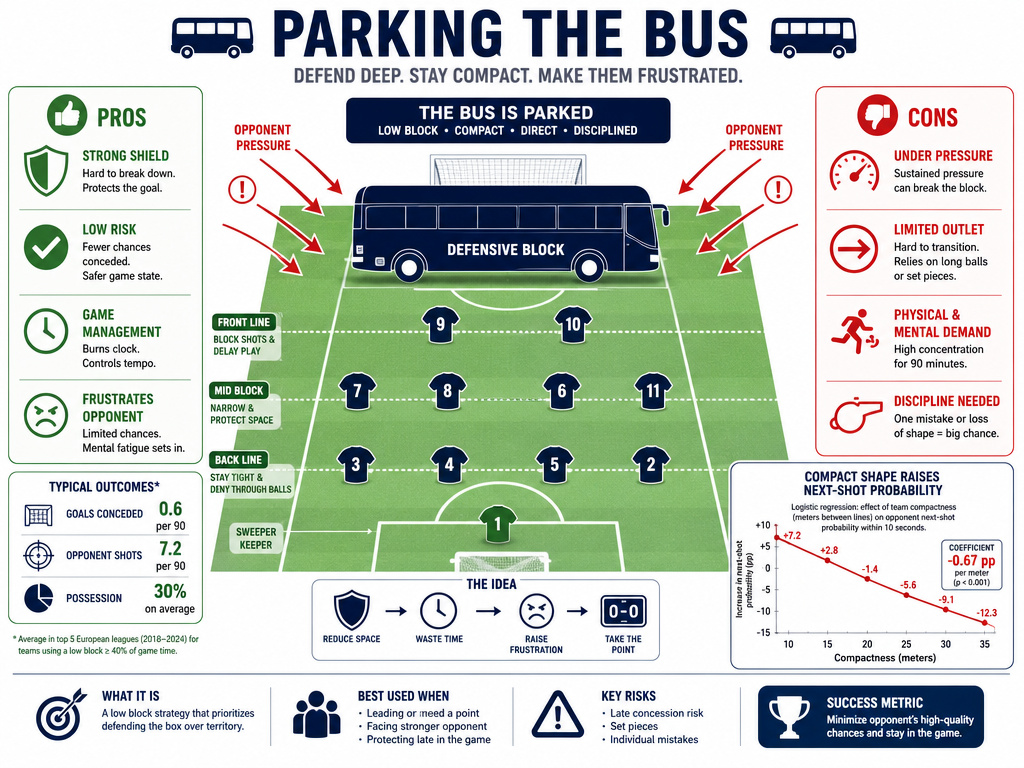
Is it a coward’s tactic or a savvy one? The debate is endless, but data and logic provide some answers.
The Pros (Why It Works):
- It Maximises Defensive Numbers. You have more players closer to your goal than the opponent has near theirs. Simple arithmetic makes scoring harder.
- It Reduces Risk. By not committing players forward, you eliminate transitional vulnerabilities. There’s no space behind your defence to exploit.
- It Frustrates Opponents. Facing a wall can lead to impatient, speculative shots from range or hopeful crosses, which are low-percentage chances.
- It Requires Less Athleticism. Constant high pressing is exhausting. Maintaining a deep, compact shape is less physically demanding, which can be crucial for lesser teams or in hot conditions.
The Cons (Why It Can Fail):
- It Invites Pressure. You are conceding territory and possession. The opponent will have the ball in your final third for long periods, increasing the likelihood of a lucky deflection, a set-piece, or a moment of individual brilliance.
- It Offers Little Attacking Outlet. Without a credible counter-attack, there’s no relief valve. The pressure is one-way and relentless.
- It Relies on Extreme Discipline. One player switching off for a second can open a channel for a pass or a run. The margin for error is tiny.
- The Data Suggests It Might Be Flawed. Their model used convex-hull area
A(t)as a proxy for defensive style and found its coefficient was negative and highly significant. In plain English: a more compact defensive shape by the leading team actually raised the probability that the trailing team would take the next shot. This suggests that sitting extremely deep, while intuitive, might increase your opponent’s chance of scoring next.
That last point is crucial. The study also found leading teams were most cautious with a one-goal lead, near the end of matches, and when perceived as the weaker team—exactly the scenarios where you’d expect to see the bus parked. The data implies this instinct might be counterproductive, keeping the opponent in the game by letting them dominate the ball in dangerous areas.
Where this goes sideways: Committing to a parked bus without a plan to ever relieve pressure. A team that simply camps in its box for 45 minutes will usually concede. The best parked buses, like Atletico’s, have a sharp, fast counter-attack as a release, turning defence into a genuine scoring threat.
Parking the Bus vs. Low Block vs. Mid-Block
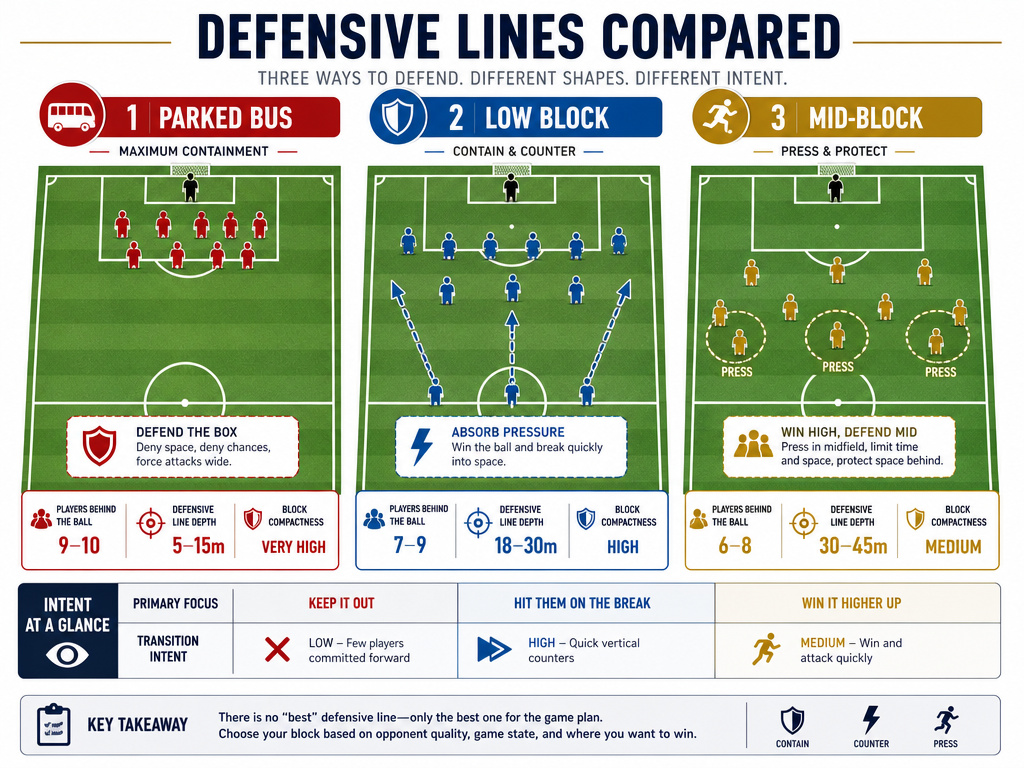
This is where casual analysis often stumbles. Not all deep defending is parking the bus.
| Tactic | Typical Line of Engagement | Primary Intent | Attacking Posture |
|---|---|---|---|
| Parking the Bus | Own penalty area / edge of box | Containment, time-wasting | Minimal to none; often no forwards ahead of the ball. |
| Low Block | Just inside own half | Absorb pressure, counter-attack | Structured; 2-3 players ready for fast transitions. |
| Mid-Block | Centre circle / halfway line | Lure opponent forward, win ball in midfield | Balanced; several players involved in both phases. |
The difference is in intent and aggression. A low block is a defensive platform designed to spring a counter-attack. A parked bus is primarily about forming a barrier. A low block might press certain triggers or step up to intercept; a parked bus rarely does. Think of Atletico Madrid (low block, aggressive counter) versus a League Two team trying to hold a 0-0 draw at a Premier League side in a cup match (parked bus, pure survival).
Similarly, a mid-block is a proactive defensive strategy about controlling space and forcing turnovers in the middle third. It has nothing to do with parking the bus. Confusing them is a sure sign someone is using the terms loosely.
How to Break Down a Parked Bus
So you’re facing a team that has parked a double-decker in front of their goal. What do you do? Patience and specific tools are required, not just more passion.
- Use Extreme Width. Stretch the compact block horizontally. If their block is narrow and you play narrow, you’re playing into their hands. Get the ball to wingers or overlapping full-backs and deliver early crosses.
- Create Overloads on one side. Drag their entire block over to one flank with sustained passing, then quickly switch play to the opposite side where they are now understaffed.
- Shoot from Distance. This is a last resort, but it forces the defenders to step out to block, which can disrupt their shape and open passing lanes. A deflected shot is often how these games are decided.
- Master Set-Pieces. Corners and free-kicks are golden opportunities against a packed defence. A well-worked routine can beat a mass of bodies.
- Utilise Creative Dribblers. One player with the individual skill to beat a man in a tight space can break the entire system. They draw multiple defenders, creating chaos and openings.
The worst thing you can do is play directly into the centre of their defence with slow, predictable passes. That’s exactly what they want. You need movement, variety, and the mental fortitude to keep probing for 90 minutes without getting frustrated.
For a deeper dive on this specific challenge, our guide on breaking down a low block covers the attacking strategies in detail.
Frequently Asked Questions
What does the phrase “parking the bus” mean in football?
It describes a team setting up in an extremely deep, compact, and defensive formation, with little to no intent to attack. The phrase was popularized by Jose Mourinho in 2004. The Cambridge Dictionary park the bus entry defines it as defending without trying to attack, with almost all players staying deep.
Who started the park the bus tactic?
The tactic of ultra-deep defence predates the phrase. However, the term “parking the bus” was introduced to English football by Jose Mourinho on 19 September 2004. He used it to criticise Tottenham’s defensive approach after a 0-0 draw. You can trace its linguistic history in the Cambridge Core journal article on the phrase’s usage.
What is the best formation for parking the bus in football?
There is no single “best” formation, as it depends on the players available. The most common and effective shapes are the 5-4-1 (three centre-backs, four midfielders) and the 4-5-1 (often a 4-1-4-1). Both provide two dense banks of four or five players, making the centre incredibly difficult to penetrate.
Is parking the bus a negative tactic?
It is often described as a negative approach because it prioritises not conceding over trying to score, though some sources define it neutrally. Mourinho’s original use was a criticism. However, managers who employ it argue it is a pragmatic and necessary tool in certain game situations. Its reputation depends entirely on whether you value result-oriented pragmatism or entertainment-oriented aesthetics.
Where did the term “park the bus” originate?
The first recorded use in English football was by Jose Mourinho after Chelsea’s 0-0 draw with Tottenham on 19 September 2004. He said, “As we say in Portugal, they brought the bus and they left the bus in front of the goal.” The phrase existed in Portuguese football slang before this, but Mourinho’s high-profile use made it mainstream. The Wiktionary park the bus entry also documents this etymology.
Before You Go
The debate over parking the bus is really a debate about what football is for. Is it a results business or a form of entertainment? The tactic sits uncomfortably in the middle, a necessary evil for some, a blight on the game for others.
The academic data from the SFU study offers a cold splash of reality: the instinct to retreat into an ultra-compact shell with a lead might actually increase your opponent’s chances. It’s a bold claim that challenges decades of coaching dogma. Perhaps the most effective defence isn’t the deepest one, but the one that best controls the transition between winning the ball and using it.
That’s the final, unspoken layer. Parking the bus isn’t just a shape; it’s a state of mind. It’s the decision to stop playing your game and try to stop theirs instead. Sometimes it’s genius. Sometimes it’s a trap you set for yourself. Knowing the difference is what separates a pragmatic point earned from two needlessly dropped.
