
Goalkeeper Glove Sizing Guide: How to Measure and Fit
This post contains affiliate links. As an Amazon Associate, we earn from qualifying purchases.
Goalkeeper glove sizing comes down to two numbers: your hand’s circumference or width, plus the specific cut and model of the glove you’re buying. Measure around your palm below the knuckles (excluding the thumb), then use the brand’s chart. Adidas, Uhlsport, and others all have their own formulas. Recommendations vary; for example, Keeperstop suggests a 1/4″ to 1/2″ gap, while Adidas suggests 0.5″ to 1″.
That measurement is just the start. The real confusion kicks in because every brand translates those inches into a size differently, and the tightness you want depends entirely on the glove’s cut. A goalkeeper glove sizing guide is essential to navigate these differences.
What follows: how to take the two critical measurements, a breakdown of the four conflicting sizing formulas from major brands, and how to adjust your size for finger protection systems and different glove cuts. By the end, you’ll be able to look at any glove’s spec sheet and know whether to order your usual size, go up, or go down.
Key Takeaways
- Measure your hand circumference just below the knuckles, excluding the thumb; this is the most common method, but brands like Uhlsport prioritize hand width.
- Brand sizing is not universal; a hand measuring 8.5 inches could be a size 9 in Adidas, a 9.5 in Uhlsport, or a 10 in FORZA, always check the specific brand’s chart.
- Keeperstop recommends a 1/4″ to 1/2″ gap for optimal latex contact, but other sources like Adidas recommend 0.5″ to 1″.
- Tighter glove cuts (like negative or hybrid) require more precise sizing; a size that feels roomy in a flat cut will be constricting in a negative cut.
- Always size up for gloves with fixed finger protection (like Saviour GK’s TITANIUM range); the internal spines reduce interior space.
How to Measure Your Hand for Gloves
Forget guessing by age or height. Your hand dimensions are the only reliable starting point. You need a soft tape measure and five minutes.
There are two schools of thought: circumference and width. Most brands, including Adidas and retailers like AuthenticSoccer, use circumference. Others, like Uhlsport and Keepers, design their charts around width. You should record both.
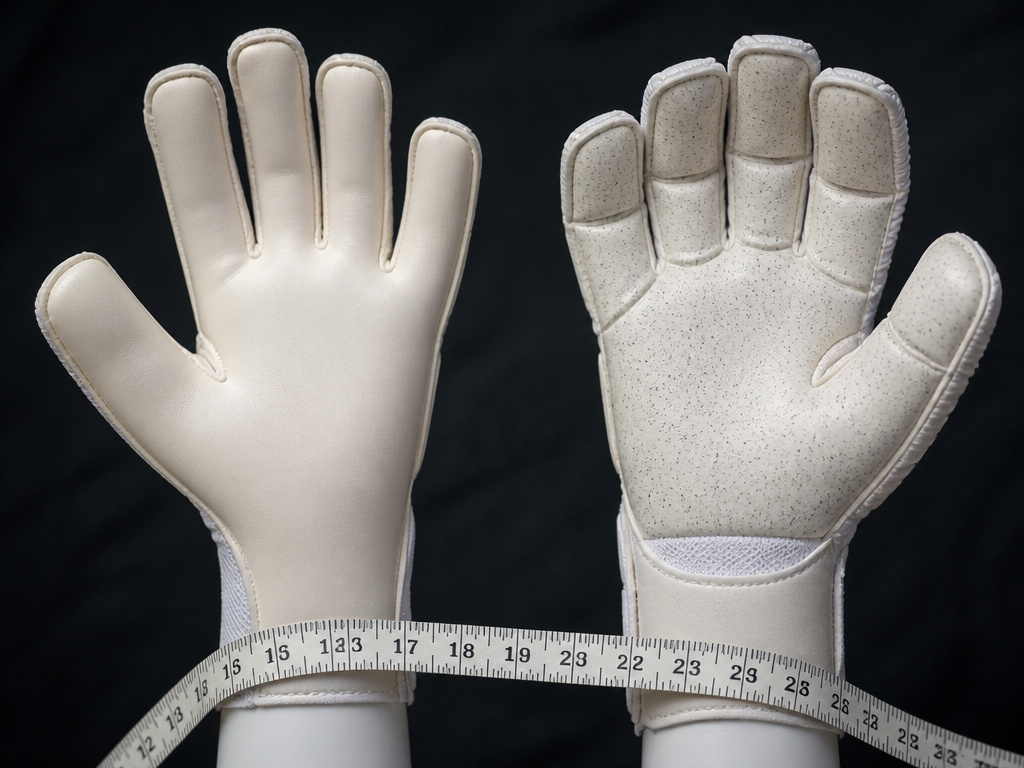
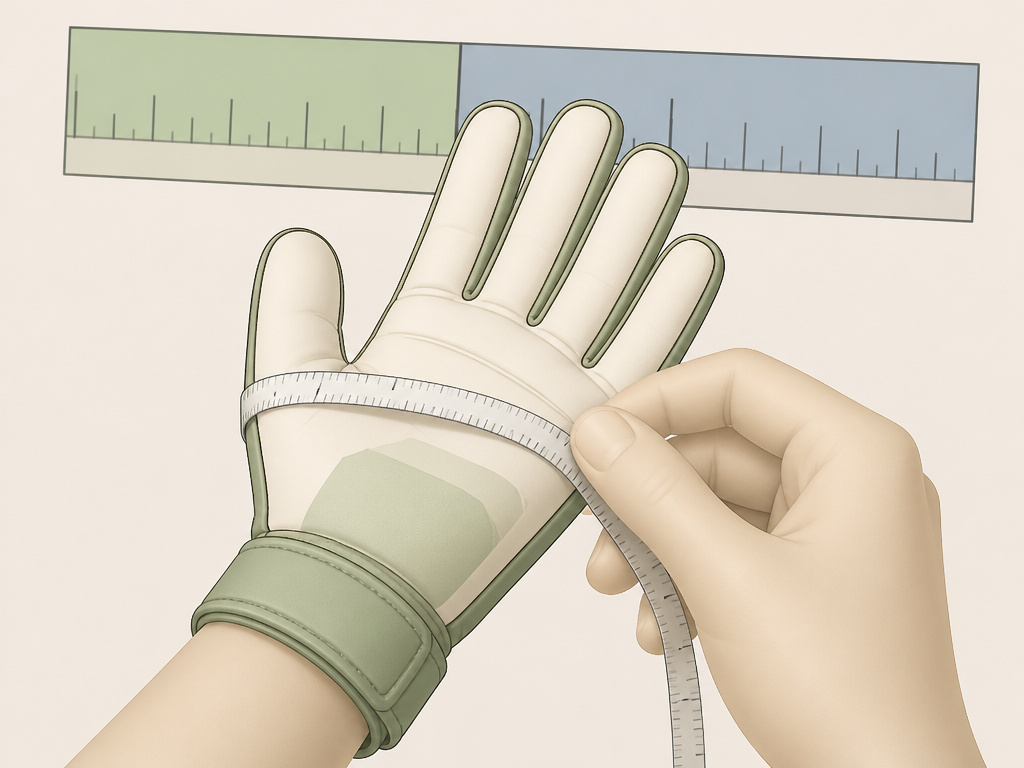
The Technical Snippet: To measure hand circumference, wrap the tape around the widest part of your palm, just below the knuckles, excluding the thumb. For hand width, measure straight across the same widest part of the palm, from the outside edge below the little finger to the outside edge below the index finger, again excluding the thumb. Record both measurements in inches and centimeters.
Step 1: Circumference.
Wrap the tape snugly around your palm, right below the base of your four fingers. Keep your thumb out of the loop. Don’t pull the tape tight enough to compress your hand, just enough so it sits flat without gaps. Note the number. Do this for both hands and use the larger measurement.
Step 2: Width.
Place the tape at the outermost point on the side of your hand, below the little finger knuckle. Stretch it straight across your palm to the same point below the index finger knuckle. Keep it flat. This gives you your hand width.
Why this matters: If you only take a circumference and then shop for an Uhlsport glove, you’ll be lost. Their primary chart is based on width. Having both numbers allows you to use any brand’s sizing chart.
Decoding the Brand Charts: Four Formulas, One Hand
Here is where the clean theory meets messy reality. For example, your measurement might be a circumference of 8.5 inches. What size is that? It depends entirely on whose chart you’re reading.
| Brand / Source | Sizing Formula (Circumference Method) | Example: 8.5″ Measurement |
|---|---|---|
| Adidas | Round up to next whole inch (or add 2.5 cm). | 8.5″ → round up to 9″ → Size 9 |
| Academy Sports, AuthenticSoccer, Keeperstop | Round up to next whole inch, then add 1. | 8.5″ → round up to 9″ → 9 + 1 = Size 10 |
| Uhlsport | Use direct lookup chart based on hand width (94-96mm = Size 9.5). | 8.5″ circumference correlates to ~ Size 9.5 (per width chart) |
| FORZA | Direct measurement correlation (8.5IN = Size 10). | 8.5″ → Size 10 |
As you can see, the same hand could be labelled three different sizes. This isn’t a mistake, it’s a reflection of different glove cuts and internal padding, a core reason you need a detailed goalkeeper glove sizing guide. The “add 1” formula is used by retailers like Academy Sports, AuthenticSoccer, and Keeperstop. Different brands use different formulas, such as Adidas’s round-up method or the “add 1” method.
Where this goes sideways: Assuming your size is universal. Buying a Size 10 in Adidas and a Size 10 in a brand that uses the “add 1” formula will get you two very different fitting gloves. One will be snug, the other will be sloppy.
What to do with your numbers:
- Find the official size chart for the specific brand and model you want.
- Match your circumference to brands like Adidas, Reusch, or Nike.
- Match your width to brands like Uhlsport or Keepers.
- If the brand uses the “round up and add 1” method (like Academy Sports or AuthenticSoccer), follow that. Note that Adidas uses a different method (round up to determine size).
The Big Question: How Much Room Is Too Much?
You’ve navigated the chart and picked a size. Now, how should it actually feel on your hand? The old adage that goalkeeping gloves should be “worn big” is only half the story.
The goal is to have the ball contact the latex palm, not the fabric finger tips. To do that, your fingers must stop short of the very end. But how short?
Common mistake: Wearing gloves a full size too big for a “pro” look. I did this for a season, fingers swimming in empty latex at the tips. The result was fumbled low drives and a constant feeling of disconnection from the ball. A large amount of dead space is too much.
Recommendations for the ideal fingertip gap vary among experts and retailers. Here’s the disagreement laid out:
| Source | Recommended Fingertip Gap | Notes |
|---|---|---|
| Keeperstop | 1/4″ to 1/2″ (a fingernail’s length) | Cited as optimal for control and durability. |
| Adidas | 0.5″ to 1″ (1 to 2.5 cm) | Stated in their official sizing guide. |
| AuthenticSoccer | Up to 1.5″ | Represents the traditional “wear them big” advice. |
Keeperstop recommends a 1/4″ to 1/2″ gap, while Adidas suggests 0.5″ to 1″ and AuthenticSoccer states up to 1.5″. It ensures maximum latex contact with the ball while giving just enough room to prevent jamming. A gap that is too large can cause you to catch the ball with fabric, killing grip and feel.
The pinch test: No tape measure? With the glove on, pinch the tip of a finger. If you can barely pinch any material, it’s too tight. If you can pinch a small fold of latex, the fit may be good. If you can pinch a big, loose flap, the glove is too big.
How Glove Cut and Features Force a Size Change
Your measured size is a baseline. The glove’s design will demand the final adjustment. Think of it like sizing football boots, a sleek, synthetic boot fits differently than a classic leather one.
Tighter Cuts (Negative, Hybrid, Evo-Neg):
These cuts are designed to fit like a second skin. The stitching is on the inside, reducing bulk. If you’re between sizes, size up. A Saviour GK LEGACY range glove, for example, is built for a tight fit, and they advise going half a size up from your standard if needed. The same logic applies when comparing negative cut vs roll finger designs, the negative will feel tighter in the same labelled size.
Finger Protection Systems (Fingersave, FingerLock):
Gloves with built-in, non-removable spines are not just stiffer, they take up interior space. Saviour GK explicitly recommends going a full size up for their TITANIUM Range with FingerLock Technology. If you’re considering finger save gloves, factor this in. Your usual size will likely feel restrictive.
Traditional Cuts (Flat, Roll Finger):
These have a roomier build. You can often stick to your measured size, or even go down half a size if you prefer a snug feel without the constriction of a negative cut. This is where the older “add 1” sizing formula often applied.
The cut doesn’t just change feel; it changes the glove latex contact point. A tighter cut places premium latex right where your fingers meet the ball. A sloppy fit shifts that point, wasting the technology you paid for.
Special Cases: Youth Sizing and Mismatched Hands
Youth Goalkeepers:
For youth goalkeeper gloves, the rules are the same, measure, don’t guess by age. Youth and adult glove sizing ranges are different. Brands like Keepers note their youth range covers sizes 5-7.5, with adult sizes starting at 8. Growth spurts are your enemy; For youth goalkeepers, allowing a little room for growth can be a wise play. When in doubt, the slight room for growth is the wiser play.
One Hand Larger Than the Other:
It’s common. Always size for the larger hand. A glove that’s too tight can cause excessive wear and be uncomfortable. A glove that’s slightly roomy on the smaller hand may still be wearable.
Before You Buy: The Final Checklist
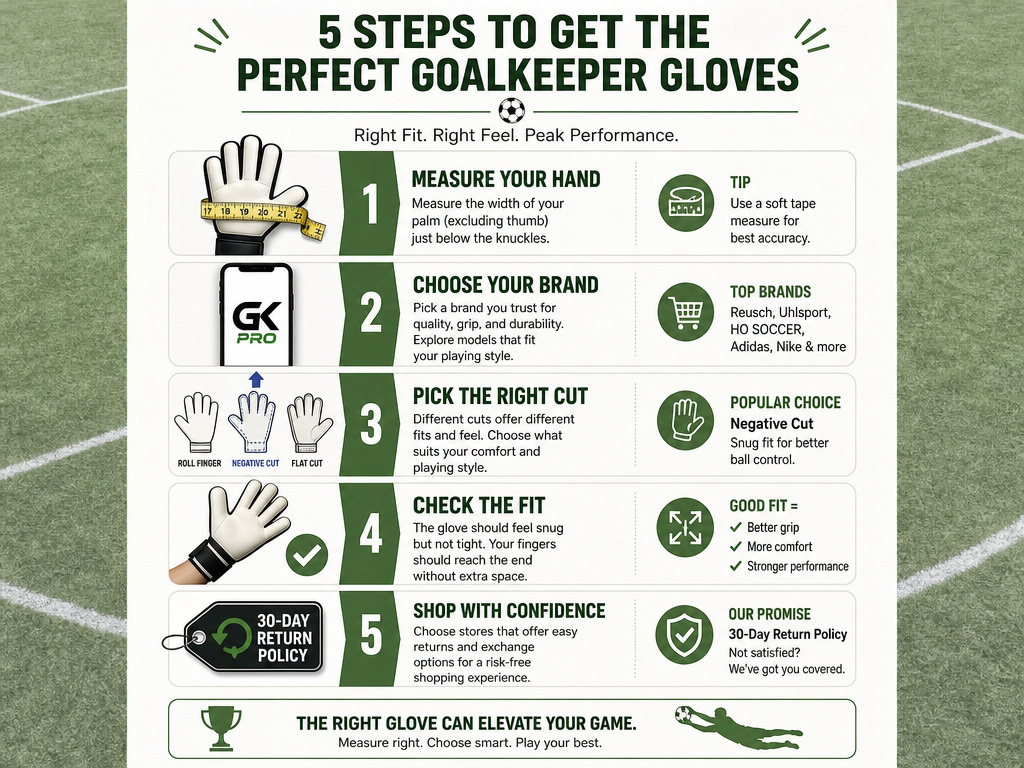
- Measure Both Hands. Use the larger measurement.
- Find the Exact Brand Chart. Don’t use a generic chart for a specific model. Check the product page or brand’s support site.
- Apply the Cut Rule. Negative/hybrid cut? Consider half a size up. Fixed finger spines? Consider a full size up.
- Know Your Preference. Do you want a second-skin feel or a bit of room? This is the final veto on the size chart.
- Check the Return Policy. Even with perfect measuring, nothing beats trying them on. Ensure you can exchange if the fit is off.
Remember, the right size is the foundation of good goalkeeping. It affects everything from confidence to durability. A well-fitted glove is crucial for performance. And once you’ve got them, learn how to clean goalkeeper gloves and how to make goalkeeper gloves last longer, that’s where the real value is.
Size charts with measurements (inches/cm) per size
Manufacturers provide specific size charts, but the numbers vary by brand. For example, one brand’s size 9 corresponds to a hand circumference of 8.5 to 9.5 inches, while another’s size 9.5 fits a width of 3.67 to 3.78 inches and a circumference of 9.66 to 10.43 inches. A different brand lists its size 10 for a hand measurement of 8.5 inches. Because these measurements are not universal, you must check the specific chart for the glove model you want, using a dedicated goalkeeper glove sizing guide. Sizing can also differ between a brand’s own product lines, so always refer to the official guide for that particular glove.
Sizing by age and/or height as a rough guide
While not a precise method, age and player size can offer a starting point. Some brands categorize their ranges, with youth gloves typically covering smaller sizes and adult gloves covering larger ones. For instance, one size guide notes that children’s and youth gloves often fall within a specific smaller size range, while adult gloves occupy a larger one. However, hand size varies greatly among individuals of the same age or height. Use these categories only for an initial estimate before taking your actual hand measurements. The most reliable fit comes from using a tape measure, not an age bracket.
Frequently Asked Questions
What if I’m between sizes on the chart?
Some brands, like Adidas, instruct you to round up to the next whole size. Others have different methods. If you prefer a non-tight fit, Uhlsport recommends choosing half a size up. The safer bet is always to round up.
How snug should goalkeeper gloves be?
Snug, but not tight. You should be able to make a firm fist without the palm material pulling excessively or the seams straining. Your fingertips should not be pressed hard against the end. A little wiggle room is necessary for circulation and to prevent the latex from overstressing.
Do all brands fit the same?
No. Sizing varies significantly by brand and even by model within a brand. A Nike size 9, an Adidas size 9, and an Uhlsport size 9 will all fit differently. Always consult the individual size chart for the glove you are purchasing.
Can I use my soccer glove size for other sports?
No. Goalkeeper glove sizing is unique. Goalkeeper glove sizing is unique to the sport.
What’s more important, glove size or glove cut?
They are equally important and directly linked. The right size in the wrong cut will still feel wrong. Understand the different glove cuts (negative, roll, flat, hybrid) first, as the cut will dictate how you should interpret your base size.
The Bottom Line
Throw out the idea of a universal glove size. Your starting point is a tape measure and your own hand. Your finishing point is the specific size chart for the specific glove you want, adjusted for its cut and features. Aim for that quarter-to-half-inch fingertip gap, it’s the difference between catching with latex and catching with cloth. And if you remember one thing, let it be this: a glove that fits perfectly but is poorly cared for will fail faster than a mediocre glove that’s maintained. The fit gets you in the game; the maintenance keeps you there.
