
Football Boot Sizing Guide: How to Get the Right Fit
This post contains affiliate links. As an Amazon Associate, we earn from qualifying purchases.
A football boot sizing guide starts with your foot length in centimetres, not your shoe size. Match that measurement to the brand’s official size chart, then adjust for material stretch, leather gives, synthetic does not, and your foot shape. For a proper fit, sources recommend leaving a gap at the toe; CleatsHub and Elite Champions Coaching suggest 5–12 mm, while Sports Direct advises 4–8 mm.
That length-first rule from the football boot sizing guide flips the script for most people buying online. You are not guessing if a UK 9 is right; you are checking if a 27.1 cm foot matches the brand’s UK 9. The charts from Nike and adidas disagree on that conversion by half a size, which is why one brand can feel ‘small’ when it is just labelled differently.
What follows is a walkthrough of the measurement, the brand quirks that break the standard advice in a football boot sizing guide, and how to handle the common pitfalls of shopping without trying boots on. By the end, you will know how to read a size chart, when to size up for width, and why that thumb-width of space is essential.
Key Takeaways
- Measure your foot length in cm and match it to the brand’s official chart, this bypasses inconsistent UK/US/EU conversions that cause most sizing errors.
- Synthetic uppers (Nike Mercurial, adidas X) stretch very little; if they are not comfortable when new, they will not become comfortable. Leather (adidas Copa, Mizuno Morelia) will mould to your foot over time.
- Ignore your everyday shoe size. Sources disagree on sizing down: Elite Champions Coaching says most players take a half-size down, while Nike advises that recreational players generally do not need to size down.
- A boot that is too large for a child is an injury risk on a turn. Leave a maximum of one thumb-width of growing room at the toe.
The most reliable method is to measure your foot length in centimetres at the end of the day, then compare that measurement directly to the manufacturer’s size chart. This eliminates guesswork caused by inconsistent conversions between UK, US, and EU sizing systems.
The 4-Step Foot Measurement Process
Forget what size you wear in trainers. Your foot length in centimetres is the only number that matters, and getting it wrong means buying the wrong boot twice. Here is how to get it right once.
Sources agree the best time is later in the day; adidas recommends the end of the day, and Sports Direct suggests late afternoon or early evening. Your feet swell during the day, and measuring them at their largest ensures your boots will not pinch during a match.
Now, the steps:
- Place a piece of paper flat on the floor against a wall. Stand on it with your heel touching the wall.
- Mark the longest point of your foot. This is usually your big toe, but for some people, it is the second toe. Hold a pencil straight up and down to trace the outline.
- Measure the distance from the wall to your mark in centimetres. Use a ruler or a tape measure; do not guess.
- Repeat for the other foot. Always use the measurement from your longer foot.
That centimetre figure is your starting point. Do not add anything to it yet. That number, say, 26.7 cm, is what you will match against the brand’s size chart.
How Much Space Should Be at the Toe?
You have your foot length. Now, how much extra room does the boot need? The answer is specific, and sources disagree on the exact millimetre.
Sources disagree on the exact amount: Elite Champions Coaching and CleatsHub suggest 5–12 mm, while Sports Direct advises adding 4–8 mm. That is enough space for your foot to slide forward slightly during a sprint without jamming your toes. If the gap is larger and your heel lifts more than 8–10 mm when you walk, the boot is too long.
This rule is absolute for kids. A boot that is too large is an injury risk on a turn. Leave one thumb-width of growing room, and not a millimetre more.
Leather vs. Synthetic: The Stretch Factor
The material of the boot’s upper decides your break-in period and whether you should size for comfort now or later. This is where the standard ‘true to size’ advice falls apart.
Leather boots (adidas Copa, Mizuno Morelia, Puma King) stretch. According to adidas, organic materials like leather will stretch over time and adapt to a wider fit. You can buy them snug, not painful, with the correct toe length, knowing they will mould to your foot over time. The Puma King, for example, uses kangaroo leather and is offered in standard and wide widths.
Synthetic boots (Nike Mercurial, adidas X, Puma Ultra) do not. Nike states its synthetic boots require little to no break-in time, and adidas notes that uppers like Primeknit “tend to have little to no stretch and will keep their initial fit.” If a synthetic boot is too tight across the forefoot when new, it will not magically become comfortable. You need the right size, or a different model, from the start.
| Upper Material | Break-in & Stretch | Sizing Strategy | Example Models |
|---|---|---|---|
| Leather/Kangaroo | Will stretch and mould over 3-4 wears. | Size for correct length; allow a snug width that will ease. | adidas Copa, Mizuno Morelia, Puma King |
| Synthetic/Knit | Minimal to no stretch. Keeps initial fit. | Must be comfortable from first wear. Do not size for future stretch. | Nike Mercurial, adidas X, Puma Ultra |
|
Navigating Brand and Model Quirks
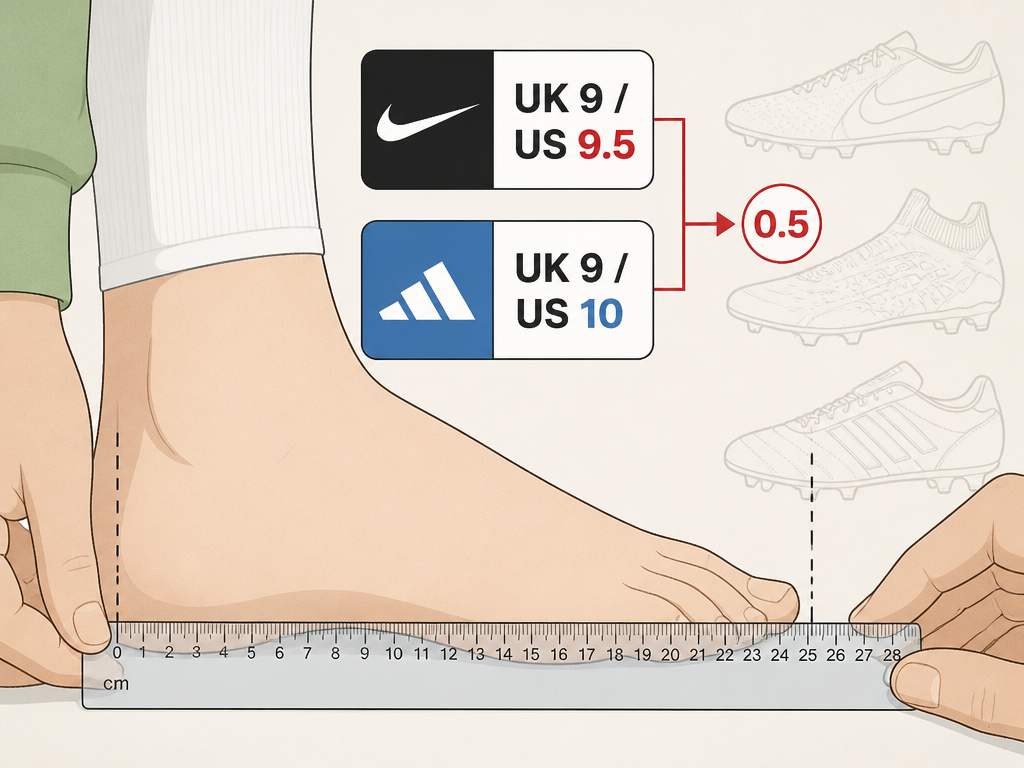
Your foot length in cm might correspond to different labelled sizes in Nike and adidas charts due to a systemic discrepancy. This is not a mistake, it is a labelling discrepancy, and it is the number one reason players think a brand ‘runs small’.
FootballBoots.co.uk points out that Nike and adidas sizes differ by roughly half a size in the UK-to-US conversion. It is a systemic difference in their charts, not necessarily in the physical boot. Always convert your foot length to the brand’s specific chart.
Within brands, individual models have their own personalities. A ‘true to size’ label for Nike does not apply to every silo.
- Nike Phantom runs roughly a quarter-size long compared to other Nike lines.
- Puma Future last is noticeably wider than the Puma Ultra last.
- adidas Copa Pure is generous in the forefoot but can let narrow feet slip at the heel.
Then there are regional lasts. Mizuno’s Japanese sizing tends to run narrower. A common adjustment is going half a size up from your UK running shoe size. For players with genuinely wide feet, New Balance offers Furon and Tekela models in a genuine 2E wide fit, a proper solution, not just a size-up workaround.
Should You Size Up or Down?
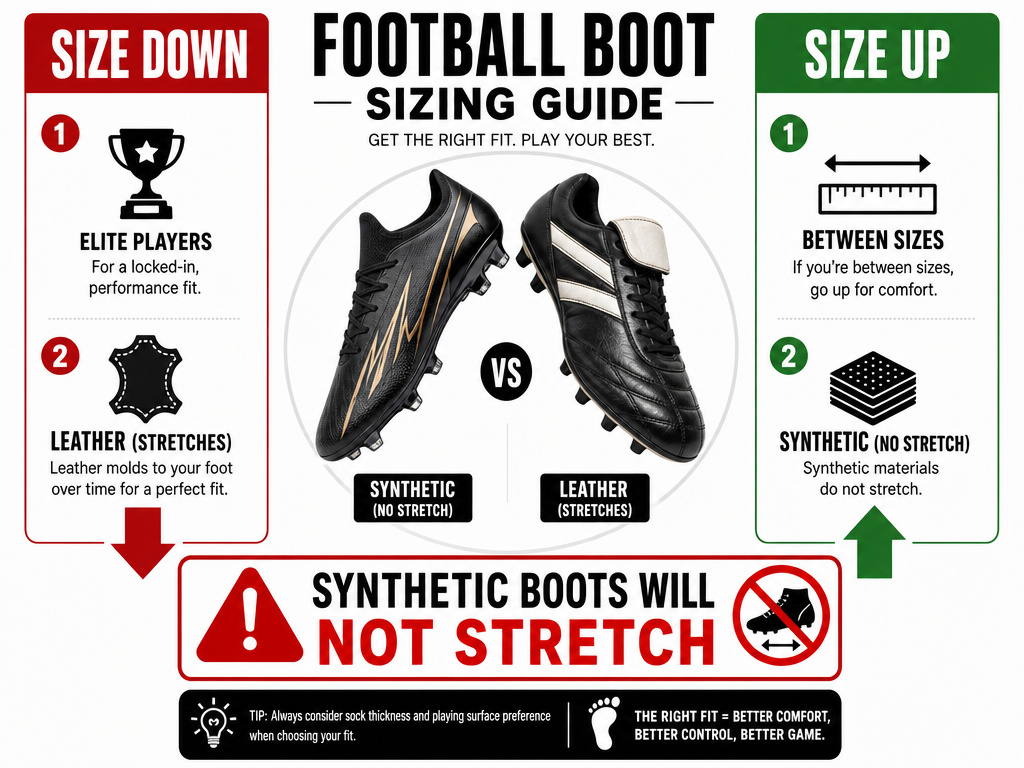
The eternal question. The answer splits by player level and material, and the sources do not fully agree.
Nike provides the clearest tiered advice: Elite players can size down a half to a full size for a closer ball feel. Recreational players generally do not need to size down. The logic is that elite players prioritise an ultra-precise touch over comfort, while weekend warriors do not.
The broader consensus from fitters and guides is that most players take a half-size down from their everyday shoe. This is because football boots are built for a snug, performance fit, while trainers are built for all-day comfort with more room.
Here is the decision matrix to cut through the noise:
| Your Situation | General Rule | When to Deviate |
|---|---|---|
| Foot measurement between sizes | Size up. (Nike and others recommend this). | Only size down if you are an elite player seeking that skin-tight feel for synthetic boots. |
| Wide feet | Size for length first. Seek wide-fit models (New Balance 2E, Puma WIDE). | Do not size up for width if it makes the boot too long, causing heel slip. |
| Buying leather boots | Can fit snugger at first, as they will stretch. | If between sizes, the smaller size may work if the length is acceptable. | | Buying synthetic boots | Must fit perfectly from the first try-on. | If between sizes, lean toward the larger size for immediate comfort. |
Where this goes sideways: Sizing down in a synthetic boot because ‘it will stretch.’ It will not. You will end up with numb toes and a boot you cannot wear.
The Online Purchase Strategy
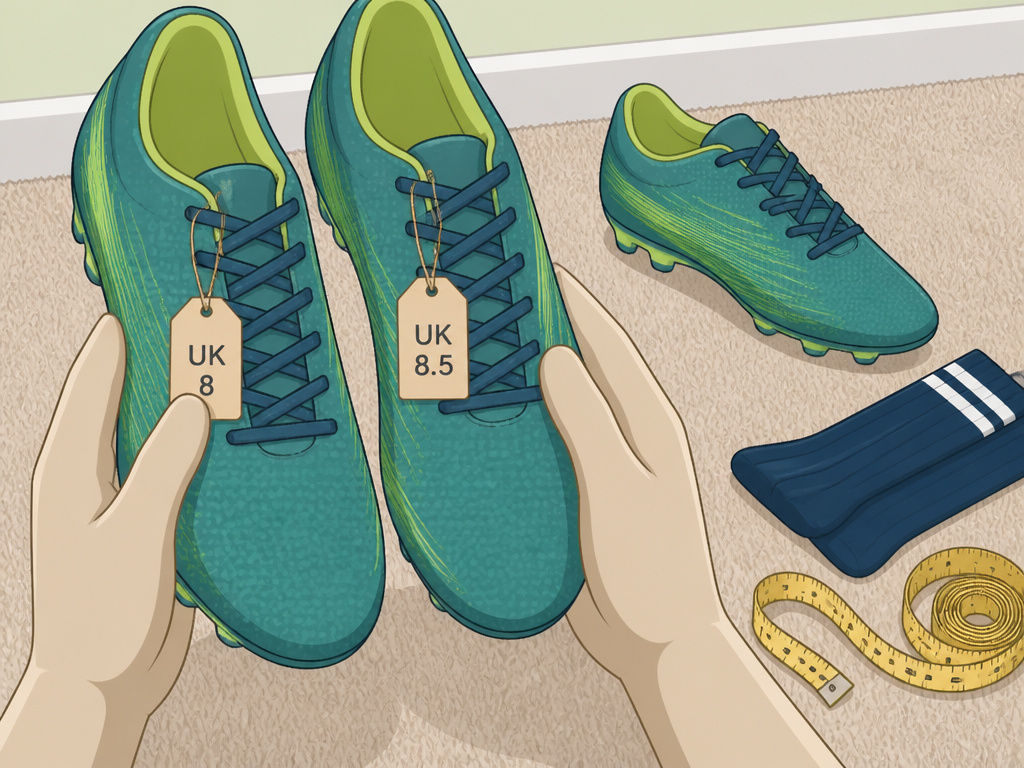
Buying boots without trying them is a gamble, but you can stack the odds in your favour. Your measurement is your ante. Here is how to play the hand.
First, only shop from retailers with a clear, free returns policy. Read the fine print. You need to be able to wear the boots indoors (on carpet) to assess the fit properly.
Your best tactic is to order two adjacent sizes. If your measurement points to a UK 8, order an 8 and an 8.5. Try both with your football socks on in the evening. Walk around. Do a few lunges. The right size will announce itself, it is the one you are not thinking about. The wrong size will have a hotspot, a slip, or a pinch.
Check the model-specific fit notes on the product page. Reputable retailers often add lines like “runs large” or “fits narrow.” For instance, notes on the adidas Copa Pure might mention its generous forefoot, which is crucial info for narrow-footed players.
How to use football boot size conversion charts
Official size charts from different brands do not always align. A common discrepancy is that Nike and adidas football boot sizes differ by roughly half a size in the UK-to-US conversion. This means a UK size 8 from one brand may correspond to a different US size than the other. It’s one of the most common reasons players think a brand ‘runs small’ when it’s actually just a labelling difference. Australian and UK sizes are effectively the same number, while US sizing runs about one size higher. When using a chart, always refer to the specific brand’s official guide, not a generic one, and prioritize your foot measurement in centimetres over any lettered size.
Frequently Asked Questions
Is football boot size the same as shoe size?
No, not directly. Football boots are designed to fit snugger than everyday shoes for better ball control and stability. Most players end up taking a half-size down from their regular shoe size, but the only reliable method is to measure your foot in cm and use the brand’s specific size chart.
How do I know my football boots are the right size?
You need to check three things: length, width, and heel lock. For length, stand up with your football socks on, there should be about a thumb’s width (5-12 mm) of space at the toe. For width, the boot should feel snug across the ball of your foot without pinching or bulging over the sole. For heel lock, your heel should not slide up and down when you walk or jog.
Should you go up 1/2 size in football boots?
Only in specific cases. Go up a half-size if your foot measurement falls directly between two sizes on the chart, if you have a high instep that feels crushed in the correct length, or if you are buying a notoriously narrow model (like the Nike Mercurial) and have wide feet. Do not size up hoping a synthetic boot will stretch.
What if my boots are slightly too big?
Little heel slip (a few mm) in new boots can be normal, but excessive space is a problem. Ensure you are using a proper lacing technique to lock your heel down. If there is still a large gap at the toe or your foot slides during cuts, the boot is simply too long and should be exchanged for a smaller size.
Before You Go
The one rule that overrides all others: a boot that does not fit correctly cannot perform correctly. It does not matter if it is the lightest, most expensive, or most endorsed model on the planet. If it is too long, your touch disappears. If it is too narrow, every pass becomes a pain.
So, measure your feet. Not tomorrow, not when you are about to click ‘buy’, today. Get that number in centimetres. It is the single most useful piece of information you will ever have for buying boots.
Then, apply the material rule like a law. Synthetic means no stretch. Leather means patience. And if you are ordering online, buy the two sizes. The cost of a return is nothing compared to the cost of a season spent in the wrong boots.
Finally, for the kids, resist the urge to buy big. One centimetre of growing room is the absolute max. Their coordination and safety depend on a boot that fits now, not next year.
