
Football Pitch Dimensions and Markings Explained
This post contains affiliate links. As an Amazon Associate, we earn from qualifying purchases.
Football pitch dimensions and markings explained: IFAB Law 1 allows a pitch 90-120 m long and 45-90 m wide, with lines no wider than 12 cm. The Premier League and UEFA Categories 3 and 4 use 105 m by 68 m. The goal area is 5.5 m, the penalty area 16.5 m, the penalty mark 11 m.
That 90-120 m length window is wide enough for two legal pitches to differ by 30 m end to end. Each competition then picks its own slice of the range, and the slices don’t match. A pitch that passes one rulebook can fail the next.
What follows covers the rulebooks that narrow the range, every line and area, how to set a pitch out, the space around it, and youth sizes.
Key Takeaways
- A foul with contact on the penalty area line counts as inside the area, so the referee awards a penalty kick.
- The FA’s own guide recommends 100 m x 64 m for adult football, so 105 m x 68 m applies at the top level only.
- Measure to the outside of the lines, and measure the goal and penalty areas from the inside of each goalpost.
- The FA’s minimum run-off for pyramid clubs is 1.83 m, while a new ground should provide at least 3 m.
- The FA’s metric guide puts a 9v9 pitch at 73 m x 46 m, and its line colours tell you the format at a glance.
What Are the Official Dimensions of a Football Pitch?
I once tried to pace out a pitch on a local park. I got about 90 metres, on a pitch that was meant to be longer. (My stride, it turns out, is a suggestion rather than a unit.)
Two lessons came out of that. In football pitch dimensions and markings explained, sizes vary inside a permitted range, and a tape beats a stride every time.
IFAB Law 1 sets touchline length between 90 m and 120 m and goal line width between 45 m and 90 m. International matches use 100-110 m by 64-75 m. Competitions choose lengths and widths inside those limits, and the Premier League standard of 105 m by 68 m applies unless the Premier League Board allows otherwise.
The Laws work like a recipe that says season to taste. IFAB’s Law 1 sets the limits, and competitions may choose the length of the goal line and touchline within them. Length is the touchline. Width is the goal line.
The Rulebooks Side by Side
Six rulebooks give six answers. Read the table by asking which competition you’re actually playing in.
| Rulebook | Length x width | Applies to |
|---|---|---|
| IFAB Law 1, general | 90-120 m x 45-90 m | All matches under the Laws |
| IFAB Law 1, international | 100-110 m x 64-75 m | International matches |
| UEFA Categories 1 and 2 | 100-105 m x 64-68 m | UEFA stadium categories |
| UEFA Categories 3 and 4 | 105 m x 68 m exactly | Higher UEFA categories |
| Premier League | 105 m x 68 m | Unless the Board allows otherwise |
| The FA guide | 100 m x 64 m | Adult football, National League System Steps 1-6 |
The FA’s Section 38 recommends 110 x 70 yd for senior football. Its metric guide lists 100 m x 64 m for adult football. That’s the same pitch in two units, give or take rounding, and you can read both in The FA’s Section 38 and the FA metric guide.
UEFA’s top two categories ask for more than a size. UEFA’s regulations add an automated under-soil irrigation system, plus pitch heating and/or a pitch cover depending on location and climate.
Same sport, six answers.
Why Is There No Single Football Pitch Size?
Because the Laws were written to allow variety. IFAB states that competitions may set the touchline and goal line lengths within Law 1’s dimensions, and every rulebook in the table above exercises that choice differently.
Ground space does the rest. A law-firm note from Walker Morris says six Premier League clubs had pitches slightly smaller than 105 m x 68 m at the time of writing. The most common reason for the Board approving a smaller pitch was space constraints from a city-centre location. Clubs also need prior Premier League approval before altering pitch dimensions during the season.
Three forces shape a ground’s final size:
- The competition’s own range. Law 1 gives the outer limits; leagues and tournaments narrow them.
- The plot of land. Stands, roads and houses decide whether a pitch can grow.
- Board approval. Premier League clubs need it for anything off the 105 m x 68 m standard.
Euro 2028 gives a dramatic example, though I’d treat it carefully. A fan site, Anfield Index, reports that Anfield missed out as a host venue because of pitch size and that Stamford Bridge also fails UEFA’s dimension standards. That’s a secondary source, not UEFA’s own word.
Does a bigger pitch change how teams play? I’d love to say yes with a straight face. The evidence behind this article doesn’t quantify it, so I won’t pretend it does.
Also, the section number for the Premier League’s size rule varies by source. Walker Morris cites K.15, while another summary I came across cites K.18 and K.19. Check the current handbook before quoting a clause.
Every Line and Area on the Pitch, and What It’s For
Football pitch dimensions and markings explained at their simplest answer three questions: where does a foul turn into a penalty, where must players stand before a restart, and how far is everything from goal?
Here’s each marking with its measurement from IFAB Law 1:
- Goal area: 5.5 m, measured from the inside of each goalpost. Fans call it the six-yard box.
- Penalty area: 16.5 m, measured from the inside of each goalpost. The 18-yard box.
- Penalty mark: 11 m, measured from the centre of the mark to the back edge of the goal line.
- Penalty arc and centre circle: both have a 9.15 m radius.
- Corner arc: 1 m radius.
- Halfway line: splits the pitch in two. On a 5v5 pitch, the FA also uses it as the retreat line for goal kicks.
The Penalty Area: Where Defending Gets Dangerous
I tell new fans to stop seeing the box as a rectangle to memorise. See it as the zone where defending gets dangerous, because a foul inside it costs a penalty. Once that clicks, the size makes sense.
The line itself matters too. Under Law 1, lines belong to the areas they bound. IFAB’s own FAQ gives two cases: a reckless foul with contact on the penalty area line is a penalty kick and a caution, and a kicker’s team-mate who touches the line before the kick has encroached. In that second case the goal is disallowed and the defenders get an indirect free kick, with no card.
Try this at the next match: pick one defender who is nowhere near the ball and watch his feet around that line. Most of the job is staying on the right side of it.
Who knew a stripe of paint carried that much weight?
The part nobody mentions: Measure to the centre of a line and the boundary moves. IFAB measures from the outside of the lines, and a line can be up to 12 cm wide, so a marker who measures to the middle puts each edge off by about half a line width. The error stays in place for every match until someone re-measures.
Corners, Flags and Optional Marks
Corner flagposts must be at least 1.5 m tall.
How to Set Out a Pitch Without Repeating Montreal’s 2016 Mistake
On 22 November 2016, the first leg of the MLS Eastern Conference Final between Montreal Impact and Toronto FC started late. League officials had reviewed the penalty areas and found them wrong. Kick-off was delayed while the lines were repainted.
The sources disagree on the exact error. MLS said the 18-yard boxes were too narrow. Athletic Business said the box lines sat about 2 yd too close to the goal, and Goal.com said the boxes were narrower than the 44 yd width. Whichever is right, the fix happened at pitchside, minutes before a playoff match.
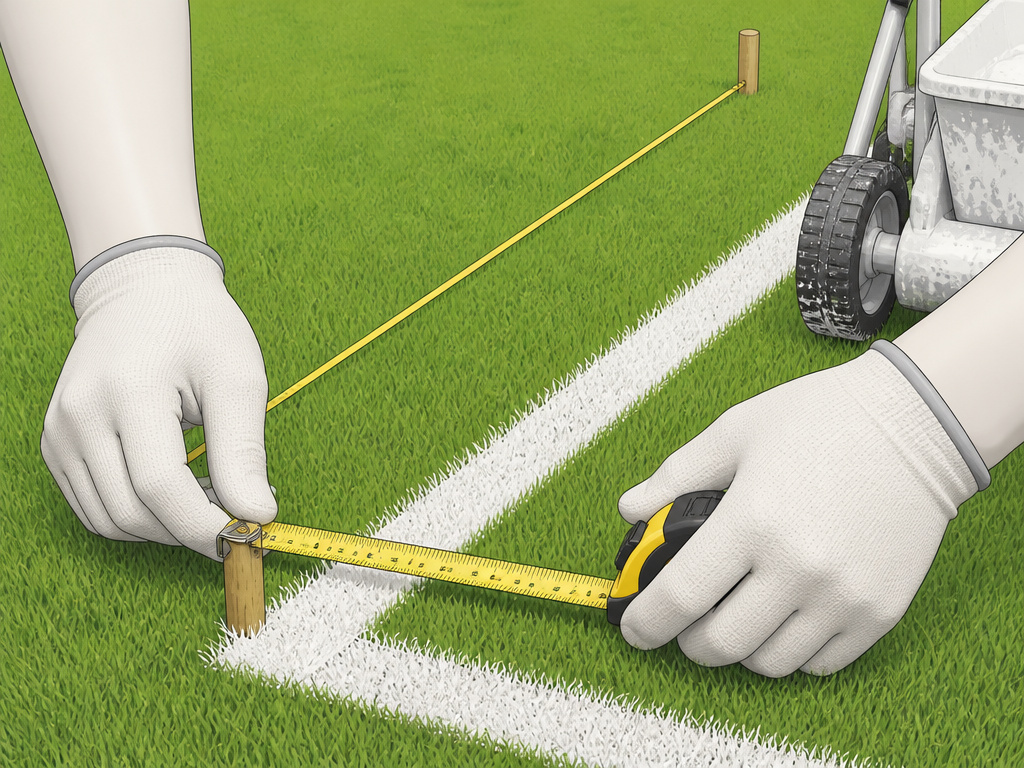
A sound routine for marking a football pitch starts with the rulebook, not the paint:
- Pick the rulebook first. Write down the length and width your competition requires. Skip it and you can paint a pitch that is legal under IFAB and still wrong for your league.
- Peg the rectangle and check both diagonals. Equal diagonals mean square corners. Skip the check and the lines look straight while one corner leans, and every area drawn from it is off too.
- Measure to the outside of each line. That’s IFAB’s convention. Measure to the centre instead and every boundary shifts by half a line width.
- Set the goal and penalty areas from the inside of each goalpost. Those are the 5.5 m and 16.5 m figures. Measure from the wrong spot and the box comes out the wrong size, and nobody notices until an official checks.
- Fix the penalty mark at 11 m, then swing the 9.15 m arc. Measure from the centre of the mark to the back edge of the goal line. Get it wrong and every penalty is taken from the wrong distance.
- Keep every line to 12 cm or less, all the same width. The FA says marked lines should match in width, and anything over 12 cm breaks Law 1.
- Walk the lines before kick-off. Fresh line paint leaves a white smear on your boots when you step across it, and that tells you a line is still wet before a player slides through it.
Not gonna lie, the diagonal check is the step I’d least want to skip. It takes minutes and catches the kind of error a tape along one side never will.
Where this goes sideways: Converting units by hand. IFAB’s printed yard figures don’t convert exactly from its metre figures, so a pitch can pass in one unit and fail in the other. Pick the unit your competition uses and measure in it from start to finish.
Goals, Flags and the Run-Off Around the Pitch
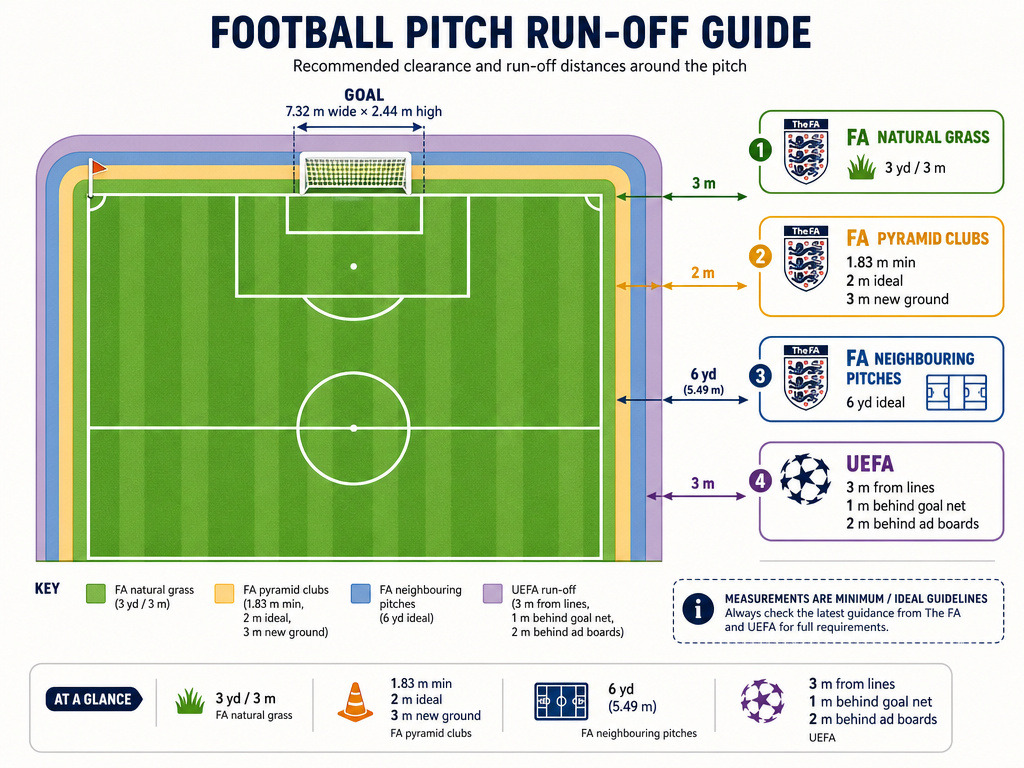
The official goal dimensions are 7.32 m wide and 2.44 m high.
IFAB recommends that goals in official FIFA or confederation competitions meet the FIFA Quality Programme for Football Goals. At lower levels, Law 1 gets applied loosely. If a corner flag is missing or the posts are grey, IFAB’s Practical Guidelines recommend the referee allow the match with the teams’ agreement and submit a report. A crossbar that breaks and can’t be repaired or replaced ends the match: it must be abandoned.
The space around the pitch is where the rulebooks differ most, and they measure different things:
- FA, natural grass pitches: a run-off of at least 3 yd (or 3 m) all round.
- FA, pyramid clubs: minimum 1.83 m (6 ft), ideally at least 2 m, and at least 3 m for a new ground.
- FA surface rules: natural grass, never tarmac or concrete, with no barriers or obstructions. A 3G run-off must meet full-size pitch standards and be green.
- FA, neighbouring pitches: ideally 6 yd between them.
- UEFA: structural elements and fixed pitchside equipment at least 3 m from the line markings and 1 m from the back of the goal net, plus at least 2 m of operational space behind advertising boards.
These figures don’t contradict each other. They apply to different levels. The FA is writing about safety margins for clubs, while UEFA is writing about stadium fittings in its competitions.
Check the handbook for your own league before you buy turf or fencing. A run-off that satisfies the FA’s minimum for a pyramid club does not satisfy UEFA’s 3 m clearance for fixed equipment.
What Size Is a Youth or Small-Sided Pitch?
The FA steps pitches up with age, from 37 m x 27 m for 5v5 to 100 m x 64 m for adults. Goals grow in step, and the table shows both.
| Format | Pitch (yd) | Pitch (m) | Goal (ft, height x width) |
|---|---|---|---|
| 5v5, U7-U8 | 40 x 30 | 37 x 27 | 6 x 12 |
| 7v7, U9-U10 | 60 x 40 | 55 x 37 | 6 x 12 |
| 9v9, U11-U12 | 80 x 50 | 73 x 46 | 7 x 16 |
| 11v11, U13-U14 | 90 x 55 | 82 x 50 | 7 x 21 or 8 x 24 |
| 11v11, U15-U16 | 100 x 60 | 91 x 55 | 8 x 24 |
| 11v11, adult | 110 x 70 | 100 x 64 | 8 x 24 |
The FA’s Section 38 gives the yards and its Cheshire FA metric guide gives the metres. U17-U18 football uses the same 110 x 70 yd as adults. Run-off adds to these figures: the FA’s recommended total for U17 and over is 116 x 76 yd. County FAs and leagues may have their own rules, so their handbooks come first.
Line colours tell you the format. The FA recommends red for 5v5, yellow for 7v7, blue for 9v9 and white for 11v11. That makes it possible to cross-mark several formats on one area. A 9v9 pitch fits lengthways on a 100 m x 64 m pitch at 68 m x 46 m, or across it at 64 m x 46 m, and the FA recommends blue lines for either.
The FA also allows the Laws to be modified for under-16s, women, veterans over 35 and players with disabilities. Field size, ball, goal width, crossbar height and period length can all change.
Adult small-sided games have their own 5-a-side rules. None of the sources behind this article give adult five-a-side or futsal pitch sizes, so I’m leaving numbers off rather than guessing.
Surfaces, Grass Height and Line Colours: Where the Top Leagues Split
UEFA allows a field of play of natural grass, reinforced natural grass (hybrid) or artificial football turf of 100% artificial fibres. The Premier League allows none of the last. Its handbook says no league match is played on an artificial surface, and undersoil heating is required on all pitches, according to Walker Morris’s summary.
Natural, hybrid and artificial pitch types face different rules depending on the competition. At international level IFAB demands that artificial turf meet the FIFA Quality Programme for Football Turf in matches between representative teams of FIFA-affiliated associations and in international club competitions, unless IFAB grants a dispensation.
The Premier League also controls the grass itself. Blades can’t exceed 30 mm, the whole surface is cut to the same height, and patterns are banned. Only straight parallel lines running across the width, perpendicular to the touchlines, are allowed. That’s why top-flight pitches on TV show plain light and dark bands, with no checkerboards or circles.
I’d skip memorising the 30 mm limit unless you tend a Premier League pitch. The line colours matter more to most readers:
- UEFA wants a green surface with white lines, and no non-football lines visible.
- IFAB allows artificial surfaces to carry other lines, provided they are a different colour and can be clearly told apart from the football lines.
- The FA recommends white lines for 11v11, and lines can be no wider than 12 cm.
Are US College Soccer Fields a Different Size?
Gridiron has nothing to do with it. When people ask whether college and NFL fields match, they mean American football, which sits outside IFAB’s Laws and outside the sources I used, so I won’t quote gridiron measurements.
College soccer does have its own rule. NCAA Rule 1.1.2, as reproduced in a 2010-11 NISOA overview, says facilities constructed after 1995 must be at least 70 yd wide (64.01 m) by 115 yd long (105.16 m). The rule also makes the home team tell the visitors before the game about changes to field dimensions, playing surface or location.
The ranges quoted around that rule disagree. The NISOA overview summary gives 70-80 yd wide and 115-130 yd long for fields built from 1995 to 2010. An SMU student paper quotes 65-80 x 110-120 yd. That source is dated, so check the current NCAA rulebook before you plan a field.
The 2026 World Cup question is another gap. No source behind this article states a pitch size for the tournament, and I won’t invent one. FIFA’s competition regulations are the place to look.
Frequently Asked Questions
What are the official dimensions of a football pitch?
IFAB Law 1 allows a touchline of 90-120 m and a goal line of 45-90 m. International matches use 100-110 m by 64-75 m. The Premier League and UEFA Categories 3 and 4 use 105 m by 68 m. The FA recommends 100 m by 64 m for adult football.
Why is there no standard football pitch size?
Law 1 gives a range, and competitions choose lengths and widths inside it. Ground space also forces compromises. Walker Morris reports six Premier League clubs with slightly smaller pitches, mostly because of city-centre sites.
What is the pitch size for the 2026 World Cup?
None of the sources behind this article state it, so I won’t guess a figure. FIFA’s competition regulations are the document to check. What Law 1 does say is that international matches run 100-110 m by 64-75 m, and artificial turf in FIFA-affiliated international matches must meet the FIFA Quality Programme for Football Turf unless IFAB grants a dispensation.
Are college and NFL fields the same size?
That question is about American football, which isn’t covered by IFAB or by the sources here, so I’m not quoting gridiron numbers. For college soccer, NCAA Rule 1.1.2 sets a minimum of 70 yd wide by 115 yd long for facilities built after 1995.
How wide can pitch lines be, and do they count as part of the area?
Lines can be no wider than 12 cm (5 in). Under Law 1, lines belong to the areas they bound. A foul with contact on the penalty area line counts as inside the area, so it’s a penalty.
The Bottom Line
If someone quotes 105 m x 68 m at you, ask which rulebook. It’s exact for the Premier League and UEFA Categories 3 and 4, but the FA recommends 100 m x 64 m for adult football and IFAB allows far more.
Your first step this week: find the handbook for your own league, write down its length and width, and check the pitch with a tape. Measure to the outside of the lines. Walk the diagonals.
One concession. Several sources here are secondary, dated or in conflict, including the NCAA ranges, the Montreal details and the Premier League clause number. Treat those as pointers and confirm them in the primary document.
My own bias: I’d rather a new fan learn the penalty area as a danger zone than memorise 16.5 m. It always comes back to the basics, and the numbers stick once you know why the lines are there.
