
Football Drills You Can Do Alone: A 20-Minute Session
This post contains affiliate links. As an Amazon Associate, we earn from qualifying purchases.
Effective solo football drills require a ball, a wall, and a 20-by-15-foot rectangle. Structure a 20-minute session with timed blocks: 4 minutes of dynamic warm-up, 5 minutes of ball mastery, 4 minutes of first-touch wall work, 5 minutes of finishing or agility, and a 2-minute cool-down. This format, grounded in the FIFA 11+ Kids injury-prevention framework, builds skills while cutting injury risk by nearly half.
The key isn’t just repeating moves. It’s matching the drill to your space and stopping when your technique breaks down, not when the timer runs out. Most guides list football drills you can do alone but skip the protocol that turns a list into a session that actually changes your game.
What follows is the structure, the sourced timings, and the one rule about concrete that keeps your knees intact for football drills you can do alone. You’ll walk away with a 20-minute plan you can run in a driveway, plus how to adapt it when all you have is a patch of grass.
Key Takeaways
- Follow the FIFA 11+ Kids framework for your warm-up and cool-down; the research shows it cuts overall injuries by 48% and severe injuries by 74%.
- A complete solo session fits in a 20-by-15-foot rectangle, with specific drills like figure-8 dribbling needing just a 6-foot square.
- Ball work on concrete is fine for wall passing and sole rolls, but avoid repetitive jumping or bounding on hard surfaces to prevent stress injuries.
- For youth players under 10 (U10), all training should be bodyweight only. For U11/U12, supervised work with a dumbbell up to 5 pounds is acceptable.
- Practice 20-30 minutes, 4-5 times a week. Short, frequent sessions beat one long weekly grind for skill development.
Why Solo Drills Work (And What They Can’t Fix)
Solo training gives you unlimited reps. There’s no queue, no waiting for a pass, no coach’s whistle moving you to the next station. It’s how you build the muscle memory for a clean first touch or a sharp pull-back turn. But it has a ceiling.
You can’t replicate decision-making under pressure. A wall won’t fake a tackle, and a cone won’t adjust its positioning. That’s fine. The job of solo work is to make the technical action automatic, so in a game, your brain is free to scan the field and make the choice, not worry about controlling the ball.
The research is clear: players who reach the elite level logged significantly more hours of self-directed practice in their youth than those who didn’t. Solo work builds the technical base that team practice then applies.
The best football drills you can do alone have a measurable goal, beat your time, hit 50 consecutive passes, control 10 aerial returns. That turns practice from mindless repetition into deliberate improvement.
The 20-Minute Solo Training Session (A Sourced Template)
You don’t need an hour. A focused 20-minute session, done consistently, builds skill faster than a sporadic, unfocused hour. Here’s the breakdown, with every time and space requirement pulled from coach-approved sources.
| Block | Time | Focus | Example Drills | Space Needed |
|---|---|---|---|---|
| Warm-up | 4 min | Dynamic movement, injury prevention | Jogging, high knees, leg swings, FIFA 11+ Kids exercises | 20-by-15 ft rectangle |
| Ball Mastery | 5 min | Close control, touch rhythm | Toe taps, sole rolls, V-pulls, Box Dribble Challenge | Body width to 5×5 ft square |
| First Touch / Wall Work | 4 min | Passing, receiving, control | Wall Pass Streak, One-Touch Control, Aerial Traps | 8-12 ft from a wall |
| Finishing / Agility | 5 min | Shooting accuracy, quick feet | Target Shooting, Cone Slalom, Ladder drills | 20-ft lane or goal area |
| Cool-down | 2 min | Static stretching, recovery | Calf, quad, hamstring holds | Same as warm-up |
The 4-minute warm-up is essential. The FIFA 11+ Kids program it’s based on isn’t just busywork. The study by Rössler et al. In Sports Medicine (2018) found it reduced overall injuries by 48% and severe injuries by 74% when done at a minimum effective frequency of once a week. It prepares tendons and ligaments for the twists and stops ahead.
The Alicante Football Academy notes that practicing for 20 to 30 minutes, four to five times a week, is more effective than one long session. Your body learns in shorter, more frequent bursts.
Essential Solo Drill Catalogue
Ball Mastery: Your 5-Minute Touch Builder
This is the foundation. Start every session here. Your goal is hundreds of touches in a tight space.
- The 1000 Touches Challenge: Cycle through toe taps, side rolls, pull-backs, tick-tocks, and around the world. Do each for 30 seconds. The full challenge takes 4-5 minutes. The rhythm matters more than speed.
- Box Dribble Challenge: Mark a 5×5 foot square. Dribble inside it for 60 seconds without letting the ball escape. Count your touches. Next time, beat that number.
- Figure 8 Infinity: Place two cones 6 feet apart. Dribble in a continuous figure-8 pattern. How many can you complete in 2 minutes? The goal is smooth turns, not frantic stops and starts.
Where this goes sideways: Rushing through ball mastery. The moment your touches get heavy and the ball is slapping your foot, stop. Reset. Five minutes of clean, intentional touches beats ten minutes of sloppy ones.
These drills are the core of any good solo ball mastery routine. They translate directly to better close control in a crowded midfield.
Wall Drills: The Coach That Never Tires
A wall is your best training partner. It returns every pass with perfect consistency, letting you isolate your technique.
The sources don’t agree on the perfect distance, and that’s useful. It means you should vary it.
- LevelUp.soccer starts Wall Pass Streak at 6 feet for tight control.
- Soccer Source Coaching sets up at 7 yards (21 feet) for longer passing.
- footnotefc.com uses 3 meters (~10 feet) for inside kicks and 5-7 meters (~16-23 feet) for instep power.
Start close for a rhythm drill, can you make 50 consecutive passes with each foot as suggested by LevelUp.soccer? Then step back. A longer return flight trains your first touch to cushion a harder pass.
For serious practice at home, mastering these wall drills is the single biggest upgrade you can make.
Shooting & Finishing: Creating Game-Like Pressure
Without a goalkeeper, you have to create your own stakes. Use targets and time limits.
- Target Shooting: Hang two shirts or place cones in the top corners of a goal. Take 10 shots. The goal from LevelUp.soccer for Target Shooting is to hit the corners 50%+ of the time. Track it. Left foot only, right foot only, then alternate.
- Dribble and Finish: Start 20 yards out. Dribble toward goal at speed and shoot. Vary your angle each time. The target from LevelUp.soccer is to score 7 out of 10. This links your final touch to the shot, which is where most solo practice fails.
The Concrete vs. Grass Decision (A Safety Rule)
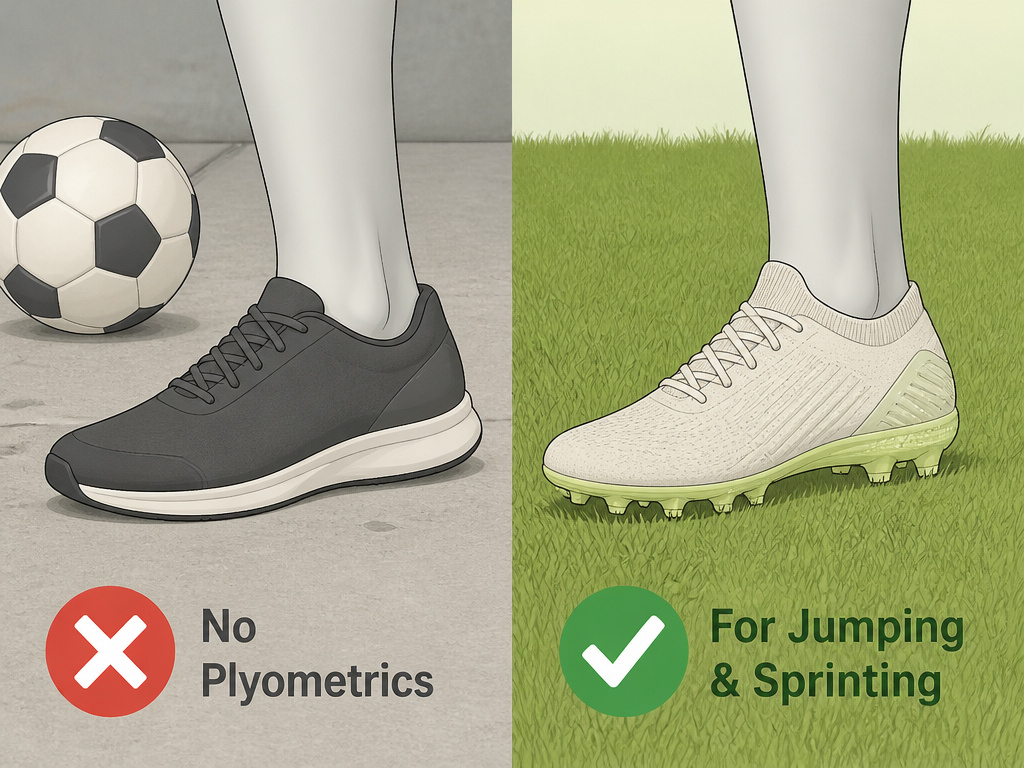
Here’s a specific, physical rule most guides miss. Your driveway or a concrete patch is a viable training surface, but only for the right drills.
According to soccerskills.app, ball work on concrete is fine for drills like sole rolls and wall passing, as it provides a true bounce that sharpens touch. However, the same source states concrete is contraindicated for repeated two-foot landings, bounding, depth jumps, and any drill where the same landing pattern repeats dozens of times.
Common mistake: Doing plyometrics on concrete. The source from SoccerSkills.app is blunt: avoid repeated two-foot landings, bounding, depth jumps, and any drill where the same landing pattern repeats dozens of times. The impact stress on knees and ankles accumulates fast.
If you have both surfaces, split your session. Do ball mastery and wall passing on the driveway for that true bounce. Then move to grass for your warm-up and any finishing/agility blocks that involve jumping or sprinting.
Drills for Specific Development Goals

Building a Reliable Weak Foot
Ignoring your weak foot is like playing with one boot tied. Solo practice is the perfect, pressure-free environment to fix it.
Dedicate one full ball mastery block per week to weak-foot-only work. Do your Box Dribble Challenge using only your left foot (if you’re right-footed). For wall drills, set a goal of 20 straight passes with your weak foot before you’re allowed to use your strong one. The progress is slow, then sudden. For a dedicated plan, our guide on how to improve your weak foot breaks it down further.
Incorporating Agility Without a Ball
Football fitness is about change of direction, not just running. Use a simple agility ladder or set up cone drills for your conditioning block.
- Cone Slalom (Beat the Clock): Set up 6-10 objects in a line. Weave through as fast as you can with the ball, then try to beat your time. LevelUp.soccer allocates 5-7 minutes for multiple runs.
- T-Drill: Place cones in a T-shape. Sprint forward, shuffle sideways to one cone, then the other, then backpedal. It mimics the multi-directional movements of a game.
Gear That Actually Helps (And What’s Overrated)

You need a ball, some markers (cones, water bottles, rolled-up socks), and a wall. That’s the 90% solution.
A rebounder net is the one piece of kit that can elevate wall work. Unlike a flat wall, a rebounder can be angled to return balls in the air or on the ground, simulating different types of passes. If you get serious about your solo football practice at home, understanding the pros and cons of rebounders is a smart next step.
Overrated? Fancy dribbling mannequins or complex hurdle sets for beginners. A set of six basic cones and your own two feet will get you further, faster.
Frequently Asked Questions
What are the best solo soccer drills for beginners?
Stick to the ball mastery block: toe taps, sole rolls, and simple inside-inside rolls. Add basic juggling, drop the ball, kick it up once, catch it, and find a wall for gentle passing. The Joner Football Blog recommends picking 4-5 drills and doing each for 2-3 minutes for a solid 10-15 minute starting session.
How many times a week should I train alone?
Aim for consistency over marathon sessions. The Alicante Football Academy research points to four to five times a week for 20-30 minutes as the sweet spot for skill development. Daily 15-minute sessions beat a single two-hour weekly slog.
Can I really improve my shooting without a goalkeeper?
Absolutely. Without a keeper, you focus purely on technique and accuracy. Use targets (corners, specific netting spots) and set pass-back scenarios from a wall to practice one-touch finishes. The pressure comes from your own scoring percentage target.
Is it okay to practice on concrete?
Yes, for the right drills. Concrete is excellent for ball mastery and wall passing due to its predictable bounce. However, strictly avoid any repetitive jumping, hopping, or bounding exercises on it to protect your joints. Move those drills to grass.
How do I stay motivated training by myself?
Set measurable, daily goals. Not “get better,” but “achieve 50 consecutive wall passes with my left foot” or “beat my Cone Slalom time by 0.5 seconds.” Write your records down. Seeing tangible progress is the best motivator there is.
The Bottom Line
The magic number is twenty. A focused 20-minute session, built on the injury-preventing FIFA 11+ framework and split into timed blocks, is the most effective thing you can do alone. It turns a list of drills into a real practice.
Remember the concrete rule, fine for the ball, terrible for your knees. And stop each block the moment your technique gets messy, not when the clock tells you to. That discipline, more than any fancy footwork, is what separates a routine from real improvement.
Now, find your rectangle, grab your ball, and start the clock. The wall is waiting.
