
Direct Football vs Possession Football: How to Choose
This post contains affiliate links. As an Amazon Associate, we earn from qualifying purchases.
Direct football looks to break the opposition’s defensive lines with the fewest passes in the shortest time. Possession football aims to control the match through ball retention and a higher volume of shorter, safer passes. The right choice depends on your team’s personnel, the opponent’s setup, and the match conditions, and the data shows neither is a magic bullet for success.
That’s the fundamental split, but the conversation usually turns into a shouting match about aesthetics versus pragmatism, often framed as direct football vs possession football. It’s more useful to ask a different question: what does a goal look like in each system? Rewind every goal 20 seconds. A possession goal often starts with a fullback recycling play to a holding midfielder under no pressure. A direct goal starts with a central defender stepping into a loose ball and driving a line-breaking pass into a channel. The buildup is the story. The finish is just the punctuation.
Here’s what follows: a breakdown of the stats from the last two World Cups, the physical demands each style places on a squad, and the one thing every coach gets wrong when trying to switch between them.
Key Takeaways
- According to a PLOS One study of the 2018 and 2022 Men’s World Cup finals, the geometric directness (DIR) of an attack was the only significant factor increasing the likelihood of a goal (β = 1.009, p < 0.0001).
- A Frontiers in Psychology Bundesliga study found that while offensive playing style strongly affects physical and technical performance, its influence on match success (goals, points) was marginal (p ≤ 0.36, R² = 0.10–0.13).
- For coaches, game control, measured by metrics like the Index of Game Control (IOC), is a more reliable indicator of success than a rigid commitment to either possession or direct play.
- Possession-play teams covered more absolute sprint and high-intensity running distance over a full match, while counter-attacking teams covered more of that distance per second they held the ball.
- Blending both styles based on match context, a structured, direct possession approach, is more effective than a dogmatic commitment to one philosophy.
What Does ‘Direct’ Actually Mean?
A structured, controlled attacking brand of football that seeks to break lines and attack space with as few passes and as little time as possible. Not reliant on hopeful balls over the top, but designed to capitalise on spatial and numeric vulnerabilities.
That definition from Total Football Analysis is crucial. It separates modern direct play from the old ‘Route One’ caricature. The aim isn’t just to boot it long. It’s to progress the ball through the thirds with purpose and efficiency. Think of it as gardening: you’re not randomly scattering seeds (long balls). You’re preparing the soil (creating space), planting in deliberate rows (structured runs), and weeding out gaps between your lines.
This style thrives in specific moments. Against a high-pressing opponent, a direct pass into the space behind the press can be more effective than trying to play through it. For a team with a resource disadvantage, like a newly promoted side, investing in a solid defensive block and a direct transition can offset a technical gap. It’s pragmatic.
The tools are different. You’re looking for vertical passes that break lines, runners who attack space immediately, and a target forward who can hold up play and bring others into the game with one or two touches. Playing off a target forward, as the tactical guide notes, can get the majority of the team’s ball progression through two passes, with only three total passes needed to go from the defending third to the attacking third.
Common mistake: Equating direct play with a lack of coaching or structure. A well-drilled direct team has as many rehearsed patterns as a possession side, they’re just triggered faster and executed over longer distances.
And What Are We Calling ‘Possession’?
Possession football is the other end of the tactical spectrum, but it’s also been reduced to a slogan. It’s not just “passing for passing’s sake.” The core idea is control. Control of the ball, control of the tempo, control of the opponent’s positioning. By monopolizing the ball, you fatigue the opposition physically and frustrate them mentally, waiting for the moment their defensive shape cracks.
This requires a specific skillset. Players need superior first touch, comfort receiving under pressure, and the passing range to switch play and stretch the block. The system relies on structured positional play principles and build-up play from the back to circulate the ball safely. The extreme version is tiki-taka, but most possession sides today are more vertical and direct in the final third.
The physical cost is the hidden tax. A 2023 study of the German Bundesliga in Frontiers in Psychology found teams with a higher ball-possession style coefficient were physically more demanded over a whole match. They exhibited more accelerations and decelerations (p ≤ 0.01, R² = 0.69) and covered more high-intensity distance (p ≤ 0.01, R² = 0.36). Maintaining possession means constantly moving to create passing lanes, which is a different, more sustained kind of fatigue than the explosive bursts of a counter-attack.
What the Data Actually Says
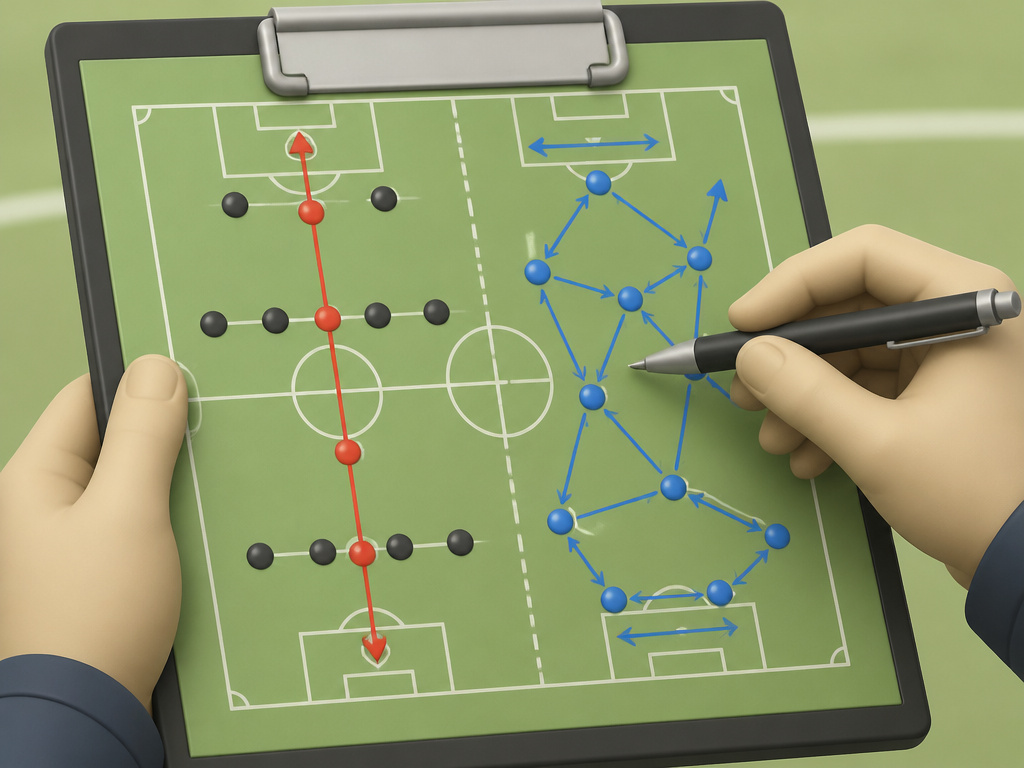
This is where the conversation gets interesting, because the research doesn’t agree on a single answer. You have to look at the studies side-by-side.
| Study | Focus | Key Finding on Style Effectiveness |
|---|---|---|
| PLOS One (2024) | 2018 & 2022 Men’s World Cup Finals | Attack directness (DIR) was the only significant factor increasing goal likelihood. “Attacking tactics must be more direct.” |
| Exa.ai World Cup (2018) | 59 World Cup Matches | Possession-play teams achieved higher values in all variables related to goal scoring, attacking, and passing than direct-play teams. |
| SAPUB / Groningen | 676 Elite Matches (Bundesliga, World Cup) | Successful teams prefer possession play. Game control (IOC) is the most important success variable irrespective of style. |
| Frontiers in Psychology (2023) | 2020/21 German Bundesliga | Offensive playing style had a limited influence on success-related variables (goals, points) (p ≤ 0.36, R² = 0.10–0.13). |
The PLOS One direct attack study is compelling for its focus. By measuring the geometric directness of each possession, they isolated a clean variable: straighter-line attacks lead to more goals. This seems to advocate for a direct approach. Yet, the Exa.ai World Cup analysis of the same tournament found possession teams outperformed direct teams across the board in attacking metrics. How do you square that?
Context is everything. The PLOS study looked specifically at the finals, where stakes are highest, space is minimal, and one direct moment can decide everything. The broader Exa.ai study looked at all 59 matches, where possession teams might dominate weaker opponents. This gets to the heart of it: a team’s optimal style isn’t fixed. It should flex based on the opponent, the scoreline, and the match phase. The SAPUB tactical behavior evaluation supports this, concluding that game control matters more than a rigid stylistic label.
Which Style Demands More From Players?
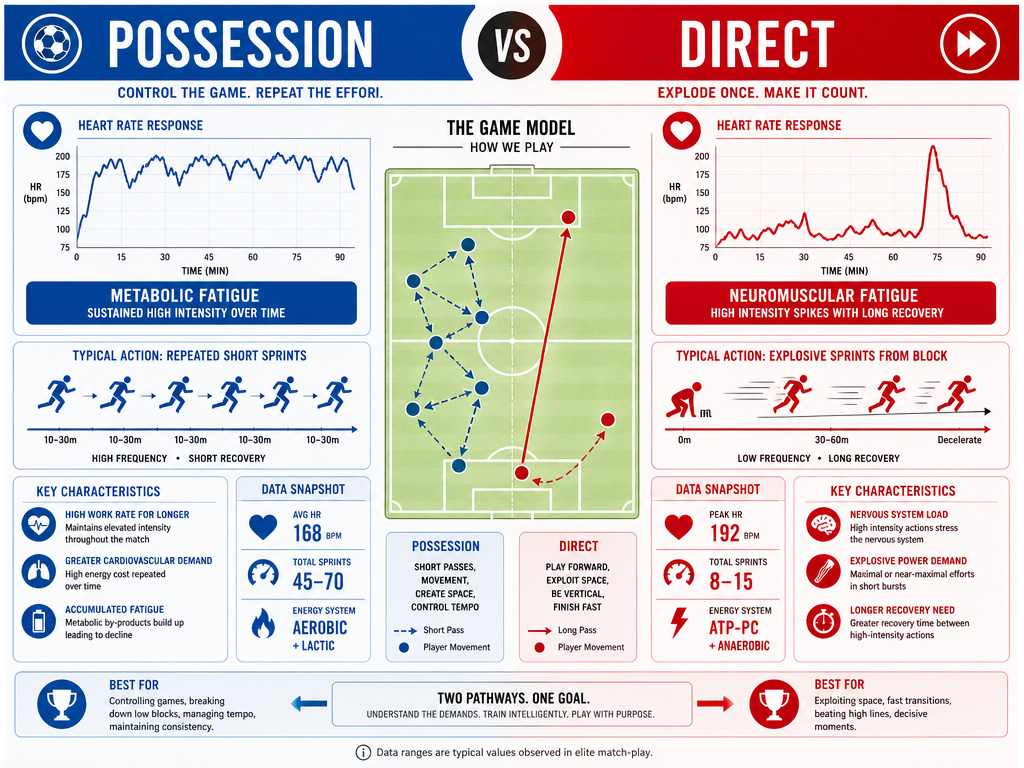
Ask any player who has done a preseason under a coach committed to extreme pressing or relentless possession: the style dictates the fatigue. The data confirms it, but with a twist.
Possession teams, as the Bundesliga study shows, put in more total hard yards. Over 90 minutes, they accumulate more accelerations, decelerations, and high-intensity running. The game is constantly restarting from their own touches, demanding repeated short, sharp movements to offer angles. It’s a grinding, metabolic fatigue.
Counter-attacking teams live on the other side of the ball. They defend in a compact mid or low block, then explode forward on the turnover. The Frontiers in Psychology study found these teams cover more high-intensity and sprint distance per second they are in possession. Their physical output is concentrated into ferocious, anaerobic bursts. It’s a nervous-system fatigue.
| Physical Demand | Possession Style | Counter-Attacking / Direct Style |
|---|---|---|
| Match-Long Load | Higher total accelerations/decelerations & high-intensity distance. | Lower total volume, but higher peak intensities. |
| Load During Possession | Lower intensity per second of possession. Sustained, moderate activity. | Higher intensity per second. Explosive, maximal efforts in short windows. |
| Primary Fatigue Type | Metabolic (aerobic endurance). | Neuromuscular (power, speed endurance). |
| Key Training Focus | Repeatability of short bursts, change of direction, passing lane patterns. | Maximal sprint speed, reactive acceleration, defensive shape transitions. |
This has huge implications for squad building and training. A possession coach needs a squad with immense aerobic capacity and technical security under fatigue. A direct coach needs athletes, players who can recover quickly between all-out sprints and maintain defensive discipline. Trying to force a squad built for one style to play the other is a fast track to injuries and underperformance.
Can You Blend Them? The ‘Direct Possession’ Hybrid
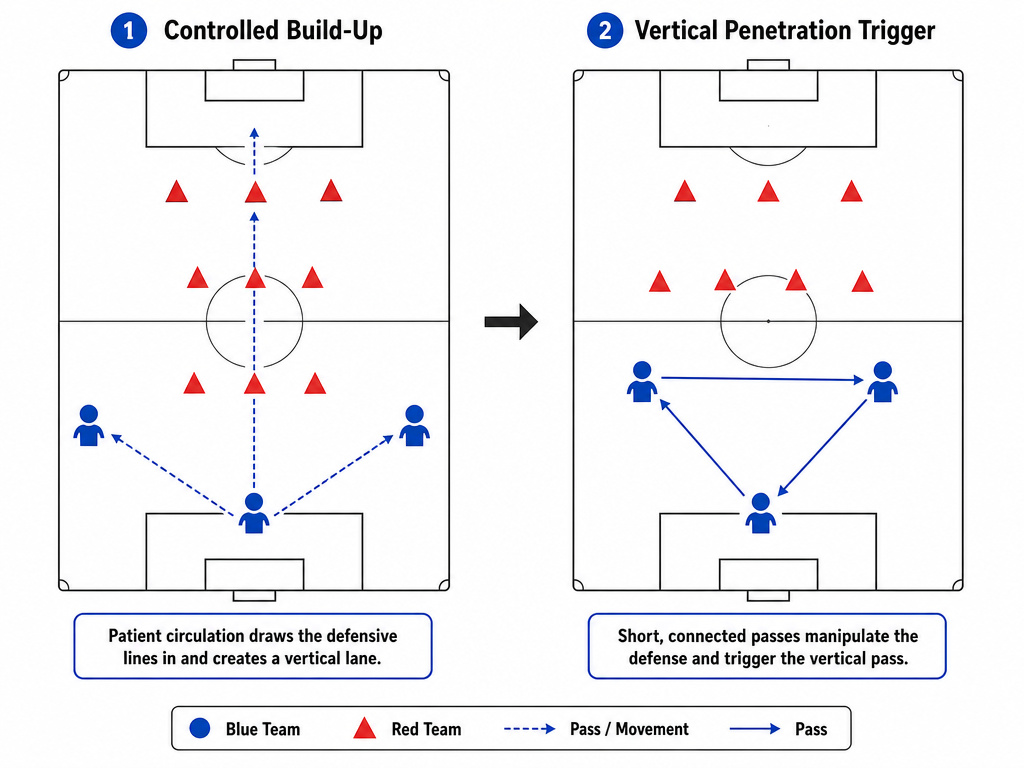
The smartest coaches in the direct football vs possession football debate don’t pick a side; they use both tools. The concept of “direct possession” bridges the gap. It’s a controlled, structured approach that still seeks to attack space vertically at the first opportunity. It’s not tiki-taka, and it’s not hoof-ball. It’s the middle way.
A team might use positional play principles to build from the back, drawing the opponent’s first line of pressure. Once that line is engaged, the trigger is a vertical pass into a midfielder between the lines or a wide player in the channel. The next thought is forward, not sideways. The 2018 World Cup data hints at this hybrid’s effectiveness: both possession- and direct-play teams achieved higher passing accuracy and more deliveries into the attacking third when playing against possession-play teams. This suggests that having a multi-speed attack, the ability to switch from control to penetration, is vital.
Where this goes sideways: Trying to implement a hybrid without the right personnel. A midfielder who isn’t a natural line-breaking passer will kill the ‘direct’ part. A forward who can’t combine in tight spaces will kill the ‘possession’ part. You need players comfortable in both languages.
This is where modern analysis tools like Wyscout and StatsBomb are invaluable. They don’t just count passes; they map passing networks and progressive carries. They can show a coach if their team is actually playing the hybrid they envision, or if they’re just passing sideways until they lose the ball. The hybrid model requires incredible tactical intelligence from players, who must constantly read the game to know whether this is a moment to circulate or a moment to penetrate.
How to Choose (And How to Switch)
So, you’re a coach. Your team has been a classic, mid-block 4-4-2 direct side, but you want to introduce more possession principles. How do you start without causing chaos?
Don’t start with the first-team match on Saturday. Start on a Tuesday morning on a half-pitch with no opponents. Walk through the basic rotations: the drop of the center-back, the check of the six, the overlap of the fullback. Do it at walking pace. Then add passive pressure. The aim is to build the muscle memory of the shape before adding the pressure of a real match. I’ve watched teams try to flip their style in one week of training and spend the entire next game bypassing their midfield out of sheer habit. The old patterns are deep.
Your first sessions should focus on ball retention under zero pressure. Then, ball progression against a staggered press. Finally, finishing the sequence with a chance on goal. This builds the philosophy from the back forward. Conversely, if you’re a possession team wanting to add a direct edge, your drills should focus on transition moments: winning the ball and attacking a recovering defense in 3 vs. 2 or 4 vs. 3 scenarios within six seconds.
The personnel check is essential. Do you have a center-back who can step in and play that splitting pass? Do you have a forward who can pin a defender and bring others in? If not, you either recruit for it or you modify the tactic to suit the players you have. Football isn’t played on a whiteboard.
Practical Drills for Each Philosophy
For coaches looking for session ideas, here are two simple drills that isolate the core intent of each style.
Possession Drill: 4-Zone Possession
- Setup: Create a rectangular grid divided into four horizontal zones. Play with two teams and a neutral floater.
- Rules: Teams score a point by completing 5 consecutive passes. They score bonus points if, during that sequence, they make a pass that successfully moves the ball from Zone 1 (defensive) to Zone 4 (attacking) via Zones 2 and 3 without the ball being played back into a previous zone.
- Coaching Point: This forces players to think about vertical progression and playing through the lines while maintaining possession. It kills the habit of safe backwards passes.
Direct Play Drill: Transition & Finish
- Setup: Use a half-pitch. Start with a small-sided game in a central area.
- Rules: The coach plays a ball to one team. Their objective is to attack the large goal as quickly as possible, with a maximum number of passes from the moment they gain possession. The defending team, upon winning the ball, must immediately switch play to two target players stationed in the wide channels, who then combine to attack a small counter-goal.
- Coaching Point: This rewards quick, vertical decision-making and simulates the explosive transition of a direct or counter-attacking style. It emphasizes speed of thought and execution over elaborate buildup.
The Bottom Line
The direct football vs possession football debate isn’t really about which is better. It’s about which is better for your team, right now, against this opponent. The data from top-level studies is conflicted because the answer is contextual.
If your team is technically superior, possession can control the game and grind down opponents. If you’re the underdog or playing on a heavy pitch, direct play can be the great equalizer. But the most dangerous teams in the world today are the hybrids, the ones who can do both. They can lull you with 20 passes and then strike with one devastating through ball.
For a coach, the first step is honest evaluation. Use the tools available: tracking data, pass maps, the peer-reviewed soccer tactics research. Does your data show you’re actually playing the style you think you are? Are you creating chances? The final test is always the scoreboard, but the path to getting there is paved by these tactical choices. Choose the one that fits, not the one that’s fashionable.
How to beat a possession-based team
One research-based approach to defeating a possession-focused side is to prioritize directness in your own attacks. A PLOS One study of World Cup finals found the geometric directness of an attack was the only significant factor increasing goal likelihood, advising that ‘attacking tactics must be more direct.’ However, other studies show possession play can also be highly effective. This doesn’t mean simply hitting long balls, but rather breaking lines and attacking space with speed and purpose. Force the possession team to defend in transition, where their organized structure is most vulnerable. This approach uses the finding that all teams, regardless of their usual style, see their passing metrics improve when facing a direct-playing opponent.
Impact on youth development and player skills
Choosing a dominant playing style shapes the technical and physical profile of players. Youth systems favoring possession play demand players who excel in short, horizontal passing and maintain high success rates under pressure. These players must also cope with greater physical demands over a full match, including more accelerations, decelerations, and high-intensity running. In contrast, development geared toward a direct or counter-attacking style emphasizes different skills. Players learn to execute longer passes, make decisive runs into space, and perform high-intensity actions in short, explosive bursts during transitional moments. The chosen philosophy fundamentally dictates the skill set a player must master.
Statistical analysis of goals and success rates (e.g., passes per goal)
Statistical studies present a complex picture of effectiveness. One analysis of World Cup finals found that a more direct attacking path was the sole significant factor in creating goals, suggesting efficiency is key. Another World Cup study noted that possession-based teams actually achieved higher values in all variables related to goal scoring and attacking. The University of Groningen / SAPUB study concluded that successful teams generally prefer possession play, but that game control is the most important variable for success, regardless of tactical approach. Meanwhile, a Bundesliga study found the influence of a team’s offensive playing style on final success metrics like goals and points was relatively small, indicating other factors are often decisive.
Frequently Asked Questions
Which style is more effective for scoring goals?
The research presents differing conclusions. A PLOS One study of World Cup finals found direct attacks significantly more likely to score, while a broader Exa.ai analysis of the 2018 World Cup found possession teams had better attacking metrics. The effectiveness depends heavily on context: the level of the teams, the match situation, and the playing conditions.
Is possession football more physically demanding?
Yes, but in a different way. Studies show possession teams cover more total high-intensity distance over a full match due to constant movement to create passing lanes. Counter-attacking teams cover less total distance but hit higher intensities in shorter, more explosive bursts during their possessions.
Can a team successfully switch from one style to another?
Yes, but it’s a long-term project, not a pre-season tweak. It requires recruiting players with the specific technical or physical attributes for the new style, and extensive training to ingrain new patterns of movement and decision-making. Attempting a rapid switch often leads to confused performances and poor results.
What is ‘direct possession’?
It’s a hybrid tactical approach. It maintains the structured control and build-up principles of possession football but with a heightened emphasis on vertical, line-breaking passes at the first opportunity. It’s not “hit and hope”; it’s about calculated, fast penetration through a defense’s organizational gaps.
