
Catenaccio Explained: Italy’s Defensive Door-Bolt
This post contains affiliate links. As an Amazon Associate, we earn from qualifying purchases.
Catenaccio is an Italian defensive football system built on two principles: a sweeper, or libero, playing behind a line of tight man-markers, and a compact team shape designed to absorb pressure and score on rapid counter-attacks. Its most famous practitioner was Helenio Herrera’s Inter Milan, which won three Serie A titles and back-to-back European Cups in 1964 and 1965 using this method.
That gap between the libero and his markers is where the whole system lived. It wasn’t about eleven men behind the ball. The essence of catenaccio explained is that it was about building a structure so disciplined that the other team ran out of ideas before you ran out of patience.
What follows is the story of that structure: the Austrian coach who first drew the blueprint, the Italian teams that perfected it, the specific matches that broke it, and the unmistakable shadow it still casts over how teams defend today.
Key Takeaways
- Catenaccio’s name means “door-bolt” in Italian, perfectly describing its goal of locking down a defence.
- The system hinges on the libero (sweeper) playing behind a line of dedicated man-marking defenders.
- Helenio Herrera’s Inter Milan perfected it in the 1960s, winning two consecutive European Cups.
- The system’s decline began with defeats to Celtic in 1967 and Ajax in 1972, which exposed the vulnerabilities of rigid man-marking.
- While pure catenaccio is extinct, its principles of defensive compactness and fast counter-attacks remain deeply influential.
The Origins: From Swiss Verrou to Italian Chain
The catenaccio explained story doesn’t start in Italy. It starts with an Austrian coach named Karl Rappan and his work in Switzerland in the 1930s. Facing teams with better players, Rappan needed a way to level the playing field. His solution was the verrou. French for “bolt”.
Rappan’s verrou system, proposed in 1932, was essentially a 1–3–3–3 formation. He dropped a player, the verrouilleur, behind a line of three fixed defenders. This “bolt” player swept up anything that got through, while the team sat deep, absorbed pressure, and looked to break.
It was a pragmatic response to a talent gap. The system gave Rappan’s teams, like Servette and the Swiss national side, a structure that could frustrate superior opponents.
The idea drifted south into Italy after World War II. A coach named Nereo Rocco is credited with one of the first major Italian adaptations. At Triestina in 1947, he used a similar sweeper-and-markers system to guide the club to a second-place finish in Serie A. The Italian version was taking shape, and it needed a name. They called it catenaccio, the door-bolt.
The Two Core Principles: Libero and Man-Marking
Strip away the history and the famous teams, and catenaccio explained rested on two simple, interlocking ideas. Get these wrong, and you didn’t have catenaccio. You just had a deep defence.
First, the libero. This is the “free man,” the sweeper. He played behind the main defensive line and had no direct opponent to mark. His job was pure reading and reacting: cover for teammates who got beaten, intercept through balls, and mop up any loose ball that trickled through. A great libero was also the first pass of the counter-attack.
Second, strict man-marking. In front of the libero, every defender was assigned an opposition attacker. They followed their man everywhere, from the centre circle to the byline. This wasn’t about holding a neat defensive line; it was about personal duels all over the pitch. The libero behind them was the safety net, allowing the markers to be aggressive without fear.
| Principle | Role | Key Player Example | Why It Worked |
|---|---|---|---|
| Libero (Sweeper) | Free defender behind the line; covers space and starts counters. | Armando Picchi (Inter Milan) | Provided a numerical advantage (spare man) at the back. |
| Man-Marking | Defenders track specific opponents across the pitch. | Tarcisio Burgnich (Inter Milan) | Nullified individual attacking talent through relentless focus. |
| Compact Block | Entire team defends deep in a narrow, layered shape. | The Grande Inter unit | Denied space between the lines, forcing opponents into wide, low-percentage areas. |
The beauty, and the eventual fragility, of the system was in this relationship. The markers created the chaos by following men everywhere; the libero restored order from behind. It made the penalty area feel impossibly small for the opponent.
Herrera’s Grande Inter: Catenaccio Perfected
If catenaccio has a poster boy, it’s Helenio Herrera. When the Argentine-born coach took over Internazionale in 1960, he didn’t just adopt the system; he weaponised it with scientific precision. His Grande Inter side became the most feared and successful catenaccio team in history.
Herrera’s version used a 5–3–2 formation on paper, but it was the roles within it that mattered. Picchi was the libero. In front of him, dedicated man-markers formed a formidable barrier. But Herrera added a twist: his full-backs were instructed to overlap and attack. This wasn’t a team that parked the bus. It was a team that bolted the door, waited for you to lean on it, and then exploded out the other side the moment you stumbled.
The results were undeniable. Under Herrera, Inter won Serie A titles in 1963, 1965, and 1966. More importantly, they conquered Europe, winning the European Cup in 1964 (against Real Madrid) and 1965 (against Benfica). They did it by doing what catenaccio did best: letting technically superior, possession-dominant teams have the ball in non-threatening areas, then punishing them with ruthless, fast breaks.
The mental image of Herrera’s Inter is a team in a perfect, shifting block. When they won the ball, the transition was rehearsed and devastating. They didn’t just defend; they defended with a purpose.
Why Catenaccio Faded: The Matches That Broke the Bolt
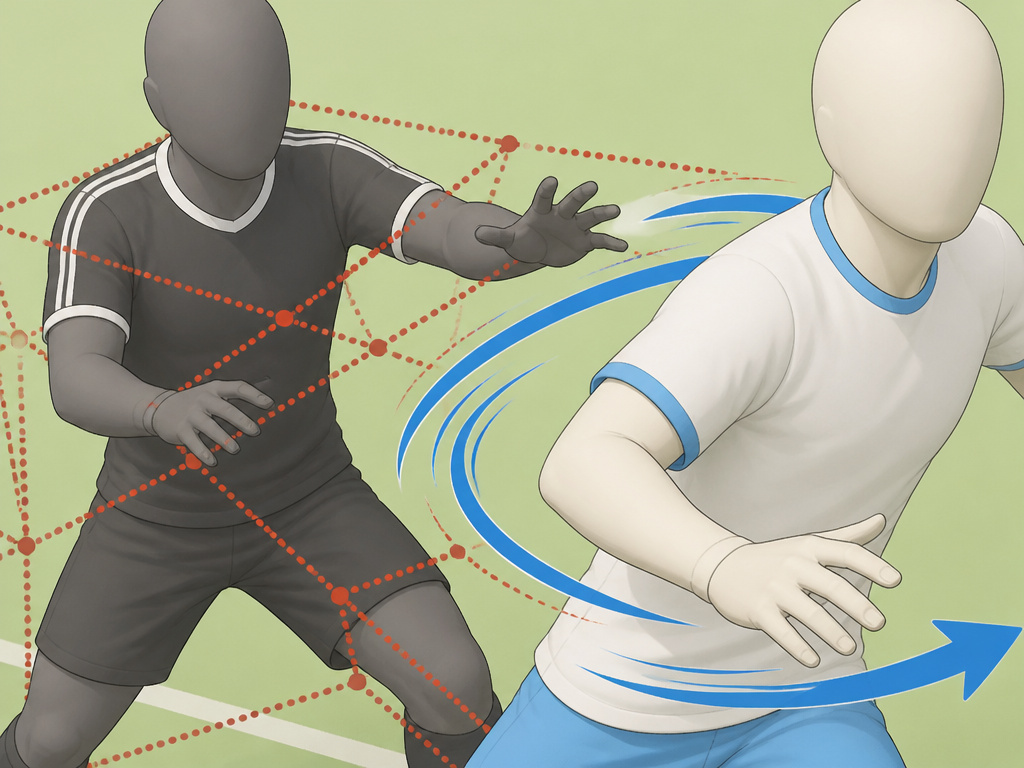
No system lasts forever. Catenaccio’s dominance was challenged and ultimately dismantled by a more fluid philosophy: Total Football. The decline wasn’t a slow fade; it has famous dates attached to it.
25 May 1967, European Cup Final: Jock Stein’s Celtic faced Herrera’s Inter. Inter took an early lead through a penalty. What followed was a masterclass in defeating catenaccio. Celtic refused to play into Inter’s hands. They used the full width of the pitch, stretched the man-markers, and applied sustained attacking pressure. The Scottish side won. It was a symbolic blow, proving the bolt could be forced if you didn’t let the game become static.
1972, European Cup Final: Rinus Michels’ Ajax faced Inter again. Ajax, the pioneers of Total Football, won 2–0. Their players constantly interchanged positions. Ajax’s players constantly interchanged positions, pulling Inter’s rigid man-markers out of position and creating exploitable gaps. The rigid man-marking system was systematically pulled apart by positional fluidity.
These matches exposed the core vulnerability. Man-marking breaks down when players keep moving. By the late 1970s, the hybrid zona mista (mixed zone) system, which blended zonal defence with some man-marking, had replaced pure catenaccio in Italy. Arrigo Sacchi’s AC Milan in the late 1980s, with its aggressive zonal pressing and high defensive line, marked the decisive final break.
Common Misconceptions and Modern Legacy
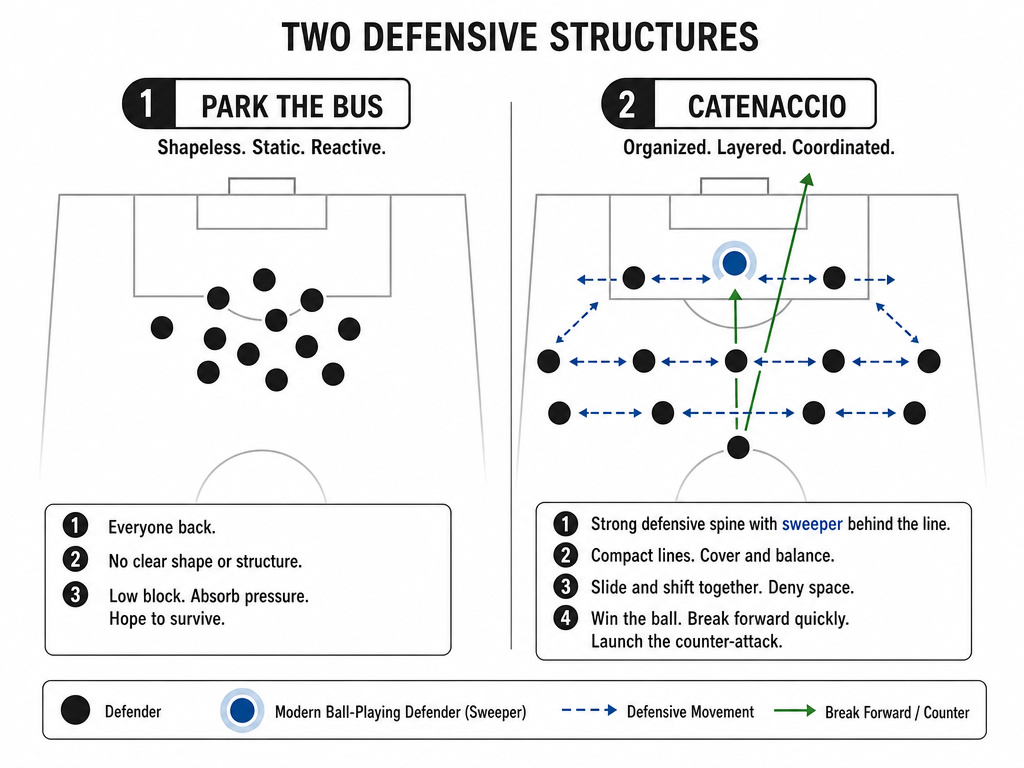
Catenaccio suffers from a caricature. People hear the name and picture eleven men in their own penalty box, aiming for a 0-0 draw. That misses the point.
Misconception 1: It was only defensive. Herrera’s Inter scored goals. The system was built to create counter-attacking opportunities, not just prevent goals. It was a balance.
Misconception 2: It’s the same as “parking the bus.” Parking the bus is a desperate, often shapeless, last-ditch effort to hold a result. Catenaccio was a rehearsed, structured, proactive plan to control a game through defensive organisation.
So, does catenaccio still work today? Not in its pure, 1960s form. The modern offside trap, zonal defending, and laws against persistent foul-breaking have made strict man-marking a rarity. However, its DNA is everywhere.
Diego Simeone’s Atlético Madrid is the clearest modern heir. They defend in a deep, incredibly compact block, concede possession, and strike with lethal precision on the break. The mechanics are different, it’s zonal, not man-marking, but the philosophy is identical: defend as an intelligent unit, and make the transition your weapon.
The libero role itself evolved into the ball-playing centre-back. The libero role itself evolved into the ball-playing centre-back, who steps into midfield from deep to initiate attacks.
Frequently Asked Questions
What does “catenaccio” mean in Italian?
It translates directly to “door-bolt.” The name perfectly captures the system’s objective: to bolt the defensive door shut against the opposition’s attack.
Does any team still use catenaccio?
No team uses the classic 1960s catenaccio system with a dedicated libero and strict man-marking. However, the core principles, a deep, compact defensive block combined with fast, organised counter-attacks, are alive and well in many modern teams, most notably Diego Simeone’s Atlético Madrid.
Why is Italian football so defensive?
Catenaccio is a major reason for this stereotype. The immense success of Herrera’s Inter and other Italian sides using defensive systems in the 1960s and 70s ingrained a culture of defensive organisation and tactical caution in Serie A. While modern Italian football is more varied, the legacy of valuing defensive solidity as an art form remains strong.
What’s the difference between catenaccio and Total Football?
They were tactical opposites. Catenaccio was about rigid structure, fixed positions, and man-marking. Total Football, pioneered by Rinus Michels, was about fluidity, position-swapping, and zonal control. Total Football’s movement was specifically designed to break down catenaccio’s rigid marking.
The Bottom Line
Catenaccio wasn’t a negative tactic. It was a logical, highly effective solution to a specific problem: how to beat teams with better players. It gave the world the libero, completely changed defensive organisation, and proved that a team with 35% of the ball could be in complete control.
Its story is a perfect chapter in football’s endless tactical evolution. One system rises, another finds its weakness, and the game moves forward. But the shadow of that bolted door still falls across the pitch every time a team digs in, stays compact, and waits for its moment to spring.
