
10 Best Soccer Referee Watches in 2026
This post contains affiliate links. As an Amazon Associate, we earn from qualifying purchases.
The Casio AE-1500WH Digital Sports Watch is the best overall pick for most referees, thanks to its 1/100-second stopwatch, 24-hour countdown timer and roughly 10-year battery. If you want GPS and training data, the Best Premium Smartwatch is the Garmin fēnix 7X Pro Sapphire Solar, and the Best Bright Display is the Garmin Forerunner 165.
A referee watch has one job: keep match time, stoppage time and sometimes sin bin time accurate, and stay readable when you are sprinting, sweating or standing in the rain. Extra features only matter if they do not slow that job down.
This guide is built from specifications, manufacturer documentation, expert round-ups and patterns in owner feedback. You get 10 watches sorted by what each does best, from simple timers to full GPS smartwatches.
Top 10 Soccer Referee Watches in the Market
Certain content that appears on this site comes from Amazon. This content is provided "as is" and is subject to change or removal at any time.
The Best Soccer Referee Watches, Reviewed
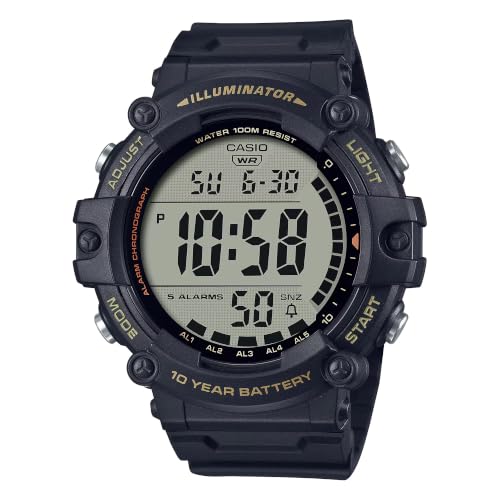
Casio AE-1500WH Digital Sports Watch
What We Like
- 1/100-second stopwatch for precise stoppage timing
- 24-hour countdown timer for match clocks
- Extra large display, easy to read
- About 10-year CR2032 battery life
Trade-offs
- No GPS tracking, unlike the Garmin fēnix 7X Pro
- Digital timing only, no distance or pace data
A 1/100-second stopwatch and a 24-hour countdown timer mean you can time stoppages precisely and run the match clock without juggling extra gear. That is exactly what a referee needs out on the pitch. The extra large display keeps the numbers readable at a glance mid-jog, and the LED backlight with afterglow helps during evening kickoffs under poor light. Add a CR2032 battery rated for about 10 years, and you are never scrambling for a replacement before a big fixture. The lightweight resin case and band stay comfortable on the wrist through a full match, which matters when you are running all afternoon.
The trade-off is that this is a plain digital watch. There is no GPS, so you will not get the tracking that the Garmin fēnix 7X Pro offers as a multisport GPS watch, and anything beyond timing and alarms needs a separate device. Against the Casio W800H, the closest rival, both list 100-meter water resistance and a 1/100-second stopwatch, so the decision comes down to this model’s extra large display and its listed 24-hour countdown timer. For a referee who wants dependable timing and nothing to charge, this is the straightforward choice.
Garmin fēnix 7X Pro Sapphire Solar

What We Like
- Solar-charging Power Sapphire lens extends battery life
- Built-in LED flashlight with strobe modes
- Large 1.4-inch display for quick glances
- Wrist-based running power and advanced pacing modes
Trade-offs
- 51 mm case is bulky next to 43 mm Forerunner 165
- Pulse Ox is not available in all countries
A 1.4-inch display means you can read elapsed time and heart data at a glance while jogging backward down the touchline, without squinting at a tiny face. That matters when you are running the middle and still need to keep track of the clock. This is the watch for the referee who treats fitness seriously and wants one device for match days and training. The Power Sapphire solar lens stretches battery life to weeks in smartwatch mode, so you are not hunting for a charger before every Sunday fixture. Wrist-based running power and pacing modes let you gauge your workload across a match.
Size and focus are the costs of choosing this Garmin. The 51 mm case is a lot of watch for a small wrist, and the 43 mm Garmin Forerunner 165 sits far more lightly under a match shirt. Much of what the fēnix offers, like hill score, endurance score and training readiness, is built for multisport athletes rather than for officials who simply need to time a game. The built-in flashlight with strobe modes is handy for evening training runs and walking back to the car after a late kickoff. If all you want is a reliable stopwatch and countdown, the Casio AE-1500WH covers that with far less complexity. Choose the fēnix when you want fitness depth along with the timing.
Garmin Forerunner 165 Smartwatch

What We Like
- Brilliant AMOLED touchscreen with button controls
- Built-in GPS for pace and distance
- Up to 11 days in smartwatch mode
- Lightweight 43 mm case for long matches
Trade-offs
- GPS mode lasts up to 19 hours, so charge between tournaments
- Smaller 43 mm face than the fēnix 7X Pro's larger build
A brilliant AMOLED touchscreen means you can glance at your wrist mid-sprint and read your numbers without squinting, even when you are chasing play down the touchline. That matters for a referee who has no time to stop and fiddle. Traditional button controls sit alongside the touch display, so you are not forced to rely on the screen alone. Built-in GPS and wrist-based heart rate record pace and distance, which helps you see how much ground you really cover across ninety minutes. At 43 mm and lightweight, it also stays out of the way during a long match.
You will be using its activity profiles and stopwatch-style tools rather than a purpose-built match mode. Battery is fine for weekends, with up to 11 days in smartwatch mode, but GPS mode tops out at 19 hours, so heavy tournament schedules need a top-up. Compared with the Casio AE-1500WH, which is a simple digital sports watch with a stopwatch and countdown timer, the Forerunner 165 gives you far richer screen and tracking, but less plain-and-simple fuss.
Timex Ironman Classic 30 Watch

What We Like
- 100-hour chronograph covers long sessions
- Three customizable alarms for scheduling
- INDIGLO backlight for after-dark reading
Trade-offs
- 38mm case is smaller than the Endure 30's 42mm
- No GPS, unlike the Garmin Forerunner 165
Thirty laps of memory means you can log a whole stretch of match events without wiping the display. For a referee, that translates into recording split times, stoppage periods or interval efforts, then reviewing them afterward instead of scribbling on a card. The 100-hour chronograph adds headroom, so a long tournament day with many starts and stops will not run the clock out. Set periods are easy to manage with the countdown timer that runs up to a full day, and the three customizable alarms can nudge you toward warm-ups or half-time routines.
Size and scope are the compromises with this one. The 38mm resin case is compact, which is comfortable on a wrist that is already carrying a whistle hand and cards. It is smaller than the 42mm Timex Ironman Endure 30 Shock, though, if you want a larger face. There is no GPS here either, so the Garmin Forerunner 165 is the better pick if you want distance and pace data from the pitch.
Product photos
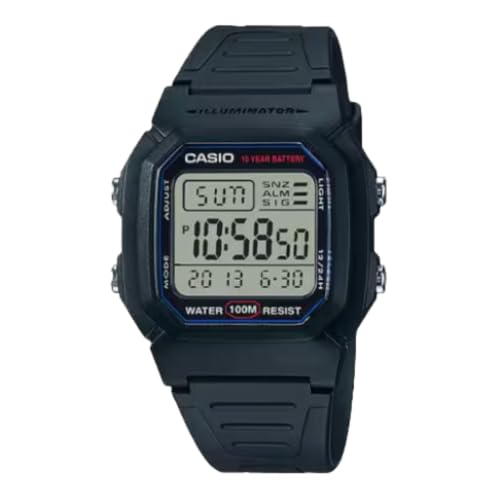
Casio W800H Digital Watch
What We Like
- 1/100-second stopwatch for precise timing
- 24-hour countdown timer for match periods
- 100-meter water resistance handles rain and mud
- 10-year CR2025 battery means little upkeep
Trade-offs
- No GPS, so no distance or sprint data
- Backlight only; no color display like Suunto Race S
- Basic digital face has no heart rate tracking
Pairing a countdown timer that runs up to 24 hours with a 1/100-second stopwatch means you can run the clock for a half and still time stoppages down to the hundredth. That covers the core job of a referee watch without any extras. The CR2025 battery is rated for up to 10 years, so you will not be hunting for a charger the night before a fixture. Put it on, set it, and forget it. For a new official, a youth league volunteer or anyone who needs a spare, the simple button-driven timing tools keep match time easy to manage.
The trade-off is simple: this is a timekeeper, not a tracker. There is no GPS, so you will not see distance covered or sprint data, which a watch like the Garmin Forerunner 165 is built to record. The LED backlight with afterglow helps under floodlights and in the evening, but it is a basic display. Still, the 100-meter water resistance shrugs off wet touchlines, and the alarm and dual time are handy extras. If timing is all you need, it does that cleanly.
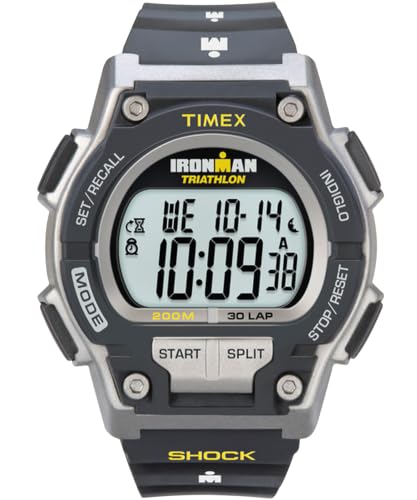
Timex Ironman Endure 30 Shock Watch
What We Like
- Case is shock resistant to I.S.O. standards
- 100-hour chronograph with 30-lap memory
- 24-hour countdown timer plus three alarms
Trade-offs
- Water rating excludes scuba diving, only surface sports
- Resin strap tops out at an 8-inch wrist
- Digital display only, no GPS or heart tracking
Shock resistance to I.S.O. standards is the headline here, and it tells you the case is built to handle everyday bumps without the watch becoming unreliable. That matters because a timing tool you cannot trust after a knock is no use at all. The 100-hour chronograph and 30-lap memory let you keep running time and log splits without juggling anything else, while the 24-hour countdown timer handles fixed-length periods. For a grassroots or youth official who wants something sturdy and simple, this is a sensible fit.
Size and scope are where this Timex asks for compromise, since it is a basic digital timer rather than a smart device. There is no GPS or tracking, so you won’t get distance or pace data like you would from the Garmin Forerunner 165. The 200-meter water resistance covers rain and splashes comfortably, though it is not meant for scuba diving. The resin strap fits wrists up to 8 inches, which is fine for most but could be snug on larger ones. The Casio AE-1500WH lists 100M water resistance, so this Timex offers double the depth rating, plus a lap memory built for timing.
Armitron Sport Chronograph Digital Watch

What We Like
- Water resistant to 330 feet (100 M)
- Chronograph and lap functions for timing play
- 2nd time zone and military time included
Trade-offs
- Rated for snorkeling, but not for diving
- No GPS, so no distance tracking
Water resistance to 330 feet (100 M) means rain, mud, a soaked pitch or a dunk in the pool will not be a worry on matchday. That is the clearest reason this watch suits a referee who works in all weather. The chronograph and lap functions let you track elapsed match time and split periods, while the alarm can nudge you toward half-time or stoppage checks. The resin case keeps the build simple and the red top ring makes it easy to spot on the wrist.
A simple digital timer rather than a smart device, this watch keeps its focus narrow. Nothing in the feature list suggests it tracks your runs or maps your movement, so if you want distance covered across ninety minutes, a Garmin Forerunner 165 is the pick to look at. The listing also stops short of diving, covering snorkeling and swimming only. Still, for a referee who wants straightforward timing with water resistance, the feature set is focused and sensible. The 2nd time zone and military time are small extras, but the core job of counting minutes cleanly falls to the chronograph.
Polar Pacer GPS Watch

What We Like
- Ultra-light 0.1-pound build
- Up to 35 hours in training mode
- Always-on MIP color display
- GPS tracks every step and turn
Trade-offs
- Runner-focused: tracks pace and laps, not referee tools
- Full 100-hour battery needs power save mode
Weighing just 0.1 pounds, this watch is light enough that you will barely notice it on your wrist. That matters for a referee, because a heavy watch bounces and rubs when you sprint to keep up with a counterattack. The always-on color display lets you glance down at your time and stopwatch without flicking your wrist. GPS follows every step and turn, so the distance you covered is there when the whistle goes. The design is simple and easy to use, built around the basics rather than a maze of menus.
Built for runners rather than referees, this Polar keeps its tracking centered on time, pace, distance, laps and a stopwatch. Nothing is designed specifically for match officials, so you will be adapting running tools to the touchline. Battery life is generous at up to 35 hours in training mode, enough to cover many matches between charges. The 100-hour figure only applies in power save mode, so treat it as a standby-style option rather than the everyday number. Anyone wanting a light, uncomplicated watch will find the Polar keeps things straightforward.
Product photos
SUUNTO Race S AMOLED GPS Watch

What We Like
- 1.32" 466dpi AMOLED touchscreen with digital crown
- Dual-band L1/L5 GNSS across five satellite systems
- 13 days daily battery, one-hour fast charge
- Only 60 g and 11.4 mm thin
Trade-offs
- 30 hours in GPS performance mode limits multi-day events
- Fenix 7X Pro adds solar charging; this has none
A 60 g body that is just 11.4 mm thin means this watch stays comfortable through ninety minutes of sprinting, backpedaling and sudden changes of direction. Referees who dislike a bulky wrist brick will notice that right away. The 1.32-inch AMOLED screen at 466dpi stays sharp, so you can glance at the time or your run data under floodlights or in harsh midday sun without squinting. The digital crown adds a quick way to scroll when gloves or sweat make a touchscreen fiddly. Add dual-band GPS tracking, and your distance and pace record stays dependable between tall stands and open pitches alike.
Focus is where this watch gives ground. A referee mostly needs a clear clock, a stopwatch and a reliable record of match load, while this watch packs 95+ sports modes and navigation tools you will rarely touch on a pitch. Battery life is solid at up to 13 days of daily use. Performance mode with the best GPS accuracy runs up to 30 hours, so a weekend tournament with heavy tracking may still call for a top-up, and fast charging brings it back to full in about an hour. Compared with the Garmin fēnix 7X Pro Sapphire Solar, it is lighter and slimmer on the wrist, though it gives up solar charging. Against the Polar Pacer, the Suunto adds dual-band GNSS tracking and offline maps, which suit trail and outdoor work more than a flat pitch.
Product photos
SUUNTO 9 Peak Pro GPS Watch

What We Like
- 300-hour tour mode for long stretches
- Full charge in about one hour
- 10-minute charge gives 2 hours GPS
- Sapphire glass and titanium build
Trade-offs
- Casio AE-1500WH is far simpler for plain timekeeping
- 97 sport modes add clutter for refereeing alone
- Phone app needed for structured workouts and goals
Forty hours of battery in best GPS mode means you can referee a full tournament weekend of matches without hunting for a charger. Drop to endurance mode and you get 70 hours, and tour mode stretches to 300. That headroom is the reason this watch suits officials who travel to cup days, run multiple fixtures back to back, or simply forget to plug in the night before. A quick 10-minute charge gives 2 hours of GPS training, so a missed top-up before a late kickoff is easy to fix. Four satellite systems also help keep tracking steady around tall stands and buildings.
Menu depth is the main cost here, because this Suunto is a full adventure watch rather than a simple match timer. With 97 sport modes and navigation features, the menus carry far more than a referee needs for a Saturday morning fixture. Structured workouts and goals also live in the Suunto app, which means a little setup on your phone. Next to the Casio AE-1500WH, a plain digital watch with stopwatch, alarm and countdown timer, the Suunto asks for more attention. In return you get GPS tracking, a sapphire glass face and 100m water resistance built to take knocks on the touchline.
Product photos
How We Evaluated Soccer Referee Watches
This guide draws on manufacturer specifications and product documentation, expert round-ups on referee gear, and repeat patterns in owner feedback about readability, durability and battery life.
Four criteria mattered most. First, timing: a watch needs a reliable stopwatch and countdown timer so you can track elapsed time, remaining time and added stoppage time. Second, readability, meaning a large display and a backlight for evening kickoffs. Third, durability, including water and shock resistance. Fourth, battery life, because a watch that dies mid-tournament is useless.
A research-led approach has limits. We cannot judge how a strap feels after ninety minutes or how a screen looks in your local floodlights. Treat our picks as a well-informed shortlist, then match them to your own level of football and your wrist size.
What To Look For In Soccer Referee Watches
Most referees are choosing between a simple digital timer and a GPS smartwatch. The right answer depends on what you want the watch to do besides tell time, and a few core checks make the choice easier.
The best referee watch has a stopwatch you can start and stop without looking, plus a countdown timer for match periods. It also needs a display that stays readable in rain and dim light. A battery that lasts a full season or tournament weekend matters too. GPS and heart rate data are optional extras.
Timing Functions
Soccer timekeeping goes beyond a simple clock. You want a stopwatch that can pause for injuries and delays, and a countdown timer that handles a match half. The Casio AE-1500WH and Casio W800H both pair a 1/100-second stopwatch with a 24-hour countdown timer, which covers the basics.
Lap memory helps when you need to log events. The Timex Ironman Endure 30 offers a 100-hour chronograph with 30-lap memory, plus three alarms.
Display and Battery
Large digits matter more than fancy graphics. The Casio AE-1500WH has an extra large display, while the Garmin Forerunner 165 uses a bright AMOLED touchscreen with button controls. Backlights such as the INDIGLO on the Timex Ironman Classic 30 help for evening kickoffs.
Battery is where simple watches shine. Both Casio models run about 10 years on a coin cell, while GPS watches need regular charging. The Garmin Forerunner 165 lasts up to 11 days in smartwatch mode but up to 19 hours with GPS on, so plan your charging around tournament schedules.
Durability and Extras
Match days mean rain, mud and knocks. The Casio W800H offers 100-meter water resistance, the Armitron Sport Chronograph is rated to 330 feet (100 M), and the Timex Ironman Endure 30 has a shock-resistant case. Pair the watch with the rest of your referee equipment so every tool is easy to reach and quick to read.
GPS adds distance and pace data that fitness-minded officials like, but it also adds charging and complexity. Before you buy, run through a few practical checks:
- Can you start, stop and reset the stopwatch by feel, with gloves or wet hands?
- Is the case size comfortable on your wrist for a full match?
- Does the backlight work well enough for dusk or evening games?
- Will the battery last your busiest tournament weekend?
- Do you want a second watch for backup timing?
Rule of thumb: choose the simplest watch that covers your timing needs, and add GPS only if you will actually use the data.
Soccer Referee Watches Compared
The table below lines up all 10 watches so you can compare timing tools, GPS features and battery life at a glance.
| Product | Display | Weight | Battery |
|---|---|---|---|
| Casio AE-1500WH Digital Sports Watch | Digital | 0.2 pounds | About 10 years |
| Garmin fēnix 7X Pro Sapphire Solar | 1.4-inch | 0.2 pounds | Weeks (solar) |
| Garmin Forerunner 165 Smartwatch | AMOLED touchscreen | 0.1 pounds | Up to 11 days |
| Timex Ironman Classic 30 Watch | Digital | N/A | N/A |
| Casio W800H Digital Watch | Digital | 0.1 pounds | 10-year life |
| Timex Ironman Endure 30 Shock Watch | Digital | 0.1 pounds | N/A |
| Armitron Sport Chronograph Digital Watch | Digital | 0.0 pounds | N/A |
| Polar Pacer GPS Watch | Always-on MIP color | 0.1 pounds | Up to 35 hours |
| SUUNTO Race S AMOLED GPS Watch | 1.32" AMOLED | 0.1 pounds | 13 days daily use |
| SUUNTO 9 Peak Pro GPS Watch | N/A | 0.1 pounds | 40 hours GPS |
Frequently Asked Questions
What is the best watch for a soccer referee?
The Casio AE-1500WH Digital Sports Watch is our best overall pick for most referees. It has a 1/100-second stopwatch, a 24-hour countdown timer, an extra large display and about 10 years of battery life. If you want GPS and training data, the Garmin Forerunner 165 and fēnix 7X Pro are stronger fits.
What watches do professional referees wear?
Professional referees typically wear dedicated sports or GPS watches that handle precise timekeeping and fitness tracking. The research we reviewed does not name specific models for every competition, so focus on features instead: a reliable stopwatch, readable display, durable case and battery that lasts through a full match day.
Why do refs wear two watches?
Many referees wear two watches so one can run the match clock while the other tracks stoppage time or acts as a backup. If a watch fails, is stopped by mistake or runs out of battery, the second keeps the match on track. It also helps with separate timing, such as sin bin penalties at lower levels.
Do I need a GPS watch to referee soccer?
No. A simple digital watch with a stopwatch and countdown timer covers match timing. GPS suits referees who want to track distance, pace and workload for fitness. The trade-off is battery life, since GPS modes need charging every day or two, while simple Casio and Timex models run for years on a coin cell.
What features should a referee watch have for wet weather?
Look for solid water resistance and a durable case. The Casio W800H offers 100-meter water resistance, and the Armitron Sport Chronograph is water resistant to 330 feet (100 M). The Timex Ironman Endure 30 adds a shock-resistant case, which helps if the watch takes a knock on the pitch.
The Bottom Line
The Casio AE-1500WH Digital Sports Watch is the best overall choice for referees who want a simple, readable timer with long battery life. It handles stoppage timing and match countdowns without charging or menus.
If you are watching your spending, the Best Budget Pick is the Casio W800H Digital Watch. Fitness-minded officials should look at the Best Premium Smartwatch, the Garmin fēnix 7X Pro Sapphire Solar, or the Best Lightweight GPS, the Polar Pacer GPS Watch. For tough conditions, the Timex Ironman Endure 30 Shock Watch is the Best Shock Resistance pick.
Whatever you choose, prioritize reliable, glanceable timing first. Everything else is a bonus.
