
Corner Kick Routines in Football: 5 Data-Backed Plays
This post contains affiliate links. As an Amazon Associate, we earn from qualifying purchases.
Effective corner kick routines are built on three things: a delivery that beats the first defender, coordinated movement that creates separation, and a contingency plan for the second ball. The best routines don’t just aim for a tall player; they manipulate defensive instincts, turning a 6% conversion chance into a genuine scoring threat.
That 6% number is the actual conversion rate observed in a study of Portuguese amateur football, a window into how low the baseline odds are without a plan. The gap between a hopeful cross and a genuine routine is filled with rehearsed blocks, deceptive runs, and specific deliveries that various studies have linked to corner effectiveness. Effective corner kick routines in football are built on these precise elements.
What follows breaks down the five routines with statistical backing, explains why they succeed, and gives you a coach’s checklist to install one in a single training session. We’ll also cover the critical next step: what to do when the routine fails, because preventing a counter-attack is part of the play.
Key Takeaways
- Target the near-post and penalty-spot zones; a women’s football training study found that focused practice on these areas increased shots and goals, though other studies highlight successful deliveries to central, front-post, or penalty-box zones.
- Prefer inswinging deliveries, research from the Brazilian Championship found inswings are significantly associated with corner effectiveness (p=0.015).
- Use short corners to change the angle, having two attackers support a short corner is statistically significant for success (p=0.018), as it pulls defenders out of the box.
- Indirect routines can be more effective than direct crosses; analysis of the Brazilian Championship showed indirect corners had a statistically higher goal conversion rate than direct ones (p=0.001), though other studies observe frequent use of direct deliveries.
- Train the defensive transition immediately, if the first ball is cleared, your team must be drilled to counter-press or drop into a pre-drilled defensive shape.
Why Most Corner Kick Advice Is Out of Date
Talk about corners for thirty seconds and you’ll hear the same old lines. “Get it in the mixer.” “Find your big man at the back post.” “Just whip it in.”
The data says that’s mostly noise. A study of Portuguese amateur football found only 6% of corners led to a goal. Defenders won the ball 44% of the time. That’s not a lottery worth entering without a loaded die.
The difference between a generic cross and a corner kick routines in football isn’t just organization; it’s about exploiting defensive setups that studies have associated with higher corner effectiveness. For example, a study of elite Spanish football identified that successful corners often involved same-foot/same-side deliveries into the penalty box or opposite-foot crosses to the near post. The foot matching the side changes the ball’s curve and the defender’s read.
The Sloan Sports Analytics conference paper “Routine Inspection” notes that synchronized runs and pre-planned routines are a key tactical element, and that modern tracking data can even infer whether defenders are in man-to-man or zonal marking schemes before the ball is kicked.
This is about having two or three corner kick routines in football your team executes without thinking, because the movement creates the chance, not the delivery.
The 5 Corner Kick Routines Backed by Data
Here’s where we move from theory to the whiteboard. These five patterns are not invented; they are distilled from match observations, training studies, and statistical analyses of thousands of corners. Each one has a clear mechanism, a target zone, and a reason it works.
1. The Near-Post Flick-On (The Data-Backed Default)
This is a widely used effective routine in the modern game for a reason. The delivery is an inswinger to the near-post area, aiming for a player making a curved, arcing run from the edge of the six-yard box.
Why it works: The 2023 Brazilian Championship study found inswinging deliveries significantly associated with corner success (p=0.015). A women’s football training study at Montpellier showed that after focused practice, teams delivered more balls to the near-post and penalty-spot zones, resulting in more shots and goals. The near-post attacker’s job isn’t always to score; it’s to flick the ball against its flight path, wrong-footing the goalkeeper and defenders who are tracking the initial cross.
The movement: Multiple runners; one to the near post, one to the penalty spot for the knockdown, one hanging at the far post. The key is the near-post runner’s timing, they must go just as the kicker steps up.
2. The Short-Corner Re-Entry (The Space Creator)
The taker plays a short pass to a teammate close by, then moves for a return pass or overlaps. This is a matter of geometry.
Why it works: The same Brazilian study found that having two attackers supporting a short corner was a significant positive factor (p=0.018). It also noted that defenders moving out of the penalty area to engage the short play was similarly significant (p=0.021). Pulling two or three defenders out of the box automatically creates more space for the eventual cross. It changes the angle of delivery, allowing for a cut-back or a cross from a more central position.
Common mistake: Taking a short corner and then playing a hopeless cross from a wider angle. The whole point is to improve the crossing position or draw defenders out. If you don’t achieve either, you’ve just given up your set-piece advantage.
The movement: The key is creating passing options to draw defenders out and improve the crossing angle, as supported by the finding that two attackers supporting a short corner is significant. The cross should then target the space vacated by the defenders who stepped out.
3. The Penalty-Sot Pull-Back (The Deceptive Delivery)
The taker lofts a cross not towards goal, but to the edge of the penalty area, around the “D”. Attackers make initial runs towards the near post to drag defenders, before a late runner arrives onto the pulled-back delivery.
Why it works: This exploits the defensive instinct to step up. When the ball is played away from goal, defenders naturally move forward, seeking an offside trap or to clear their lines. This often leaves players trailing at the edge of the box unmarked. The Portuguese amateur study noted that 7% of corner attempts resulted in a shot from outside the penalty area; routines like this aim to create such shooting opportunities.
The movement: It requires patience and disguise. Multiple attackers make initial runs to drag defenders before a late runner arrives onto the pulled-back delivery. The player targeting the edge-of-box area should start from a deep position and time their arrival.
4. The Far-Post overload (The Physical Battle)
A long, floated outswinger or a driven cross aimed at the back post, where 2-3 attackers are positioned against isolated defenders.
Why it works: While not always the most statistically dominant, it’s a crucial change-up. It targets spaces that are harder for goalkeepers to claim and relies on individual duels. The Portuguese study found 79% of deliveries targeted the central or front-post zone, meaning the far post is often less crowded. If you have aerial dominance, this is a direct route to it. The Spanish elite study also highlighted successful patterns involving deliveries to the penalty box from a specific side.
The movement: This relies on positioning and blocking to create space for aerial duels at the far post. Their job is to block or impede the defenders marking them, creating a half-yard for the primary target to attack.
5. The Pre-Block Screen (The Set Play)
Before the kick is taken, 3-4 attacking players form a tight line or cluster in the goalkeeper’s line of sight, usually around the six-yard box. On the whistle, they break in coordinated directions, screening defenders and creating lanes for runners.
Why it works: It directly counters zonal marking. A study analyzing defender roles from tracking data presented at the Sloan conference shows that screens make it incredibly difficult for zonal defenders to track their assigned space and an attacker simultaneously. It creates hesitation, and hesitation in the box is fatal.
The movement: The block must be set early and held until the kick is taken, after which blockers break in coordinated directions to screen defenders and create lanes. A runner from deep, often from the edge of the box, attacks the space the block just vacated.
| Routine | Primary Delivery | Key Movement | Best Against | Data Point |
|---|---|---|---|---|
| Near-Post Flick-On | Inswinger to near post | Curved run, flick-on | Any marking | Inswings significant (p=0.015) |
| Short-Corner Re-Entry | Short pass, then cross | Third-man overlap, draw defenders out | Aggressive man-marking | 2+ attackers short corner significant (p=0.018) |
| Penalty-Spot Pull-Back | Lofted cross to edge of box | Late runner from deep | Zonal, step-up defenses | 7% of shots come from outside box |
| Far-Post Overload | Outswinger to back post | Back-post block & duel | Compact zonal defenses | 79% of deliveries target central/front zones |
| Pre-Block Screen | Any, after screen breaks | Coordinated scatter from static block | Zonal marking | Tracking data can infer defender roles |
Choosing the Right Routine: A Coach’s Decision Matrix
You don’t need all five. You need one or two that match your team’s strengths and the opponent’s weaknesses. This is the gap most online guides miss, they list plays but don’t help you choose.
Ask these three questions:
- What’s our primary aerial threat? If you have one dominant player, routines 1 (Near-Post) or 4 (Far-Post) are your bread and butter. If you don’t, look to 2 (Short) or 3 (Pull-Back) to create chances for more technical players.
- How does the opponent defend? Are they zonal or man-marking? You can often tell in the first few corners. Against zonal, screens (routine 5) and pulled-back crosses (routine 3) that exploit space between zones are lethal. Against strict man-marking, short corners (routine 2) that drag defenders out of position are highly effective.
- What’s our risk tolerance? Short corners (2) and pull-backs (3) keep possession but can lead to devastating counter-attacks if the final ball is poor. Direct deliveries (1 & 4) are less likely to give up a break but also less likely to create a clear opportunity.
Here’s a simple flow chart you can sketch on a notepad:
- Opponent uses zonal marking → Use Pre-Block Screens (5) or Penalty-Spot Pull-Backs (3).
- Opponent uses man marking → Use Short Corners (2) or coordinated decoy runs.
- We have an aerial advantage → Use Near-Post Flick-Ons (1) or Far-Post Overloads (4).
- We have technical midfielders → Use Short Corners (2) or Pull-Backs (3).
Where this goes sideways: Choosing a routine based on what a pro team does, without the pro team’s execution level. A U-12 team attempting a complex six-player screen will end up in an offside huddle. Start simple.
The Delivery: It’s Not Just “Whip It In”

The routine is the choreography, but the cross is the cue. This is where technique meets tactics.
- Inswingers: The ball curves towards goal. They are harder for goalkeepers to intercept and are perfect for near-post flick-ons. Data says they’re significantly effective.
- Outswingers: The ball curls away from goal. These are often used for far-post deliveries, allowing attackers to run onto the ball and generate more power. They give the goalkeeper a decision to come or stay.
- Driven vs. Looped: A driven cross arrives faster, giving defenders less time to react. A looped cross hangs, allowing attackers to time their runs. The driven cross suits the near post; the looped cross suits the penalty spot or far post.
Your choice should be dictated by the routine. A near-post flick-on demands an inswinger. A far-post overload can use either a driven outswinger or a lofted cross. The taker must be able to execute at least two types consistently.
The Unseen Half: Defending the Counter-Attack

This is the most critical content gap in corner kick advice. Every routine has a failure rate. What happens next decides games.
When your corner is cleared, you have a brief window before the opponent’s counter-attack develops. Your team is horribly out of position. There are two proven strategies:
- The Counter-Press: The moment the ball is cleared, the three closest attacking players swarm it, aiming to win it back immediately in a dangerous area. This requires immense energy and coordination.
- The Structured Drop: Immediately, the team transitions into a pre-drilled defensive shape, often a 4-4-2 or 4-5-1 block, with the widest players sprinting to cover the flanks. This sacrifices the chance to regain possession but solidifies the defense.
The part nobody mentions: It is critical to account for opponents left upfield during a corner to prevent a quick counter-attack. If you don’t have a designated player or two covering them, you’re one pass away from being 1-v-1 with your goalkeeper.
You must train one of these transitions every time you practice a corner routine. The whistle to signal the end of the drill is the clearance. What does your team do next?
A 4-Week Coaching Checklist
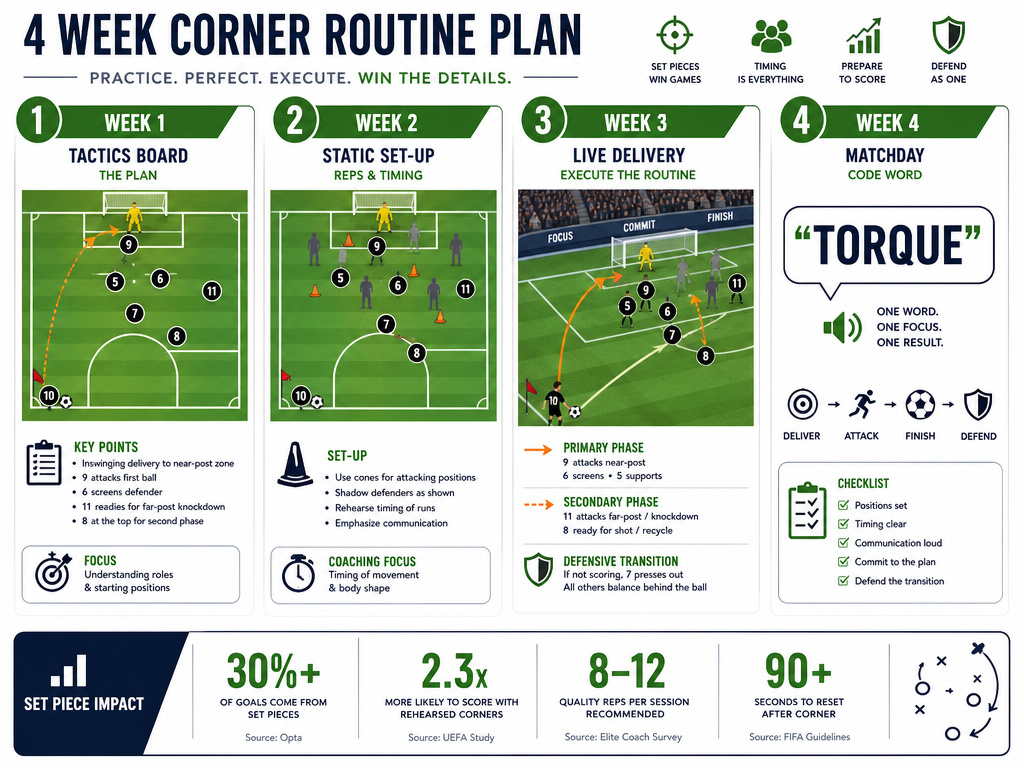
Theory is useless without implementation. Here’s how to install one routine, from the whiteboard to matchday.
Week 1: Introduction & Technique
- Explain the routine with video or diagrams.
- Practice the delivery technique in isolation (crosses to the specific zone).
- Walk through the movements without opposition. Slowly.
Week 2: Add Shadow Opposition
- Run the routine against static cones or passive defenders.
- Focus on timing: the runner’s start vs. The kicker’s approach.
- Introduce the secondary phase (what happens if the first ball isn’t won).
Week 3: Live Repetition
- Run the routine against active, but coached, defenders (start at 50% intensity).
- Work on the trigger (a call, a hand signal).
- Drill the defensive transition for 10 minutes after every 5 corner attempts.
Week 4: Integrate & Test
- Use the routine in small-sided games (e.g., a game that starts with a corner).
- Simulate match pressure: add a scoreline, make it competitive.
- Name it. Give the routine a simple code word for matchday.
Stick with this progression. Rushing to live pressure in Week 1 will teach your players the wrong habits. The goal is automatic execution, not frantic improvisation.
How to run effective corner kick routines
Research from elite Spanish football identifies successful patterns, including same-foot, same-side deliveries into the penalty box and opposite-side crosses aimed at the near post. A key tactical element is the use of synchronised runs and routines to create space and confusion. Data from the Brazilian Championship shows indirect corners, where the ball is not delivered directly into the box from the kick, have a statistically higher goal conversion rate than direct ones. Using two attackers to support a short corner routine is also linked to much greater effectiveness. The principle is to manipulate defender positioning, with studies noting that forcing defenders to move out of the penalty area or facing individual marking schemes creates more dangerous opportunities.
Frequently Asked Questions
What are the best strategies for corner kicks in football?
The best strategies are those that are practiced, simple, and based on your team’s strengths. Data points towards inswinging deliveries to the near-post and penalty-spot areas, using short corners to create better crossing angles, and employing screens to disrupt zonal defenses. The strategy is less important than the repetition.
What is the new rule for corner kicks in football?
There is no major new rule for corner kicks. The current Laws of the Game state the ball must be placed inside the corner arc, opponents must remain at least 9.15m (10 yards) away until the ball is in play, and the ball is in play once it is kicked and moves. The “new” aspect is the tactical sophistication and data analysis now applied to them.
What are some good practice drills for corner kicks?
Start with technical repetition for the kicker: repeatedly hitting a specific zone from the corner flag. Then move to shadow play: running the movements without defense. Finally, phase play: set up a scenario where Team A has a corner against Team B in a half-pitch game, with the drill ending only once the ball is cleared past the halfway line or a goal is scored. This trains both the routine and the transition.
How often are corner kicks successful?
Success is low. A study of Portuguese amateur football found a 6% goal conversion rate. Even at the highest level, like the World Cups observed in one study, conversion remains low. This is precisely why rehearsed routines are valuable, they aim to push that percentage upward by creating higher-quality chances.
Before You Go
The biggest shift involves taking one routine and drilling it until the movement is muscle memory and the transition is automatic. Pick the near-post flick-on or the short-corner re-entry, the two with the strongest statistical backing, and run the 4-week checklist.
Forget about the 6% average. Your next corner is a 100% opportunity if your players know exactly where to run, the taker knows exactly where to put it, and everyone knows what to do when the ball spins loose. That’s the difference between hoping and planning.
Back to the pitch.
