
Compactness in Football Defending Explained: The Real Gap
This post contains affiliate links. As an Amazon Associate, we earn from qualifying purchases.
Compactness in football defending means the team reduces the space the opposition can attack by staying close together, both front-to-back (vertical) and side-to-side (horizontal). The Bundesliga tracking data shows success doesn’t hinge on the whole team’s average spacing but on the local compactness of the five defenders closest to the ball, with effect sizes between -0.08 and -0.16 for surface area and spread.
The problem is everyone uses a different ruler. Coaching manuals swear by distances like 30–35 metres between lines. The Fraunhofer Institute’s work for the DFL found even professional analysts couldn’t reliably agree on what “medium” compactness looked like. A clear guide to compactness in football defending explained would help, but the game talks about it constantly while the measuring tape keeps slipping.
What follows is a breakdown of what compactness actually is, why the standard line distances are a starting point at best, and what the elite-level tracking data says really matters in the compactness in football defending explained when the other team has the ball. We’ll walk through the conflicting definitions, the surprisingly thin evidence for whole-team compactness, and the simple cues a coach can use without a GPS vest.
Key Takeaways
- Compactness is measured in two directions at once: vertical (distance from deepest defender to highest attacker) and horizontal (width of the defensive block).
- Sources disagree on the value of fixed distance rules: The Bench View cites 30–35 metres, Coach Notes uses 30–35 yards, while Footballizer explicitly states that good compactness is not measured by fixed distances.
- The critical compactness is local. The Forcher et al. Study of 153 Bundesliga matches showed the five defenders nearest the ball were significantly more compact in successful defensive actions.
- It is a constant, not a block. A team must maintain compactness whether it’s pressing high in a high press vs low block or sitting deep in a low block.
- Coaching it is about reference points, not assignments. Players move as a unit based on the ball, their nearest teammate, and the space behind them, not by sticking to a man.
What Are We Actually Talking About?
The word gets thrown around in commentary every weekend. A pundit will say a team “lost their compactness” after conceding. But what visual shape vanished?
At its core, defensive compactness is the practice of shrinking the effective space your team has to defend. It’s not about having all eleven players in your own penalty area. It’s about the distances between them being small enough that an opponent’s pass must be perfect to find a gap.
Vertical vs. Horizontal Compactness
You have to control both. A team that is narrow but stretched from its own box to the halfway line has vertical compactness but fails horizontally. The gap between the defensive and midfield lines is a motorway. Conversely, a team whose back four and midfield four are tight but spread all the way to each touchline has horizontal compactness but fails vertically. The channel between the centre-back and full-back is wide open.
Where this goes sideways: Coaching only one dimension. A team drilled to stay narrow but never taught to step up together will get played over the top. A team that squeezes the pitch front-to-back but never slides side-to-side will get stretched and passed around.
What Does a Compact Shape Actually Look Like?
Forget the blackboard X’s and O’s for a second. On a real pitch, a compact team moves like a single organism.
The back line holds its defensive line height. The midfield line maintains a short distance ahead of them, consistent with coaching advice of 10–15 yards between lines. The forwards maintain a position ahead of the midfield line. From the stands, you see three distinct, flat banks of players. When the ball is played wide, the whole unit shuffles ten yards to that side, en masse. The far-side winger might now be far from the ball, but that’s the conceded space. The block around the ball is still tight.
This is the foundation of all effective team defending. It provides the defensive cover and balance needed to snuff out attacks.
| Aspect | What It Means | How You See It Fail |
|---|---|---|
| Vertical Compactness | Short distance from deepest defender to highest attacker. | A striker is far from his own centre-back, leaving a massive gap for the opposition midfield to exploit. |
| Horizontal Compactness | Narrow width of the defensive block from touchline to touchline. | A winger isolates a full-back 1v1 because the nearest central midfielder is too far away, unable to help. |
| Dynamic Shifting | The entire block moving as one unit when the ball moves. | One midfielder ball-watches as a pass goes wide, staying central and opening a passing lane back inside. |
The Rulebook Says 35 Metres. The Data Says Something Else.
Here’s where the conversation gets messy. Ask five coaches for the ideal compactness distance, and you’ll get five answers, and two different units of measurement.
The Conflicting Distance Rules
Coaching resources are full of specific numbers. The Bench View states typically 30–35 metres between the defensive and midfield lines. Coach Notes gives roughly 30–35 yards from the back line to the front line, with 10–15 yards between adjacent lines. Tactical Rant cites a coach’s rule of 25 metres from the last defender to the centre forward, and the FIFA 2018 World Cup report found a tournament average of 26 metres between the deepest defender and highest attacker.
The 30-yard (or metre) rule is a useful coaching crutch. It gives players a tangible target. But it’s a starting point, not a law. Footballizer explicitly rejects fixed distances: “Good compactness is not measured by fixed distances.”
The units alone, metres versus yards, should tell you this isn’t a precise science. A gap measured in yards is not directly equivalent to one measured in metres. That three-metre difference is the space a clever number 10 lives in. Which manual is right? They all are, for the teams they describe. The real question in the compactness in football defending explained is: do these whole-pitch distances actually predict defensive success?
The Research Disagrees with the Rulebook
In 2023, a study by Forcher et al. Analyzed 153 Bundesliga matches from the 2020/21 season using the DFL’s tracking and event data. They looked for differences in compactness and organizational measures between successful and unsuccessful defensive plays.
The key finding was stark: they found almost no difference in whole-team compactness or organizational measures between the two outcomes. The average spacing of the entire team didn’t determine whether a defensive action succeeded.
The meaningful difference was local. The five defenders closest to the ball were more compact in successful defensive plays, with effect sizes (−0.08 ≤ d ≤ −0.16) for surface area and spread. The battle was won in the immediate vicinity of the ball, not by the grand, average geometry of the whole side.
This aligns with an earlier DFL project with the Fraunhofer Institute, which tried to build a “Compactness Indicator.” They found defining it was difficult, with analysts holding multiple opinions. When annotating defensive scenes as low, medium, or high compactness, interrater reliability was 89% only when confusing levels 1 (low) and 3 (high). Level 2 (medium) was hard to annotate reliably.
| Source | Claim on Compactness | Key Data Point |
|---|---|---|
| Coaching Manuals (The Bench View, Coach Notes) | Defines success by fixed line distances (30-35 m/yds). | Prescriptive distances for vertical and horizontal spacing. |
| Forcher et al. (2023 Bundesliga Study) | Whole-team compactness showed almost no difference between successful/unsuccessful plays. | Analysis of 153 matches; significant effect only for 5 defenders nearest the ball. |
| Fraunhofer/DFL Project (2016) | Compactness is difficult to define and annotate objectively. | Analysts had 89% agreement only when ignoring ‘medium’ (level 2) compactness. |
Think about what this means for a coach. You can drill your back four and midfield four to be exactly 32 metres apart all game. But if, when the ball arrives in your final third, your nearest central midfielder and full-back are slow to close down that 5-yard gap between them, the perfect whole-team shape is irrelevant. The defensive shape broke down where it mattered most.
Why Compactness Matters (Beyond the Obvious)
It’s not just about being hard to break down. A compact shape is the platform for everything else a team wants to do defensively, and even offensively.
The Foundation of Pressing and Transitions
A compact team can press effectively because players are close enough to support each other. If your forward presses the centre-back, the midfield line is only 10 yards behind, ready to cut off the passing lane to the opponent’s midfielder. This creates the pressing traps that define teams like Jurgen Klopp’s Liverpool.
Conversely, when you lose the ball, a compact shape means you’re already in a defensive structure built on compactness. There’s no desperate, 40-yard sprint back to goal because you were already connected. This concept of rest defence, maintaining a defensive structure even while in possession, is built on compactness.
The Strategic Trade-Off: Compactness vs. Coverage
This is the eternal tactical tug-of-war. As Breaking The Lines notes, increasing defensive coverage of width forces a sacrifice of space elsewhere. If you push your full-backs high to provide attacking width, your centre-backs must spread wider to cover, which can break horizontal compactness and open gaps between them.
A back three formation is often an attempt to solve this. It provides natural width in defence with three central defenders, aiming to maintain coverage without sacrificing compactness. But it requires immense discipline from the wing-backs, who must track back to form a back five. Get that wrong, and you’re exposed.
Common mistake: Chasing the ball. One player gets pulled out of the block to press a defender who has an easy outlet pass. That one move breaks the compactness, a domino falls, and suddenly there’s a gap where there shouldn’t be.
How to Coach It (Without the Tracking Data)
Most of us don’t have Bundesliga-level tracking data. So how do you train and assess compactness on a Sunday league pitch or a training ground?
Use Reference Points, Not Numbers
Stop yelling “Stay 30 yards!” from the touchline. Players can’t measure that in the flow of a game. Instead, coach reference points: the ball, your nearest teammate, the space behind you.
A simple drill: In a controlled possession game, whenever the ball is passed, every defending player must take three quick steps to adjust their position relative to the ball and their teammates. The focus isn’t on winning the ball back; it’s on the collective movement. You’ll hear the shift, the sound of twenty boots shuffling on turf at once.
Simple Cues for Assessment
You don’t need a drone. Ask yourself these questions while watching your team defend:
- Can I see a clear gap between our defensive and midfield lines? If yes, you lack vertical compactness.
- When the ball goes to their winger, does our entire back line shift over, or does only the full-back move? If it’s just the full-back, you lack horizontal compactness and dynamic shifting.
- Does our forward line look disconnected from the rest of the team when we lose the ball? If yes, your compactness in transition is broken.
This is the core work of a mid-block defense, which aims to be compact in the middle third of the pitch. The principles are the same whether you’re defending high or low.
How Compactness Evolved in Football
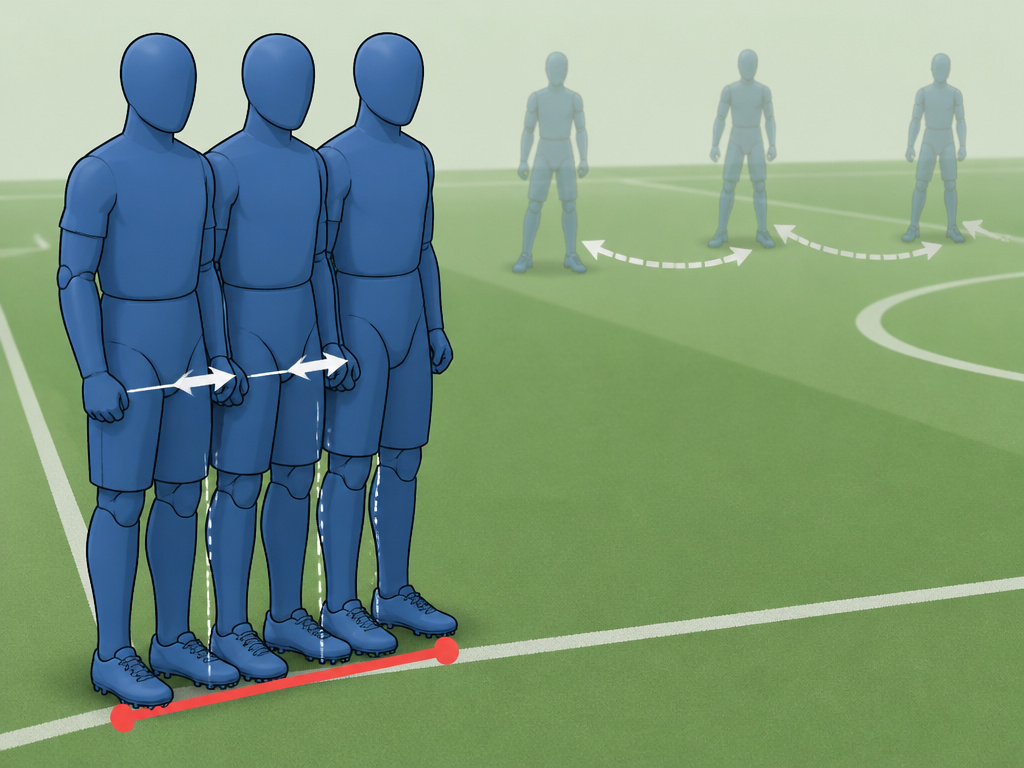
While modern analysis uses complex metrics, the core idea of shrinking space is timeless. Early tactical systems often featured large gaps between lines. The evolution towards compactness accelerated as teams sought to control the pitch without the ball. A key moment was FIFA’s 2018 World Cup report, which noted an average distance of just 26 metres between a team’s deepest defender and highest attacker when out of possession. This highlighted a tournament-wide trend towards tighter vertical blocks. The principle remains constant: a cohesive unit moving together to deny space, whether defending high or deep on the pitch.
Formations That Naturally Create Compactness
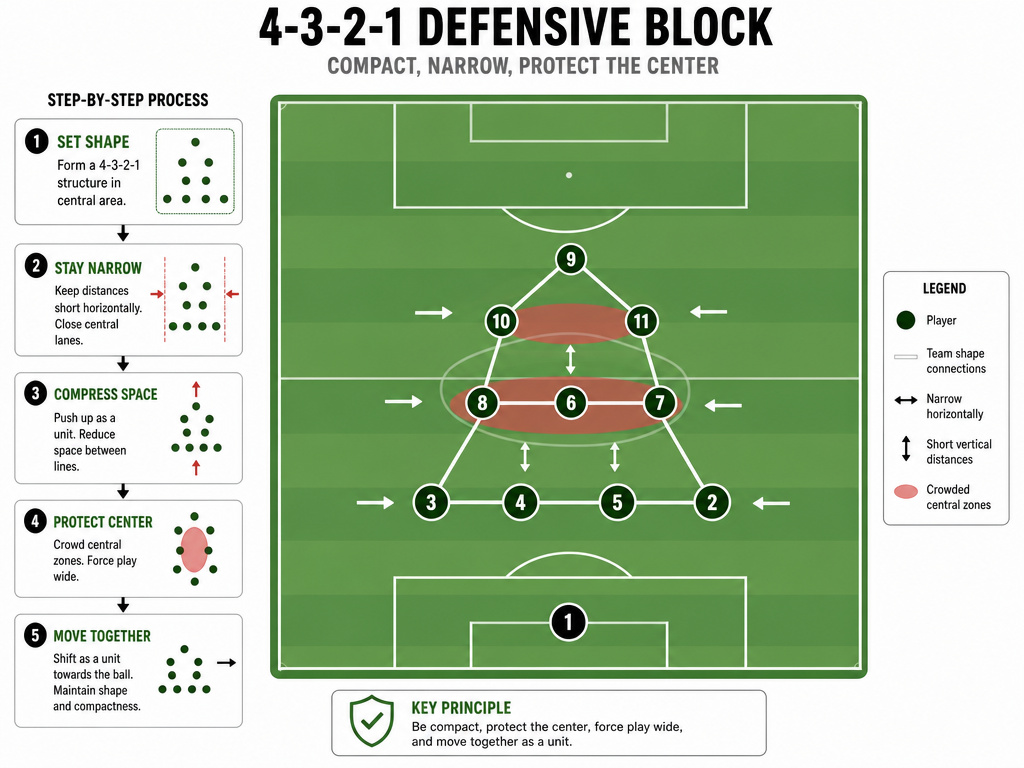
Certain team shapes inherently promote a tight defensive block. Formations with a clear central spine and connected lines, like a 4-3-2-1 or a 4-4-1-1, naturally reduce the distances between defenders, midfielders, and forwards. The key is not the formation number itself, but how the players within it move as one unit off the ball. Coaches using these systems often instruct their blocks to be narrow enough that the two widest players could cover the width of the penalty area. This prioritizes central density, forcing play into crowded areas where interceptions are more likely.
Frequently Asked Questions
What does compactness mean in football?
In football defending, compactness means your team reduces the space available to the opposition by keeping short distances between players, both from front to back (vertical) and from side to side (horizontal). It’s about the team moving as one connected unit to deny passing lanes and space in dangerous areas.
Is more compactness always better?
No. Excessive compactness can make a team too narrow and vulnerable to switches of play to the far wing. It can also leave too much space in behind the defensive line if the block is too high. The aim is a balanced compactness that denies central space while being able to shift wide to cover crosses. It’s a tool, not an absolute.
What are the 4 D’s (or 5 D’s) of defending?
The “D’s” are common coaching mnemonics for defensive principles. They often include: Delay (slowing down the attacker), Deny (blocking passing/shooting lanes), Dictate (forcing the attacker where you want them), and Defend (engaging to win the ball). Sometimes a fifth, Dispossess, is added. Compactness is the foundation that makes Delay and Deny possible.
Can a team be compact while attacking?
Absolutely. This is the principle of “rest defence.” Even when in possession, a team maintains a compact and balanced shape (e.g., a 2-3-5 formation) so that if they lose the ball, they are instantly in a structured defensive position, not stretched and vulnerable to a counter-attack.
The Real Gap
So forget the universal 35-metre rule. The Forcher et al. Study suggests that for elite teams, whole-team distance may not be the key differentiator. The magic isn’t in the grand average; it’s in the frantic, local geometry of the five players nearest the ball.
That’s the shift. You drill the overall shape so it’s a habit, a default. But you train the triggers, the backward pass that means step up, the wide pass that means slide as one, the first touch of an opponent’s midfielder that means two of your players converge. That’s where compactness lives. That’s where games are won.
The best teams aren’t just compact. They are compact where it counts, the moment it counts. Everything else is just a pretty shape on a whiteboard.
