
Zonal Marking vs Man Marking in Football: How to Spot Them
This post contains affiliate links. As an Amazon Associate, we earn from qualifying purchases.
Zonal marking is a defensive system where each defender covers a specific area of the pitch, while man-to-man marking assigns a defender to track a specific opponent. For most top teams in open play, zonal marking is the dominant system because it holds team shape better against quick passing. Many sources indicate most modern teams use a hybrid, blending zonal structure with specific man-marking assignments on key threats or at set-pieces.
The shape a team holds without the ball is what decides matches. It’s the quiet moments that decide matches, the half-second where a midfielder checks his shoulder to see if his cover is there. The choice between zonal marking vs man marking in football is the foundation of that shape.
What follows is a breakdown of how each system works, where it fails, and the practical reality you’ll see on a Saturday afternoon, where almost nobody plays a pure version of either anymore.
Key Takeaways
- Zonal marking dominates modern open play because it maintains team shape and compactness, essential against teams that move the ball quickly between the lines.
- Pure man-marking is less common at the elite level in open play but is still used to neutralize a specific superstar or, more commonly, when defending set-pieces like corners.
- The most common system is a hybrid. Most teams use a zonal base in open play, with one or two defenders given man-marking duties on a dangerous opponent.
- Communication is essential in a zonal system. The moment an attacker moves between zones, the “hand-off”, is where most zonal defenses break down.
- Your formation can influence your marking. Teams using a 4-4-2 usually operate a zonal marking system, while formations with a sweeper do not, and systems like a 3-5-2 often use a mixture.
The Core Difference: A Simple Analogy
Think of your garden. Zonal marking is like assigning someone to weed a specific flower bed. They stay in their patch, pull any weed that appears there, and trust their neighbor to handle the next bed over. Man-marking is like assigning that person to follow a single, particularly invasive weed wherever it goes, across the lawn, through the vegetable patch, even if it means leaving their own area a mess.
In football terms, a zonal defender’s position is dictated by the team’s shape. A man-marker’s position is dictated by their opponent’s run.
Zonal marking is a system where each defender covers a specific area of the pitch rather than a specific opponent. Man-to-man marking is a defensive strategy where defenders are assigned a specific opposition player to mark. These are the textbook definitions from tactical guides.
The practical difference is what happens when the ball moves. A zonal back four slides across the pitch as a unit. A man-marking back four can get stretched and twisted if the attackers make clever, criss-crossing runs.
Why Zonal Marking Took Over (And Its Weak Spots)
Here’s the thing about the game: football got faster. Coaches like Arrigo Sacchi in the late 80s showed that a perfectly coordinated zonal block could suffocate space more effectively than individual battles. The evidence includes data such as from the 2004 UEFA Champions League knockout stages, where 15 of the 16 teams used zonal marking.
The strengths of zonal marking include maintaining team shape and compactness, consistency, and flexibility, making it hard for the opposition to play through. When you win the ball back, players are often in position to start an attack.
Commonly cited weaknesses of zonal marking include the moment of the hand-off between zones and vulnerability to individual brilliance. It can also be challenging to apply at set pieces and during high pressing.
| Zonal Marking: Pros & Cons | The Advantage | The Risk If It Fails |
|---|---|---|
| Team Shape | Holds compact lines, covers passing lanes. | Attackers find “pockets” between zones. |
| Transition to Attack | Players are in position after regaining possession. | Slow to react to unpredictable individual runs. |
| Ease of Coaching | Consistent shape is easier to drill. | Communication breakdowns cause major gaps. |
Where Man-Marking Survives (And Why It “Died”)
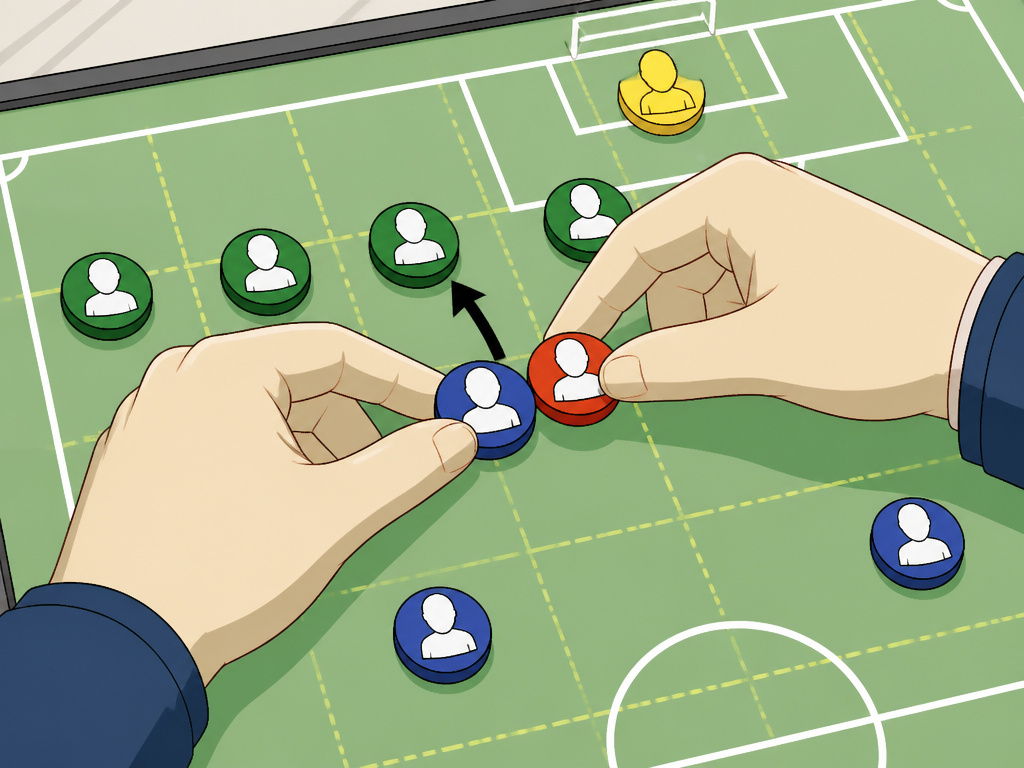
Man-marking wasn’t always the underdog. For most of football’s history, it was the default. It’s simple to explain: “You have him.” I’ve watched youth teams default to it because the instruction is so clear. Its great strength is the ability to completely nullify a single player. Think of Italy’s Claudio Gentile shadowing Diego Maradona in the 1982 World Cup.
A key flaw of strict man-marking is that it can be exploited by opposing teams with simple positional rotations, potentially creating gaps. However, a flexible variant exists where defenders may pass their mark to a teammate in certain areas.
Where this goes sideways: A strict man-marker follows their opponent into a deep midfield position. This leaves a huge gap in the defensive line that an attacking midfielder or overlapping full-back can sprint into unchecked. The fix can be achieved quickly through coordinated passing.
Wikipedia notes man-marking has been supposedly dying out, but managers like Marcelo Bielsa and Guus Hiddink have used it in the 21st century. Its modern applications include set-pieces and specific marking jobs.
The Modern Reality: Hybrid Systems and Formations
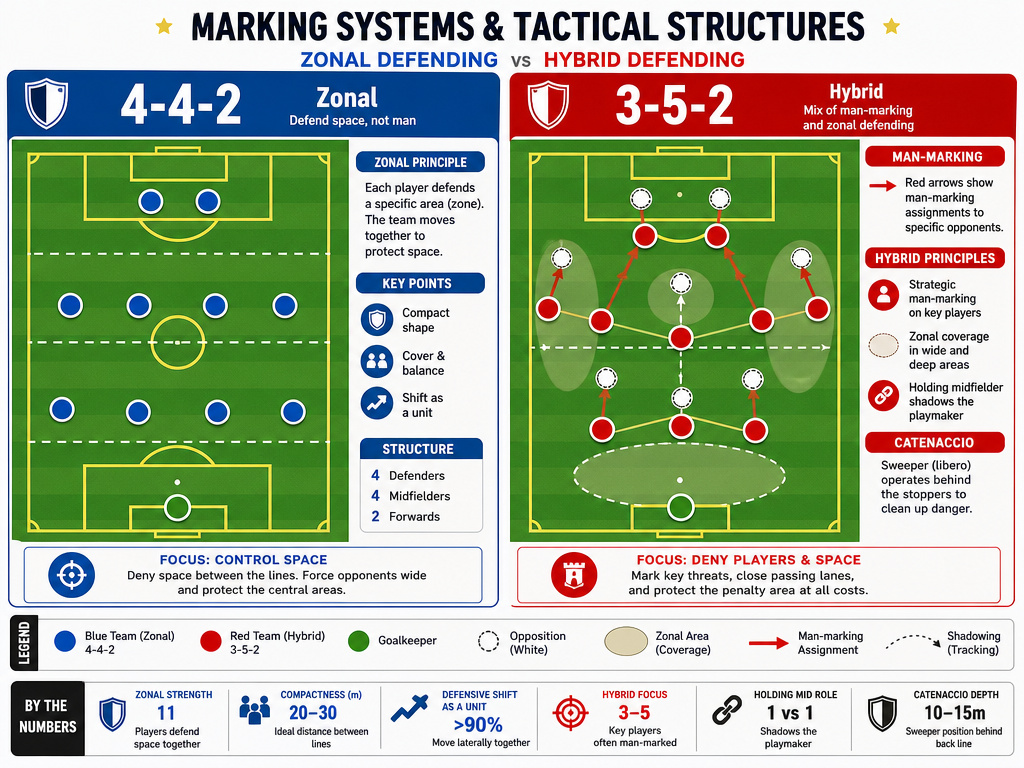
The binary debate around zonal marking vs man marking in football is mostly for pubs and pundits. On the pitch, the answer is almost always “both.” The Wikipedia entry on football marking notes that several modern formations use a mixture.
According to sources like Guide to Football, most top teams play a zonal system in open play. Then, they layer specific man-marking assignments on top. A holding midfielder might be told to stick to the opponent’s playmaker. A centre-back might follow a roaming false nine. This hybrid approach tries to get the structural stability of zonal with the individual security of a man-marker on the main threat.
Your formation heavily influences this mix. A classic 4-4-2 is almost designed for zonal marking; the two flat lines of four are easy to slide across the pitch. A 3-5-2 is different. As the Wikipedia man-marking definition explains, in a 3-5-2 that becomes a 5-3-2 in defence, you often have two stoppers marking man-to-man, a sweeper covering zones behind them, and wingbacks who have hybrid duties.
| Formation & Typical Marking System | Primary Method | Key Rationale |
|---|---|---|
| 4-4-2 / 4-3-3 | Predominantly Zonal | Flat lines are easy to move as a compact unit. |
| 3-5-2 / 5-3-2 | Hybrid (Man + Zonal) | Stoppers take men, sweeper covers space, wingbacks zone. |
| Catenaccio (Historical) | Man + Sweeper | Four strict man-markers with a zonal sweeper as insurance. |
How to Spot Which System a Team is Using
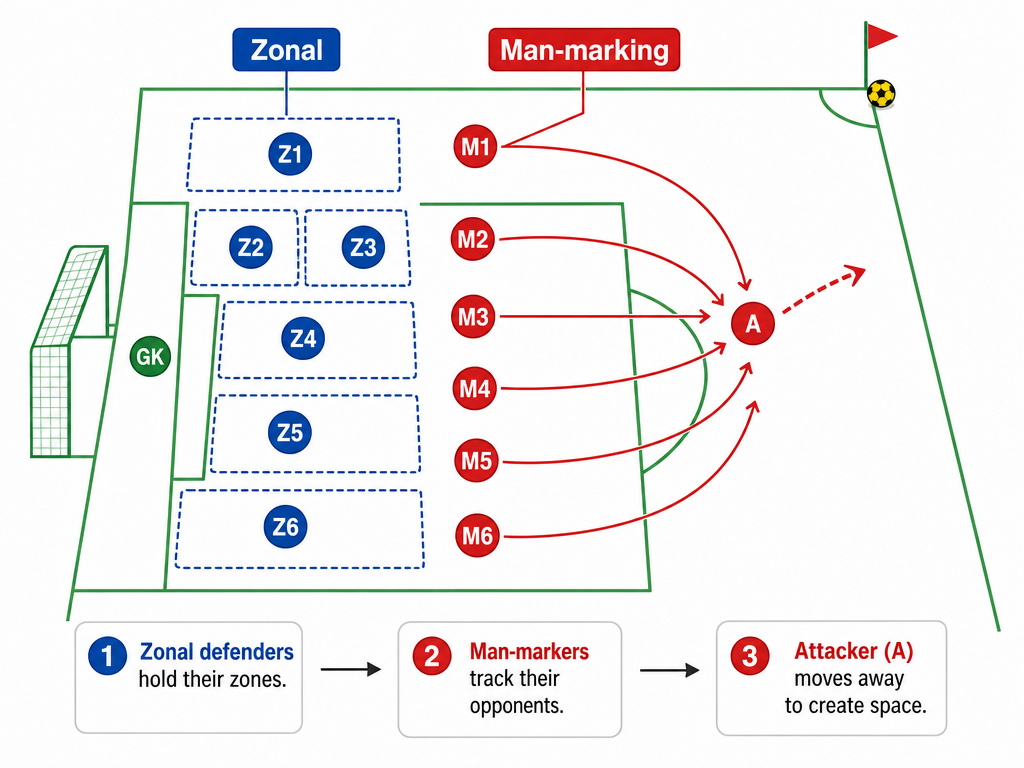
You don’t need a coaching badge. Watch for one simple thing: player movement when the ball is far away.
At a corner kick, it’s even clearer. Zonal defenders will take up static positions in specific spots in the penalty area. Man-markers will be tangled up with an attacker, following them as they make a move.
Common Mistakes Players Make (And How to Fix Them)
For players, the mistakes in each system are predictable. In a zonal system, the biggest error is ball-watching. A defender becomes fixated on the play and loses awareness of who is entering their zone from a blindside run. The fix is constant scanning and, more importantly, loud communication with the teammate in the next zone.
In a man-marking system, the classic mistake is following your man too far. A centre-back dragged into midfield leaves a fatal hole. The principle of maintaining cover and balance is the remedy here. Teammates must recognize the danger and shuffle across to cover the exposed space, while the marker knows when to hand the opponent over.
For coaches implementing these systems, understanding the core principles of team defense is the starting point. Drills for zonal marking must focus on shifting as a unit and communication drills for hand-offs. Man-marking drills need to work on recognizing when to stick and when to pass a player on, which is a core part of developing effective individual marking techniques.
Set-Pieces: The Marking Battleground
Sources disagree on the common approach at set-pieces: Wikipedia states most teams change to man marking in these situations, while Guide to Football notes many teams use a hybrid system when analyzing zonal marking vs man marking in football, with zonal coverage and specific man-markers. The reason is physical. In a crowded box, it’s harder to coordinate zonal hand-offs, and a free running attacker has a huge advantage over a static zonal defender.
A common solution is a hybrid. Many teams will set up with a zonal structure covering key areas and assign one or two dedicated man-markers to the opposition’s most dangerous aerial threats. This blends the space-coverage of zonal with the accountability of man. For a deeper dive on this specific tactical puzzle, our guide on zonal vs man marking for corners breaks down the pros and cons of each approach for set-piece defending.
The Bigger Picture: Marking in a Defensive Strategy
Marking doesn’t exist in a vacuum. It’s a component of a wider defensive strategy. A team that employs a high press might use more zonal principles, with each player responsible for pressing in a specific zone. A low block might mix more man-marking to ensure key creators are smothered.
The concept of rest defence, how a team is structured to defend immediately after losing possession, is also tied to marking. A zonal system naturally supports better rest defence, as players are already in a structured shape. A man-marking team can be more scattered after a turnover.
How to train zonal and man marking systems
Training zonal marking focuses on unit coordination. Drills should emphasize holding team shape, with defenders sliding across the pitch together in response to ball movement. Communication between players is very important. Practice scenarios where attackers rotate positions to train the hand-off moment between zones. For set pieces, a common drill places defenders in specific spots in the penalty area to defend their zone. Training man-marking is often easier to communicate. Drills start with assigning a specific opposition player to each defender, focusing on close tracking. To counter the flaw of being vulnerable to positional rotations, coaches can implement flexible man-marking rules, where a defender may pass their mark to a teammate in certain areas of the pitch.
Physical and mental demands on players
Man-marking places high physical demands on individual defenders, requiring the stamina and agility to track a specific opponent across the pitch. It can be mentally simpler to understand but demanding in concentration, as a single lapse can create a direct scoring chance. Zonal marking demands less long-distance running but requires greater collective mental discipline. Defenders must constantly scan the play, communicate with teammates, and make split-second decisions about when to engage an opponent entering their zone or when to pass them on. The system relies on players understanding spatial relationships and trusting their teammates to cover adjacent areas, which holds team shape better against quick-passing teams.
Frequently Asked Questions
How can you tell if a team is using zonal or man marking?
Watch the centre-backs when the ball is on the opposite flank. If they are holding a line and checking the space around them, it’s likely zonal. If one is consistently goal-side of a specific striker and mirroring their movements, even towards midfield, it’s man-marking. At corners, static defenders in zones indicate zonal; defenders tied to moving attackers indicate man.
What are the different types of marking in football?
The two primary types are zonal marking (defending an area) and man-to-man marking (defending a specific opponent). Most modern play involves a hybrid or “mixed” system, which blends both. Historical variants include “flexible man-marking,” where a defender follows an opponent only until they enter a teammate’s zone.
Can you mix zone and man coverage in football?
Absolutely. This is the standard for most elite teams. The base defensive structure is zonal to maintain shape, but one or two players (e.g., a defensive midfielder on a playmaker) are given strict man-marking duties. This is also common at set-pieces, using zonal coverage of dangerous spaces with man-markers on key opponents.
Why do most teams use man-marking for corners?
It comes down to accountability and physical battles. In the crowded penalty area, it’s easier to assign a defender to stick with a specific attacker, preventing a free run and jump. Pure zonal marking at corners can leave defenders static and attackers with a momentum advantage, though many teams use a zonal-man hybrid.
Before You Go
For years, the question at the top level hasn’t been ‘zonal vs man’. It’s “what’s your zonal base, and where do you add the man-marking exceptions?” The default for controlling a game is zonal structure. The tool for stopping a single genius is a man-marker.
My own bias is for the organised chaos of a zonal block, the satisfaction of seeing a team move as one. But I’ll admit it: there’s still nothing as dramatic as watching a world-class defender win a personal, 90-minute duel against a world-class attacker. The game has room for both. Your team just needs to know when to use which.
