
Pressing Triggers in Football Explained: Six Cues to Watch
This post contains affiliate links. As an Amazon Associate, we earn from qualifying purchases.
A pressing trigger is a specific, pre-agreed cue that tells every player on a team to press the ball simultaneously. Sources list different numbers of common triggers; The Bench View Soccer identifies six main triggers, while the KiqIQ blog notes modern teams train 7+ distinct triggers. Without these shared signals, a press is just one player chasing and breaking the team shape.
That list is the shared vocabulary. The art comes from knowing which of those six to use, when, and how to set the opponent up to trigger them for you. Pressing triggers in football explained, it’s the core of running smarter, as a unit, at the exact moment the opposition is most vulnerable. Pressing isn’t about running more; it’s about running smarter, as a unit, at the exact moment the opposition is most vulnerable.
What follows is a walk through the triggers, the traps teams set, and the one tactical concept from chess that explains why a coordinated press feels like you’re always a step ahead. By the end, you’ll be able to watch any match and spot the precise second the defensive team decides to pounce.
Key Takeaways
- A pressing trigger is a shared cue, not a solo decision; it converts individual effort into a coordinated team action.
- Sources disagree on which trigger is most effective; The Bench View Soccer states the most reliably effective trigger is a wide player receiving near the touchline, while Touchline Notes calls a backward pass the most common pressing trigger.
- Sources give different timings for an ideal pressing event; The Bench View Soccer states it takes less than 6 seconds, while the KiqIQ blog cites Klopp’s 5-second rule to regain possession.
- A press without a trigger creates gaps; a coordinated press always involves at least four players moving together.
- Teams train these cues until they are muscle memory, not verbal commands during a match.
What Is a Pressing Trigger? (And Why “Together” is the Only Word That Matters)
A pressing trigger is a specific, pre-agreed cue that tells the whole team to press together at the same moment. Think of it as a silent alarm that goes off in every player’s head at the same time. When it fires, the players nearest the ball accelerate, and the players further away shift to cut passing lanes. The ball-carrier’s world suddenly shrinks.
The benchmark for success is tight. Research from a University of Groningen study shows that defensive pressure percentages for successful plays are 14.47% ± 16.82%. The entire sequence, spotting the cue, closing the space, winning the ball, should wrap up in under six seconds, a key detail in any pressing triggers in football explained. Any longer, and the attacking team has time to reorganize. You’re not just chasing; you’re executing a timed, collective maneuver.
The pressing trigger is not the press itself. It is the moment the press is allowed to start. A team that sprints at everything looks ferocious early and stretched later, because every charge that is not backed up opens a gap behind it.
Where does this go wrong? Constantly. You see it in youth matches and even pro games when one eager midfielder decides to hunt the ball alone. That player is now out of the defensive shape, and the opponent has a simple pass into the space they just vacated. The trigger is what stops that. It’s the agreement that says, “We all go together, or we don’t go at all.”
The Six Common Pressing Triggers (and How They Work)
Most elite teams build their system around a core set of six triggers. They might emphasize some over others, but these are the bread and butter. The key is that each one represents a moment of maximum vulnerability for the player on the ball.
| Trigger | The Cue | Why It Works |
|---|---|---|
| Goalkeeper Receives | The ball is passed back to the keeper. | The keeper’s options are immediately limited. A short pass is risky; a long kick is a 50/50 duel. |
| Backward Pass Under Pressure | A pass is played backwards towards a player’s own goal. | The receiver often has their back to play, needing an extra touch to turn and see options. |
| Long Ball in the Air | A lofted pass is played to a teammate. | The receiver must control the ball before playing, giving the pressing team a 1-2 second window to close in. |
| Poor First Touch | A heavy or bouncing touch pushes the ball away from the receiver. | That fraction of a second where the ball is out of their control is all the press needs. |
| Isolated Player | A player receives with no supporting teammate within easy passing range. | They must dribble, lose the ball, or attempt a risky long pass—all good outcomes for the press. |
| Wide Player Near Touchline | The ball is played to a fullback or winger close to the sideline. | The touchline acts as an extra defender, trapping the player. Pressing from two sides seals the trap. |
The wide trigger is arguably the most powerful. When the ball goes to a player near the touchline, they are effectively trapped between the pressing midfielder and the white line. Their passing options are cut in half. This isn’t luck; it’s the foundation of a pressing trap, which we’ll get to next.
You don’t need all six at once. Coaches often start with just one or two. The Bench View Soccer notes that youth and amateur coaches should begin with the goalkeeper trigger and the wide trigger, they’re the most teachable and give the clearest visual feedback in a pressing triggers in football explained.
Pressing Traps: Manufacturing the Trigger
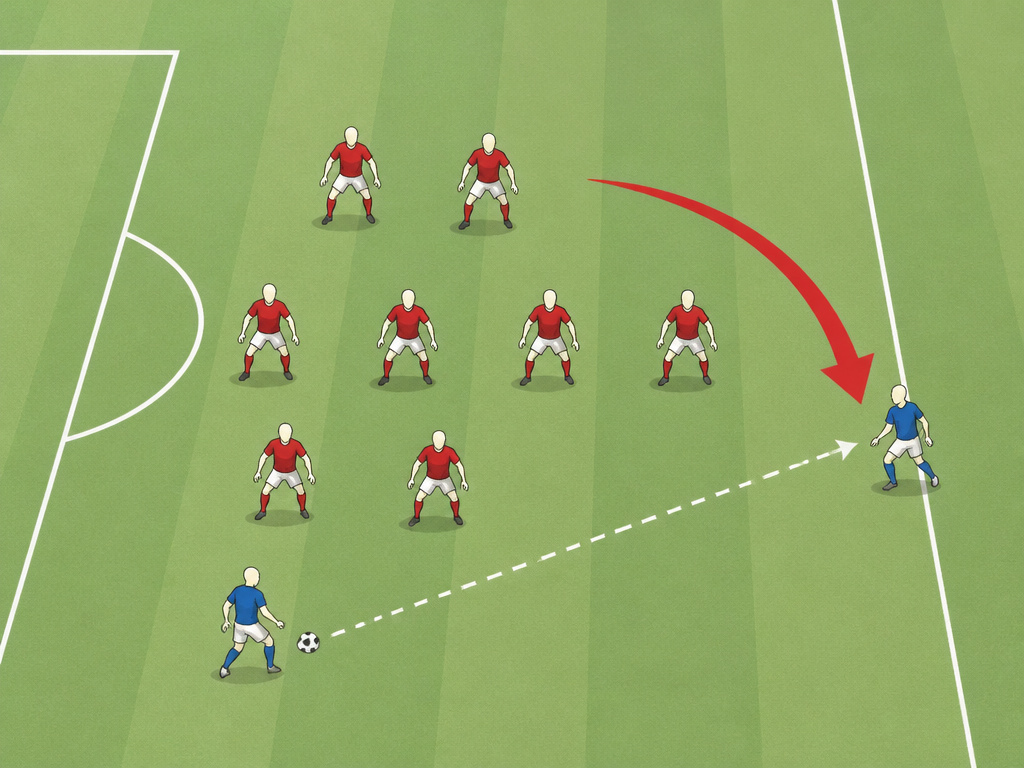
Teams don’t just wait for triggers to happen. They engineer them. This is the difference between reactive and proactive defending. A pressing trap is a deliberate setup where a team guides the opponent into a specific area of the pitch, knowing a trigger will fire the moment the ball arrives there.
The classic example is the wide channel trap. The pressing team will intentionally close all central passing options for the opponent’s center-back. The only “safe” outlet is a pass out to the fullback. The moment that pass is made, the wide pressing trigger activates. The fullback is caught in a vise.
Their compact 4-4-2 block is designed to funnel play wide, where they spring the trap. They don’t surprise anyone; they’re just better at executing the trap than most teams are at escaping it.
Common mistake: Pressing the player, not the pass. If you only pressure the ball-carrier and ignore the passing lane you just invited them to use, you’ve done their job for them.
The principle extends. A team might identify a slower player and use a pass to them as a pressing trigger. This is where proactive pressing, reading a player’s body and head position before they even receive, starts to blend with reactive triggers.
How Triggers Change by Position and System
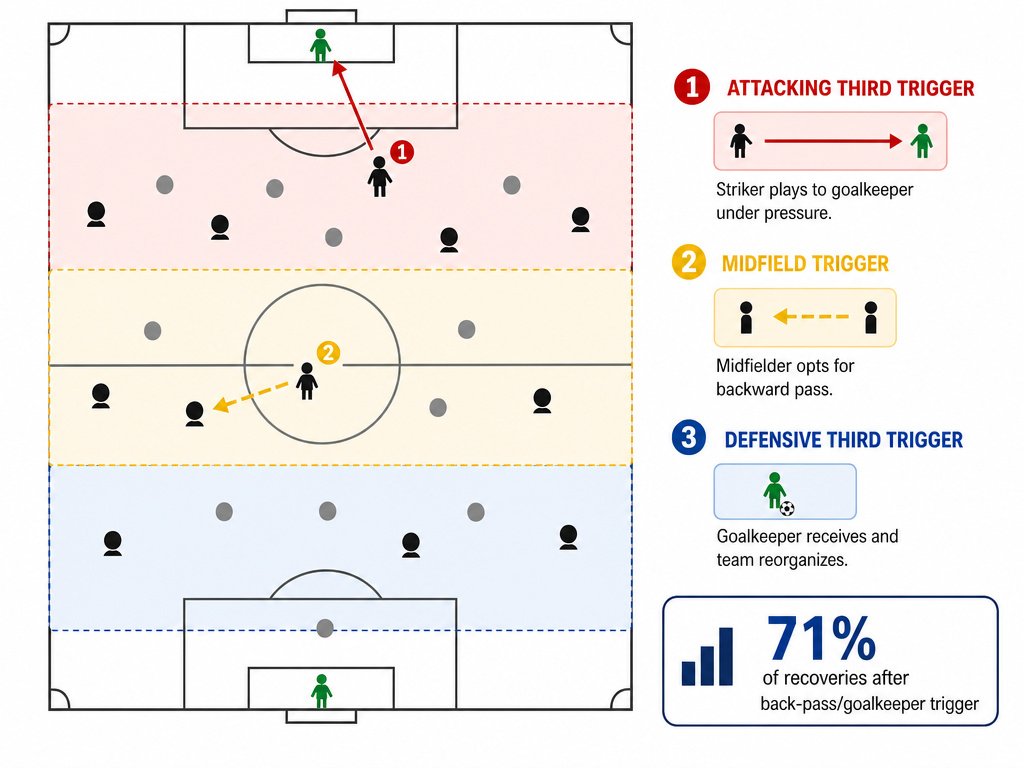
The cues a striker looks for are different from the ones a central midfielder watches. A forward pressing from the front might be solely focused on triggering a press when the goalkeeper or a center-back receives. A midfielder, however, is reading the space between lines and watching for triggers like a backward pass or an isolated opponent.
This is where the philosophical split between managers becomes clear. Philosophies on when to press vary; some systems, like Klopp’s gegenpressing, treat every loss of possession as an implicit trigger to regain the ball within seconds, while others, like Guardiola’s, use selective triggers that vary by field position, scoreline, and time.
A study cited by StatsBomb found that in Liverpool’s 2019-20 season, 71% of their defensive recoveries in the attacking third came following a back-pass or goalkeeper trigger.
When NOT to Press: The Critical “Off” Switch
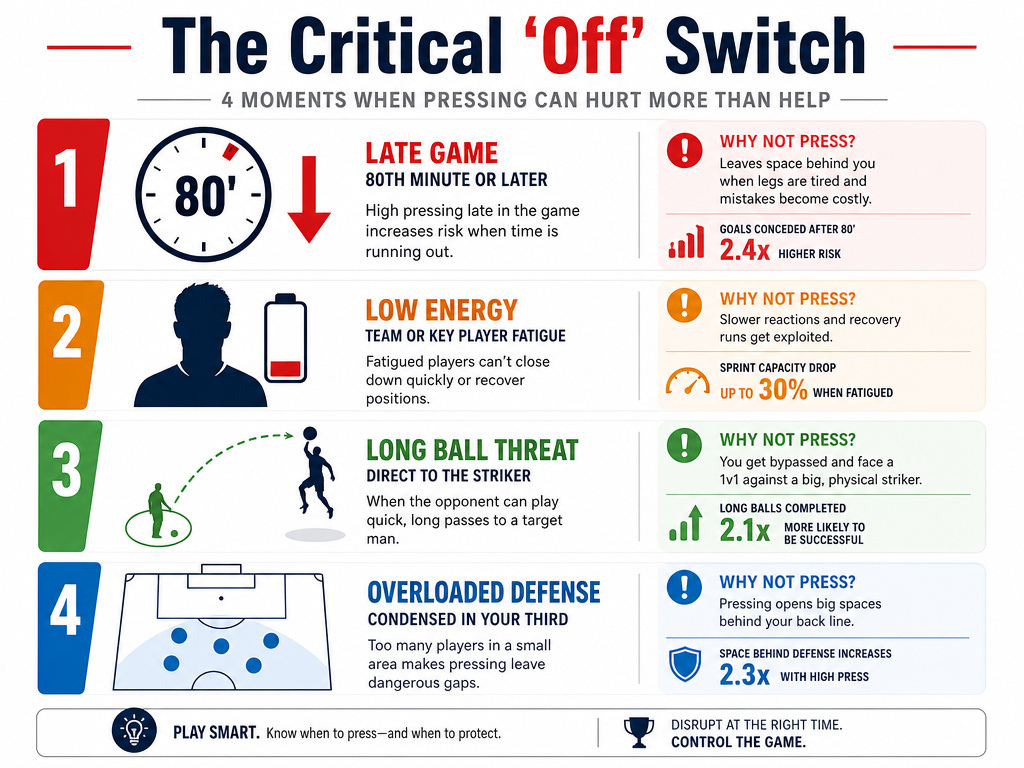
A team that presses every time it loses the ball risks exhaustion and vulnerability to counters. Knowing when to suspend the press is as vital as knowing when to trigger it. The KiqIQ blog outlines several key situations where pressing should be dialed back or turned off entirely:
- Late in a match when leading. Energy conservation becomes paramount. Switching to a compact mid-block preserves the lead.
- When overall team fitness is low. Fatigued players press slower and recover their positions slower, leaving massive gaps.
- When the opposition has a clear long-ball outlet. If the other team has a target striker who can win aerial duels, a high press just gives them space to hit.
- When your team is pinned deep in its own third. Trying to press from your own penalty area is energy-inefficient and leaves goal-scoring space behind you.
It’s also where triggers can break down. As Touchline Notes points out, the system assumes the whole team recognizes the cue simultaneously. This falls apart when players are tired, when substitutes haven’t learned the patterns, or when the opponent varies their build-up so the expected cue never appears.
Tempo: The Hidden Goal of Every Trigger
The game’s pressing tactic does more than regain possession. It’s about stealing the initiative. This is where the concept of tempo, borrowed from chess, becomes useful. In chess, you “gain a tempo” when you force your opponent to make a useless move, effectively earning an extra move for yourself.
In football, a coordinated press forces a backward or sideways pass. The opponent is now reacting to you instead of progressing their own plan. They’ve wasted a move. More importantly, by limiting their options, you allow your teammates to anticipate the next pass. A great press strings these tempos together, driving the attack backward until they either lose the ball or launch a desperate, low-percentage ball forward.
This is the ultimate payoff of trigger-based pressing. You’re not just defending; you’re dictating. You’re making the other team play the game you want them to play. A possession team might even use your triggers as bait, inviting the press only to play through it with a pre-rehearsed pattern, as noted by Touchline Notes. That’s the next level of the chess match.
Using body position as a pressing trigger
This is a form of proactive pressing, where defenders read the head and body position of the player in possession to force an error. A key cue is when a player in possession turns or faces towards their own goal. This body position limits their vision of the field ahead and slows down their next action. Seeing this, the pressing team collectively engages to close the space, knowing the opponent’s options are reduced.
Targeting a weak player as a pressing trigger
A pass to a specific opponent can act as a direct signal to press. Teams often identify a slower player or an isolated player. When the ball is played to that targeted individual, it activates the team’s press. The nearest defenders immediately converge to close them down, while others cut off their obvious passing lanes. The aim is to force that player into a hurried decision or a poor touch, creating the ideal moment to regain possession.
Frequently Asked Questions
What’s the difference between a pressing trigger and gegenpressing?
Pressing trigger is a specific cue (like a backward pass) that launches a coordinated press. Gegenpressing (or counter-pressing) is a philosophy that treats every loss of possession as an implicit trigger to win the ball back immediately, usually within 5 seconds. Gegenpressing uses triggers, but the trigger is universal and constant.
How many pressing triggers should a team use?
Sources differ on the number; The Bench View Soccer lists six main pressing triggers, while the KiqIQ blog states modern teams train 7+ distinct triggers. It’s better to master two or three (like the goalkeeper and wide triggers) than to implement six poorly. The triggers must be drilled into muscle memory through repetition on the training ground.
Can a team press without using triggers?
They can, but it’s inefficient and chaotic. Pressing without agreed triggers usually results in individual pressing, one player chases while teammates stay, which creates gaps and is easy for good opponents to play around. Trigger-based pressing is about collective, synchronized movement.
How do you coach pressing triggers?
Start in video sessions, identifying the triggers on screen. Then move to small-sided games on the pitch with rules: “Only press when the ball goes to the touchline.” Repetition is key. A key coaching challenge is teaching players the discipline to hold their shape and not press when a trigger hasn’t appeared.
What is PPDA and how does it relate to triggers?
Before You Go
The real test isn’t knowing the six triggers. It’s spotting the one that a team has decided not to use. Watch a match this weekend and ignore the ball for a moment. Watch the defensive shape. See how it contracts and expands. The entire defensive system is built on their recognition.
And if you see a player sprinting out of line while his teammates stand still, you’ll know exactly what’s gone wrong. The trigger never fired for them. The agreement was broken. Football is always more than the scoreline; it’s these silent, coordinated decisions that build the platform for everything that happens next.
