
Counter Attacking Football Tactics Explained: Step-by-Step
This post contains affiliate links. As an Amazon Associate, we earn from qualifying purchases.
A counter-attack in football is a direct, high-speed attacking transition immediately after regaining possession, designed to exploit the opposition’s disorganized defensive shape. Sources note it often leads to a numerical advantage.
The most effective ones start with a calm, deliberate defensive action, not a panicked clearance. A team defending deep by choice chooses its moment to spring, while a team forced back by pressure cannot. That distinction decides whether the next five seconds produce a chance or a turnover. This is the core of counter attacking football tactics explained.
What follows breaks down the principles, the exact phases, the players who make it work, and the common mistakes that turn a promising break into a wasted opportunity in our counter attacking football tactics explained. We’ll use data from 5,700 top-flight matches and FIFA’s own coaching framework to show why this style is brutally effective when executed with clarity.
Key Takeaways
- Counter-attacks are more efficient than positional attacks, a finding backed by analysis of thousands of top-flight matches.
- The critical mental shift is from defender to attacker immediately; hesitation here kills the move before it starts.
- Effective counters rely on width from wingers to stretch a retreating defence, creating the central space for a final pass or shot.
- While sources differ on the ideal starting point, success hinges on how you move it forward: as few touches as possible, at pace, into space.
- Adapting your counter-attacking trigger is key; what works against a high-pressing team fails against a side that sits deep in a low block.
What Defines a Counter-Attack (And Where Does It Start?)
The game allows for both because intent is more important than location. A counter-attacking team builds its entire setup around springing forward the moment the ball is won, whether that’s on the edge of the opposition’s box or the edge of its own. The opposite is a team that wins the ball and then slowly rebuilds possession from the back. The first is a counter; the second is just having the ball.
The core mechanism of the counter attacking football tactics explained is exploiting disorganization. When a team loses possession in attack, its players are out of their defensive positions. The counter-attack targets that moment with speed and directness, which often leads to a numerical advantage.
A counter-attack occurs when the defending team rapidly transitions from defence to offence. The nature of counter-attacks often allows for numerical superiority over the defence, leading to high-quality shooting opportunities.
This isn’t just theory. A peer-reviewed study in the Journal of Human Kinetics analyzed 5,700 matches from Europe’s top leagues and found counter-attacks were more efficient than positional attacks. They consistently led to better shots. The study also revealed the average efficiency of both positional and counter-attacks varied significantly by league: highest in Serie A, then the Premier League, then La Liga. This tells us the optimal execution of a counter is influenced by the tactical context of the competition you’re in.
The 5 Phases of a Successful Counter-Attack
Breaking the move into phases turns a chaotic burst into a coachable sequence. One detailed coaching playbook outlines five distinct steps.
1. Holding Defensive Shape
This is the foundation. The block must be compact, with clear distances between the lines (defence, midfield, attack). Crucially, this is a shape held by choice, not by necessity. A team passively pinned in its own box cannot counter; it can only clear. A team that has selected a deep engagement line, like the halfway line, is poised to spring. The mental discipline here is immense, every player must trust the shape and resist the urge to chase.
2. Identifying the Transition Trigger
The trigger is the event that signals “go.” It could be your centre-back cleanly intercepting a predictable cross. It could be your striker forcing a heavy touch from a receiving midfielder. It could be the opposition fullback pushing too high, leaving space behind. Players, especially those in central roles, must be drilled to recognize these triggers instantly. The game switches in that split second.
3. The First Pass
This is the most technically demanding moment. The player who wins the ball must already know his first pass before he controls it. The ball should be moved forward with as few touches as possible, and it needs to be moved at pace. A slow, controlled pass to a nearby fullback kills the transition. The target is usually a player facing forward, between the lines, or into the space behind the advancing opposition defence.
4. Running in Behind
While the first pass travels, players ahead of the ball must explode into space. This is where third-man runs from midfielders are devastating. The runner isn’t always the obvious pass; their movement pulls defenders away, creating space for the ball-carrier or another runner. Wide players are particularly crucial here to stretch the retreating defence horizontally, opening central channels.
Where this goes sideways: The ball-winner hesitates, looks up, and takes a settling touch. By then, the opposition’s midfield has recovered its shape, the passing lanes close, and the chance for a clean break is gone. It happens in three seconds.
5. Finishing the Chance
The final phase demands composure at high speed. The player receiving the ball in the final third has two main choices: drive towards goal if space permits, or play the early, decisive pass to a teammate in a better position. Greed or indecision here wastes all the previous work. The finish itself is often a first-time shot or a one-touch pass across goal.
Player Roles and Required Attributes
Not every player suits a counter-attacking system. Specific attributes are essential.
Centre-Backs & Defensive Midfielder: Their primary job is to win the ball cleanly, but their secondary, equally important role is to play the incisive first pass. They need excellent long-passing ability and the vision to spot the runner early. A defender who only wins tackles but then passes sideways is a dead end.
Wide Attackers (Wingers/Fullbacks): These are often the most important players in the counter. According to the FIFA Training Centre, they stretch the opposition. They need electric pace, the stamina to sprint 70 yards after tracking back, and the willingness to make unselfish runs that open space even if they don’t receive the ball.
Central Midfielders & Striker: Intelligence is key. The striker must often act as a link, checking towards the ball to receive and lay it off before spinning to attack the space behind, a move that commits two players to the attack instantly. Central midfielders must have the engine to support and arrive late in the box, but also the tactical sense to know when to hold and protect against the opponent’s potential counter.
| Position | Key Attribute | Role in the Counter |
|---|---|---|
| Ball-Winning Defender | Clean interception, long-passing | Triggers the move with first pass |
| Winger/Wide Forward | Extreme pace, stamina | Stretches defence, provides width |
| Central Striker | Link-play, off-the-ball runs | Draws defenders, creates space for others |
| Central Midfielder | Game intelligence, supporting runs | Makes third-man runs, provides passing option |
Effective Formations and Adjusting to Your Opponent
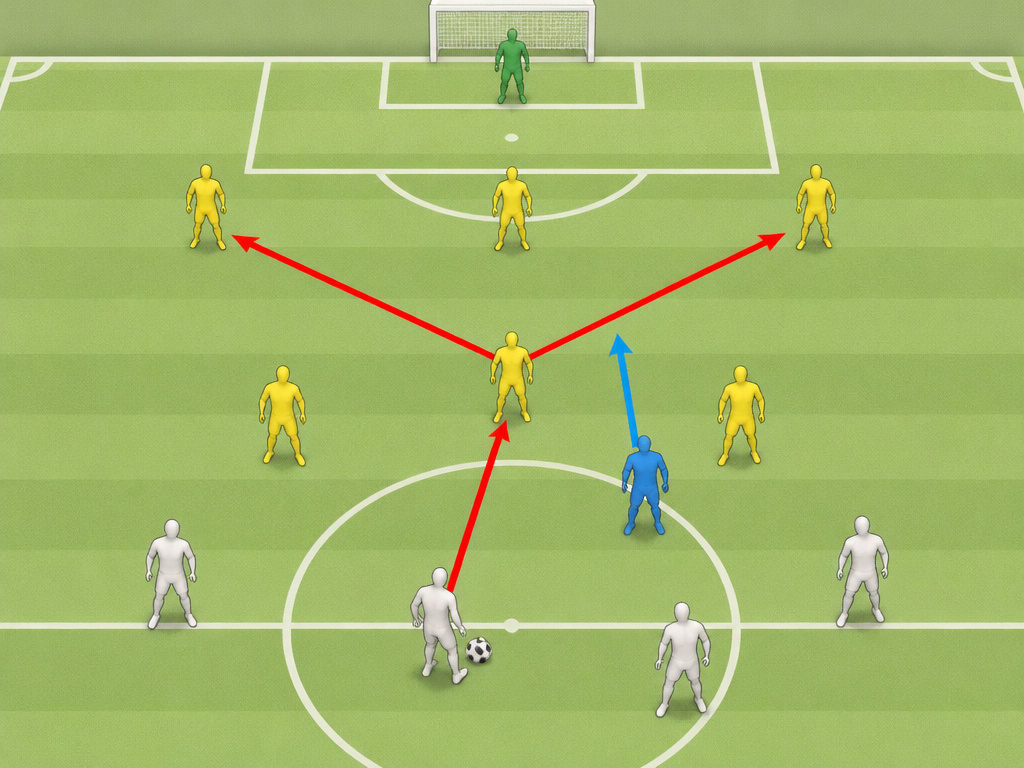
Some shapes naturally lend themselves to counters, but the best one depends on who you’re playing.
The classic 4-4-2 or 4-4-1-1 is a formidable counter-attacking platform. It provides two solid banks of four for defensive structure and two strikers to pin opposing centre-backs, creating natural passing outlets. The width comes from traditional wingers. It’s straightforward and effective, especially for teams that want to be compact and break quickly.
A 4-2-3-1 can be just as potent, with the “3” behind the striker all possessing pace and the ability to drive forward. The double pivot offers security to win the ball, and the attacking midfielder can be the key link between recovery and attack.
However, your formation must adapt. Using a high counter-press (or gegenpressing) to win the ball back is a valid trigger, but it’s high-risk. If the press is bypassed, your team is exposed. Against a possession-dominant team that pushes fullbacks high, a deep block and rapid break via the wings is effective. Against another team that also sits deep, the trigger changes; you might need to be more patient, win the ball in midfield, and break with more precision than raw pace.
This is where understanding rest defence, leaving players in position to stop a counter if your own attack breaks down, becomes a critical balancing act. Commit too many players forward on your counter, and you become vulnerable to the very tactic you’re employing.
Common Mistakes and How to Avoid Them
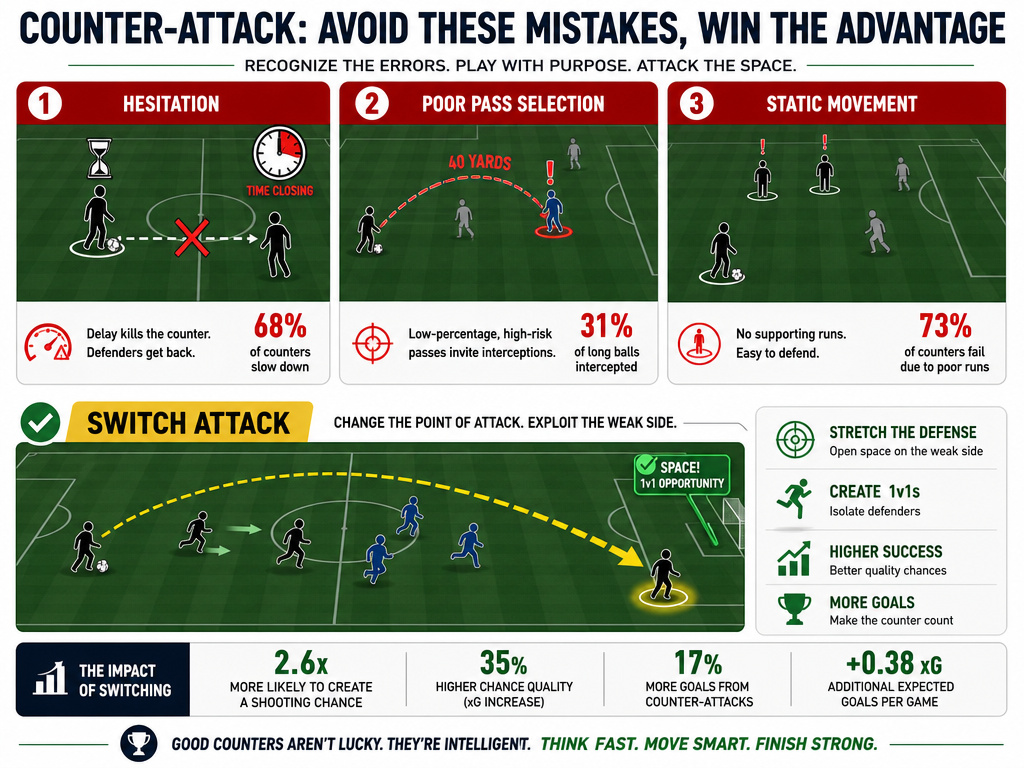
Most failed counters die from one of three errors.
Hesitation After Regaining Possession. This is the killer. The player on the ball takes an extra touch, looks up, and checks for the safe option. The window for a penetrating pass closes instantly. Drills should focus on one-touch or two-touch transitions, rewarding the fastest, most direct pass.
Poor Pass Selection. The first pass is everything. A 40-yard hopeful ball to a marked striker is a 50/50 turnover. A simple pass to the feet of a midfielder facing his own goal slows everything down. The pass must be to a player in space, facing forward, or into the path of a runner. This requires constant scanning before receiving the ball.
Lack of Coordinated Movement. One player breaks, but two others stay static. The runner is isolated, the passer has no options, and the move fizzles. Counter-attacking is a team sprint. It requires every player to understand their role in that moment: who runs in behind, who provides a short option, who hangs back for security. This only comes from repetitive pattern practice.
Common mistake: Failing to switch the point of attack. The entire break funnels down one crowded flank, ignoring the weak-side winger in acres of space. A single cross-field pass can destabilize an entire retreating defence.
The Psychological Shift and Training for It
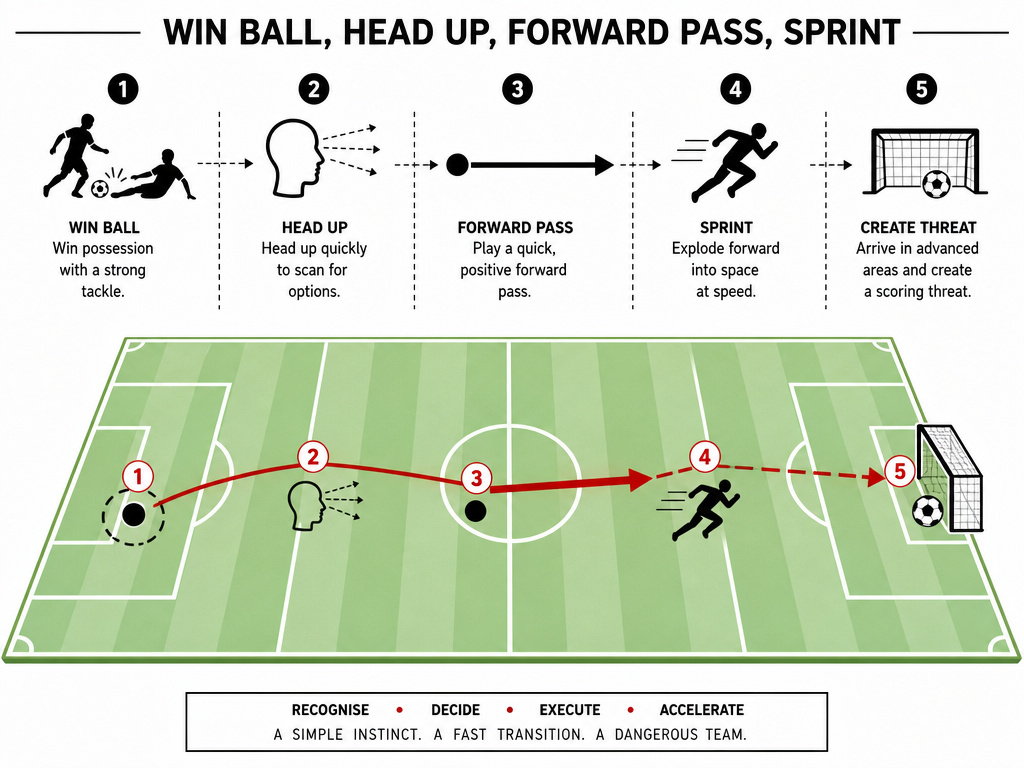
The hardest part of counter-attacking isn’t the technique; it’s the mindset. For 89 minutes, a team might be focused on disciplined, patient defending. Then, in one second, they must flip a switch to become daring, fast, attacking gamblers. That cognitive shift is immense.
Training must replicate this. Small-sided games with a “win the ball and score within 10 seconds” rule. Exercises where a goal only counts if it comes from a transition that starts in your own defensive third. The objective is to build the instinct: win ball, head up, forward pass, sprint.
It also requires a collective belief. Players must trust that if they make the run, the pass will come. And the passer must trust that the runner will be there. That trust is forged on the training ground, not in the 85th minute of a cup final.
| Training Drill Focus | Objective | Common Outcome if Skipped |
|---|---|---|
| Instant Transition Games | Builds the win-ball-and-go instinct | Players hesitate in matches, opting for safe possession |
| First-Pass Recognition | Develops scanning and forward vision | Slow, sideways passes allow opposition to regroup |
| Patterns of Running | Coordinates movement between units | Attacks break down due to isolation or overcrowding |
How to train counter attacking football
Training for counter-attacks focuses on rehearsing the rapid transition from winning the ball to creating a scoring chance. Drills should simulate the key phases: holding a defensive shape, identifying the trigger to win the ball, playing the first pass forward with minimal touches, and having players sprint into space. Emphasize pace and direct movement. Wide attackers are crucial in practice to stretch the play and create numerical advantages. Since counter-attacks are relatively uncomplicated to coach, sessions can be built around small-sided games that reward quick transitions after a turnover, ingraining the need for speed and support.
Are counter-attacks more effective than possession attacks?
A study analyzing 5,700 matches from Europe’s top leagues found that counter-attacks were more efficient than positional attacks. The average efficiency of attacks was highest in Serie A, followed by the Premier League, and then La Liga. The research, which classified teams as top, intermediate, or bottom based on league points, showed a clear hierarchy: top teams were significantly more efficient at counter-attacks than intermediate and bottom teams. This pattern was observed across all three major leagues.
Frequently Asked Questions
What is a good football formation for counter-attacks?
The 4-4-2 and 4-2-3-1 are often the most effective. The 4-4-2 offers natural width, two strikers to occupy defenders, and a solid defensive structure. The 4-2-3-1 provides a dynamic attacking trio behind a striker, all capable of carrying the ball at speed. The best choice depends on your players’ attributes and your opponent’s weaknesses.
How do you coach a team to counter-attack?
Start with the mindset: defend compactly by choice, not because you’re forced to. Then, drill the five phases in isolation: winning the ball cleanly, the immediate first pass, the supporting runs, and the finish. Use constrained small-sided games that reward quick transitions. Finally, build the collective trust that allows players to commit to the break without fear.
What’s the difference between a counter-attack and a normal attacking transition?
Counter-attack is a pre-meditated tactical strategy. The team’s shape and player roles are designed to exploit the moment of transition. A normal attacking transition is simply what happens when any team wins the ball back and goes forward, it’s more opportunistic and less drilled. A counter-attacking team practices its breaks as set plays.
Why are counter-attacks so effective?
They exploit the most vulnerable moment in football: the seconds after a team loses possession, when its players are out of defensive position and shape. By moving the ball forward with extreme speed and directness, the counter-attacking team creates numerical advantages and high-quality shots before the defence can reorganize. Data shows these shots are more efficient than those from slow possession play.
Can a possession-based team also be good at counter-attacking?
Absolutely. It’s a weapon, not an identity. Even possession-dominant teams like Manchester City or Bayern Munich will ruthlessly counter if the opponent overcommits and leaves space. The key is having players with the pace and decision-making to recognize the trigger and execute when the rare opportunity presents itself, while usually preferring a controlled build-up.
The Bottom Line
Counter-attacking isn’t a Plan B for underdogs. It’s a sharp, efficient, and statistically proven way to score goals at the highest level. Its beauty lies in its clarity: win the ball, move it forward, exploit the space.
The real art isn’t in the blinding pace or the killer final pass you see on the highlight reel. It’s in the quiet, disciplined minute before, the compact block held by choice, the defender scanning for his outlet before he even makes the tackle, the winger checking his shoulder to measure the space behind. Get those parts right, and the explosive break almost takes care of itself.
Everything changes, however, if your opponent also plays to counter. Then the game becomes a tense standoff, each side waiting for the other to overcommit. In those matches, the winner is often the team that can patiently provoke the mistake, then strike with the precision it has practiced a thousand times on the training ground. That’s when a tactic becomes a philosophy.
