
Positional Play in Football Explained
This post contains affiliate links. As an Amazon Associate, we earn from qualifying purchases.
Positional play, juego de posición in its original Spanish, is a way of organising a football team in possession. It prioritizes structured spacing over possession for its own sake, using the ball to move the opposition and create decisive spaces for progression and scoring.
That’s the textbook answer, which makes it sound like a sterile geometry problem. On a cold Tuesday night at the Etihad or the Camp Nou, it looks more like a series of gentle, inevitable shoves. A full-back tucks inside. A midfielder drifts wide. A striker drops deep. Each move pulls a defender an inch or two out of their line. After five of these shoves, a crack appears wide enough for a pass. That pass isn’t the magic. The five shoves were. This process is a perfect example of positional play in football explained.
This guide walks through the spaces, the shoves, and the system, serving as a positional play in football explained. This guide explains the most important zones, the three types of advantage to create, and why the system’s most important player often touches the ball the least.
Key Takeaways
- Sources differ on the main objective: some emphasize creating numerical superiority, others finding the ‘third man’, progressing toward goal, or targeting the half-space.
- The half-spaces (the channels between the full-back and centre-back) are the primary attacking corridors; getting the ball there forces the defense into a no-win decision.
- The Bench View Soccer describes the single holding midfielder (pivot) as the axis or most important player, but this is not presented as a universal demand by all sources.
- Sources describe the relationship differently: one states ‘tiki-taka was one expression of positional play rather than the whole of it,’ while another emphasizes ‘Positional Play is not tiki taka’ and should not be confused with it.
- Sources disagree on applicability to defense: some state it is strictly an in-possession philosophy, while others explicitly tie its principles to defensive organization and counter-pressing.
The Core Idea: Control Space, Not Just the Ball
Most people see a team passing the ball around and think “possession football,” which is a key part of positional play in football explained. They’re not wrong, but they’re missing the point. Positional play uses possession as a tool, not a goal. The real objective is to command the spaces on the pitch.
Positional play divides the pitch into a grid of zones, typically the central column, the two wide columns and the two intermediate ‘half-spaces’ between them. Players are positioned within these zones so that the team is well spread, with no two players in the same zone unless it is tactically necessary.
Think of it like tending a garden bed. You give each plant enough room to grow, and you pull weeds before they can crowd out the others. In football, the “weeds” are the gaps between your own defensive and midfield lines. Positional play is about maintaining that disciplined spacing so the opponent can’t find a foothold. When your team has the ball, that spacing creates clear, short passing lanes. When you lose it, your team is already in a compact shape to press and recover it.
The clearest line of descent runs from Total Football to modern positional play through Johan Cruyff. Cruyff imported the Dutch principles of spatial awareness and interchange to Barcelona, reshaping their youth academy, La Masia, around them. The players he influenced. Xavi, Andrés Iniesta, Pep Guardiola himself, would later become the standard-bearers.
Pep Guardiola’s Barcelona side of 2008 to 2012 is the most-referenced example of modern positional play. What made them iconic was the clarity with which they executed it: every player knew their zone, every pass had intent, and the moment they lost the ball, they swarmed to get it back. It looked effortless because the hard work, the positioning, was done before the ball arrived.
The Pitch Grid: Your Five Lanes and Three Zones
To understand where players are supposed to stand, you need to see the map they’re using. Modern positional play theory typically breaks the field down twice.
First, into five vertical lanes: the two wide lanes (touchlines), the two half-space lanes (between the full-back and centre-back), and the central lane. Each player is responsible for a primary lane, and they shouldn’t leave it unless a teammate rotates in to cover. This is why you see wingers stay painfully wide even when the ball is on the other side of the pitch, they are “stretching” the play, keeping the opponent’s defensive shape as broad as possible.
Second, into three horizontal zones: the defensive third (build-up), the middle third (progression), and the final third (creation). The objective is to have players in all five lanes across these zones, creating a web of passing options that a compact opposition can’t press all at once.
Sources differ on rigidity: some emphasize disciplined zoning with no two players in the same zone, while others stress creativity, freedom, and ‘no set positions, only shape and balance.’ If a right-back surges forward into the final third, a central midfielder might slide over to cover the right half-space lane behind them. This constant, coordinated rotation is what makes the system so hard to defend against, the markers keep changing.
Where this goes sideways: Crowding the ball side with five attackers. This kills the width and depth needed to switch play and exploit the space you’ve just worked so hard to create.
The Three Types of Superiority You’re Hunting
Sources differ on the number of superiorities: Guardiola’s staff focus on numerical, positional, and qualitative, while Paco Seirul·lo’s framework includes a fourth, socio-affective category. These are the concrete outcomes of all that careful positioning.
| Type of Superiority | What It Means | A Simple Example |
|---|---|---|
| Numerical | Having more players in a zone than the opponent. | A 3 versus 2 overload on the right flank. |
| Positional | Your players are in better, more advantageous positions (e.g., facing forward vs. The defender facing backward). | A midfielder receives between the lines, back to goal, with time to turn. |
| Qualitative | Your better player is isolated against a weaker opponent in a 1v1 duel. | A tricky winger 1-on-1 with a slower full-back. |
Sources differ on the exact categorization. Paco Seirul·lo’s framework includes a fourth, socio-affective superiority (team cohesion), while Guardiola’s staff typically focus on the three listed above. The disagreement is academic for most fans, the point is that the system is built to manufacture these mismatches.
The third-man principle is a core mechanism for achieving this. It’s a three-player passing sequence designed to bypass a single defender. Player A can’t pass directly to Player C because an opponent is in the way. So, A passes to Player B, who quickly relays to Player C, now in space. It’s a simple way to break a pressing line and create that momentary numerical or positional edge.
Teams employing positional play often prioritize patience. They circulate the ball, not to bore the crowd, but to draw the opposition out of their secure shape. A single lazy step by a defender is the trigger for a switch of play or a line-breaking pass.
The Pivot: The Axis Everything Rotates Around
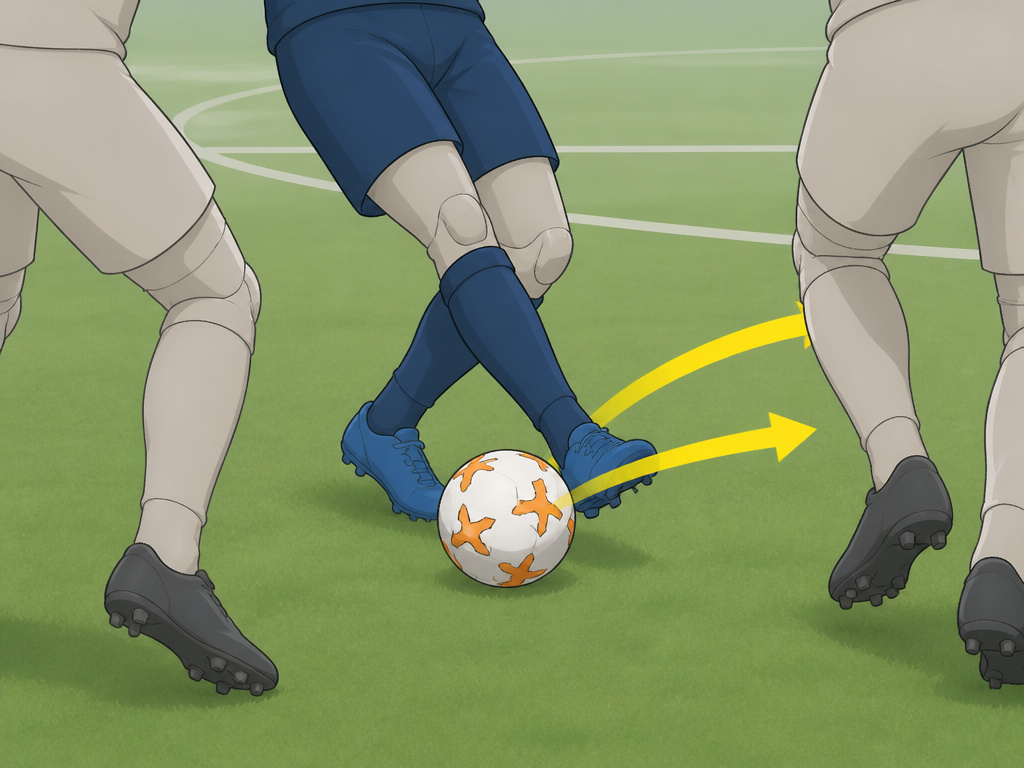
If you watch a Guardiola team and focus only on the player who scores, you’re missing the show. The single holding midfielder, the pivot, is the system’s most important cog. At Barcelona, it was Sergio Busquets. At Manchester City, it’s Rodri.
Their job is deceptively simple: be available. They position themselves between and behind the centre-backs to receive the ball, often under pressure. Their first touch is usually away from trouble, and their next pass is to the open side of the pitch. They are the metronome, the release valve, the player who turns a risky situation in defence into a controlled attack.
The part nobody mentions: The pivot’s most valuable contribution is often a five-yard pass you don’t even notice. It’s the pass that moves the pressing opponent just enough to open the lane for the decisive forward ball.
Without a press-resistant, tactically disciplined player in this role, the entire structure falters. The centre-backs have no secure outlet, the attacking midfielders have to drop too deep to get the ball, and the team becomes vulnerable on the counter. The pivot’s positioning also provides a natural shield for the defence, allowing the back line to hold a higher position.
Why the Half-Spaces Are the Final Destination
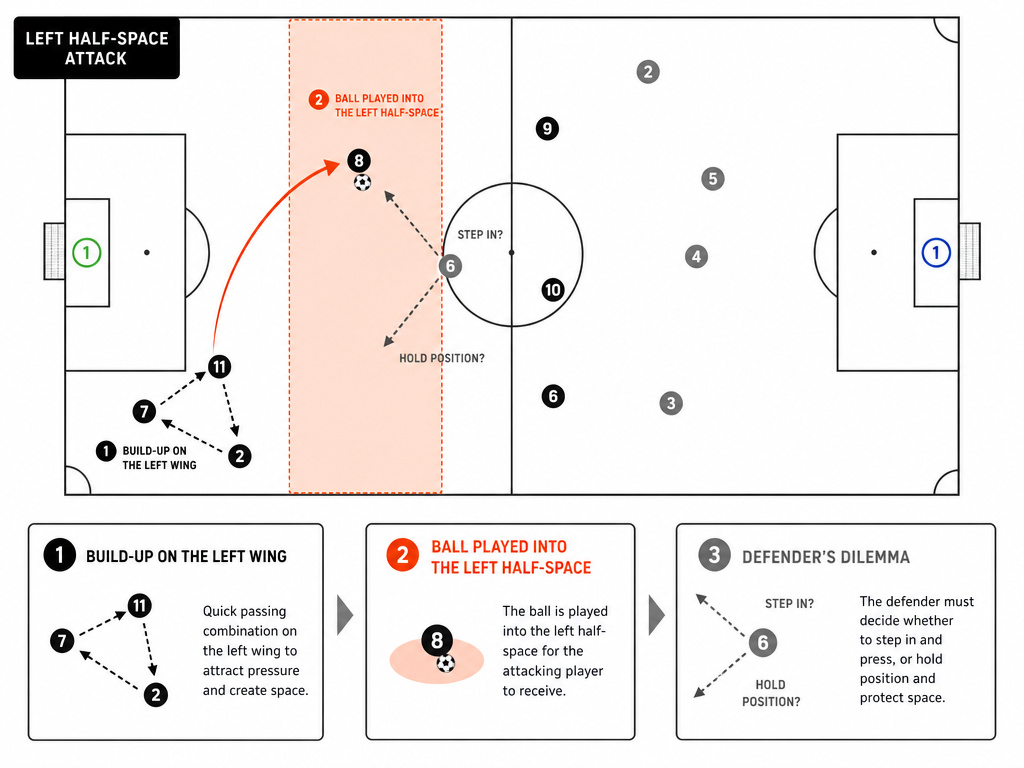
Every elaborate build-up, every patient passing sequence, every wide overload in positional play usually has the same target: getting the ball to a player in the half-space.
This is the vertical lane between the full-back and the centre-back. It is the most dangerous attacking corridor on the pitch. A player receiving there, think Kevin De Bruyne, Pedri, a young Thomas Müller, forces a defensive crisis.
If the centre-back steps out to engage, they leave the central striker unmarked. If the full-back tucks in, they leave the winger unmarked on the flank. If both hold their position, the half-space player has a clear shot or pass into the box. There is no good answer.
This is why so much of the play focuses on creating overloads on one side. It’s not to score from there. It’s to drag the entire defensive block over, overloading it to the point of rupture, so that a quick switch of play finds a teammate isolated and in space on the other side.
It’s a Defensive System, Too
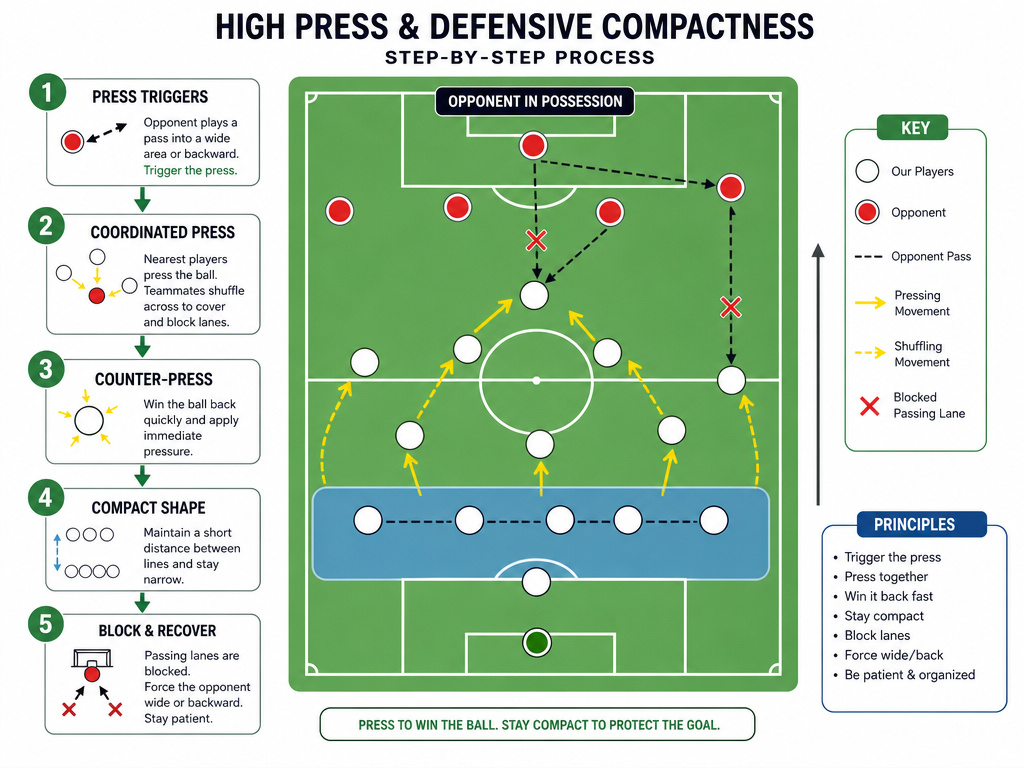
A common misconception is that positional play is only for when you have the ball. The research shows a clear disagreement here. Some sources, like Coaches’ Voice, state it’s strictly an in-possession philosophy. Others, including The Bench View Soccer and Football Coach 365, explicitly tie its principles to defensive organization and counter-pressing.
The practical evidence from top teams is decisive. Positional play requires coordinated pressing. The high, structured defensive line is a necessity to keep the team compact and close to the ball. When possession is lost, players don’t chase aimlessly. They press using specific triggers, a bad touch, a pass back to the goalkeeper, and they do it as a unit, cutting off all easy passing lanes.
This immediate counter-press is the system’s safety net. It wins the ball back in dangerous areas, and because the team’s shape in possession is already organized, they are perfectly positioned to launch the press the moment the ball turns over. The famous gegenpressing of Jürgen Klopp and the structured press of a Guardiola side are two sides of the same tactical coin: using organization to win the ball back quickly.
Positional Play vs. Tiki-Taka: What’s the Difference?
This is where semantics matter. Tiki-taka was one expression of positional play rather than the whole of it. The term emerged to describe the short-passing, possession-dominant style of Guardiola’s Barcelona and the great Spanish national team.
The crucial distinction is in intent. Tiki-taka can sometimes devolve into passing for passing’s sake, maintaining possession as an end in itself. Positional play uses possession as the means to a specific end: moving the opposition to create a scoring chance. Every pass has a job, even if that job is just to shift a defender two yards to the left.
Common mistake: Confusing a team that passes a lot with a team that plays positionally. The tell is in the spacing and the penetration. Are players standing in the same horizontal line? Are passes mostly sideways? That’s tiki-taka without the purpose.
Formations and the Teams That Use It
The formations that naturally lend themselves to positional play are those that create triangles and diamonds across the pitch. The 4-3-3 and 3-4-3 are the most common, as their base shapes provide natural connections between players in different lanes.
While Guardiola’s teams are the archetype, the principles have spread. Mikel Arteta’s Arsenal, Xavi’s Barcelona, and Xabi Alonso’s Bayer Leverkusen all use it as their tactical foundation. You can recognize it by the hallmarks: constant rotation, inverted full-backs, a single pivot, and that immediate, coordinated press upon losing the ball.
An academic study of the Bundesliga provides a statistical snapshot of what winning teams using these principles do. Winning teams in the Bundesliga tend to approach the first half of the game by expanding the field during the offensive phase (evidenced by a higher offensive width and stretching index). They also press high in defense and, in the second half, exert control by concentrating players near the ball. It’s a blueprint for using space to dominate.
How does positional play manipulate the opposition?
Positional play uses ball possession as a deliberate tool to control the opponent’s movement. The core idea is to control space, not just the ball. Teams prioritize patience, circulating the ball to draw the opposition out of their defensive shape. By making the pitch as big as possible and positioning players in specific zones, they stretch the defense. This manipulation creates the spaces and numerical advantages the system seeks to exploit. The ultimate goal is progression toward the opponent’s goal, and moving defenders is the primary method to achieve it.
Frequently Asked Questions
What is positional play in football?
Positional play (juego de posición) is a tactical system where players occupy specific zones on a vertically and horizontally divided pitch. The aim is to create structured spacing that allows for easy, progressive passing and to generate numerical, positional, or qualitative advantages over the opposition to create scoring chances.
What’s the difference between positional play and tiki-taka?
Tiki-taka is a style of play characterized by short, quick passing to maintain possession. Positional play is the broader tactical philosophy that uses structured positioning and possession as a tool to manipulate opponents and create space. Tiki-taka can be a manifestation of positional play, but not all positional play is tiki-taka.
How do you tell if a team is using positional play?
Look for a disciplined, wide shape in possession with players in all vertical lanes, a single defensive midfielder (pivot) orchestrating play from deep, constant rotation of positions, and an immediate, coordinated team press upon losing the ball.
Can any team play positional play?
In theory, yes. In practice, it requires players with high technical ability, tactical intelligence, and discipline. Specifically, it needs a press-resistant pivot, players comfortable receiving between lines, and wingers who understand their role in maintaining width. Without these profiles, the system easily breaks down.
The Bottom Line
Positional play isn’t a magic formula. It’s a logical, space-focused framework for organising a football team. It argues that controlling where your players stand is more important than how much they touch the ball.
The next time you watch a match, don’t just follow the ball. Watch the spaces. Watch the weak-side winger holding his width. Watch the defensive midfielder constantly checking his shoulder. Watch for the moment a midfielder’s run pulls a centre-back out of the back line. That’s the game within the game. The pass that splits the defence is just the final, visible product of a dozen invisible, intelligent shoves.
It turns football from a chaotic battle into a game of chess played at a sprint. And once you see the board, you can’t unsee it.
