
3-4-3 Formation Pros and Cons: The High-Wire Balance
This post contains affiliate links. As an Amazon Associate, we earn from qualifying purchases.
The 3-4-3 soccer formation uses three central defenders and a double-pivot midfield, creating a balanced 5-attacker/5-defender structure. Its core strengths are attacking overloads and a secure central defence, while its main weaknesses are vulnerability to wide counter-attacks and immense physical demands on the wing-backs. For most teams, its success hinges entirely on having players who fit those specific, demanding roles.
That 5-5 split isn’t just a theory—it’s the mechanism that makes the system tick. Five players commit forward, while the other five cover behind them. The shape thrives on creating numerical advantages: an extra attacker upfront, an extra defender at the back. But for every advantage it engineers, the formation carves out a specific, exploitable space for the opposition.
What follows is a walk through the gears of the 3-4-3, including a detailed look at the 3-4-3 formation pros and cons. We’ll look at the player profiles it needs, the exact moments it becomes thin, the coaches who have bet their reputations on it, and how it stacks up against the formations it most often faces. By the end, you’ll know not just what the numbers mean, but where the real battles are won and lost on the pitch.
Key Takeaways
- The system’s structure commits five outfield players to attacks, while the other five cover underneath and focus more on defending, but this balance is precarious and shifts constantly with possession.
- A single weak or fatigued wing-back can collapse the entire shape, making the role the most physically demanding in modern football.
- The formation is chronically vulnerable in wide areas on the counter because three defenders must cover the full width of the pitch when wing-backs are caught upfield.
- The 3-4-2-1, a common variant, saw a major surge in the Premier League, jumping from 71 uses in 2023-24 to 117 in 2024-25, indicating a renewed tactical trend.
- Compared to the similar back-three 3-5-2, the 3-4-3 trades a central midfielder for an extra attacker, sacrificing midfield control for greater pressing and offensive power.
What the 3-4-3 Formation Actually Is
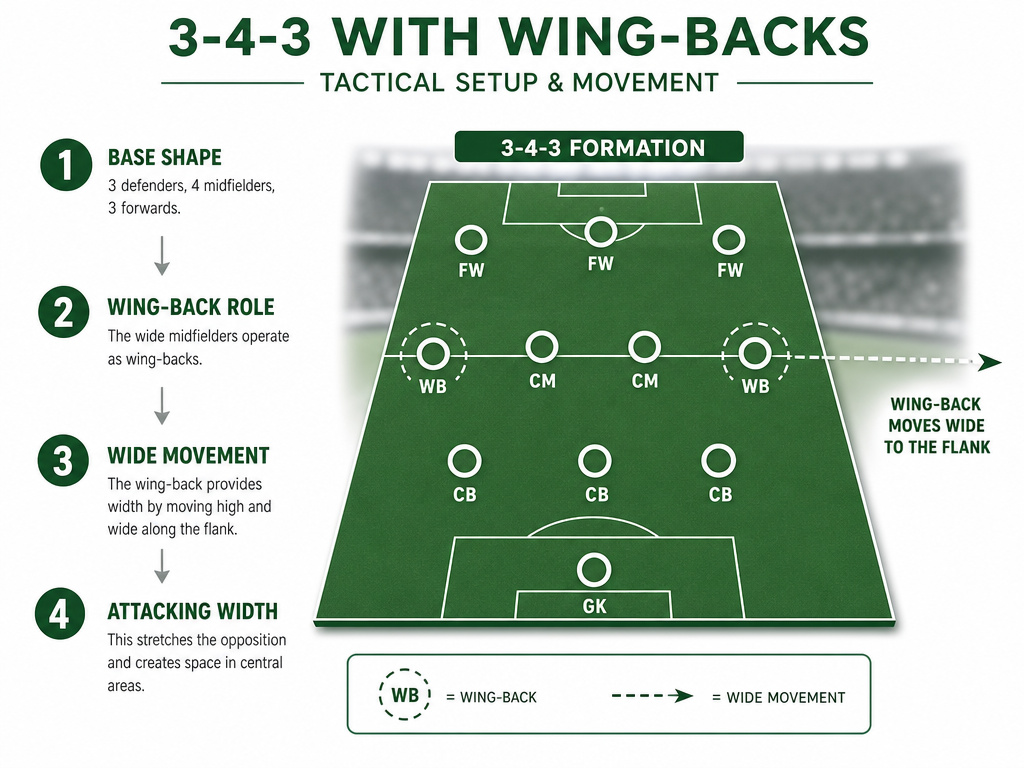
Forget the digits for a second. The 3-4-3 isn’t a fixed shape; it’s a starting point for controlled chaos. At its most basic, it fields three central defenders, two central midfielders (a double pivot), two wing-backs, and a front three.
The 3-4-3 is a formation that uses three central defenders and, ahead of them, a double pivot in central midfield. Two wing-backs provide attacking width, while a front line of three can line up in several different ways, most commonly as a 3-4-2-1 with two attacking midfielders behind a striker.
The front three is where the flexibility lives. It can be a flat line of two wingers and a centre-forward, but the modern preference is for a 3-4-2-1: a lone striker with two number 10s tucked in behind, operating in the half-spaces between the opposition’s defence and midfield. This creates the central overloads that proponents like Johan Cruyff believe solve the ‘waste of an attacking player’ issue of a back four.
Historically, the idea of a back three isn’t new. The old W-M formation from the early 20th century is cited as the first example of a back three being used consistently. Sources disagree on the origin of the modern 3-4-3: some say it evolved from Italy’s defensive 3-5-2, while others credit Johan Cruyff’s Barcelona ‘Dream Team’ with popularising it in the late 1980s and early 1990s. Teams there were comfortable with a defensive 3-5-2; pushing a midfielder higher and adding a forward created a more aggressive version. Johan Cruyff’s Barcelona ‘Dream Team’ of the late 80s and early 90s later popularised it, often morphing from a 4-3-3 into a 3-4-3 in possession.
Core Strengths and Advantages
The 3-4-3 sells itself on balance and overloads. It’s designed to give you more of what you want, where you want it.
Attacking with a Front Five
The system naturally creates a five-pronged attack. The front three, supported by the two advancing wing-backs, stretches defences horizontally and vertically. This is especially potent in the 3-4-2-1 setup, where the two attacking midfielders can receive the ball between the lines, turn, and combine with the overlapping wing-back and the striker. You get central penetration and wide overloads simultaneously.
A Solid Defensive Base
With three central defenders, teams have a numerical advantage against a standard two-striker attack. The extra centre-back also allows the wider defenders to step into midfield with less risk, knowing there’s cover behind. This facilitates build-up play from the back.
Fluidity and Pressing Power
The shape is fluid by design. It encourages positional rotation, especially between the wing-backs, wide forwards, and central midfielders. This unpredictability can disorganise defences. With three forwards already positioned high, the 3-4-3 is ideally set up for a coordinated high press. The wing-backs can jump on opposing full-backs, while the central trio cuts off passing lanes through the middle.
Key Weaknesses and Vulnerabilities
For every strength, the 3-4-3 has a corresponding soft spot. These aren’t minor flaws; they are structural trade-offs that opponents actively hunt.
The Relentless Wing-Back Dilemma
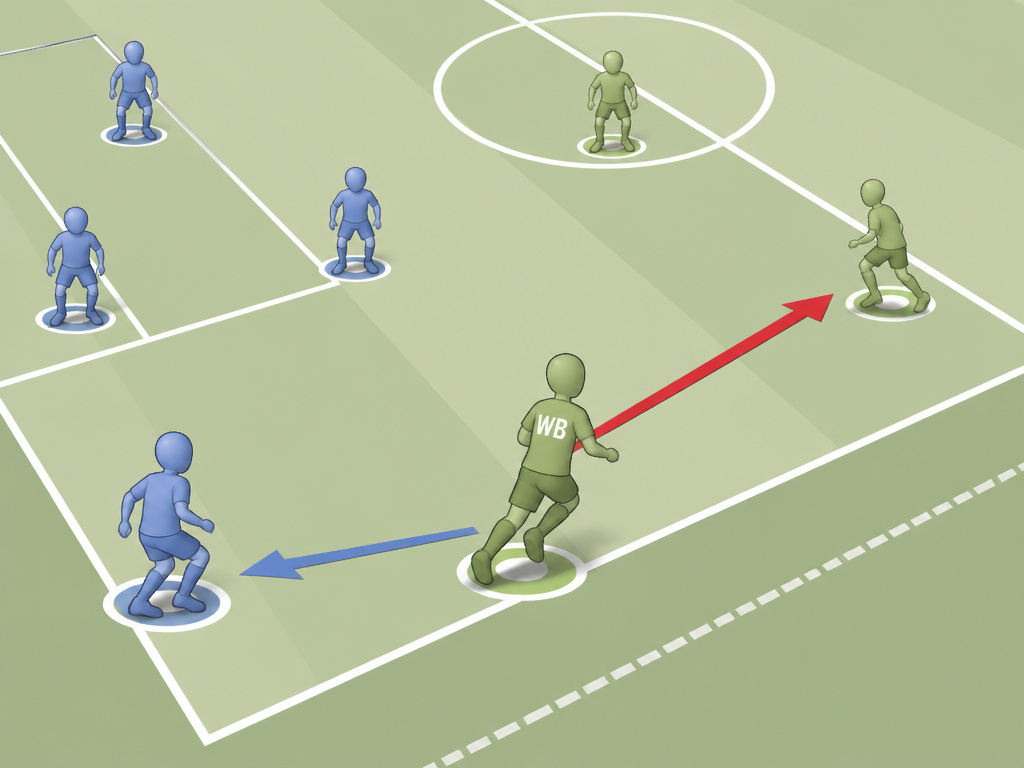
This is the system’s defining pressure point. The wing-backs are asked to be auxiliary wingers in attack and auxiliary full-backs in defence—for the full 90 minutes. If they tire or are caught upfield, the entire structure warps.
Where this goes sideways: One wing-back shirking a defensive recovery run. The back three gets stretched across the full width of the pitch, a single cross-field pass exploits the gap, and a 2v1 situation against the remaining centre-back unfolds within seconds.
The physical demand is so intense that it dictates squad building. You either need world-class athletes in those roles or a deep bench to rotate them.
The Thin Midfield Line
With only two central midfielders, the 3-4-3 is inherently vulnerable to being overrun in the middle of the park. A midfield three, like in a 4-3-3, can easily outnumber them. This is most acute during transitions, right after the team loses possession, when the two midfielders can be instantly isolated.
Exposed Flanks on the Counter
This is the most famous weakness. When the wing-backs commit forward, the three centre-backs must shuffle wide to cover the channels. It’s a lot of ground for three players. A quick switch of play or a direct ball into the space behind an advanced wing-back can launch a dangerous counter-attack before the defensive block can reset.
| Vulnerability | Cause | Consequence |
|---|---|---|
| Wide Counters | Wing-backs caught upfield, back three stretched. | Opposition creates 2v1 or 3v2 situations on the flanks. |
| Midfield Overload | Only two central midfielders vs. A midfield three. | Loss of control in the centre, easy progression for opponent. |
| Wing-Back Fatigue | Extreme physical demand over 90 minutes. | Defensive coverage drops, attacking width diminishes late in games. |
Player Roles and Required Profiles
You can’t just plug any eleven players into a 3-4-3 and expect it to work. The formation demands very specific skill sets. Miss one, and the whole machine grinds to a halt.
The Back Three: More Than Just Defenders
The central defender, often the sweeper, needs to be a distributor, comfortable stepping into midfield with the ball. The wider centre-backs must be agile enough to cover the channels when the wing-backs are forward. All three need to be excellent communicators to coordinate their shifts and squeezes.
The Double Pivot: Connectors and Shields
The two central midfielders are the engine room. One often sits deeper, protecting the defence and recycling possession. The other has more license to link with the attacking midfielders. Both need a high level of tactical discipline—they must know when to hold position and when to cover for a wing-back. A lack of coordination here leaves a canyon in front of the back three.
Why the Wing-Back Role is So Difficult
This isn’t just a position; it’s a job description for a superhero. The ideal wing-back possesses the pace and crossing ability of a winger combined with the tackling stamina and defensive awareness of a full-back. They must have the engine to make sixty-yard sprints repeatedly for the entire match. As noted by coaching analysts, these roles require players who are “speedy, hard-working, and have excellent stamina” because they “need to contribute at both ends of the pitch constantly throughout the 90 minutes.”
The Front Three: Interchangeability and Intelligence
The striker, whether a traditional target man or a false nine, must be able to hold up play and bring others into the game. The two attacking midfielders (or wide forwards) need to be creative, capable of playing in tight spaces, and willing to work back without the ball. Their movement between the lines is what breaks down stubborn defences.
Teams That Use the 3-4-3 Effectively
The formation’s credibility comes from a lineage of successful teams. It’s not a theoretical experiment; it’s a trophy-winning blueprint.
Antonio Conte’s Chelsea (2016-17)
After a rocky start with a back four, Conte switched to a 3-4-3 in September 2016. The result was a 13-game winning streak and a Premier League title. Victor Moses and Marcos Alonso, previously squad players, were unleashed as wing-backs, while N’Golo Kanté and Nemanja Matić formed an imperious double pivot. It was a masterclass in fitting players to a system.
Xabi Alonso’s Bayer Leverkusen (2023-24)
Alonso’s ‘invincible’ Bundesliga title-winning side was built on a 3-4-3 foundation. It emphasized short, quick passes through midfield and controlled possession, proving the system isn’t only for counter-attacking teams. His approach showed its versatility for proactive, possession-dominant football.
Rúben Amorim’s Sporting CP
The modern disciple of the system, Amorim has led Sporting to Portuguese titles with his unwavering 3-4-3 (often a 3-4-2-1). His philosophy is famously rigid: “there’s no plan B.” At Manchester United, he is now attempting to implement the same demanding, wing-back reliant system, a testament to his belief in its superiority.
Gian Piero Gasperini’s Atalanta
For years, Atalanta has been Serie A’s great entertainers with a high-risk, high-reward 3-4-3. Their game is based on relentless attacking, aggressive pressing, and fluid positional play, all powered by their wing-backs providing the team’s entire width.
How It Compares to Other Formations
The 3-4-3 doesn’t exist in a vacuum. Its value is often defined by how it matches up against common alternatives.
3-4-3 vs. 3-5-2
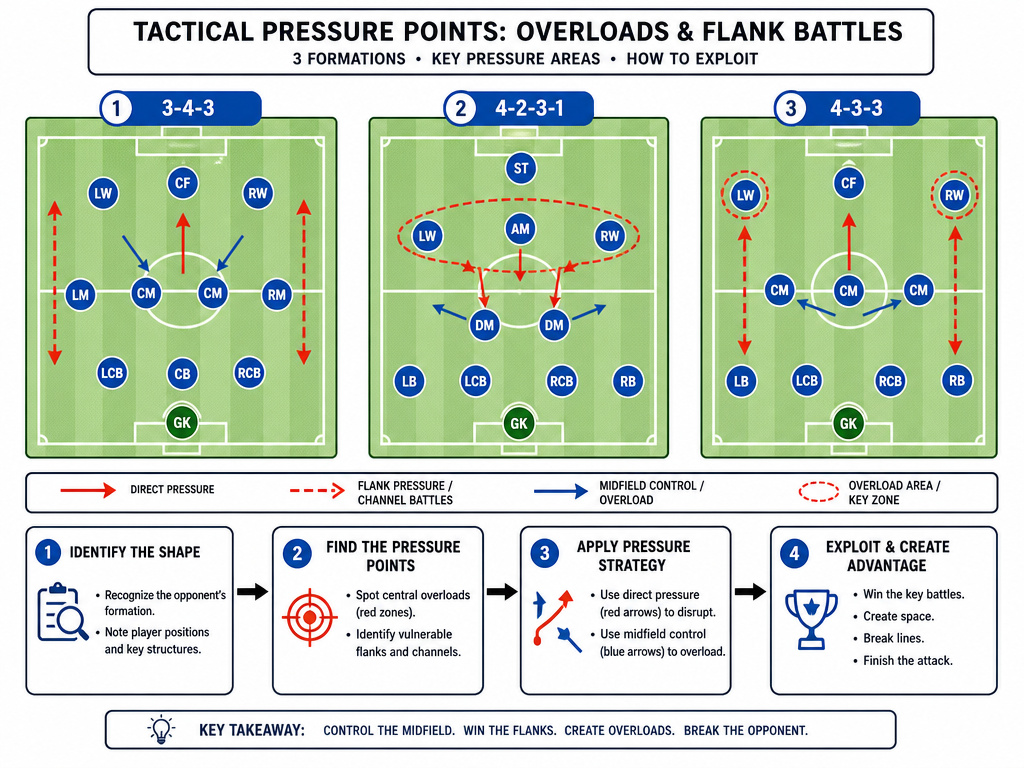
This is the closest comparison, as both use a back three and wing-backs. The difference is in the midfield and attack. The 3-5-2 uses three central midfielders and two strikers. The 3-4-3 sacrifices one of those midfielders for an extra attacker (a number 10). The trade-off is clear in the 3-4-3 formation pros and cons: it gains more pressing power and central attacking threat but accepts a thinner midfield that can be overrun.
3-4-3 vs. 4-2-3-1
When you compare a 3-4-3 formation pros and cons to a 4-2-3-1, note the latter is a very common formation—it was the primary shape for 13 of the 20 Premier League clubs in the 2024-25 season. This matchup is a fascinating duel. The 4-2-3-1’s strength is overloading the 3-4-3’s two-man midfield with its attacking midfielder and two wide playmakers. A well-executed 4-2-3-1 formation is often cited as one of the most effective ways to counter the 3-4-3, as it contests the centre while also having full-backs to engage the opposing wing-backs.
3-4-3 vs. 4-3-3
The classic 4-3-3 provides more natural midfield control with its trio, which can overwhelm the 3-4-3’s double pivot. However, the 3-4-3’s back three can handle the 4-3-3’s single striker more comfortably, and its wing-backs can pin back the 4-3-3’s wide forwards. It becomes a battle of the flanks. Recent Premier League data shows a shift: as the 3-4-2-1 rose to 117 uses in 2024-25, the 4-3-3 formation fell from 172 to 114 uses in the same period.
Defensive Shape and Transitions
The number on the team sheet is almost irrelevant once the whistle blows. A 3-4-3 is rarely a 3-4-3 for the whole game.
The Defensive Block
Out of possession, the 3-4-3 almost always collapses into a back five. The wing-backs drop level with the back three, but sources describe the resulting block differently, with some noting a 5-4-1 or 5-3-2, and others a compact 5-2-3 or even a 5-5-0. This makes the team compact and difficult to break down through the middle. Sources describe this fluid change, with some noting it becomes a “5-4-1 or 5-3-2,” while others specify a “compact 5-2-3” or even a “5-5-0.” The principle is the same: get numbers behind the ball.
The Transition Trap
This is where the system is most dangerous—and most vulnerable. When possession is won, the front three and wing-backs are already in advanced positions, ready to launch a rapid counter. But the reverse is also true. Lose the ball carelessly, and those same players are now out of the defensive structure. The two central midfielders can be instantly outnumbered, and the channels behind the wing-backs are exposed. Training for these moments—immediate counter-pressing and organised recovery runs—is non-negotiable.
I used to believe the digits in a formation told you how a team played. Then I watched a nominal 4-4-2 turn into something closer to a 4-2-4 when it had the ball. The 3-4-3 is the ultimate example of this: it’s a 5-4-1 without the ball, a 3-2-5 in settled possession, and only a 3-4-3 on the graphics package before kick-off.
Common Mistakes and Implementation Tips
Many teams, especially at amateur levels, see the success of top clubs and try to mimic the 3-4-3 without the requisite pieces. Here’s where it usually goes wrong.
Mistake 1: Using Unsuitable Wing-Backs
Putting a traditional winger or a slow full-back in the wing-back role is a recipe for disaster. The player must have the hybrid skillset. If you don’t have at least two players who fit the mold, choose a different formation. This is why the system “suits a squad less when the full-backs are not natural wing-backs.”
Mistake 2: Neglecting Midfield Cover
The two central midfielders must be drilled to protect the centre. Against a midfield three, they might need to play more conservatively, almost forming a temporary back five with the defenders. Pushing them both forward without cover invites the opponent to play straight through the heart of the team.
Mistake 3: Poor Defensive Transition Organization
Coaches must drill what happens the second the ball is lost. Do the nearest forwards and wing-backs press immediately to win it back? Or do they all drop into a mid-block? Having no clear trigger leads to the chaotic, exposed transitions that sink 3-4-3 teams.
| Common Mistake | Why It Happens | The Fix |
|---|---|---|
| Square pegs in wing-back holes | Assuming any attacking full-back can do the job. | Profile the role strictly: elite stamina, defensive commitment, and attacking quality are all mandatory. |
| The midfield canyon | The double pivot gets isolated trying to cover too much ground. | Instruct one midfielder to sit deeper, almost as a third centre-back in build-up, to add security. |
| Chaotic transitions | No coordinated plan for losing possession. | Implement a clear counter-press signal (e.g., lose ball in final third) and a default drop-off shape (5-4-1) for all other scenarios. |
How does the 3-4-3 attack?
According to Jobs in Football, the 3-4-3 is the most attacking of the back-three formations. It commits five outfield players to attacks, with the wing-backs providing crucial width and the front three operating in central and half-spaces. This structure creates overloads in attacking areas, solving what some coaches see as a waste of an attacking player in a back four. The principles often encourage short, quick passes through midfield to progress the ball. However, this offensive commitment has a cost: the two central midfielders can be left exposed and outnumbered immediately after possession is lost.
What are the midfield setups in a 3-4-3?
The standard midfield in a 3-4-3 is a flat or double-pivot of two central midfielders. This setup provides a stable base behind the attacking five, but it can be thin against opponents who overload the center of the pitch. Some managers tweak this into a 3-4-2-1, where the two attacking midfielders operate in a diamond-like shape behind a striker, offering more central support. The choice hinges on the need for defensive solidity from a flat two versus the desire for greater creative density and link-up play through a more advanced, compact midfield unit.
Frequently Asked Questions
What is the main weakness of the 3-4-3 formation?
Its primary weakness is vulnerability to quick counter-attacks, especially in the wide areas. When the wing-backs are caught high up the pitch, the three centre-backs must spread out to cover the full width, leaving them exposed to switches of play and overloads. The two-man central midfield can also be easily overrun by a trio.
What is the difference between a 3-4-3 and a 3-5-2?
Both use a back three and wing-backs. The key difference is in midfield and attack. The 3-5-2 uses three central midfielders and two strikers, favouring midfield control. The 3-4-3 uses two central midfielders and three attackers (often a striker with two number 10s), trading midfield security for greater attacking numbers and pressing strength.
Which famous managers use the 3-4-3?
Antonio Conte famously won the Premier League with it at Chelsea. Xabi Alonso built Bayer Leverkusen’s unbeaten title season on it. Rúben Amorim is a staunch modern advocate, using it to win titles at Sporting CP. Historically, Johan Cruyff’s Barcelona also used a fluid 3-4-3 derived from a 4-3-3.
Is the 3-4-3 an attacking or defensive formation?
It’s designed for balance. Structurally, it commits five players to attack and five to defence. However, its propensity to create attacking overloads and demand ultra-offensive wing-backs makes it one of the most attacking of the back-three formations. Out of possession, it quickly becomes a deep 5-4-1 block.
How do you counter a 3-4-3 formation?
Effective counters focus on its weak points. Use a midfield three (like in a 4-3-3) to overload the double pivot. Attack quickly in transition, targeting the space behind the advanced wing-backs. A 4-2-3-1 formation is particularly effective, as it contests the centre and the flanks simultaneously. For more detailed strategies, our guide on how to beat a three-man defence covers the specific tactical moves.
The Bottom Line
The 3-4-3 is the high-wire act of football formations. When performed by experts with the right personnel, it’s a breathtaking spectacle of balance, fluidity, and attacking power. But the margin for error is razor-thin. It demands elite athletes in specific roles, relentless discipline, and a coach with absolute conviction.
Its recent resurgence in the Premier League, as detailed in The Athletic’s 3-4-3 formation tactical explainer, shows top coaches still believe the rewards outweigh the risks. For most amateur teams, though, implementing it without the requisite wing-back stamina and midfield understanding is a shortcut to being pulled apart on the break. The formation isn’t a magic trick. It’s a magnifying glass: it makes your strengths blinding and your weaknesses fatal.
