
Defensive Midfielder Role in Football
This post contains affiliate links. As an Amazon Associate, we earn from qualifying purchases.
A defensive midfielder is a central player who positions themselves between the defense and midfield, primarily tasked with protecting the back line, disrupting opposition attacks, and initiating their team’s build-up play. Known as the No 6, this role demands a unique blend of tactical intelligence, physical endurance, and technical passing ability to control the game’s tempo from a deep position.
The position’s depth is where most guides stop, but that’s only half the story. The real job happens in the transitions immediately after your team loses the ball, when space is wide open and everyone’s out of shape. That’s when a defensive midfielder earns their keep, not by tackling, but by occupying the passing lane before the attacker even looks up. This is the core of the defensive midfielder role in football.
This guide unpacks everything: the six core duties that define the defensive midfielder role in football, the five distinct player archetypes from destroyer to segundo volante, and the physical toll exacted by modern football. You’ll learn the difference between a single pivot and a double pivot, why some teams need a destroyer while others need a passer, and how to read the game from the deepest midfield slot.
Key Takeaways
- The role isn’t just about tackling; tactical positioning and screening passing lanes prevent attacks before they reach the defense.
- Central midfielders cover very high distances, with a systematic review finding an average of 11,012 meters per match, and operate at a higher average heart rate than any other position.
- Choose a destroyer for a counter-attacking team needing ball recovery; choose a deep-lying playmaker for a possession side focused on build-up.
- A single pivot leaves central spaces exposed if the lone No 6 is pulled wide; a double pivot provides more defensive cover and build-up options.
- It is very rare for a player to embody all three major archetypes, as noted in tactical analysis.
The Six Core Responsibilities
Forget the old idea of a midfield “destroyer” who just kicks people in the defensive midfielder role in football. The modern defensive midfielder is a proactive problem-solver. Their first job is to stop the attack before it becomes one.
The Premier League’s official analysis breaks it down cleanly: without the ball, the No 6 supports a high press by screening access into the opposing central forward. They jump on opposing midfielders when teammates commit forward. They can drop into a back four or even a temporary back five to add an extra defensive presence. It’s a role of constant anticipation.
Where this goes sideways: A single pivot defender pulled wide to cover a flank leaves the center of the pitch wide open. This is the systemic weakness of systems like the 4-3-3; the space in front of the center-backs becomes a highway for a late-running attacker.
In possession, their duties shift. They become the primary outlet for the center-backs, the player who turns defense into attack. Concepts like rest defence and compactness are essential here. If the No 6 gives the ball away cheaply, the team is instantly vulnerable to a counter because they are the last central shield.
According to Wikipedia, the role has specific regional names: ‘volante de marca’ or ‘volante de contención’ in South America and Mexico, and ‘trinco’ in Portugal. The shirt number also shifts: in England, the deepest midfielder is the No 6, but in some countries, coaches use the number four for that role, with central defenders as numbers five and six.
The Physical Demand: It’s a Marathon, Not a Sprint
If you think this is a cozy role for a player who can’t run, look at the data. A systematic scoping review of 178 studies published in Sports Medicine lays it out. Central midfielders cover greater total and high-speed distance than forwards or central defenders.
External (wide) midfielders might have the highest sprint distance, but the central man’s workload is relentless and varied. The same Springer systematic scoping review found midfielders also operate at a higher mean heart rate as a percentage of their maximum than any other position on the pitch.
| Playing Position | Average Total Distance | Key Physical Trait |
|---|---|---|
| Central Midfielder | 11,012 m (range: 9,202–12,261 m) | Greatest total & high-speed distance |
| External Midfielder | 10,894 m (range: 9,538–12,320 m) | Highest sprint distance (330 m) |
| Forward | 9,383 m (± 820 m) | Explosive acceleration |
| Central Defender | 9,226 m (± 720 m) | Strength in duels |
The job is getting harder. A biomechanical review argues the modern game brings “an exponential increase in intensity and a drastic reduction in maneuvering space” for defensive midfielders. This isn’t just about stamina anymore. It demands aerobic power and reactive strength to simply stay healthy.
This scientific reality often clashes with the tactical primers. The guides talk about scanning and passing, which are vital. But if a player’s body can’t meet the physical baseline, covering the 10,562 meters recorded in a position-specific demands study (PMC), the cleverest mind on the pitch is useless after the 60th minute.
The Five Archetypes: From Destroyer to Playmaker
Not all defensive midfielders do the same job. The position is the broadest in football, which is why so many specialized roles exist. Picking the right one for your team’s style is the first major tactical decision a coach makes.
Here’s a breakdown of the five main types, from most defensive to most creative:
- The Holding Midfielder (The Anchor): The classic No 6. They sit in front of the center-backs, protect the central channel, and rarely venture forward. Their value is positional discipline and providing a safe passing outlet. A possession-dominant team usually wants a passer at the base of midfield, with press resistance mattering more than the positional discipline of a pure holding midfielder.
- The Destroyer: Their specialty is winning the ball back through tackling, intercepting, and tactical fouling. Think of a classic destroyer whose specialty is winning the ball back through tackling, intercepting, and tactical fouling. They give creative teammates freedom by doing the defensive “dirty work.” The trade-off is they often contribute less in build-up play.
- The Deep-Lying Playmaker (The Regista): This role is defined by passing, not tackling. Players like Sergio Busquets, Toni Kroos, and Andrea Pirlo receive from defenders and control the game’s tempo with their distribution. The Italian tradition calls this the regista. They need protection around them, as their defensive positioning can be less disciplined.
- The Half Back: A hybrid role used in possession-based systems. The player starts in midfield but drops between the center-backs to form a back three during build-up, allowing the full-backs to push high. It requires the positioning of a defender and the passing of a midfielder.
- The Segundo Volante: A Brazilian term meaning “second pivot.” In a double pivot, this is the more advanced of the two who makes late runs into the box to become a goal threat. It’s a role for a dynamic, box-to-box style player who starts from a deeper base.
The best-holding midfielders in history typically possess two of these archetypes, as it is very rare for someone to embody all three.
Most teams build around complementary pairs. A classic partnership is a destroyer (ball-winner) alongside a deep-lying playmaker (passer). Modern examples like Rodri show a player who excels as a playmaker from deep but also engages in defensive actions higher up the pitch, supported by a system that covers for him.
The Single vs. Double Pivot Choice
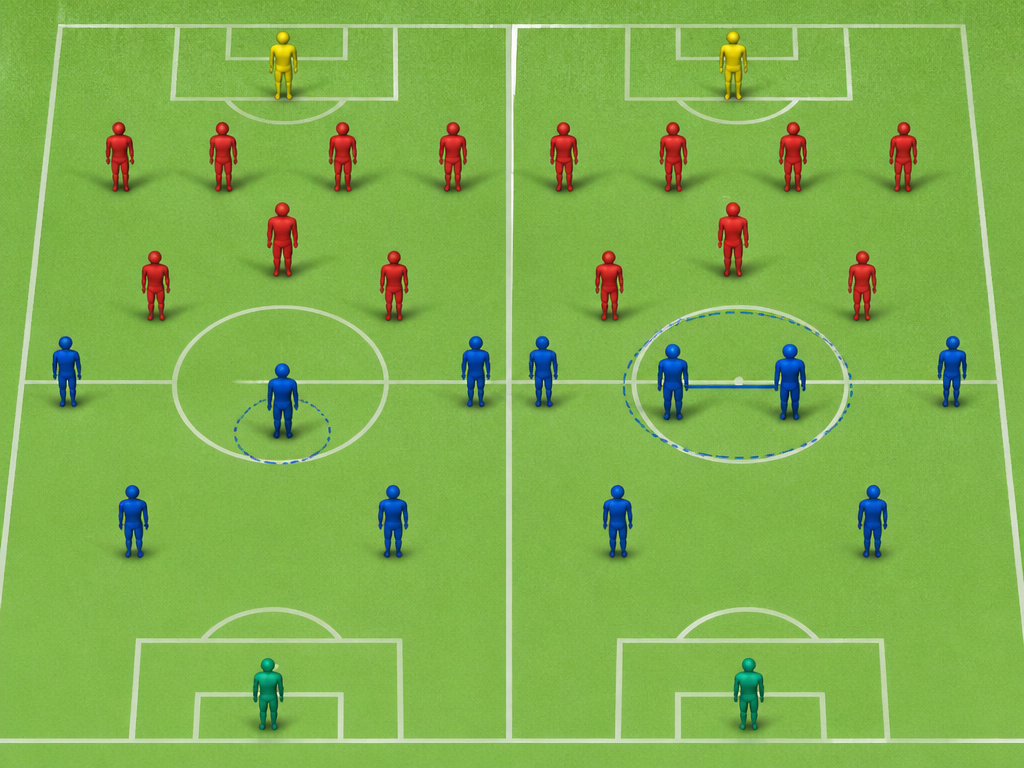
This is the tactical fork in the road. Does your team play with one defensive midfielder (a single pivot) or two (a double pivot)? The answer dictates everything about your team’s shape and the type of player you need.
| System | Typical Formation | Best For | Key Vulnerability |
|---|---|---|---|
| Single Pivot | 4-3-3, 4-1-4-1 | Possession-dominant teams wanting creativity from deep. | The lone holder must cover the entire width of the pitch. If pulled wide, the center is exposed. |
| Double Pivot | 4-2-3-1, 4-4-2, 3-5-2 | Teams needing defensive cover behind a No 10, or a stable counter-attacking platform. | Can lack a direct central presence if both holders sit deep, sometimes creating a gap to the forwards. |
The 4-2-3-1 formation is the classic modern home for a double pivot. The two players share duties, often with one holding and the other stepping forward. This system provides excellent defensive cover and more passing angles during build-up.
The 4-3-3 setup, with its lone holder at the base of the midfield triangle, is the canonical shape for a single pivot. It asks that single player to be an absolute monster physically, as they are the only shield. Teams that use a single pivot effectively, like Manchester City with Rodri, usually dominate the ball so much that the defensive workload is reduced.
Your choice here dictates the player profile. A single-pivot team usually wants a passer, a deep-lying playmaker or a half-back. Press resistance matters more than pure tackling. A counter-attacking or high-pressing team with a double pivot often wants at least one destroyer. Recovery speed and duel-winning become the priority.
How to Train for the Role (Beyond Fitness)
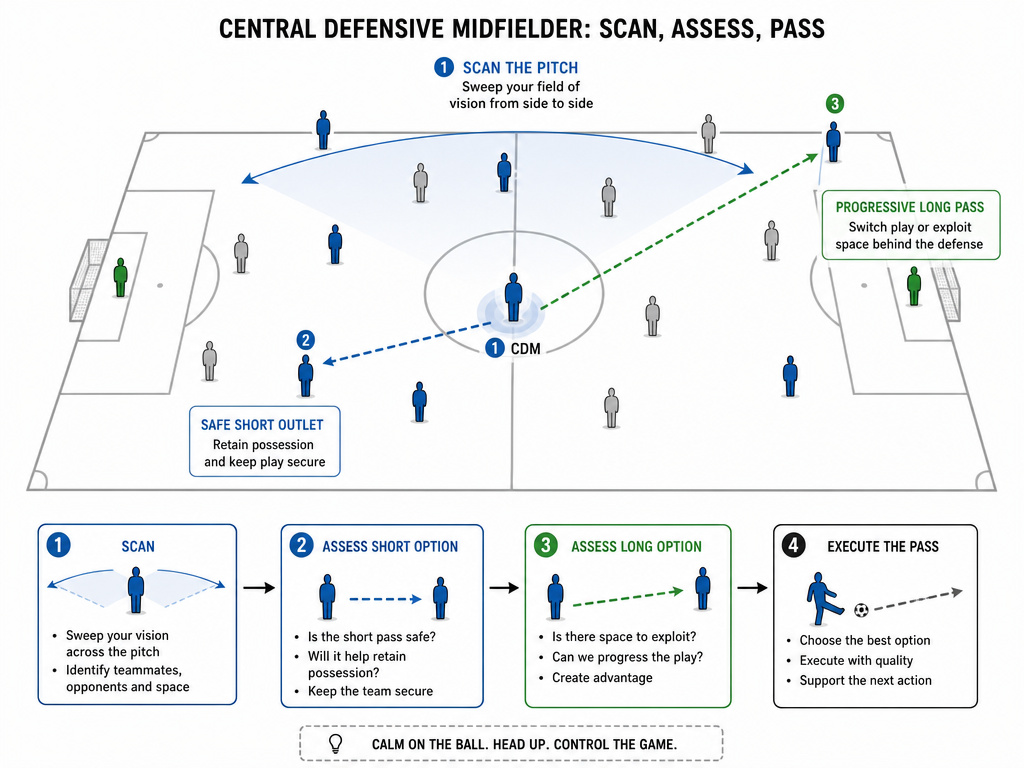
You can’t just run laps and watch film. The defensive midfielder’s brain needs specific training. The skill isn’t in reacting to the play in front of you; it’s in anticipating the play that’s about to happen two passes ahead.
Start with scanning drills. Before you even receive the ball, you should know the positions of the nearest opposition presser, your safest outlet, and your most progressive option. Practice receiving under pressure with a defender immediately closing you down, the first touch must be away from danger, into space.
Common mistake: Diving into a tackle when an attacker receives the ball back-to-goal. The correct move is to jockey, slow the play, and shepherd them into a support defender. A missed tackle leaves you on the ground and the defense exposed.
Work on your medium-to-long-range passing. You don’t need to be an expert at long-range switches, but you must be able to reliably hit a winger or full-back at medium range, both along the ground and in the air. The ability to break the first line of the press with a pass is what turns a defensive midfielder into a playmaking regista.
Finally, practice communication. You are the eyes for the back four. You see the whole pitch. You must be loud and clear in organizing the midfield line, telling defenders when to step up and when to drop. A silent No 6 is a liability, no matter their technical skill.
What shirt number does a defensive midfielder wear?
The number 6 is traditionally associated with the defensive midfielder, a deep-lying player who operates at the base of a midfield unit. This originates from English football’s early numbered shirts, where in the old 2-3-5 formation, the left-half in the midfield line wore the six. Today, a team often uses one player in the No 6 role, supporting two more advanced midfielders ahead in a shape like 4-3-3. Numbering conventions vary; some countries and coaches use the number four for the deepest midfielder instead, with central defenders taking five and six. The role itself is known by other names like anchor, screener, or regionally as ‘volante de marca’ or ‘trinco’.
How does a defensive midfielder communicate and organize?
The defensive midfielder is the team’s tactical organizer from a deep position. Their primary job is to protect the central area in front of the defence, which requires constant verbal instruction and positional cues to teammates. They must direct the press, alert players to opposing runners, and orchestrate the team’s defensive shape. This organizing extends to build-up play, where they often drop to receive the ball and dictate the tempo. A player in this role needs exceptional awareness to screen passes into the opposition’s central forward and to cover spaces if defenders are pulled out of position. Effective communication ensures the entire unit moves as one.
Frequently Asked Questions
What is the main role of a defensive midfielder?
The primary role is to protect the space in front of the central defenders by intercepting passes, making tackles, and screening the opposition’s most creative players. Equally important is their role in starting attacks by receiving the ball from defenders and distributing it to more advanced teammates.
Is CDM a hard position to play?
Yes, it is arguably the most physically and mentally demanding position. Data shows central midfielders cover the greatest distance during a match and operate at a higher cardiovascular load. The role also requires constant tactical awareness, quick decision-making, and excellent technical passing under pressure.
What’s the difference between a defensive midfielder and a deep-lying playmaker?
Defensive midfielder (often a holding midfielder or destroyer) prioritizes defensive actions, breaking up play, winning duels. A deep-lying playmaker prioritizes dictating the game through passing, tempo control, and creative distribution from deep. Many modern players, like Rodri, blend both archetypes.
What’s better, a single pivot or a double pivot?
Neither is universally better; it depends on the team’s style. A single pivot (like in a 4-3-3) gives a team more attacking numbers but asks one player to cover immense ground. A double pivot (like in a 4-2-3-1) provides more defensive stability and build-up support but can leave a gap between midfield and attack if not coordinated.
Who are the best defensive midfielders of all time?
Legends include purely defensive “destroyers” like Claude Makélélé and modern hybrids like Sergio Busquets, who perfected the deep-lying playmaker role. Currently, players like Rodri define the elite standard, combining defensive acuity with world-class distribution.
Before You Go
The biggest shift in understanding this role is moving from seeing it as a job of destruction to one of control. The best defensive midfielders don’t just stop attacks; they prevent them from even starting. They manage the space, they dictate the tempo, and they set the stage for everything their team does.
If you take one thing, let it be this: watch a match and focus only on the space between the opposition midfield and attack. See how often the defensive midfielder is already there, cutting off the angle, before the pass is even played. That’s the art of it. It’s quiet, it’s often thankless, and it’s what wins games.
For most amateur teams, the default should be a double pivot. The margin for error is smaller, and having two players to share the defensive and distribution duties covers more individual weaknesses. Unless you have a truly exceptional athlete and reader of the game, two good heads are better than one brilliant one struggling alone in a single pivot system.
