
What Size Football for Kids by Age: The Official Chart
This post contains affiliate links. As an Amazon Associate, we earn from qualifying purchases.
Use a size 3 ball for children under 7 to under 10 (The FA), or for U6-U8 (U.S. Soccer). Move to a size 4 for U9-U12 (U.S. Soccer), though The FA keeps U9-U10 on size 3. A size 5 ball is for U13 and older. The right size ensures safety, proper technique, and enjoyment by matching the ball to a child’s physical development.
That “U13 and older” part is the one universal rule. It’s the jump before that, from size 3 to size 4, where national guidelines on what size football for kids by age diverge, and where a well-meaning purchase can accidentally put the wrong tool in your child’s hands.
What follows is a breakdown of the official rules from The FA and U.S. Soccer, the research from FIFA that’s changing the conversation, and what it all means for touch, control, and that all-important joy in the game. By the end, you’ll know exactly which size to buy and why the governing bodies sometimes disagree.
Key Takeaways
- The FA mandates a size 3 ball for all under-7s to under-10s in its Mini-Soccer program, with no heading permitted in matches for these age groups, while U.S. Soccer uses a size 4 for U9-U10.
- U.S. Soccer’s Player Development Initiatives use size 3 for U6-U8 (paired with 4v4) and size 4 for U9-U12 (paired with 7v7 for U9-U10 and 9v9 for U11-U12).
- FIFA’s youth research introduces “Lightweight” categories for sizes 4 and 5, acknowledging that weight matters as much as circumference for safety and skill development.
- Always check your local league’s rules first. A national guideline is just that, your child’s coach will specify the exact ball for matches and training.
- A ball that is too heavy undermines technique. It encourages toe-poking and poor passing form as a child struggles to move it.
The Official Age and Size Chart (Simplified)
You’ll find a dozen simple charts online answering what size football for kids by age. The problem is, they often present a single, universal answer that doesn’t exist. Here’s the clearer picture, showing where the major authorities agree and where they don’t.
| Age Group (U.S. / Int’l) | The FA (England) | U.S. Soccer | Common “Consensus” |
|---|---|---|---|
| U6-U8 (5-8 yrs) | Size 3 (U7-U8) | Size 3 | Size 3 |
| U9-U10 (8-10 yrs) | Size 3 | Size 4 | Size 4 |
| U11-U12 (10-12 yrs) | Size 4 (implied for U11+) | Size 4 | Size 4 |
| U13+ (12+ yrs) | Size 5 | Size 5 | Size 5 |
The tension is in that U9-U10 box for the what size football for kids by age question. The FA’s 2025 handbook is explicit: “under 7s to under 10s will play with a size 3 ball.” This is a recent shift, extending the use of a smaller, lighter ball to aid technical development. Across the Atlantic, U.S. Soccer’s model moves players to a size 4 at U9. Neither is “wrong”, they’re different developmental philosophies.
A size 4 ball has a circumference of 63.5 to 66 centimetres and weighs 350 to 390 grams. The difference in size and weight from a size 3 changes how the ball feels on the foot and in the air for a nine-year-old.
Why Size (and Weight) Actually Matter
This isn’t about arbitrary numbers. A ball is a tool for learning. Give a young player a ball that’s too large and heavy, and three things happen. First, they can’t properly wrap their foot around it to strike it cleanly, promoting a stabbing, toe-poke technique. Second, receiving a pass feels like stopping a cannonball, it bounces off their foot. Third, they simply get tired and frustrated faster.
The goal at the youngest ages is maximum touches and growing confidence. A size 3 ball is easier to dribble, pass, and shoot for a small child. It turns success from a struggle into a possibility. This is the core thinking behind The FA’s rule and the U.S. Soccer Player Development Initiatives, which pair ball size with smaller pitches and fewer players to keep the ball close.
A Deep Dive into the Governing Body Rules
You can’t talk about official ball sizes without looking at the rulebooks. This is where the commodity advice online falls short, it rarely cites its sources.
The Football Association (The FA) – Mini-Soccer Handbook
The FA’s 2025 Mini-Soccer handbook is the law for youth football in England. Its directives are specific and come with important safety caveats.
- Ball Size: “Under 7s to under 10s will play with a size 3 ball.”
- Heading: “No deliberate heading in matches for Under 7s up to and including Under 10s.” Furthermore, for training: “For age groups u5 to u11 heading should NOT be introduced in training sessions.”
- Game Format: U7-U8 play 5v5; U9-U10 play 7v7.
The logic is holistic. Smaller ball, smaller teams, no heading, it’s a package designed to keep the focus on foot skills, spatial awareness, and enjoyment. If you’re following FA-affiliated leagues, this isn’t a recommendation; it’s the standard.
U.S. Soccer – Player Development Initiatives (PDIs)
U.S. Soccer’s framework is equally structured but charts a slightly different path. It’s a ladder where ball size, player numbers, and pitch size progress together.
- U6-U8: Size 3 ball, 4v4 format.
- U9-U10: Size 4 ball, 7v7 format.
- U11-U12: Size 4 ball, 9v9 format.
- U13+: Size 5 ball, 11v11 format.
Notice the size 4 ball spans four age years (U9-U12). The philosophy here is about progressive challenge. The jump to a size 4 at U9 coincides with more players on a bigger field, introducing new tactical problems while the ball itself becomes slightly more demanding to control.
FIFA’s Evolving Youth Research
FIFA’s “Youth Football Specification Recommendation” proposes two development routes based on age groups (under-13s, under-11s, under-9s) and introduces ‘Lightweight’ categories for sizes 4 and 5.
Where this goes sideways: Assuming “Size 4” is one standard. FIFA’s research shows a Lightweight Size 4 (closer to 350g) is better for U-11s transitioning from a Size 3, while a standard Size 4 (up to 390g) suits U-13s moving toward a full-size ball. Most off-the-shelf balls don’t make this distinction yet.
This research, done with Erlangen University, is explicitly trying to link ball specifications to health and safety data. It’s an admission that the old rules of thumb weren’t fully evidence-based. The takeaway for parents is that weight is a critical spec to glance at, not just the size number.
Choosing the Right Ball for Your Child’s Stage
With the rules laid out, how do you turn this into a decision? Think in phases.
Phase 1: First Kicks (Ages 3-5)
This is pre-team, backyard fun. A size 3 ball is perfect, but even a size 2 or 1 can be great for toddlers. The aim is familiarity, not precision. Our guide on the best soccer ball for a 3-year-old covers durable, beginner-friendly options.
Phase 2: Foundation & Mini-Soccer (U6-U10)
Now you must follow your league. If you’re in England, you’re buying a size 3 until your child hits the U11 age group. In the U.S., you’ll likely need a size 3 for U6-U8 and a size 4 for U9-U10.
This is where quality matters. A cheap, plasticky ball will be too light and bouncy, making control harder. Invest in a training ball with a textured surface for grip. The right size 3 soccer balls have a consistent shape and a weight that feels substantial but not heavy.
Phase 3: The Transition (U11-U14)
Players are growing fast, and the game gets more serious. The ball is a size 4 (U11-U12) or transitions to a size 5 (U13+). This is the stage where owning two balls isn’t a bad idea: a match-quality ball for games and a durable, all-weather training ball for practice.
The feel of the ball becomes pronounced. A size 4 soccer ball used in damp conditions shouldn’t soak up water and double in weight. Check for thermal-bonded panels or tight stitching and a mention of water resistance.
Special Cases: Futsal, Beach, and “Lightweight” Balls
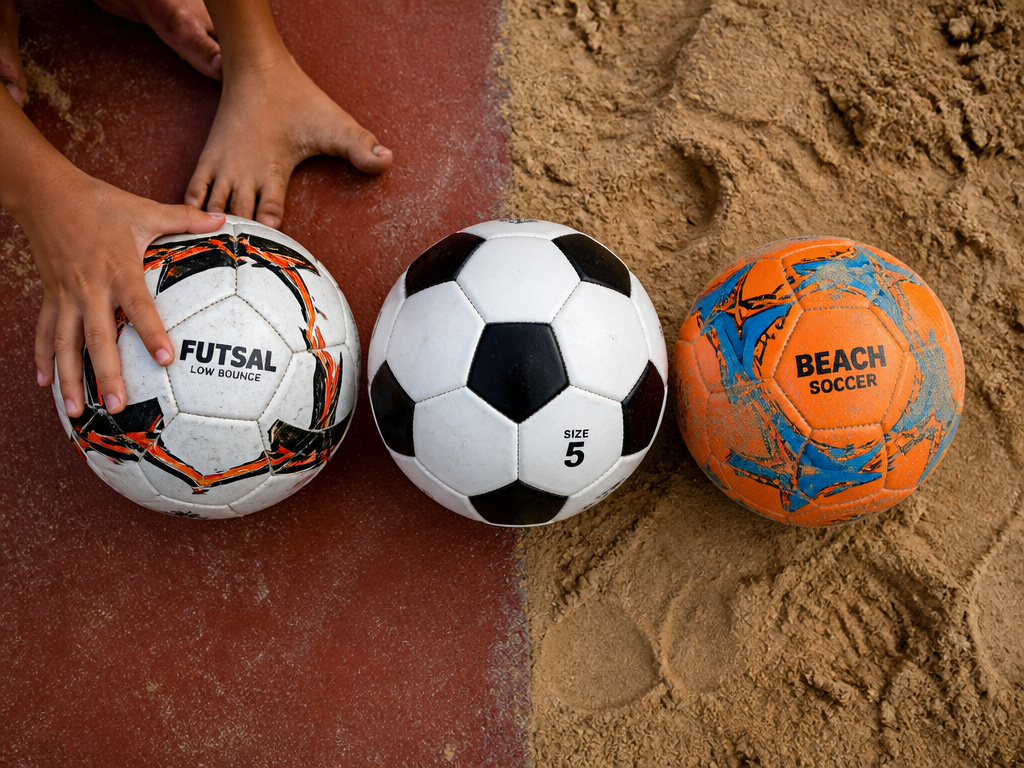
Not all small balls are the same. The sport variant changes the specification entirely.
Futsal: The FA handbook specifies a “Size 3 Futsal ball” for U12 and under, and a “Size 4 Futsal ball” for U13 to seniors. These balls are denser, have less bounce (about 30% of a regular football), and are designed for hard indoor surfaces. Using a regular outdoor ball for futsal ruins the game’s controlled, technical nature.
Beach Soccer: A size 5 ball but lighter and softer, made for bare feet on sand.
Lightweight Balls: As per FIFA’s new research, these are emerging as a category. They carry a standard size (4 or 5) but are constructed to sit at the lower end of the legal weight range. For a player struggling with the heft of a standard ball as they move up a size, a lightweight version can be a brilliant training aid to maintain proper technique.
Common Pitfalls and How to Avoid Them
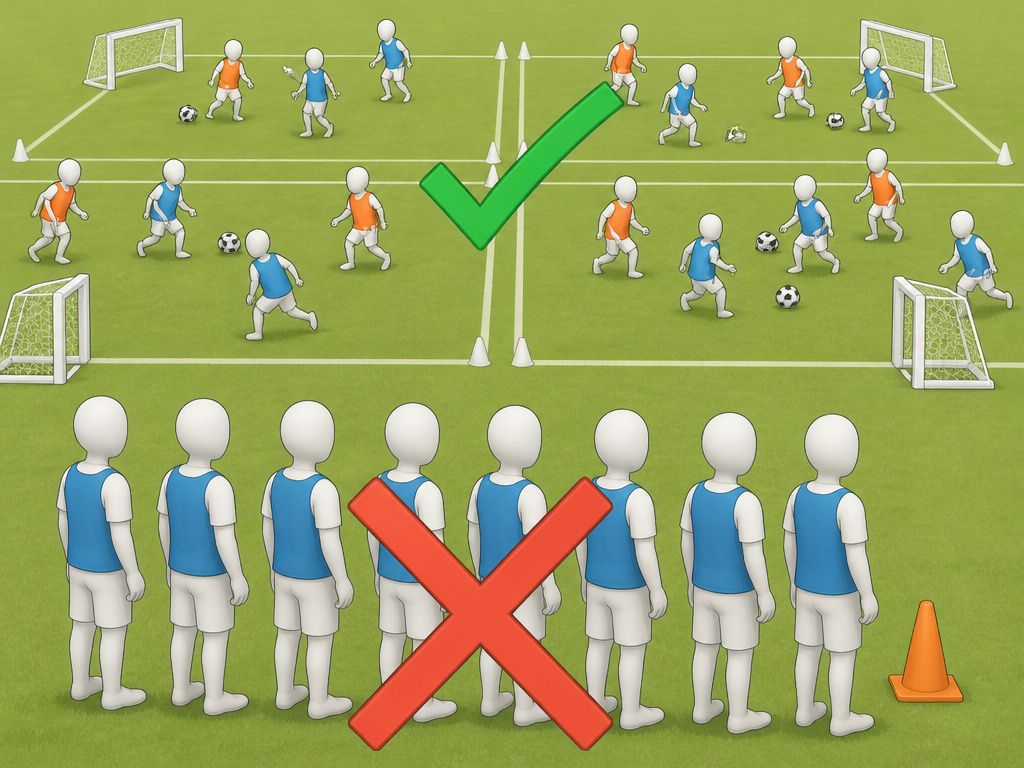
Even with the right size, a few simple mistakes can hamper development.
- Over-inflation or Under-inflation. A rock-hard ball is painful to control and head. A soft ball won’t travel true. The correct pressure for a size 5 ball is between 0.6 and 1.1 atmospheres at sea level. Use a pump with a pressure gauge.
- Buying a “Size Up” to Grow Into. Don’t. A year with a ball that’s too big can ingrain poor technique that takes years to correct. The best youth footballs are the right size for right now.
- Ignoring the Surface. A high-end, smooth-panel match ball will be shredded on concrete or asphalt. Use a durable training ball with a rubber or reinforced TPU cover for hard ground.
- Forgetting About Feel. Let your child handle the ball before you buy (if possible). The stitch height, panel texture, and firmness are personal preferences that affect confidence.
What is the official high school and adult size?
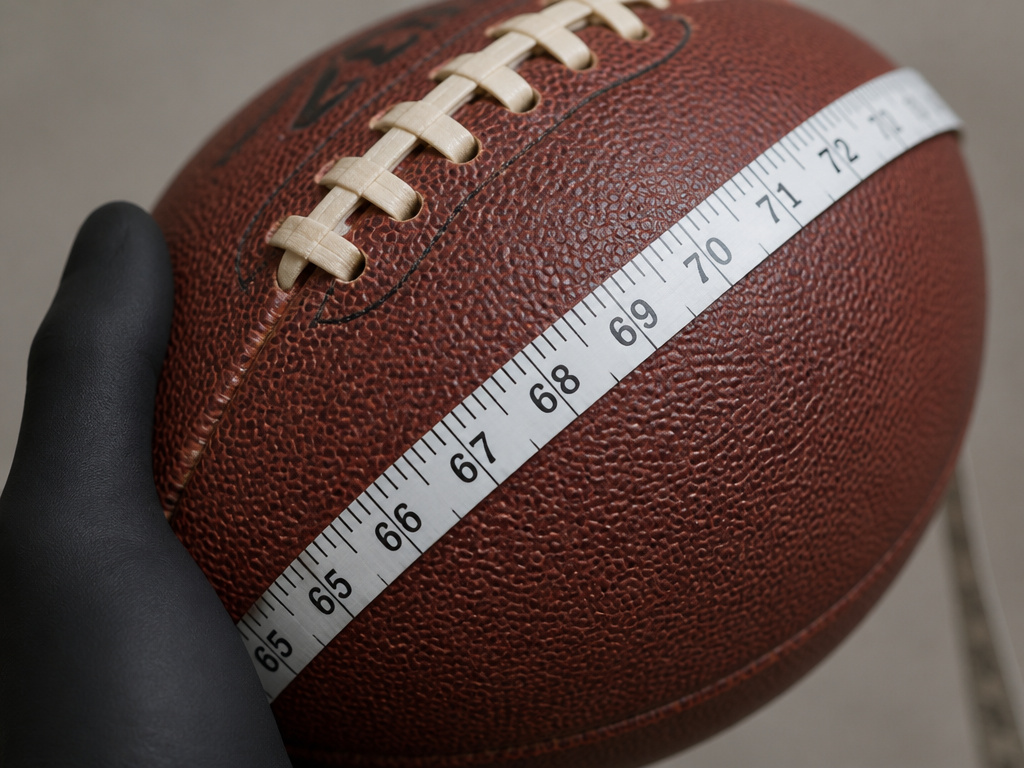
The official size for high school, college, and all senior football is a Size 5 ball. FIFA’s Laws of the Game specify that this ball must have a circumference of 68 to 70 centimetres and a weight of 410 to 450 grams at the start of a match. This is the standard adult match ball used in professional, amateur, and most youth football from around the age of 13. In the U.S., U.S. Soccer’s guidelines also designate Size 5 for players U13 and older, aligning with the global standard for official play.
How do league guidelines differ?
Major football associations have specific rules. The Football Association (The FA) states that players from under-7s to under-10s use a Size 3 ball. U.S. Soccer’s guidelines differ, using a Size 4 ball for players in the U9 to U12 age groups. For players aged around 13 and older, both associations and FIFA agree on the use of the standard Size 5 ball. These differences mean a 9-year-old in England would use a Size 3, while a 9-year-old in a U.S. Soccer program would use a Size 4. Always check your local league’s specific handbook.
Frequently Asked Questions
What size football for a 7-year-old?
Follow your national association. In England (FA), it’s a size 3. In the United States (U.S. Soccer), it’s also a size 3 for the U8 age group, which typically includes 7-year-olds. Always confirm with your local league.
Can a 9-year-old use a size 4 football?
It depends on the league. Under U.S. Soccer rules, yes, a 9-year-old (U10) uses a size 4. Under The FA’s current rules, no, a 9-year-old (U10) must use a size 3. This is the most common point of confusion, so checking with your child’s coach is essential.
What age do you switch to a size 5 football?
The switch commonly happens around age 12 or 13. U.S. Soccer uses size 5 for U13 and older, while general guidance states size 5 is used from around age 13+.
Are there different balls for training vs. Matches?
Yes, often. Match balls are built to tighter tolerances for consistent flight and are often more expensive. Training balls are built for durability to withstand repeated use on all surfaces. It’s wise to have a match ball for games and a tougher training ball for practice, but they should be the same size and similar feel.
How do I know if the ball is the right size?
Simple test: have your child hold the ball with both hands. If their fingertips touch or almost touch when their arms are relaxed, the circumference is likely correct. The ball should feel manageable to kick and control, not like a burden.
Before You Go
The single most important thing you can do is ask your child’s coach or league organizer for their specific ball specification. Bookmark this page, take the chart, but then get the local ruling. The beautiful game is meant to be just that, beautiful, not a frustrating battle with equipment.
When you’re ready to buy, look beyond the size number. Check the weight on the packaging if it’s listed, and opt for a brand like Select, Adidas, or Mitre known for consistency. A well-made size 3 or size 4 ball from Select, Adidas, or Mitre is an investment in those first clean strikes, those confident dribbles, and the smile that comes with them. That’s what you’re really buying.
