
Football Loan Deals Explained: A Step-by-Step Guide
This post contains affiliate links. As an Amazon Associate, we earn from qualifying purchases.
A football loan deal is a temporary transfer where a player moves to a new club for a predetermined period while remaining under contract with their parent club. The parent club (lender) retains the player’s registration, but the loan club (borrower) gains the right to use the player, typically covering some or all of their wages for the duration. FIFA regulations set a maximum loan duration of one year and, from the 2024/25 season, will limit clubs to loaning out a maximum of six players over the age of 21.
You can structure one of these deals in a dozen ways, with a fee, without a fee, with a promise to buy, or with a break clause. The mechanics are often more interesting than the headline. A loan isn’t just a placeholder; it’s a financial instrument and a development tool with its own rulebook that varies between FIFA, UEFA, and your domestic league. This is football loan deals explained.
What follows is a walkthrough of the loan system: the standard rules, the financial wrinkles clubs exploit, and the specific Premier League restrictions that trip up even experienced directors. By the end, you’ll be able to read a transfer-news headline and know exactly what kind of deal is being described.
Key Takeaways
- The FIFA maximum loan duration is one year, but deals can be structured to effectively run longer through consecutive agreements or pre-arranged extensions.
- FIFA’s 2022 Loan Regulations state that from the 2024/25 season, clubs will be limited to loaning out a maximum of six players, while the FIFA RSTP allows a club to make eight international loans out from its men’s team and eight from its women’s team.
- In the Premier League, a club can have no more than four loan players registered at once, with a maximum of two from other Premier League clubs.
- A loan with an unconditional obligation to buy must be treated as a permanent transfer for accounting purposes from day one, per UEFA rules.
- Most loans include a recall clause, allowing the parent club to bring the player back early, usually in the case of an injury crisis or if the loan isn’t working.
What Is a Football Loan Deal?
Picture the January transfer window. A club needs a striker but can’t afford a permanent fee. Another club has a young forward who isn’t getting minutes. A loan deal bridges that gap. It’s a rental agreement for a human asset.
The player’s contract with their parent club remains legally binding, a fundamental point in any football loan deals explained. The loan agreement simply suspends the obligation for that player to turn up for training at their home ground for a set period. In return, the loan club gets a player’s registration, their right to play that individual in competitive matches. The financial terms are negotiable: the loan club might pay a loan fee, cover 100% of the wages, or split the cost 50/50. The parent club often uses the deal to get an expensive player off the wage bill or to give a prospect vital first-team experience.
The part nobody mentions: A loan doesn’t just pause a contract; it creates a three-way relationship where the player’s performance directly impacts the asset value of a rival club. That tension is why recall clauses and play-time guarantees exist.
The Step-by-Step Anatomy of a Typical Loan
A loan deal doesn’t just happen when a manager picks up the phone, a key reality in the football loan deals explained. It follows a formal, often protracted, process. Missing one step can void the registration.
- Identification & Negotiation: The loan club identifies a need and a target. Their sporting director contacts the player’s agent and the parent club. Terms are discussed: duration, wage contribution, loan fee, and any special clauses (option to buy, recall option). This stage centers on bargaining power; a club urgently needing a player will pay a higher price.
- Agreement in Principle: The clubs agree on headline terms. The player and their agent are informed. Crucially, the player must consent to the move; a forced loan is rare and damages relationships. At this point, the deal is often leaked to the press as “imminent.”
- Medical & Contract Finalisation: The player undergoes a medical with the loan club. Lawyers for both clubs draft the loan agreement, embedding all negotiated clauses. The player signs any necessary paperwork, which may include a temporary addendum to their existing contract.
- Registration: This is the critical administrative act. The loan club submits the signed agreement and the player’s registration details to the relevant football authorities, the national FA and, for international loans, FIFA’s Transfer Matching System (TMS). The deal is only official once the registration is confirmed. This is why you hear about “paperwork being submitted before the deadline.”
- Integration & Review: The player joins their new squad. Many loans have break clauses or performance reviews at the mid-season point, allowing either party to reassess.
Skipping the proper registration is the most common catastrophic error. A player whose paperwork isn’t filed correctly with the FA and FIFA is ineligible to play. I’ve seen promising deals collapse because a fax (yes, some federations still use them) didn’t go through before a midnight deadline, leaving a club without their new midfielder for a crucial match.
Loan Rules: FIFA, UEFA, and the Premier League Maze
You’re not just dealing with one set of rules. You’re navigating a layered system where international, continental, and domestic regulations overlap, and sometimes contradict each other. Getting this wrong leads to fines, points deductions, or voided transfers.
The FIFA Framework
FIFA’s Regulations on the Status and Transfer of Players (RSTP) set the global baseline. Think of them as the constitution for loans.
- Duration: A loan must be for a predetermined period. The minimum is the time between two registration periods. The maximum is one year. You’ll sometimes hear about two-year loans.
- Loan-Out Cap: To prevent hoarding, FIFA rules state that for the 2024/25 season, clubs will be limited to loaning out a maximum of six players. This is the rule that forced Chelsea and other big academies to rethink their strategies.
- Exemptions: This cap has a big carve-out. It does not apply to players aged 21 and younger. The FIFA regulations on player loans also exempt players who are club-trained and are loaned out before the end of the season in which they turn 21. This encourages youth development.
- International vs. Domestic: FIFA’s hard caps primarily govern loans between clubs in different countries. The FIFA RSTP states a club is allowed to make eight international loans out from its men’s team and eight international loans out from its women’s team. However, they give national associations three years to implement their own domestic loan rules, which can differ.
Premier League Specifics
The Premier League has its own, often stricter, layer of regulation. Their rules on “Temporary Transfers” are a classic example of a domestic association going beyond FIFA’s baseline.
| Rule | Limit | Notes |
|---|---|---|
| Max Loans In | 4 registered at once | This is the total loan squad a Premier League club can have. |
| From Same Club | Max 1 player | You cannot borrow two players from, say, Manchester City. |
| From Other PL Clubs | Max 2 players | Of your four loans, only two can be from fellow Premier League sides. |
| Goalkeeper Loan | Max 1 to another PL club | A specific rule to prevent goalkeeper market manipulation. |
| Same-Window Block | Not allowed | You cannot buy a player and immediately loan him to another Premier League club in the same window. |
These restrictions do not apply to players under 21 or to homegrown players. A homegrown player is one who has been at the current club for at least three years between the ages of 15 and 21. This exemption is why many young players move on loan.
Where this goes sideways: Clubs often forget that Premier League loan restrictions only apply to domestic loans. A loan from a club in Spain or Italy does not count toward your “two from other PL clubs” limit. That’s a crucial distinction in squad planning.
UEFA’s Accounting Angle
UEFA deals with the financial reality of loans, especially those with options or obligations to buy. Their Club Licensing regulations (Annex G.4) dictate how these deals must be accounted for on a club’s books, which directly impacts Financial Fair Play (FFP) calculations.
The key distinction is between an option and an obligation.
- Option to Buy: The loan club has the right, but not the obligation, to make the transfer permanent for a pre-agreed fee. For accounting, this is treated as a pure loan. The player remains an asset of the parent club.
- Unconditional Obligation to Buy: The loan club must buy the player at the end of the loan. UEFA rules state the lender must derecognise the player as an asset from the very start. It’s a permanent transfer with delayed payment.
The grey area is a conditional obligation (e.g., “must buy if the club avoids relegation”). If the condition is “virtually certain,” it’s treated as an obligation from day one. If not, it’s booked as a loan that converts to a transfer only once the condition is met. This accounting nuance is why clubs and agents argue over the wording of these clauses for hours.
Financial Arrangements and Contract Clauses
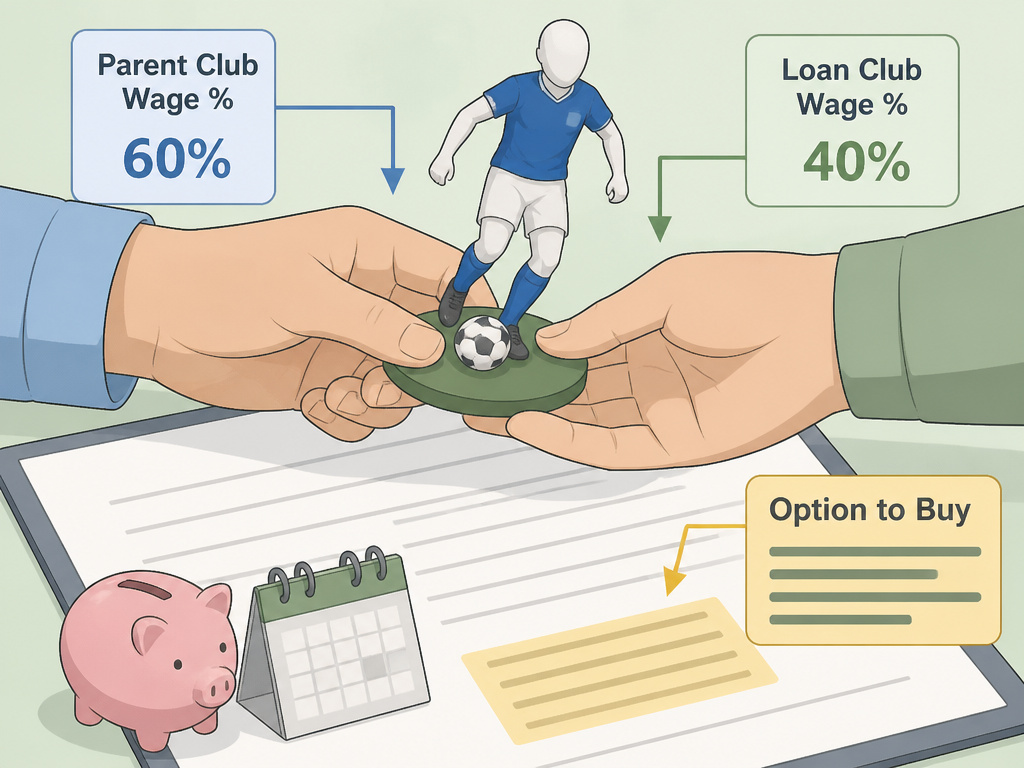
The money side of a loan is where the real negotiation happens. It’s never just “player moves, wages are covered.”
Who Pays the Wage?
This is the first question. The split can be 100%/0%, 50%/50%, or any other ratio. A parent club trying to offload a high earner might agree to pay a large chunk. A loan club getting a prized asset might pay it all. There’s no standard rule.
The Loan Fee
On top of wages, a loan club might pay a fee to the parent club for the temporary use of the player. This is common for high-profile loans. It’s essentially rent.
The Two Key Clauses: Option vs. Obligation
This is the part that defines the strategic intent of the loan.
- Option to Buy: Gives the loan club flexibility. They can try the player for a season and then decide. The fee is agreed upfront, which can be a bargain if the player’s value skyrockets.
- Obligation to Buy: A de facto permanent transfer. It’s often used for accounting (pushing the big payment into the next financial year) or when a transfer fee is agreed but the player cannot be registered until the next window. As the BBC Sport loan deal explainer notes, these are a feature of the transfer market.
Recall Clause
A safety net for the parent club. It allows them to terminate the loan early, usually in January, and recall the player. This is triggered for two reasons: an injury crisis at home, or the player not getting agreed playing time at the loan club. It turns a season-long loan into a six-month audition.
The Player’s Perspective and Potential Pitfalls
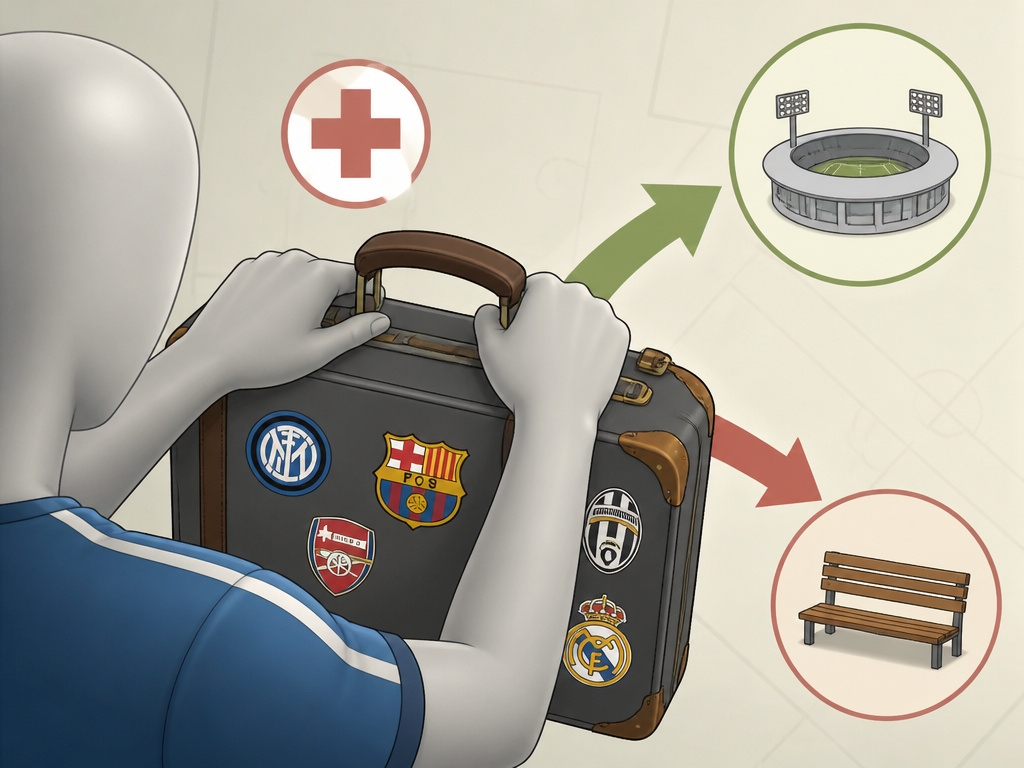
We often talk about clubs, but the player is the one moving house, changing coaches, and adapting to a new dressing room. Their consent is legally required, but their motivation varies.
A young player might crave minutes and see a loan as a career launchpad. An experienced pro might accept a loan to reignite his career or put himself in the shop window. A disgruntled star might be loaned out simply to get him out of the building. The player’s mindset directly impacts the loan’s success.
Common Pitfalls for Players:
- Lack of Integration: Joining mid-season is hard. If the loan club’s tactics don’t suit the player’s style, or if the manager who wanted him leaves, the loan can quickly turn sour.
- The “Fringe Player” Trap: A player might move for game time but end up as a backup option at the new club, replicating the problem they left.
- Injury Risk: Playing through a minor injury to prove your worth at a loan club can backfire spectacularly, damaging long-term prospects at the parent club.
Common Pitfalls for Clubs:
- Developing a Rival’s Asset: A loan club might spend a season improving a player, only to see him return to a direct competitor in peak form.
- Dependency: Relying on loan players to fill key roles is a short-term strategy. If the parent club recalls them or doesn’t renew the loan, you have a gaping hole in your squad.
- Blocking Youth Pathway: Filling a squad position with a loan player can stifle the development of your own academy talent, defeating the long-term purpose of a youth system.
For the borrowing club, the calculation is about immediate need versus long-term planning. For the lending club, it’s about asset management, preserving value, creating future profit, or simply cutting costs.
Premier League loan limits and restrictions
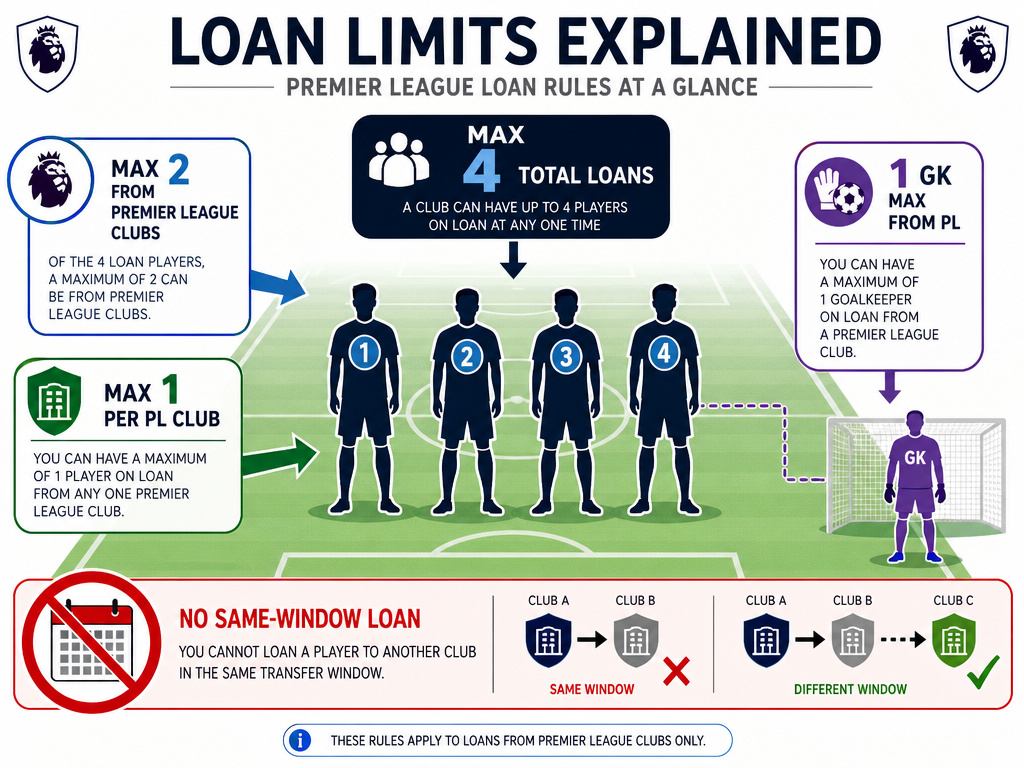
Premier League clubs face specific caps on loan deals. A club can only register a maximum of four loan players on its squad list at any one time. Within that total, it can have no more than two players on loan from other Premier League clubs, and only one of those can come from any single club. This includes goalkeepers, where a club may loan only one to another Premier League side. A notable restriction prevents a club from loaning a player to another Premier League team if they signed that player in the same transfer window. These limits generally do not apply to players under the age of 21 or to those classified as homegrown talents at their club.
How loan rules vary in other leagues
While FIFA sets global standards, individual leagues and national associations can implement their own domestic loan systems. These local rules, designed to protect competition integrity and develop young players, can differ from FIFA’s international limits. For instance, the Premier League’s specific restrictions on incoming loans apply only to deals from other English clubs; loans from foreign associations do not count toward its domestic quotas. Other competitions, like the EFL or MLS, will have their own specific regulations governing the number of loans allowed, the eligibility of players, and whether loanees can face their parent clubs. Always check the specific competition’s handbook for its current rules.
Frequently Asked Questions
Can a player refuse a loan move?
Yes. A player’s contract is with their parent club, but they cannot be forced to move to another club against their will. Their consent is required for the loan agreement. However, a player who consistently refuses reasonable loan moves may find themselves out of the first-team picture, which can pressure them into accepting.
Who pays a player’s salary during a loan?
It is negotiated on a deal-by-deal basis. The loan club may pay 100%, the parent club may pay 100%, or they may split it. There is no default rule. The arrangement is spelled out in the loan agreement.
Can a loaned player play against their parent club?
It depends on the competition and the league. In the Premier League, players on loan are not permitted to play against the team that holds their registration in league matches. They can, however, play against them in cup competitions unless they are cup-tied from having already played for the parent club that season. Other leagues, like Serie A, often have no such restriction.
What is the longest a football loan can last?
Per FIFA’s RSTP, the maximum loan duration is one year. However, clubs can agree to consecutive one-year loans, effectively creating a longer-term arrangement. A famous example is a two-year loan, which is legally structured as two separate one-year agreements.
How do loans affect Financial Fair Play (FFP)?
Loans can be a useful tool for FFP. A club can loan out a high-wage player to reduce its wage bill. For a loan with an obligation to buy, the selling club can often defer the recognition of the transfer income until the obligation is triggered, helping to balance books across financial years. Understanding the player valuation and amortisation rules is key to this.
Before You Go
The loan system is football’s flexible friend. It’s a development pathway, a financial lever, and an emergency fix. But its flexibility is also its danger. The differing rules between FIFA, domestic leagues, and UEFA’s accounting standards create a minefield.
One rule of thumb cuts through the complexity: if a loan deal includes an unconditional obligation to buy, treat it as a permanent transfer in every meaningful sense except the payment date. The player is already gone. Everything else, the options, the recalls, the wage splits, is just negotiation.
The smartest use of the loan market isn’t stockpiling talent or plugging every gap with a temporary fix. It’s identifying one clear, structural need that a specific player on the market can solve for a defined period, without mortgaging your own club’s future. That’s the balance. Most get it wrong by focusing on the name, not the fit.
