
How to Deal With Abuse as a Football Referee: Step-by-Step
This post contains affiliate links. As an Amazon Associate, we earn from qualifying purchases.
To deal with abuse as a football referee, you must know and follow U.S. Soccer Federation Policy 531-9. The policy defines specific levels of non-physical abuse and physical assault, mandates an immediate ejection (red card) for any abuse, and requires a written report to your State Referee Administrator within 48 hours. Referees are protected from the moment they arrive at the match venue (including the parking area) until they leave. The policy also extends to a referee’s family, household members, and guests attending the match.
That 48-hour clock is the one that matters most after you walk off the pitch. The official procedure is not a suggestion, it’s a binding framework that dictates exactly who investigates, what penalties apply, and when jurisdiction shifts if a local club drags its feet. Knowing how to deal with abuse as a football referee is therefore critical. If you don’t file on time, the case against the offender can stall.
What follows is the official playbook, stripped of platitudes. We’ll walk through the exact definitions that trigger an ejection, the state-specific reporting quirks that change your next move, the standardized penalty grids that determine suspensions, and the one step after a physical assault that almost no guide mentions.
Key Takeaways
- Policy 531-9 mandates an immediate ejection (red card) for any act of referee abuse, from belittling comments to threats.
- You must file a written report within 48 hours of the incident to your State Referee Administrator to initiate the formal disciplinary process.
- For physical assault, the referee must use their judgment to ensure safety; the fact sheet mandates abandoning a match only if removal of an abusive spectator does not happen in a timely or safe manner.
- For spectator abuse, U.S. Soccer Federation policy states the referee should suspend the match and have a coach or club official deal with removal. Another source (Florida Soccer Referees) provides a detailed ‘Ask, Tell, Dismiss’ protocol directed at the coach.
- Penalties escalate sharply: a second offense receives double punishment, and a third can result in a lifetime ban from U.S. Soccer-affiliated activities.
What Officially Counts as Abuse or Assault?
The U.S. Soccer Federation Policy 531-9 draws a bright line between two categories: abuse and assault. This isn’t about your personal tolerance for sideline noise. It’s about matching observed behavior to a defined, sanctionable offense. Get this wrong, and your report gets dismissed.
Referee Abuse is extreme, deliberate, non-contact behavior that causes significant harm. Think of it as verbal or psychological violence.
Referee Assault is any deliberate physical action against you or a protected party. The policy’s focus is on unwanted physical contact that makes an official feel uncomfortable or unsafe. It’s your judgement call on whether a tap on the shoulder crosses that threshold or can be handled with a verbal warning about personal space.
The policy protects you from the moment you arrive at the match venue, including the parking area, until you leave. This protection also extends to your family, household members, and guests attending the match.
The 4-Level Scale of Non-Physical Abuse
Policy 531-9 breaks non-physical abuse into four distinct levels. This isn’t just semantics, each level carries a different minimum suspension. Understanding these levels helps you describe the incident with the accuracy the disciplinary panel requires.
| Level | Definition | Example | Minimum Game Suspension (Adult on Adult) |
|---|---|---|---|
| 1: Insulting/Belittling | Actions that undermine a referee’s authority. | “Do you even know the rules?” or “You suck!” | 1 game |
| 2: Harassment/Intimidation | Threats, intimidation, or retaliation without physical harm. | Using expletives (“That call was $#!t”) or getting in the referee’s face. | 4 games |
| 3: Violent Threats | Aggression, cyberbullying, doxing, or threats of physical violence. | “See you in the parking lot,” or posting derogatory attacks on social media. | 6 games (plus 3-12 month time penalty) |
| 4: Discriminatory Acts | Hate speech based on race, gender, nationality, etc. | Using racial slurs or homophobic language. | 10 games (plus 12-24 month time penalty) |
Level 3 non-physical abuse carries a minimum time penalty of 3-12 months in addition to the game suspension.
The 3 Levels of Physical Assault and the Mandatory Response
Physical assault is a separate category with a mandatory first step: abandon the match. According to one source (Florida Soccer Referees), referees should immediately terminate the contest after a physical assault. U.S. Soccer Federation policy advises referees to use their best judgment on if the threshold for physical abuse is crossed.
Here’s how the policy breaks down physical offenses:
- Level 1: Minor Deliberate Touching. A light tap, minor shove, or slight push. Minimum suspension: 3 games.
- Level 2: Pushing, Grabbing, or Property Damage. Grabbing, pulling, pinching, or throwing an object in a non-striking manner. Minimum suspension: 10 games (plus a 6-24 month time penalty).
- Level 3: Striking or Severe Attack. Punching, elbowing, kicking, spitting, choking, or using an object to strike. Penalty: 12 months to a lifetime ban.
If a physical assault occurs, you must secure your safety. For any suspected child abuse, you must report it to law enforcement within 24 hours.
Your On-Field Protocol: From Sideline Noise to Spectator Removal
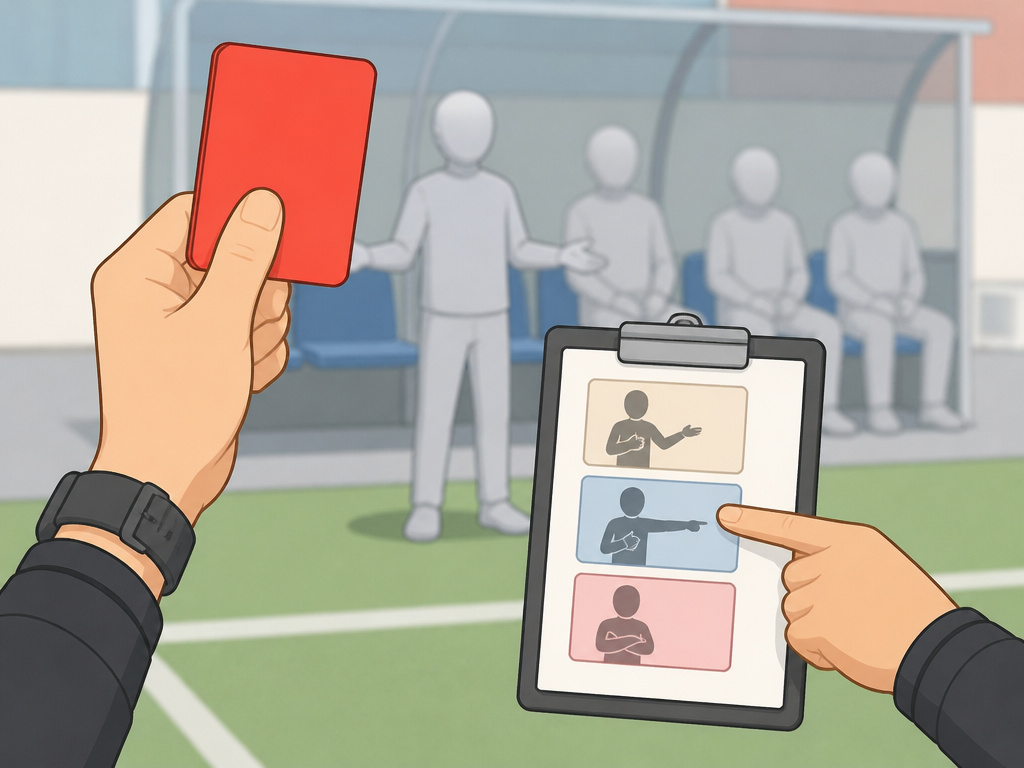
On the pitch, your tool for abuse is clear: a red card. For any instances of referee abuse the sanction should be an ejection (red card). But the tricky part often happens off the field of play, coming from the sidelines.
For abuse from players or team officials in the technical area, you have a direct line. Identify the offender, show the red card, and report it. If the offender in the technical area cannot be identified, consult your local competition rules or state referee committee for guidance.
Spectator abuse is a different chain of command. The U.S. Soccer policy states that referees do not have the authority to directly dismiss spectators. Your role is to suspend the match and direct a team or club official to deal with the removal. The Washington State Referee Committee notes that spectator abuse is handled via coaches.
Where this goes sideways: Directing your warnings to the crowd. Florida’s protocol mandates an “Ask, Tell, Dismiss” sequence directed solely at the team’s head coach. You never address the offending spectator. If the coach fails to act in a timely or safe manner, you abandon the match.
The Mandatory 48-Hour Report and Who Handles It
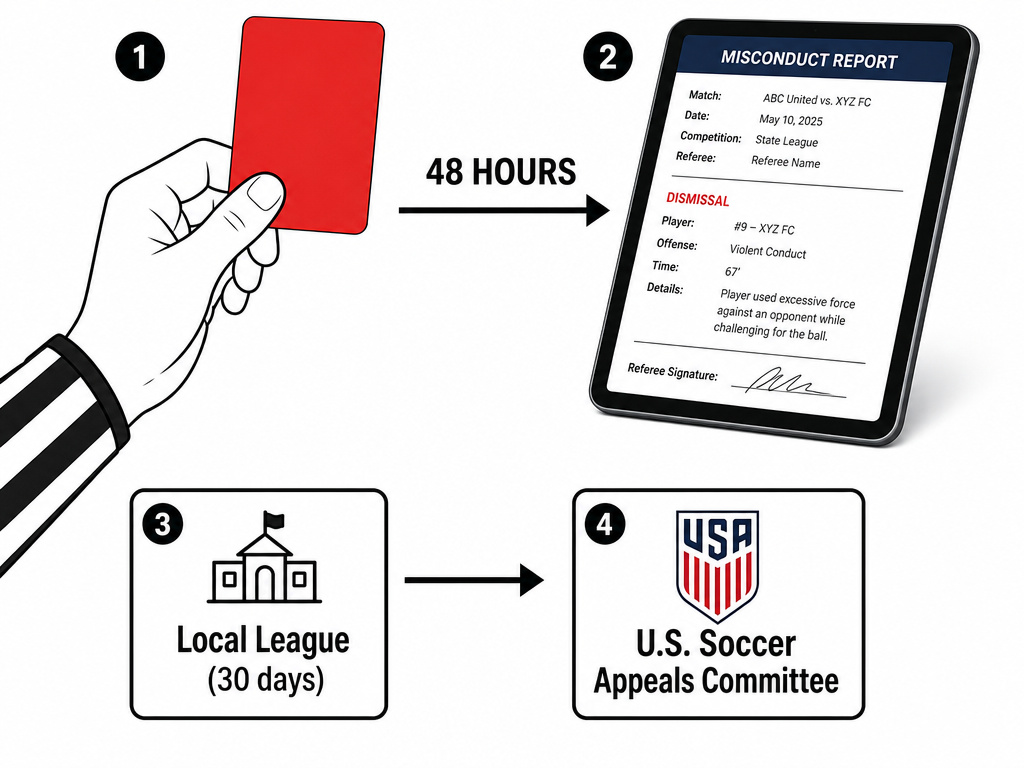
The game ends, but your job doesn’t. The mechanism that turns your red card into an actual suspension is the formal report. Policy 531-9 requires a written report to be submitted within 48 hours of the incident. For tournaments, notify the tournament director the same day, with a full report to the State Referee Administrator within 72 hours.
Your report must be factual, concise, and evidence-based. Include match details, a clear description of the incident, and any evidence like unaltered video clips or witness statements. Do not give opinions or recommendations.
There’s a crucial jurisdictional point here. The Member Organization affiliated with the match (like the local youth soccer league) has original jurisdiction to hold a hearing. However, if they fail to act within 30 days, the case automatically transfers to the U.S. Soccer Appeals Committee. The accused remains suspended during this transfer.
It’s worth knowing that the member organization is not obligated to inform you, the referee, of the hearing’s outcome. Your closure comes from knowing you triggered the process correctly.
The Standardized Penalty Grid: What the Offender Actually Faces
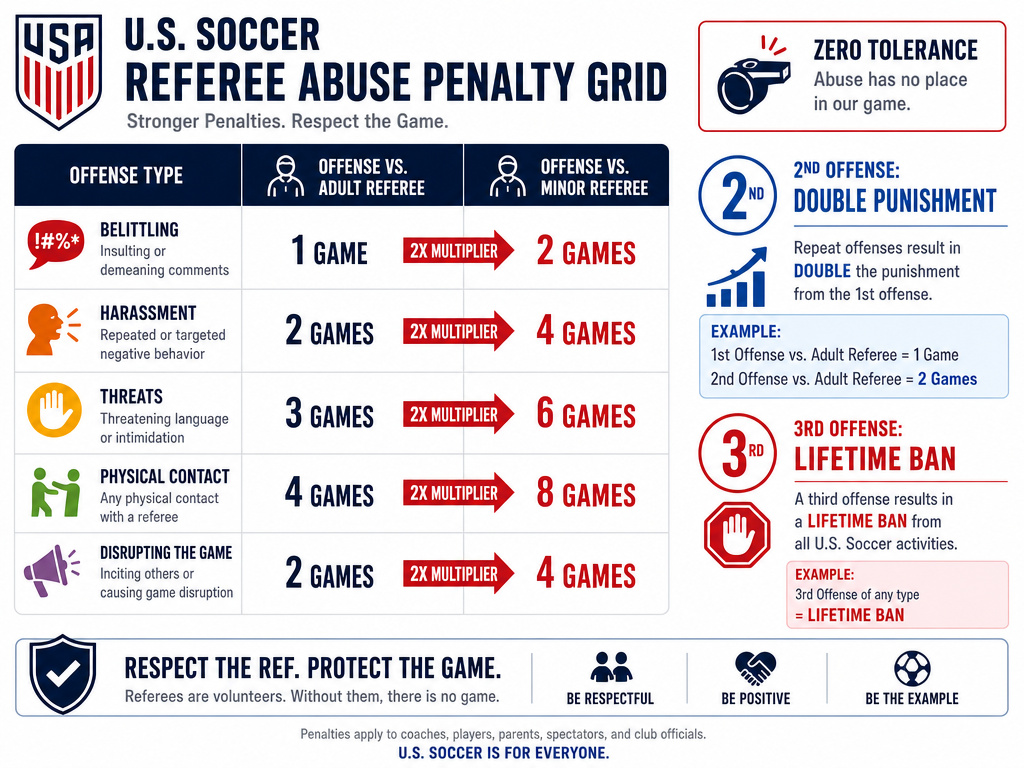
The U.S. Soccer Federation’s penalty grid shows how policy becomes punishment. The grid applies multipliers that dramatically increase penalties for adults who offend against minor referees.
For example, an adult committing a Non-Physical Level 1 offense (belittling) against an adult referee gets a 1-game minimum. That same offense by an adult against a minor referee triggers the “minor multiplier”, the penalty doubles to 2 games. For all physical offenses and non-physical Level 3 & 4 offenses against a minor, the multiplier is 3x.
Other key penalty factors from the U.S. Soccer matrix:
- Second-time offenders receive double punishment.
- Third-time offenders receive a lifetime ban.
- There is optionality for a 50% penalty reduction for a first offense from a minor.
This grid removes arbitrariness. A coach who gets in a referee’s face (Level 2 harassment) is looking at a minimum 4-game suspension, even for a first offense. The policy is designed to standardize consequences across the country.
After the Report: Mental Recovery and Legal Recourse
Filing the report closes the administrative loop, but it often opens an emotional one. The impact of abuse isn’t theoretical. The impact of abuse on referees can include significant distress and intentions to quit. Acknowledge that.
Your recovery is part of the job. Talk to your assignor or a referee mentor. Debrief with your crew. The Washington State Referee Committee recommends contacting your State Referee Administrator and assignor by the next business day just to make them aware, this starts a support chain.
If the incident was a physical assault, you have a legal right to pursue a separate path. Filing a police report at the venue is a step the Florida policy explicitly mentions. This isn’t about revenge; it’s about documenting a crime. The soccer suspension handles their participation in the sport; the legal system handles the assault.
Gaining Confidence as a Referee
Confidence comes from knowing the rules of the game and the rules of protection. You are protected from the moment you arrive at the venue until you leave, and that protection extends to your family or guests. This knowledge of how to deal with abuse as a football referee allows you to focus on officiating. Experience teaches you to use your best judgment on whether a situation crosses the threshold for abuse or assault, particularly for minor physical contact. Each match you officiate reinforces your understanding of where that line is. The policy’s detailed penalty grids for repeat offenders, including doubled punishments and lifetime bans, show that the system is designed to back you up as you build your career.
Frequently Asked Questions
What is considered referee abuse?
Under U.S. Soccer Policy 531-9, referee abuse is extreme, deliberate, non-contact behavior causing harm. It ranges from Level 1 (insulting, belittling) to Level 4 (discriminatory hate speech). Any of these acts should result in an immediate red card and a mandatory follow-up report.
Do I have to abandon the game if a spectator is abusive?
Not immediately. You must suspend the match and direct the team’s coach to remove the offending spectator. Use the “Ask, Tell, Dismiss” protocol with the coach only. If the coach fails to act in a timely or safe manner, then you abandon the match and leave the venue.
How long does the disciplinary process take?
The local Member Organization has 30 days from verifying the allegation to hold a hearing. If they don’t, jurisdiction moves to the U.S. Soccer Appeals Committee. The accused person remains suspended during any delay, so the timeline incentivizes a swift hearing.
What if the abuse happens online after the game?
Cyberbullying and doxing fall under Non-Physical Abuse Level 3 (Aggressive or Violent Threats). The reporting procedure is the same: file a detailed report with your State Referee Administrator within 48 hours, including screenshots as evidence. The penalties include a minimum 6-game suspension and a 3-12 month time penalty.
Can a referee be punished for falsely reporting abuse?
The policy and reporting forms stress factual, evidence-based accounts. Knowingly filing a false report would be a serious breach of ethics and likely subject the referee to their own disciplinary action from the state referee committee or assignor.
Before You Go
The system only works if you use it. That means showing the red card in the moment and then sitting down to write the report before the 48-hour window closes. The standardized penalties are harsh by design, a first offense for harassment is a 4-game ban because the culture needs a reset.
One final, personal stance: the best referees manage games long before a flashpoint. A clear pre-game talk with captains, consistent foul recognition, and calm communication can drain the tension that leads to abuse. But when it crosses the line, your job is no longer game management. It’s procedure. Follow it to the letter.
