
Football Scholarships Explained: The New Roster Cap Model
This post contains affiliate links. As an Amazon Associate, we earn from qualifying purchases.
Football scholarships are financial awards for playing, but the 2025 rule change flipped the model. For Division I programs, the old 85-scholarship headcount cap is gone, replaced by a 105-player roster limit with no NCAA cap on how many of those players can get aid. Division II uses 36 scholarship equivalencies, Division III offers no athletic scholarships, and NAIA allows 24. Most awards are partial, not full rides, and are renewed year-to-year by the coach.
That 105 number is a roster cap, not a scholarship guarantee. It creates room on the team, not a budget for 105 full scholarships. The money still comes from each program’s athletic department, and most outside the wealthiest conferences won’t fund every spot. This is the structural shift families are still catching up to, the ceiling moved, but the funding underneath it didn’t automatically expand. Understanding this system is a key part of having football scholarships explained.
What follows is a breakdown of the three scholarship models, what each division actually offers, and the questions you need to ask a coach to turn a percentage offer into a real four-year cost. We’ll also cover the non-scholarship paths and why the Ivy League doesn’t play this game at all.
Key Takeaways
- The 2025-26 rule change replaced fixed scholarship caps with roster limits for Division I; the 105-player roster cap is not a guarantee of 105 full scholarships.
- Most football scholarships are partial awards. Industry estimates suggest only about 1% of high-school athletes secure a full athletic ride.
- Division III and the Ivy League offer no athletic scholarships. Financial aid is based solely on academic merit and demonstrated need.
- Always ask a coach for the specific dollar value of a partial offer and whether it’s guaranteed for four years or renewed annually.
- Scholarships can be combined with academic aid, especially in Division II and NAIA, to build a more complete financial package.
The New 2025-26 Landscape: Roster Caps, Not Just Scholarships
The most common misread is treating the new Division I number as a scholarship count. It is not. Through the 2024 season, FBS football was a headcount sport with a hard limit of 85 scholarships. The NCAA Division I Board of Directors adopted new rules on June 23, 2025, effective July 1, 2025, moving football to an equivalency model with a 105-player roster limit.
Where this goes sideways: Assuming a 105-player roster means 105 full scholarships. The roster cap governs team size, not funding. A program can choose to put 50, 85, or 105 players on scholarship, and each award can be full or partial. The school’s budget decides.
This change, part of the broader House v. NCAA settlement, was structural. It gave coaches more flexibility in building a team but did not mandate new money. A program with a massive budget might fund all 105 spots. Others likely will not. This is why the first question for any recruiter should be: “How many of your 105 roster spots are fully funded for the coming year?”
The Three Scholarship Models: Headcount, Equivalency, and the New Roster Cap
You’ll hear three terms. Each dictates how money flows.
Headcount (The Old Model): Each scholarship counter was one full grant-in-aid. Think of the old 85-scholarship limit for FBS, if you were on scholarship, you got a full ride covering tuition, room, board, and books. Some sports, like basketball, still use this model.
Equivalency (The Division II/NAIA Model): The coach gets a pool of money equivalent to, say, 36 full scholarships. They can split it into any combination of partial awards. One player might get a 50% scholarship, another 25%, and they might give 100% to a star recruit. This is why most Division II offers are partial. With typical roster sizes, that 36-equivalency pool gets stretched thin.
Roster Cap (The New Division I Model): This is the 105 limit. There’s no NCAA cap on the scholarship money itself. A school could, in theory, give full rides to all 105 players. In practice, funding decides. The shift from a hard scholarship number to a roster number is the single biggest change in a decade, and it reframes the entire college football recruiting guide.
| Model | How It Works | Typical Family Experience | First Question to Ask |
|---|---|---|---|
| Headcount | One scholarship = one full ride. | Binary: full athletic aid or none. | “Is this a full grant-in-aid?” |
| Equivalency | Fixed scholarship value split among many athletes. | Partial awards are the norm. | “What is the exact dollar value of this percentage?” |
| Roster Cap | Team size is capped; scholarship funding is flexible. | Full rides possible, but budget-driven. | “How many roster spots are fully funded this year?” |
Scholarship Rules by Division: From Full Rides to No Athletic Aid
The division a school plays in sets the financial playing field. Getting this wrong, like assuming a D3 school can offer athletic money, wastes everyone’s time and misses a key point in the football scholarships explained overview.
NCAA Division I (FBS & FCS): Operates under the 105-player roster limit. Sources disagree on the nature of this limit: some state it is a roster limit with no NCAA scholarship cap (Wildaboutazcats.net), while others describe it as a maximum of 105 scholarships (NCSASports.org). 70% of Division I athletes receive some form of athletics aid. A full scholarship covers tuition and fees, room and board, and course-related books. However, not every program is “fully funded.” Some conferences even set lower limits for their members.
NCAA Division II: Uses the 36-scholarship equivalency model. According to the NCAA, 77% of all Division II athletes get athletics aid, but for football it’s usually partial. The smart move here is stacking athletic aid with academic merit money. A 25% athletic scholarship combined with a 50% academic award can cover most costs at a state school.
NCAA Division III: Offers no athletic scholarships. According to the NCAA, 80% of all Division III athletes receive nonathletics aid (merit/need-based). Coaches can advocate in admissions, but the financial aid office determines the package. Don’t dismiss D3; the net price after academic aid can be lower than a partial D2 offer.
NAIA: Allows 24 scholarship equivalencies. The model is similar to D2, partial awards are common, and stacking with academic money is expected. The recruiting calendar is less rigid than the NCAA’s.
Ivy League: A special case. These schools do not award athletic scholarships. All financial aid is need-based. A recruited athlete gets the same package as any other student with a similar financial profile.
Common mistake: Comparing a 50% offer at a D2 school to a 0% offer at a D3 school without running the net price calculator. The D3 school’s academic grant might make it cheaper.
How Do Roster Caps and Equivalencies Actually Work?

We’ll make the math concrete. This is where offers turn from percentages into real family budgets.
Imagine a Division II program with its 36 equivalencies. The coach has the monetary value of 36 full scholarships to allocate. If the roster has 90 players, they can’t give everyone a full ride. A typical approach might be:
- Give 10 blue-chip recruits a full scholarship (10 equivalencies used).
- Give 40 more players a 50% scholarship (20 equivalencies used: 40 players x 0.5).
- The remaining 40 players are walk-ons (0 equivalencies used).
- Total: 30 equivalencies used, 6 left in reserve for mid-year additions.
Now, a Division I FCS program under the new 105-player roster cap. The coach can carry 105 players. The athletic director gives them a budget that may be based on historical scholarship spending. The coach now has choices:
- Fund 63 players with full scholarships (using the old budget).
- Spread that same budget across more players, offering 80 players a 78% scholarship (80 x 0.78 = ~63 equivalencies).
- Any combination in between.
The roster limit expanded possibility, not necessarily funding. This is why the official NCAA student-athlete aid resources stress that scholarships are awarded by coaches and renewed annually, the budget is a moving target.
A full football scholarship covers tuition and fees, room and board, and course-related books. A partial scholarship covers some fraction of that cost and counts as the matching fraction of an equivalent.
The Recruiting Reality: How Offers Work and What to Ask
The offer letter is the starting line, not the finish. Coaches operate in a world of limited spots and uncertain yield. They often extend more verbal offers than they have scholarships, knowing some recruits will choose other schools.
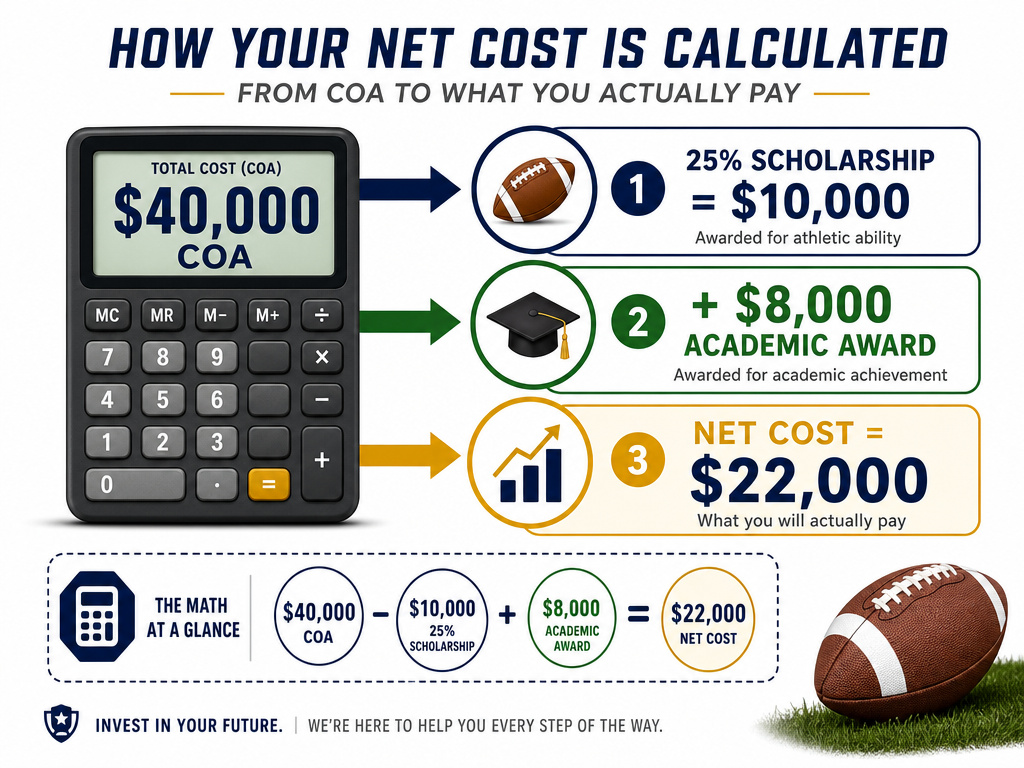
When you get an offer, you need to translate it. A “25% scholarship” is meaningless without the school’s total cost of attendance (COA). Here’s the drill:
- Get the COA: Find the full annual price (tuition, room, board, fees, books, personal expenses) on the school’s website. Say it’s $40,000.
- Calculate the Award: A 25% scholarship is $10,000 per year.
- Add Other Aid: Factor in academic scholarships, Pell Grants, or outside awards. Maybe you get an $8,000 academic award.
- Find Your Net Cost: $40,000 – $10,000 – $8,000 = $22,000 per year out-of-pocket.
Now you can compare offers across divisions. That $22,000 D2 cost might be higher than a $18,000 D3 cost after need-based aid. This financial reality, a critical takeaway from the football scholarships explained breakdown, shapes the entire pathway to college soccer in the US and every other sport.
Three non-negotiable questions for the coach:
- “Is this offer guaranteed for four years, or is it renewed year-to-year?” (Most are year-to-year).
- “What are the conditions for renewal?” (Usually, remain in good academic and team standing).
- “Can this athletic award be combined with my academic merit scholarship?”
Walk-Ons, Blueshirts, and Other Paths to the Roster
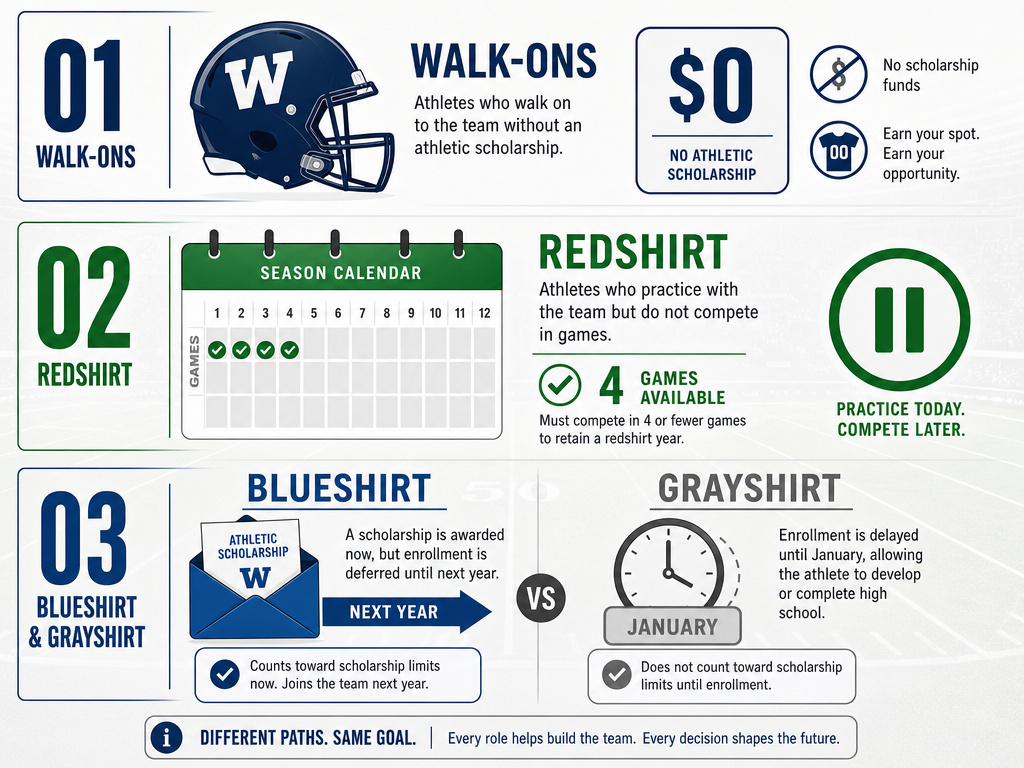
Not every player on the 105-man roster is on scholarship. Walk-ons are crucial for depth and practice squads. They receive no athletic aid but are full team members. The new roster cap actually benefits walk-ons, there are more roster spots available, even if they aren’t funded.
Then there are the “shirt” classifications that affect eligibility and scholarship timing:
- Redshirt: A player who practices with the team but does not compete in more than four games. They preserve a year of eligibility.
- Grayshirt: A recruit who delays full-time enrollment (often until January semester). They don’t practice or play in the fall, which pushes their eligibility clock back. This is often used when a program is over its initial counter limit.
- Blueshirt: A rare classification where an unrecruited walk-on is awarded a scholarship at the start of camp and counts against the next year’s scholarship limits.
These paths are complex, coach-driven, and highlight that making a roster often involves more strategy than just accepting an offer. Understanding them is as important as knowing the steps for joining a football academy.
How many football scholarships are there?
More than 500,000 college athletes compete across over 20,000 NCAA teams, but securing a full athletic ride is highly competitive. Industry estimates suggest only about 1% of high school athletes receive one. The landscape changed in 2025 when Division I football moved from a headcount sport with an 85-scholarship cap to an equivalency model with a 105-player roster limit. This roster limit is not a scholarship guarantee; schools are not required to fund every spot. Division II programs work from 36 equivalencies, and Division III offers no athletic scholarships. Coaches award scholarships year to year, and renewal is not guaranteed.
Frequently Asked Questions
Is every Division I football scholarship a full ride?
No. While the new rules allow for full scholarships, most programs outside the Power 4 conferences do not have the budget to fund 105 full rides. Partial scholarships remain very common in FCS and Group of Five FBS programs. Always ask what percentage of a full grant-in-aid the offer represents.
What is the easiest football position to get a scholarship for?
There is no “easy” position. Scholarship distribution is about team needs and the specific talent in a recruiting class. However, specialists (kickers, punters, long snappers) have far fewer scholarships allocated nationally, making those spots exceptionally competitive in a different way. Coaches often prefer to walk on a specialist and use the scholarship elsewhere.
How do football scholarships work with academic money?
They can usually be combined, a practice called “stacking.” This is most common in Division II and NAIA. An athletic scholarship is considered a resource, and the school’s financial aid office will typically allow academic grants to fill the gap up to the total cost of attendance. The NCAA official scholarship policy encourages combining aid.
Can a scholarship be taken away?
Yes. Athletic scholarships are one-year agreements renewed at the coach’s discretion. They can be reduced or not renewed for athletic performance, injury, violating team rules, or academic ineligibility. Schools must provide written notice by July 1 if they do not intend to renew.
Before You Go
The biggest shift in your planning should be this: separate the roster spot from the scholarship dollar. A place on a 105-man team is not a promise of payment. The real work starts when you get an offer percentage, stop there and convert it into a four-year net cost for your family.
If the numbers don’t add up, look at Division III or need-based Ivy League aid. The absence of an athletic scholarship isn’t a dead end; it’s a different financial equation. And for most families, that equation, not the badge on the helmet, decides what’s possible.
Start with the school’s net price calculator this week. Put in your financial details and see what a year actually costs. That number, more than any highlight film, tells you which divisions are in play. Everything else is just noise until you know what you can afford.
