
How to Play College Soccer in the USA: Step-by-Step
This post contains affiliate links. As an Amazon Associate, we earn from qualifying purchases.
To play college soccer in the USA, you must navigate two parallel tracks: meet the NCAA’s academic eligibility standards and proactively market yourself to coaches within a strict recruiting calendar. For Division I and II, this starts with registering at the NCAA Eligibility Center and completing 16 core courses, with Division I requiring a minimum 2.3 core-course GPA. While some sources suggest the process can begin early with coaches, other sources emphasize that the primary method is for the athlete to contact coaches themselves.
The academic rules are specific and fixed, but they’re just the gate. The real work is a years-long sales job where you are the product. You build a highlight video, email dozens of programs, and manage a timeline where Division I coaches can’t officially call you until June 15 after your sophomore year. Understanding how to play college soccer in the USA requires navigating this entire process.
What follows is the map for how to play college soccer in the usa: the divisions, the hard academic numbers, the year-by-year recruiting checklist, and the reality of the weekly grind once you get there. This isn’t about talent alone. It’s about organization.
Key Takeaways
- Register with the NCAA Eligibility Center if targeting Division I or II, it’s mandatory for final certification.
- Start emailing coaches early, but know that Division I coaches cannot call or message you for recruiting purposes until June 15 after your sophomore year.
- Aim for a 2.3 core-course GPA for Division I, with 10 of 16 core courses done before your seventh semester.
- Build your list wide, there are over 2,200 college soccer programs; most are not Division I.
- Expect a significant weekly commitment to athletics as a college player, with the offseason barely lighter.
Understanding the College Soccer Landscape
The first step in learning how to play college soccer in the usa is knowing where you might fit. This isn’t about picking a dream school; it’s about finding programs where your academic and athletic level matches the roster’s needs.
There are 2,215 college soccer programs in the U.S.: 1,212 women’s and 1,003 men’s teams. They are spread across several governing bodies, each with its own vibe and rules.
- NCAA Division I (562 programs): The highest level of competition and resources. The time commitment is intense, a median of 34 hours per week on athletics. Full-ride athletic scholarships exist but are rare; most offers are partial.
- NCAA Division II (460 programs): Strong competition with a greater emphasis on balance. The median athletic commitment is 32 hours weekly. Scholarships are available and the recruiting timeline can extend later.
- NCAA Division III (820 programs): No athletic scholarships, but significant academic aid is common. The focus is on the “student-athlete” model, with a median of 29 hours per week for sports.
- NAIA (373 programs): Similar to Division II in competitiveness, with more flexible eligibility rules and athletic scholarships. There is no NCAA-style recruiting calendar.
- Junior Colleges (NJCAA): A two-year pathway often used for development, improving grades, or gaining exposure before transferring to a four-year program.
The median Division I roster carries 28 players. When building your target list, look at the rosters of programs you like. If they have four returning players in your position for the next two classes, the roster spot you’re fighting for is tiny.
Common mistake: Chasing only the Division I badge. A player getting 90 minutes a game at a strong Division III school is in a better developmental position than one riding the bench at a low-tier DI program. The right level is where you play.
The Official Academic Hurdle: NCAA Eligibility
For Division I and II, your soccer ability is irrelevant if you don’t clear the NCAA’s academic bar. This process is centralized through the NCAA Eligibility Center, a separate entity from the colleges themselves.
You must register with the Eligibility Center, usually in your junior year of high school. They will certify your academic records and amateur status. Domestic Division III athletes are certified on campus, but international players enrolling at DIII schools must still use the Eligibility Center for amateurism certification.
The academic requirements for Division I are precise:
- Complete 16 NCAA-approved core courses.
- 10 of those 16 courses must be finished before the start of your seventh semester (junior year).
- Of those 10 early courses, 7 must be in English, Math, or Natural/Physical Science.
- Earn a minimum core-course GPA of 2.3.
NCAA academic eligibility requirements are not set by the college you choose. They are a national standard verified by the Eligibility Center. You can find the full breakdown in the official NCAA Eligibility Center guide.
International students with solely international academic credentials are exempt from the “10/7” core-course rule, but they must still meet the overall 16-course and GPA standards. Final athletics certification can be requested on or after April 1 for fall enrollment, or October 1 for winter/spring enrollment.
| Division | Eligibility Center Required? | Core-Course GPA Minimum | Athletic Scholarships |
|---|---|---|---|
| NCAA Division I | Yes | 2.3 | Yes (often partial) |
| NCAA Division II | Yes | Set by NCAA | Yes |
| NCAA Division III | No (for domestic students) | Set by school | No |
| NAIA | No (uses NAIA Eligibility Center) | Set by school | Yes |
The Recruiting Timeline: When Things Actually Happen
Recruiting is a calendar-driven game. The biggest surprise for most families is that for Division I, the coach cannot make the first recruiting contact. You can.
Freshman/Sophomore Year: This is your foundation phase. Focus on skill development and grades. Start building a highlight video. You can begin emailing coaches to introduce yourself, they can receive your materials and may reply with non-recruiting information. Attend ID camps for experience, not with expectation.
June 15 after Sophomore Year: This is the magic date. Per NCAA Bylaws 13.1.3.1 and 13.4.1, Division I coaches can now call, text, email, and send recruiting materials. Your proactive emails from earlier should have you on their radar.
Junior Year: This is the most critical period. Communication with coaches intensifies. You’ll take official visits. This is when most serious scholarship offers are made. Coaches are evaluating you on and off the field during the recruiting process.
Senior Year: If uncommitted, there is still time, many Division II, III, and NAIA spots are filled now. Finalize your Eligibility Center registration. Make your decision and sign your National Letter of Intent (NLI) on the first signing day, which for the 2026-27 cycle is November 11, 2026.
Division II and III coaches can message you at any time, and the NAIA has no recruiting calendar. The pressure of the DI date doesn’t apply everywhere, but the principle does: the player who organizes their credentials and reaches out early controls the process.
How to Get on a Coach’s Radar (The Real Work)
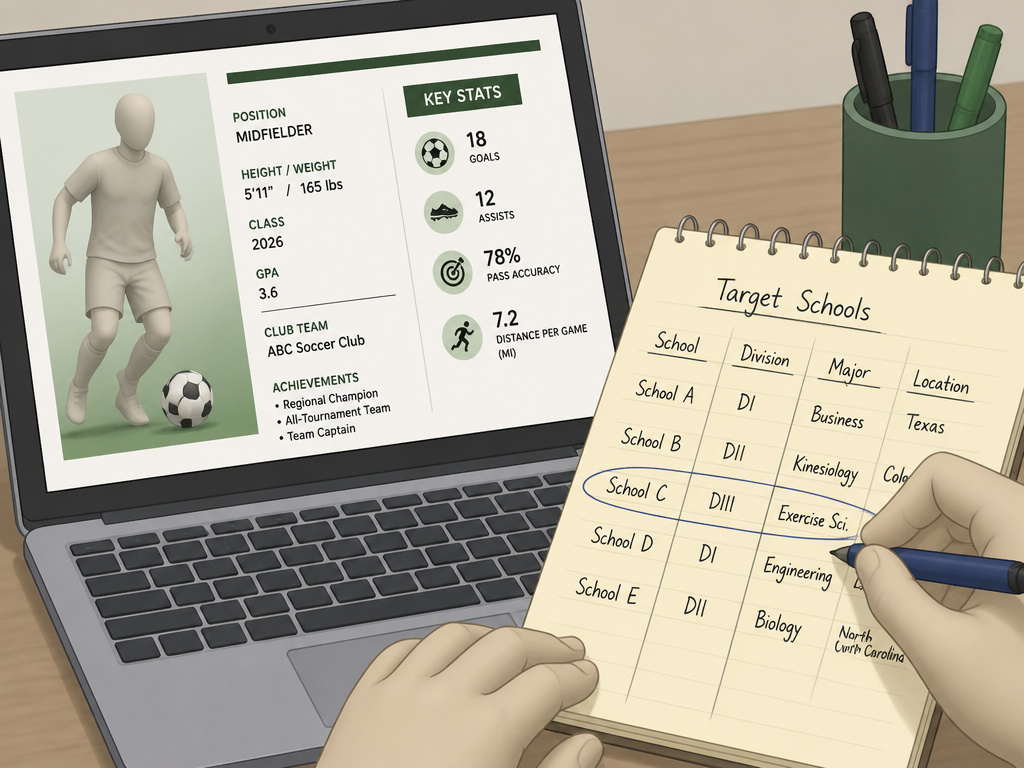
You get recruited by contacting coaches yourself. This is a sales and marketing project that lasts years. Here’s the five-part job, in order.
- Build a Realistic Target List. Start with 30-40 schools across multiple divisions. Use factors like academic major, team style, location, and roster depth at your position. Tools like Startline can show you roster composition by class year.
- Create a Coach-Friendly Profile. This is a one-page soccer résumé and a 3-4 minute highlight video. The video must be sharp: good footage, you circled before each clip, your best actions first. Coaches often decide in 60 seconds.
- Craft and Send Initial Emails. Keep them short. Include your graduation year, position, club, GPA, a sentence on why you like their program, and a link to your video. Send it to the head coach and assistant. This initial outreach is how you start the recruiting conversation.
- Follow Up Relentlessly. Send updates after tournaments, when you have new grades, or when your schedule changes. A polite email every 3-4 weeks keeps your name fresh. Attend the ID camps of schools that show genuine interest.
- Manage Visits and Offers. An unofficial visit (you pay) can happen anytime. An official visit (school pays) can only happen after specific dates, typically your junior year. Compare offers based on the full picture: scholarship amount, academic fit, and team culture.
A common pitfall is confusing interest levels. A mass invitation to a paid ID camp is marketing. A personalized email from a coach asking for your full game film is genuine interest. The difference is stark.
Life as a College Student-Athlete: The Time Commitment
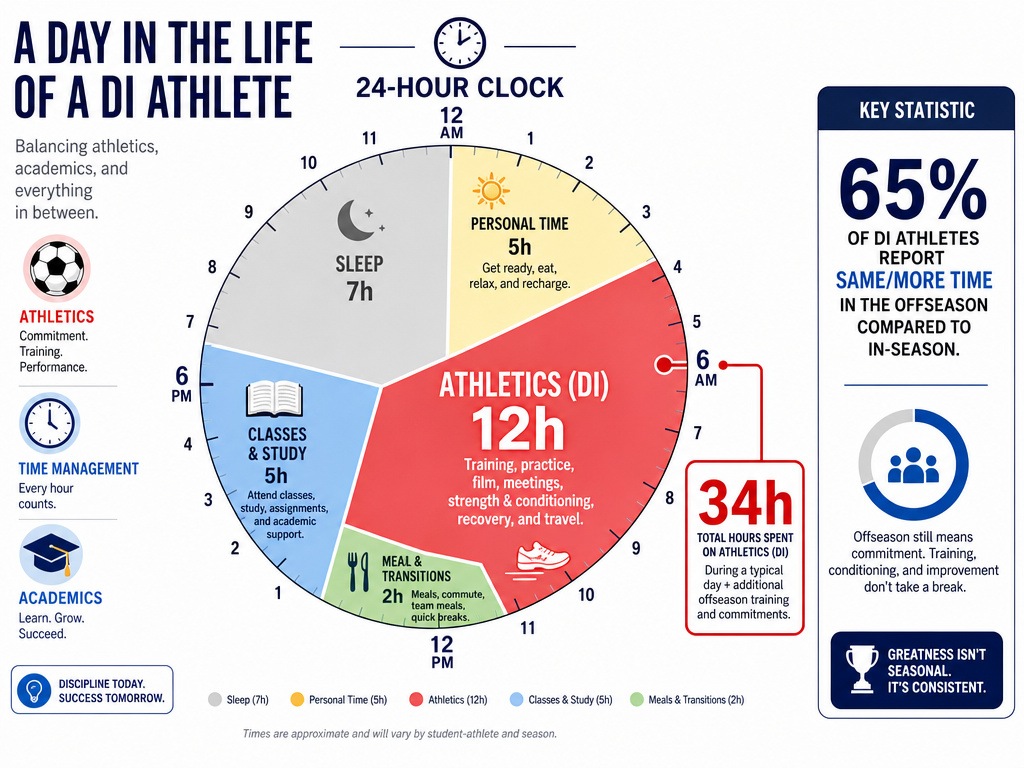
Making the team is one thing. Thriving on it is another. The NCAA GOALS study quantifies the reality: this is a part-time job on top of a full-time academic load.
The median weekly hours spent on athletics is 34 for DI, 32 for DII, and 29 for DIII. “Athletics” includes practice, games, strength training, film review, and mandatory meetings. During the season, your days are scheduled in blocks from 6 AM to 10 PM.
Where this goes sideways: Players don’t account for the offseason. The same study found 65% of DI and 64% of DII athletes reported spending the same or more time on athletics in the offseason. Summer is for conditioning packets and staying fit. The break is short.
For Division I and II (except specific sports like men’s ice hockey and skiing), you have a 12-month grace period after high school graduation to enroll full-time before eligibility penalties start. The balance is a skill you learn fast, miss a class for a road trip and you’re already behind.
Alternative Pathways: Walk-Ons, Tryouts, and Late Blooms
Not every roster spot is filled through traditional recruitment. There are other doors.
- Walk-Ons: This is typically an invited player who makes the team without an athletic scholarship. You usually need to have been in communication with the coaching staff. Being a “preferred walk-on” means they want you on the team but don’t have scholarship money for you.
- Open Tryouts: Some programs, especially at the Division II, III, or NAIA level, hold open tryouts at the start of the academic year. These are high-pressure, one-shot opportunities to impress. Your fitness and technical sharpness must be at a varsity level from the first whistle.
- Junior College Route: Playing one or two years at a JUCO allows you to develop, improve your grades, and get film against college competition. Coaches from four-year schools frequently recruit from the JUCO ranks.
- Post-Graduate Years: If you need more development time after high school, a post-graduate year at a prep school or academy can provide high-level games and exposure without starting your college eligibility clock.
These paths require exceptional self-motivation. You are betting on yourself without the safety net of a guaranteed spot. But for late-blooming players or those who fell through the recruiting cracks, they are a legitimate second chance. This shows that while the college system has rigid rules, determined players can sometimes find a way in through alternative pathways.
How to Use Recruiting Websites and Services
Recruiting platforms are tools to build your list and get your profile in front of coaches. They host databases of college programs and often provide a way to create a player profile. Use these services to research teams, understand roster composition, and identify coaches to contact. The primary recruiting method remains you reaching out directly to coaches with your information. A service can help organize your search, but it does not replace the work of making personal contact, sending your game film, and following up. Focus on platforms that help you take that direct action and manage your communication timeline effectively.
Frequently Asked Questions
How hard is it to get into D1 soccer?
It is highly competitive. With only 562 Division I programs and each carrying roughly 28 players, there are about 15,000 roster spots nationally. When you consider the thousands of high school and international players vying for them, the odds are long. Success requires a combination of high-level talent, academic qualification, and proactive, persistent recruiting work.
What GPA do you need to go D1 in soccer?
You need a minimum core-course GPA of 2.3 on your 16 NCAA-approved classes to be eligible for competition and athletics aid. However, to be admitted to the university, you will likely need a much higher overall GPA, often 3.0 or above, depending on the school’s academic standards. The 2.3 is the NCAA’s floor, not the university’s.
Can you play college soccer without being recruited?
Yes, primarily through walk-on invitations or open tryouts. A “walk-on” is usually a player the coaches are aware of and invite to join the team, often without a scholarship. “Open tryouts” are less common but do occur; they are a single-session audition where you must immediately standout among dozens of other hopefuls. Both paths are far less secure than traditional recruitment.
How do international players get recruited?
The process is similar but adds layers. International players must navigate visa requirements (typically an F-1 student visa), transcript evaluations, and often English proficiency tests (TOEFL/IELTS). Many use accredited agencies to help with placement and paperwork. Notably, over 30% of Division I men’s soccer players are foreign-born, so the pathway is well-established.
Are there age limits for playing NCAA soccer?
There is no specific age limit, but there are “grace period” rules after high school graduation. For most Division I and II sports, you have a 12-month grace period to enroll full-time before you start losing seasons of eligibility. Some sports, like Division I skiing, have longer grace periods (up to 3 years or the 21st birthday). If you compete organized competition after your grace period ends, you can lose one season of eligibility for each consecutive 12-month period.
Before You Go
The path to playing college soccer is a marathon of administrative boxes and personal advocacy. The athlete who succeeds is often not the most gifted 14-year-old, but the 17-year-old who can manage a spreadsheet of coach contacts, understand a GPA requirement, and edit a video clip.
Start with your grades. That’s the part you can control right now. Then build that first highlight video, it doesn’t need to be perfect, it needs to exist. Send ten emails to programs that genuinely interest you, not just the ones with the biggest stadiums. The response, or lack thereof, is your first real scouting report.
And remember, the system has over 2,200 doors. One of them fits your key. Your job is to find it, knock, and be ready to walk through.
