
How Football Trials Work: The Real Process Explained
This post contains affiliate links. As an Amazon Associate, we earn from qualifying purchases.
The real answer to how football trials work is that there are two parallel systems. Open trials are public tryouts, often for non-league or showcase events, while academy trials are almost always invitation-only assessments that follow strict Football Association (FA) rules like the 18-week maximum trial period and mandatory YD8 registration forms. The process you face depends entirely on your age and the level you’re targeting.
Most people picture a single, high-pressure day where a scout picks a star. That’s the movie version. The actual machinery of how football trials work is more about bureaucracy, extended observation, and a lot of paperwork.
What follows is a walkthrough of both systems, the open-day cattle call and the quiet, multi-week academy assessment, plus the unspoken rules that decide who gets the next look. This explains what happens on the day, what the person with the clipboard is actually noting, and how to tell a real opportunity from an expensive fantasy.
Key Takeaways
- Open trials are for visibility; academy trials are for verification. Big open days are for finding players scouts haven’t seen, while academy assessments confirm what they already suspect about a player they’ve invited.
- The FA caps formal academy trials at 18 weeks, with initial assessments commonly structured as a 6-week period. This is governed by Youth Development Rule 242 and requires a completed YD8 form before starting.
- Legitimate trials with professional clubs are typically free or low-cost. The FA and Action Fraud warn that anyone demanding a large advance payment for a “guaranteed” trial is likely running a scam.
- Scouts decide very quickly if you’re physically and technically ready. The rest of the trial is about your decision-making, attitude, and how you make players around you better.
- Your single best move after a trial is a short, polite follow-up email within 48 hours. Most players never do this, so it makes you memorable and shows professionalism.
The Two Main Types of Football Trial
You’re not just going to “a trial.” You’re entering one of two distinct recruitment funnels, and confusing them is the first mistake in understanding how football trials work.
The open trial is the classic image: a field full of hopefuls, numbered bibs, and drills. Clubs use these to cast a wide net, particularly for senior non-league teams, with many held in July and early August. They’re a numbers game. The other system is the academy assessment, which is how professional clubs operate for players under 16. Here, a scout has usually already flagged you. Your “trial” is often a 6-week period of coming to training one night a week with the age-group squad, not a single day.
The Football Association’s Youth Development Rule 242 stipulates a maximum trial period of 18 weeks for academy players. Before any such trial, the player and parents must complete a YD8 form, which is returned to the league.
Chris Robinson, Head of Academy Recruitment at Southampton FC, puts it bluntly: “Most better academies are moving away from the big set piece trials… They are very hit and miss.” The shift is towards extended assessment. A recommended player might be assessed over a few weeks, perhaps one night a week for six weeks, to see if they’re ready for a full trial.
Open Trials: The Showcase Model
These are your advertised events. A club or a private company like UK Football Trials organizes a day where anyone who pays and meets the age requirement can attend. The value here is exposure rather than a direct contract. At a well-run event, scouts from multiple clubs might be present.
The format is usually condensed and intense. For older players (15-28), a UK Football Trials event might run three hours: 100 minutes of coached training, a short break, then 70 minutes of 11v11 matches. Everything is filmed. The goal is to get your clip in front of scouts who wouldn’t otherwise see you.
Where this goes sideways: Paying a high fee for a vague promise. Legitimate open trials run directly by professional clubs are typically free or low-cost. If an event charges hundreds and guarantees “exposure to Premier League scouts,” treat it with extreme caution.
Academy Assessments: The Invitation-Only Path
This is how you actually get into an academy. A scout sees you playing for your grassroots team, your club coach recommends you, or you stand out at a development centre. The club then invites you in for a closer look. This isn’t a one-off.
You’ll train with the academy squad for a period that, as the FA rule states, can last up to 18 weeks but commonly starts as a 6-week observation. There’s often a mid-trial review to give feedback. The decision is made by consensus between recruitment and coaching staff. They are judging your ability along with how you fit into their environment, absorb instructions, and develop over time.
A Typical Trial Day Structure
Whether it’s a one-day open trial or the first session of a longer assessment, the structure on the ground follows a familiar pattern. Knowing it calms the nerves.
First, you’ll register and get a bib with a number. Scouts use these numbers to identify you on their clipboards. Then comes the warm-up, don’t treat this as filler. Coaches watch who is focused and moving with purpose from minute one. The technical drills come next: passing patterns, possession grids, small-sided games. This is where they check your first touch under pressure and your scanning habits.
The main event is the match, either small-sided or full-pitch. This is where your decision-making is laid bare. The session often ends with a fitness test or a cool-down. At some open trials, there’s a debrief. For example, UK Football Trials gives younger players a 15-minute talk with individual graded feedback on ten areas of their game.
| Phase | Duration | What Coaches Are Scanning For |
|---|---|---|
| Registration & Warm-up | 15-30 mins | Punctuality, preparation, basic athleticism. |
| Technical Drills | 45-60 mins | First touch, passing technique, body shape when receiving. |
| Small-Sided Games | 30-45 mins | Decision speed, spatial awareness, communication. |
| Full Match | 60-90 mins | Tactical understanding, work rate, consistency under fatigue. |
| Debrief/Cool-down | 10-15 mins | Coachability, attitude in success or disappointment. |
The rhythm is deliberate. It moves from controlled technique to chaotic decision-making. A player who looks great in drills but goes missing in the game has just told the scout everything they need to know.
What Scouts Are Actually Watching (It’s Not Just Skills)
You know they’re watching. But most players guess wrong about what’s on the checklist. Technique gets you in the door. Everything else gets you the contract.
The scout’s first filter is physical and technical: are you fit, and can you control the ball? That assessment is often made in the first ten minutes. After that, they’re looking for the cognitive and psychological traits that are harder to coach.
- Your eyes, not your feet. Are you scanning the pitch before you receive the ball? A player whose head is on a swivel signals they’re thinking a pass ahead. A player who only looks at the ball is reacting, not anticipating.
- Reaction to mistakes. Do you lose focus after a bad pass or a missed tackle? Or do you immediately work to win the ball back? Resilience is essential for scouts. They’d rather see a player who makes five mistakes but fights for five recoveries than one who plays safe and invisible.
- Communication without the ball. Shouting for a pass isn’t communication. Organizing a back line, pointing where you want support, encouraging a teammate after an error, that’s what they note. Silence is a negative mark.
- How you make others play. This is the big one. Do your movements create space for teammates? Does your passing choice make the next player’s job easier? A selfish player who beats three men but loses the ball is a liability. A simple player who constantly finds the right pass makes the whole team function.
I used to think the trial star was the one scoring screamers. Then I watched a scout for a Category One academy. He didn’t cheer a single goal. He spent the entire small-sided game watching a central midfielder who barely touched the ball but was constantly pointing, shifting, and closing passing lanes. That player got the invitation. The goal scorers didn’t.
Position-Specific Priorities
A scout’s checklist changes with your position. A one-size-fits-all approach will get you cut.
| Position | Primary Scout Focus | A Common Trial Mistake |
|---|---|---|
| Goalkeeper | Command of the box, distribution speed (feet and hands), communication. | Staying silent on crosses or back-passes. |
| Centre-Back | Defensive positioning, aerial dominance, ability to step out with the ball. | Just booting it clear instead of looking for a controlled outlet. |
| Full-Back/Wing-Back | Stamina to overlap, 1v1 defensive solidity, quality of crosses. | Getting caught too far up the pitch repeatedly. |
| Central Midfielder | Receiving under pressure, passing range, tactical discipline to hold shape. | Trying Hollywood passes every time and giving possession away cheaply. |
| Winger/Forward | Movement off the shoulder, finishing composure, work rate to press. | Staying static when the team is out of possession. |
The lesson is to play to your role’s requirements, not to the crowd. A defender who tries to dribble like a winger is telling the scout they don’t understand the job.
The Unspoken Rules: FA Regulations and Scam Red Flags
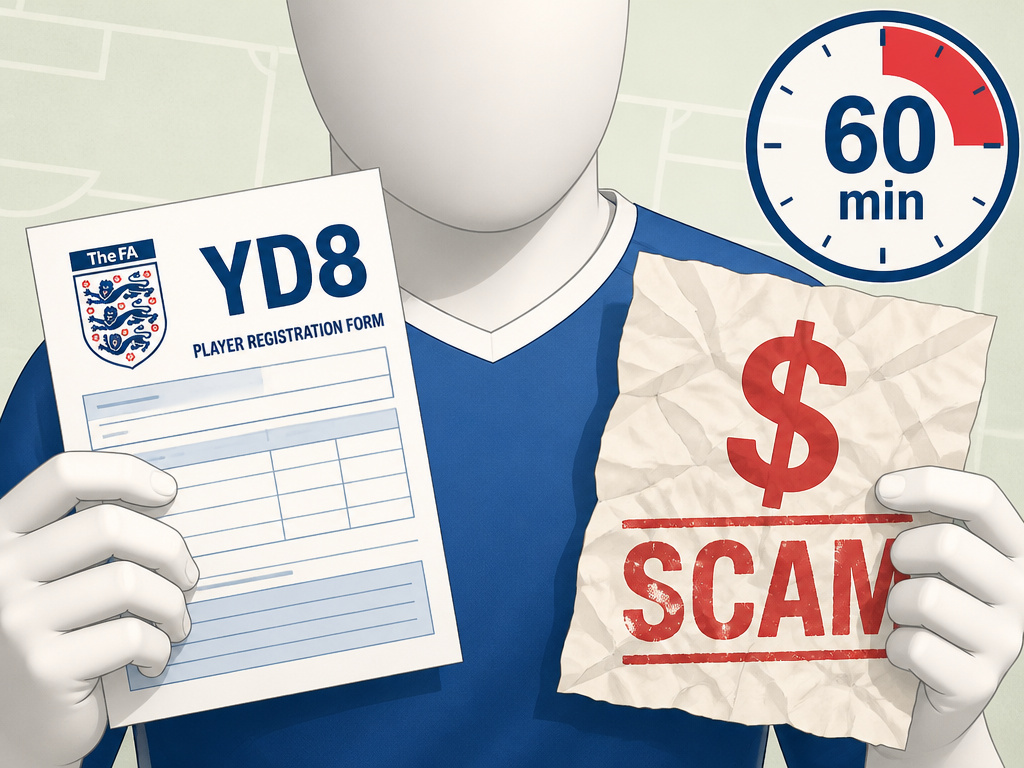
This is the part most people miss. The trial process is wrapped in bureaucracy and, sadly, fraud. Not knowing the rules can disqualify you. Not spotting the scams can cost you money.
The Football Association has clear youth development rules. The Football Association (FA) prohibits a player from undertaking trials with more than one club at the same time. The Football Association (FA) states a player cannot accept a trial if registered with another academy without the existing club’s consent. For younger age groups (Under-9 to Under-11), the FA specifies a maximum travel time of one hour for trials. However, sources disagree on rules for other ages; for example, one private trial company states under-13s must be within a 60-minute drive and 13-15 year-olds within 90 minutes.
Then there’s the paperwork. The YD8 form is mandatory for any academy trial period. It is a safeguarding and registration document. If a club doesn’t mention it, that’s a major red flag about their legitimacy.
Common mistake: Ignoring travel rules. One private trial company states under-13s must live within a 60-minute drive, and 13-15 year-olds within 90 minutes, for a club to sign them. Turning up from three hours away, no matter how good you are, can be an instant deal-breaker for an academy bound by catchment area policies.
The bigger danger is the outright scam. The FA and Action Fraud have issued repeated warnings.
- The Advance-Fee Fraud: Someone posing as an agent or club scout contacts you, promises a trial with a big club, and demands an upfront payment for “admin fees,” “travel guarantees,” or “accommodation.” Once paid, they vanish.
- The Expensive Showcase: A company charges hundreds for a “trial” that is really just a training session with no real scouts or club staff in attendance. The promise of “exposure” is entirely fabricated.
The rule is simple: Legitimate trials with professional clubs do not demand large advance payments. A small admin fee for an open day might be plausible, but any demand for significant money before you’ve even been seen is a signal to walk away.
After the Whistle Blows: The Post-Trial Process
The trial ends, and the silence begins. This is where anxiety peaks, but a little knowledge turns waiting into strategy.
For a one-day open trial, you might hear nothing at all. It’s a hard truth. If scouts were interested, they’d have taken your details via the organization. For a multi-week academy assessment, the process is more structured. There’s often a final meeting or a call from the recruitment officer.
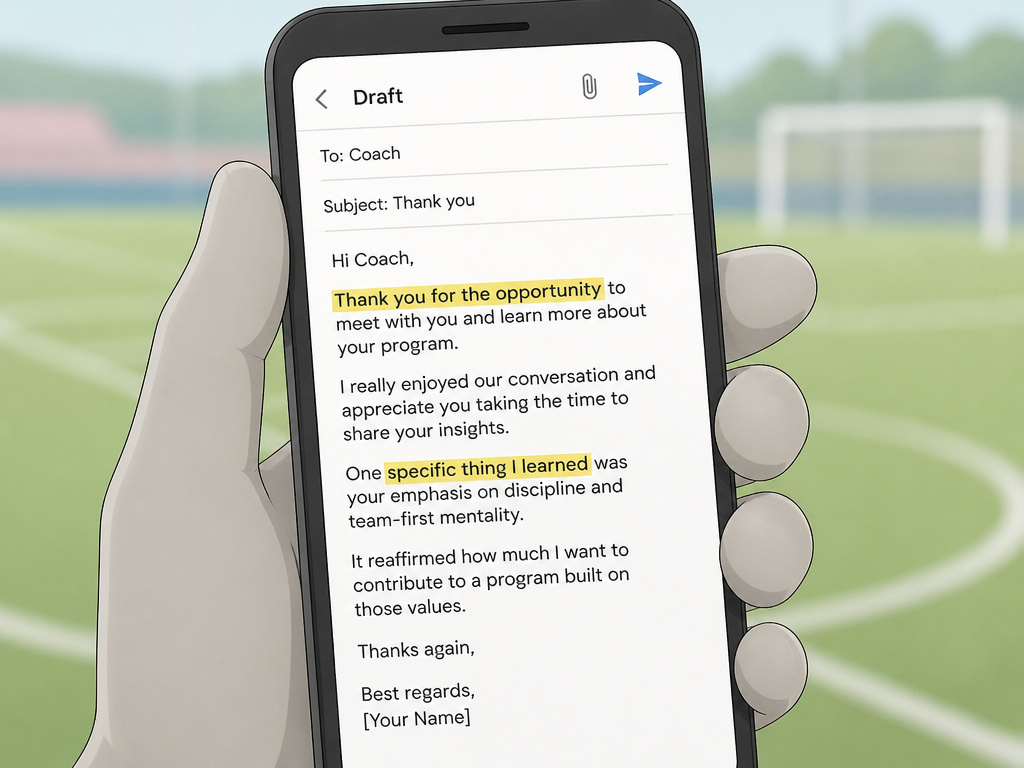
Your most powerful tool is the follow-up email. Send it within 48 hours, addressed to the main coach or scout you met.
- Keep it to three sentences.
- Thank them for the opportunity.
- Mention one specific thing you learned or enjoyed about the session.
- Politely say you look forward to hearing any feedback when they have a moment.
This is professionalism, not nagging. Most players never do it, so you immediately stand out. It also keeps your name fresh in their mind during deliberations.
If the answer is no, and you can, ask for one piece of feedback. Frame it as a development question: “Is there one area of my game you’d suggest I focus on improving?” You won’t always get an answer, but when you do, it’s gold dust.
For older players at the end of an academy pathway, there are structured next steps. The League Football Education (LFE) Assessment Trial is for players released after a two-year apprenticeship. These are held regionally in April and May and are attended by scouts from other clubs.
What level of fitness is required for a football trial?

There is no single fitness standard, as requirements vary by age and the type of trial. For a typical open trial event, which might last a few hours to a full day, you need to be prepared for sustained activity. This often involves a training session followed by a match. For academy assessments, which are more common and can last several weeks, you must show you can train consistently at a high level, often one night a week over a six-week period. The key is to arrive in condition to perform your technical skills under physical pressure throughout the entire evaluation, whether it’s a single day or a longer period.
Frequently Asked Questions
What should I bring to a football trial?
Bring two pairs of boots (molded studs and astro-turf trainers if possible), shin pads, water, and any necessary medication. Wear plain, non-branded training gear unless instructed otherwise. Arrive at least 45 minutes early to register, warm up properly, and get your bearings.
Can I get a trial if I’m over 16?
Absolutely. The pathway changes, but doesn’t close. Open age trials for non-league and semi-professional clubs are common. The location rules that bind academies (60-90 minute drives) no longer apply. Your route shifts towards performance in adult football, strong match video, and direct contact with club chief scouts or first-team managers.
How do I find genuine trials?
Start with official club websites, especially in the “Academy” or “Trials” section. For senior football, check the websites of non-league clubs in your area. Be wary of third-party aggregator sites that charge for listings, cross-reference any opportunity with the club’s own official channels before committing.
What are the odds of getting signed from a trial?
They are long, but not impossible. One private trial company reported that in one year, scouts requested the details of 426 players from their events, with about 1 in 6 getting scouted. Remember, “getting scouted” means interest, not a contract. An academy might invite dozens for assessment to fill one or two spots in a squad. The odds improve dramatically if you’re arriving via a personal recommendation or scout invitation rather than an open call.
Are paid football trials ever worth it?
It depends entirely on the operator. A fee to cover facility costs for a verified event with actual club scouts present can be a legitimate opportunity for exposure. Paying a large sum to a company that makes vague guarantees about “connections” is almost never worth it. Always ask: which specific club staff will be there, and what is their direct role in recruitment?
Before You Go
The trial is a test, but not in the way you think. It’s a test of your preparation, your composure, and your understanding of the game’s hidden geometry. The players who progress are the ones who see the pass before the space opens, and the ones who treat a mistake as a trigger to work harder, not a reason to hide.
Forget the idea of a single magic day. The path to join an academy or become a pro is built on consistent performance, whether that’s over a 6-week assessment or a full season in a competitive league. Use trials as a diagnostic tool. The feedback, even in the form of silence, tells you where you stand and what to work on next.
Your next move is to take one piece of actionable feedback, go back to your regular team, and work on it until it’s a strength, rather than searching for another trial immediately. Then you’ll be ready, not just hopeful, for the next look.
