
North West Derby History Explained: Head-to-Head Numbers
This post contains affiliate links. As an Amazon Associate, we earn from qualifying purchases.
The North West Derby is the football match between Liverpool and Manchester United. Its north west derby history explained is rooted in the economic and cultural competition between the two cities since the 19th century. The rivalry is defined by consistent competition for domestic and European trophies, a deep-seated historical enmity, and a scarcity of direct player transfers between the clubs.
That geographical and economic context is what separates this from a standard local derby. It’s not about two clubs from the same city fighting for neighborhood bragging rights. This is a clash of two regional powerhouses, each representing a distinct identity and history that has been in conflict long before football existed. The rest of this guide explains how that history shaped the rivalry, the key eras and matches that defined it, and how it compares to other footballing clashes around the world.
Key Takeaways
- The North West Derby specifically refers to Liverpool vs Manchester United, not Liverpool vs Manchester City or any other combination.
- The rivalry’s roots are in 19th-century industrial competition, notably the construction of the Manchester Ship Canal which bypassed Liverpool’s port.
- Head-to-head, the record is remarkably close, with United holding a slight edge in wins, but the trophy counts of both clubs are the primary measure of success.
- Direct player transfers between the two clubs are exceptionally rare, with Phil Chisnall in 1964 being the last move from United to Liverpool.
- The fixture’s intensity is amplified by distinct and antagonistic fan cultures, including specific chants and banners that reference shared tragedies.
What is the North West Derby in Football?
If you hear “North West Derby,” the speaker is talking about Liverpool versus Manchester United. Full stop. This clarification is necessary because the phrase contains a geographic term, “North West”, and a place name, “West Derby,” which is actually a suburb of Liverpool. That linguistic overlap causes confusion. The Hundred of West Derby was a historical administrative division of Lancashire, not Derbyshire. But in football parlance, the “North West Derby” has one meaning, a point clarified in any proper north west derby history explained.
It is the defining rivalry of English football. While the Merseyside derby (Liverpool vs Everton) is local and familial, and the Manchester derby (United vs City) has grown in recent decades, the clash between England’s two most successful clubs carries a unique weight. The rivalry encompasses competition for every major trophy, a historical cultural clash between the cities, and a mutual antipathy that rarely, if ever, sees players move directly between the clubs.
The term “North West Derby” refers exclusively to the fixture between Liverpool Football Club and Manchester United Football Club. It is distinguished from local derbies by the 35-mile distance between the cities and the scale of the clubs’ global support and historical success.
The Industrial and Football Rivalry Origins
The cities didn’t need football to dislike each other. By the late 19th century, Manchester was the world’s first industrial city, a powerhouse of cotton milling. Liverpool was its gateway to the world, a booming port where raw materials arrived and finished goods were exported. Liverpool’s docks and merchants levied significant charges on Manchester’s goods.
Manchester’s response was the Manchester Ship Canal, opened in 1894. It was a direct, deliberate piece of economic warfare, a 36-mile canal that allowed ships to bypass the Port of Liverpool entirely and sail right into the heart of Manchester. It crippled Liverpool’s port trade and cemented a relationship of resentment. When Liverpool Football Club was founded in 1892 and Manchester United (as Newton Heath) in 1878, they inherited this pre-existing civic rivalry. The football pitch became the new arena for a very old conflict.
The Historical Timeline of the Rivalry
The rivalry evolved in distinct eras, often mirroring the fortunes of English football itself.
The Early and Mid-20th Century (Pre-1960s): Matches were fierce but the clubs weren’t the dominant forces they would become. United had the Busby Babes, a tragic and beloved team, while Liverpool was a strong second-division side. The rivalry was present but not yet the national obsession.
The Shankly and Busby/Revie Era (1960s-1970s): This is where the modern rivalry crystallized. Bill Shankly transformed Liverpool into a relentless trophy-winning machine. Meanwhile, Matt Busby rebuilt United after the Munich Air Disaster, winning the European Cup in 1968. The two charismatic Scottish managers, Shankly and Busby (and later Don Revie’s Leeds), fought for supremacy. Liverpool began their era of dominance, but United had the first European crown, a point of pride and contention.
The Ferguson Challenge (1990s-2013): For decades, Liverpool’s trophy cabinet grew while United languished. Then came Alex Ferguson. His explicit mission, stated early on, was to “knock Liverpool off their fucking perch.” His 26-year reign did exactly that. United overtook Liverpool in league titles (20 to 19, currently) and dominated the new Premier League era. This period changed the rivalry from one of Liverpool’s historical superiority to a desperate battle to reclaim status. The clashes were often volatile, featuring iconic players like Steven Gerrard, Jamie Carragher, Ryan Giggs, and Paul Scholes.
The Modern, Post-Ferguson Era (2013-Present): With Ferguson retired, the rivalry has lacked the same consistent title conflict, as both clubs have faced cycles of rebuilding and challenges from Manchester City and others. Yet, the fixture loses none of its sting. It remains the most-watched domestic club match in world football, where seasons can be defined and managers judged, regardless of league position.
| Era | Defining Feature | Key Figures | Power Balance |
|---|---|---|---|
| Pre-1960s | Civic rivalry sets foundation | N/A | Largely even, neither dominant |
| 1960s-1970s | Managerial clash & domestic rise | Shankly, Busby | Liverpool’s domestic ascendancy begins |
| 1990s-2013 | United’s dominance & title race war | Ferguson, Gerrard, Keane | United overtakes Liverpool in titles |
| 2013-Present | Cyclical rebuilding, global spectacle | Klopp, various managers | Neither consistently dominant; fixture defines seasons |
Head-to-Head: The Numbers Behind the Rivalry
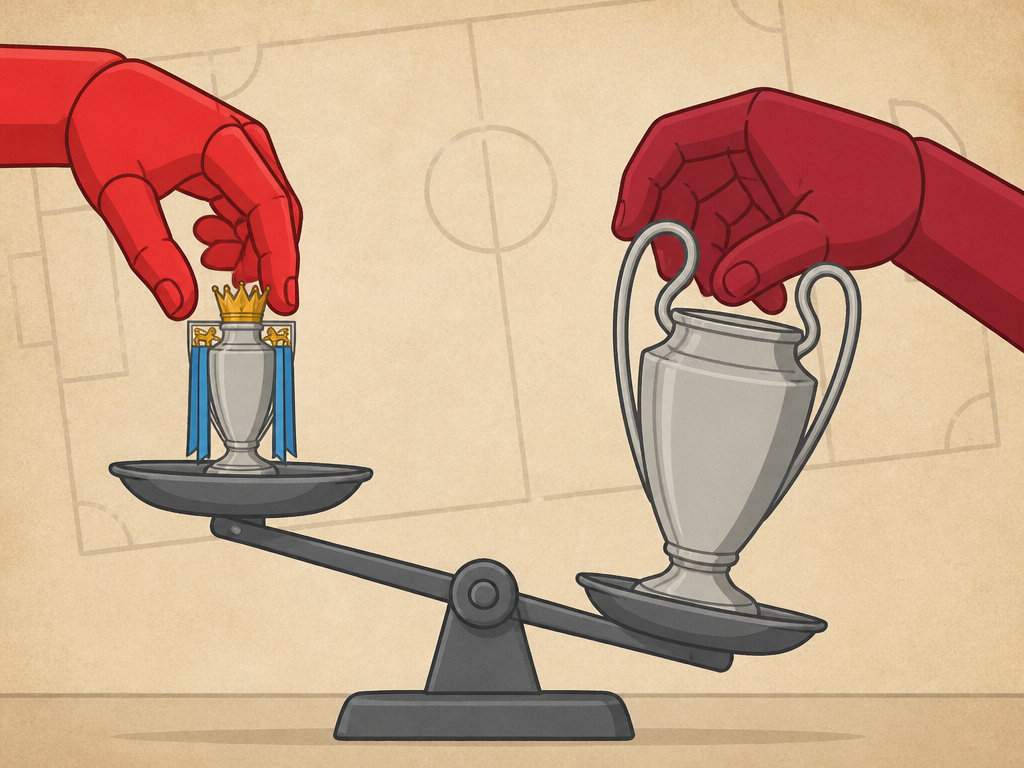
The statistical record reflects the rivalry’s competitiveness. Across all competitions, the wins, losses, and goals are strikingly close. Manchester United holds a slight historical edge in total wins, but the margin is narrow enough that a few key results can shift the narrative. What the raw numbers can’t capture is the weight of when those wins occurred, a last-minute winner at Anfield, a victory that clinches a title, or a comeback in a cup semi-final.
Where this goes sideways: Focusing only on the all-time win count. The real story is in the trophy haul and the victories that decided championships. A 1-0 win in a mid-table season stings, but a 2-1 win that denies your rival the league title echoes for decades.
For fans, the most cited statistics are the league titles (United 20, Liverpool 19) and European Cups (Liverpool 6, United 3). This inverse success, domestic vs. European, fuels endless debate. Liverpool supporters brandish their European pedigree as proof of greater stature on the ultimate stage. United fans point to their unparalleled domestic supremacy in the Premier League era. The head-to-head record is the weekly battleground, but these trophy counts are the war’s final score.
The Rivalry in Fan Culture and on the Terraces
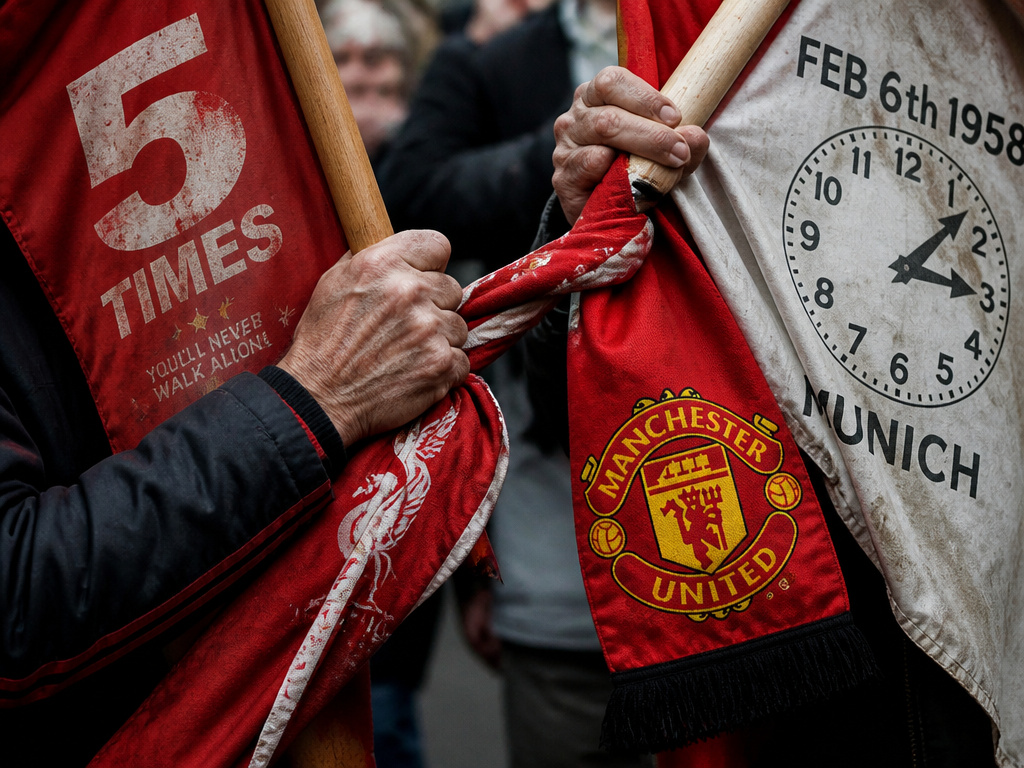
The atmosphere inside Anfield or Old Trafford on derby day is electrically hostile. This isn’t playful banter; it’s a 90-minute expression of deep-seated identity. The chants are weaponized history.
Liverpool fans sing about Munich. United fans sing about Hillsborough. These are not mere taunts; they are the nuclear option, using the other club’s most profound tragedies as a cudgel. It is the darkest, most condemned aspect of the rivalry, yet it persists, illustrating the depth of the animosity. Beyond the tragedies, the songs catalogue the rivalry’s history: United fans crowing about “20 times” to the tune of “Show Me the Way to Go Home”; Liverpool fans reminding them of “Five Times” in Europe.
The culture of football fans in this fixture is also about banners and symbolism. The Munich clock, the “5 Times” flag, references to Heysel and Hillsborough, the visual landscape is a silent, potent echo of the songs. This intense fan culture is what makes a televised match feel like a live wire. You can hear the history in every shout and see it in every unfurled flag.
How It Compares to Other Major Football Rivalries
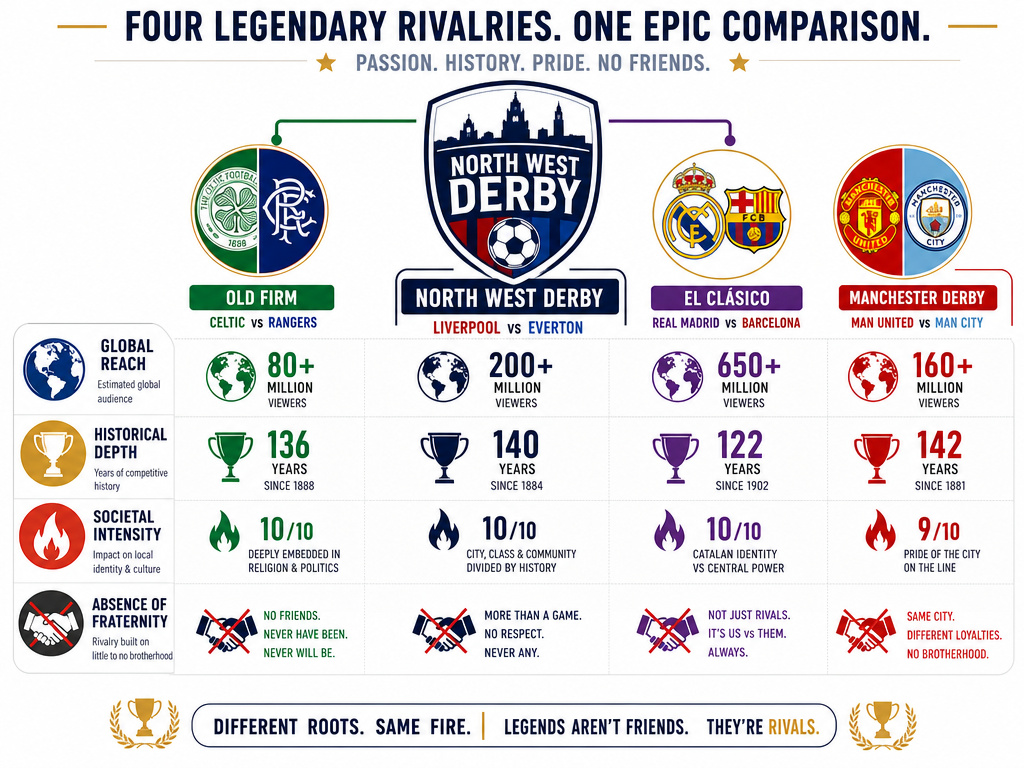
Is the North West Derby the biggest in the world? It has a strong claim, but it exists in a global pantheon.
- The Old Firm Derby (Celtic vs. Rangers): This is arguably more intense on a week-to-week, societal level, fused with religious and political identity in Glasgow. However, the North West Derby has a far greater global commercial reach and, in the modern era, more consistent relevance on the European stage.
- El Clásico (Barcelona vs. Real Madrid): For most of the 21st century, this was the biggest club fixture globally, featuring Messi and Ronaldo. Its rivalry is also deeply political (Catalonia vs. Castile). While El Clásico might edge it in global TV ratings during the peak Messi-Ronaldo years, the North West Derby’s roots are older, its hostility is arguably more visceral in the stadium, and it lacks any recent direct player exchanges, unlike the occasional transfer between Barcelona and Madrid.
- The Manchester Derby (United vs. City): This is a rising force, especially since City’s financial takeover. It’s now a direct title-deciding clash. But it lacks the historical depth and global legacy of the Liverpool-United rivalry. The Manchester derby is about current supremacy; the North West Derby is about eternal supremacy.
The North West Derby’s unique blend is its foundation in non-football history, its perfect balance of historical success (trophies are close enough to argue over), and its complete absence of fraternity between the clubs. That last point is crucial.
The “No-Transfer” Rule and Shared History
Most major rivalries see the occasional controversial transfer. Sol Campbell from Tottenham to Arsenal. Luis Figo from Barcelona to Real Madrid. The North West Derby has almost none. The last direct transfer from Manchester United to Liverpool was Phil Chisnall in 1964. In the other direction, it was way back in 1912. This isn’t an accident or a statistical quirk; it’s a cultural embargo.
Players understand that crossing that divide is the ultimate betrayal. Peter Beardsley and Michael Owen played for both, but via other clubs, which somewhat dilutes the treason. Paul Ince was called a “big-time Charlie” by Roy Keane for joining Liverpool, but even that was after a stint in Italy. This self-enforced blockade reinforces the idea that the clubs exist in separate, opposed universes. It makes the rivalry purer and more absolute than almost any other.
Frequently Asked Questions
What is the history of West Derby?
West Derby is a suburb of Liverpool, not a reference to the football rivalry. Historically, the Hundred of West Derby was an important administrative division of Lancashire dating back to the Norman period. It was bounded on the west by the Irish Sea and River Mersey. This historical place name is often confused with the football term “North West Derby,” but they are separate subjects.
Is the North West Derby Liverpool vs Manchester City?
No. This is a common modern point of confusion due to Manchester City’s rise. The North West Derby is specifically Liverpool vs Manchester United. The match between Liverpool and Manchester City is a major fixture and title-deciding clash, but it does not carry the historical derby title. The Manchester derby is United vs City.
What was the most memorable North West Derby match?
Picking one is impossible for fans, but several are iconic. The 1994 3-3 draw at Anfield, with a last-minute equalizer, is legendary for its drama. The 2009 4-1 United win at Old Trafford was a brutal demonstration of power at Liverpool’s expense. More recently, Liverpool’s 5-0 win at Old Trafford in 2021 and the 7-0 victory at Anfield in 2023 are historic results that will be sung about for generations.
How does the North West Derby affect Premier League title races?
Historically, it has been decisive. Throughout the 1990s and 2000s, results in this fixture often swung the title momentum between United, Liverpool, and Arsenal. In the 2008/09 season, United’s victories over Liverpool were crucial in pipping them to the title. Even when both aren’t top, the match can derail a rival’s confidence and campaign in a way no other fixture can.
What are the common chants in the North West Derby?
The chants are a dark folklore. United fans sing “Always the Victims” and “Murderers,” referencing Hillsborough. Liverpool fans retaliate with chants about the Munich Air Disaster. Beyond the tragedies, United fans sing “20 Times” about their league titles. Liverpool fans counter with “Five Times” (now “Six Times”) about European Cups and “Have you ever seen Gerrard win the league?” It’s a sonic war of historical grievances.
The Bottom Line
The North West Derby is more than a football match. It’s the recurring climax of a story that started with ship canals and industrial jealousy. It measures success not just in goals but in decades of bragging rights over league titles and European Cups. The rivalry is kept raw by a fan culture that weaponizes history and a silent pact that stops players from crossing the divide.
For all the talk of other derbies, none combine the historical depth, the global scale, the competitive balance, and the sheer, unadulterated hostility of Liverpool versus Manchester United. It’s the fixture that defines seasons, ends managerial tenures, and reminds everyone that some arguments in football are never settled, they’re just paused until the next kick-off.
