
GPS Vests in Football Explained: The Goalkeeper Exception
This post contains affiliate links. As an Amazon Associate, we earn from qualifying purchases.
GPS vests in football are wearable sensor pods that track player performance and workload. They use a combination of GPS and inertial sensors to collect a vast amount of data, measuring metrics like distance, speed, acceleration, and heart rate. Their use is governed by strict safety regulations, primarily IFAB Law 4, which mandates they are not dangerous and are certified under the FIFA Quality Programme for EPTS. While generally safe, a 2018 study found a specific injury risk for goalkeepers wearing chest-mounted devices.
You see them under every training top now. That tight black vest, the pod nestled between the shoulder blades. It’s not a fashion choice or a new kind of sports bra. It’s a piece of equipment that has quietly changed how the game is managed off the pitch, and the topic of gps vests in football explained is how this data works. The data it spits out decides who trains tomorrow, who needs a rest, and sometimes, who gets subbed.
But the technology is only half the story in the gps vests in football explained. The real conversation happens in the rulebook and the equipment room. What’s allowed in a match? What happens if a player lands on the pod? And why does the shirt a player wears over it matter as much as the sensors inside it? We will examine its design.
Key Takeaways
- Match-legal GPS vests must be FIFA Quality Programme certified, a standard for which devices had to be tested and approved before 1 June 2018 to be eligible for use in official competitions.
- The primary injury risk isn’t from the pod itself but from tight vests causing abrasion, with a 2018 study showing 0.21 skin abrasion injuries per 1000 playing hours for under 18 team players and 0.39 for under 19 team players from upper-back worn EPTS vests.
- Goalkeepers face a unique risk; a 2018 study documented 3.17 chest contusions per 1000 playing hours for female goalkeepers when devices were worn on the sternum.
- Under IFAB Law 4, the device must not be attached to the match shirt and must have no protruding parts that could endanger any player.
- Sensors in the Catapult Vector S7 pod, like its accelerometer and gyroscope, sample movement data at up to 1000 Hz, turning a training session into millions of data points for load management.
How the Vest Actually Works (It’s Not Just GPS)
Forget the simple idea of a car satnav. A modern GPS vest pod is a suitcase of sensors. The GPS module, often a 10Hz GNSS receiver, pins your location on the pitch. But GPS alone is fuzzy, especially when changing direction quickly. That’s where the inertial measurement unit (IMU) takes over.
Inside a pod like the Catapult Vector S7, a tri-axial accelerometer, a gyroscope, and a magnetometer all work together, each sampling data at up to 1,000 times per second. The accelerometer feels every jolt and step. The gyroscope senses rotation, that sharp turn, that spun finish. The magnetometer acts as a compass. Fuse these streams with the GPS signal, and you get a precise, second-by-second map of movement. Add a heart rate monitor, and you have the full picture: the external load and the internal cost.
A single pod like the Catapult Vector S7 can capture over 1,250 data points every second. Over a 90-minute session, that’s a torrent of raw numbers waiting to be translated into decisions.
This is the core of modern player tracking data. It tells a coach not just that a midfielder ran 12km, but that 2.1km of it was high-intensity, that they made 47 accelerations over 3 m/s², and that their heart rate spent 22 minutes in the red zone. It turns intuition into evidence.
The 3 Non-Negotiable Safety Rules (and the One That’s a Myth)
The image of a hard plastic pod on a player’s spine rightly raises questions. Football’s lawmakers did more than just hope for the best. They built a regulatory wall. The foundation is IFAB Law 4, which permits Electronic Performance and Tracking Systems (EPTS) as an exception to the rule against electronic equipment.
The rules are specific and physical. First, the device must not be attached to the shirt. It lives in its own vest. Second, it must not be dangerous to the wearer or any other player, no sharp edges, no clumsy neck fastenings. Third, it can have no parts extending out from the surface. The pod must sit flush.
The myth is that this is a casual approval. The real safety gate is the FIFA Quality Programme for EPTS. To be certified for use in official competitions, a device must pass a battery of tests outlined in FIFA’s official handbook. One key test simulates a player falling directly onto the pod. The device must be conditioned at 23°C ±2°C and ambient humidity for 12 hours before impact, and the test itself must happen in a room between 20°C and 26°C. This isn’t guesswork; it’s a laboratory standard for a contact sport.
| Rule (IFAB Law 4) | Practical Meaning | Common Misstep |
|---|---|---|
| Not attached to the shirt | Worn in a separate vest or harness | Trying to sew a pouch into the match jersey |
| Not dangerous to any player | No sharp edges; smooth, rounded casing | Using a generic hard case not designed for impact |
| No protruding elements | Pod sits completely flush with the vest surface | A poorly designed clip or button sticking out |
Where does the risk actually live? Not in dramatic fractures, but in the mundane. A 2018 scientific study on GPS vest safety from Sheffield Hallam University broke it down. For youth players wearing vests on the upper back, injuries were almost exclusively minor skin abrasions, with a 2018 study reporting 0.21 injuries per 1000 playing hours for an under 18 team and 0.39 for an under 19 team. The cause? An excessively tight vest, not the pod. The lesson is simple: comfort is a safety feature. A vest that chafes is a vest that’s worn wrong.
Training vs. Match Rules: When Can They Actually Wear It?
This is where the practicality hits. In training, the vest is a free agent. Clubs use them daily to monitor load, tailor sessions, and avoid overtraining. The data flows freely to the laptops of analysts and sports scientists.
Matchday is a different protocol. The laws allow EPTS use in official competitions provided the competition organiser ensures the technology is safe, FIFA-certified, and that the data is reliable and accurate. The competition organiser must ensure the technology is safe and FIFA-certified. They also must guarantee that the data stream to the technical area is reliable and accurate. This shifts liability from the player to the league or federation.
In practice, most clubs use vests only in training. But for those that do use them in matches, the rule is absolute: the vest is worn under the match jersey, invisible and secure. No exceptions. This separation is crucial for equipment managers. A training top can be chosen for its compatibility with the vest. A match jersey has different requirements, tighter fit, lighter fabric, official branding, that must not compromise the safety or function of the device underneath.
Where this goes sideways: Assuming match approval is automatic. Each competition must explicitly approve the use of specific, certified devices. Using an uncertified vest in a match is a breach of Law 4.
The Goalkeeper Exception and Other Hidden Challenges
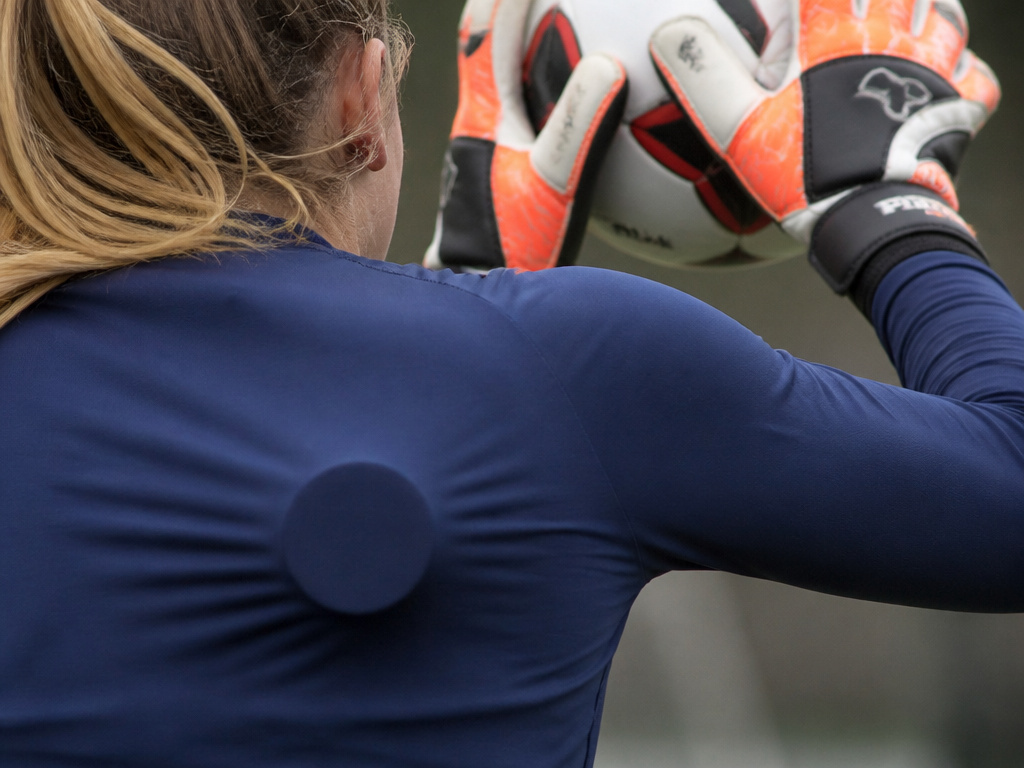
The safety standards assume an upper-back placement. For goalkeepers, that assumption can break down. The Sheffield Hallam study flagged a specific scenario: female goalkeepers wearing a device on a chest strap. Here, the reported contusion injury rate for female goalkeepers was 3.17 per 1000 playing hours. The pod became a focal point for impact energy from the ball. For outfield players, the risk is abrasion. For a keeper in a drill, it can be a direct blow.
The other silent challenge in the gps vests in football explained is kit management. That vest and pod create a hard, warm point on the upper back. The training top worn over it isn’t just a shirt; it’s part of the sensor system. According to equipment specialists, it needs to check three boxes:
- No seam directly over the pod (or it rubs raw).
- Fabric that manages heat buildup from the electronics.
- A consistent, snug fit to stop the pod shifting and killing data accuracy.
A loose top means a sliding pod, which means garbage data. It’s a small detail that changes the value of the entire expensive system. This is why savvy clubs consider training equipment as an integrated system, not a collection of parts.
What the Data Actually Tells a Coach (And What It Misses)
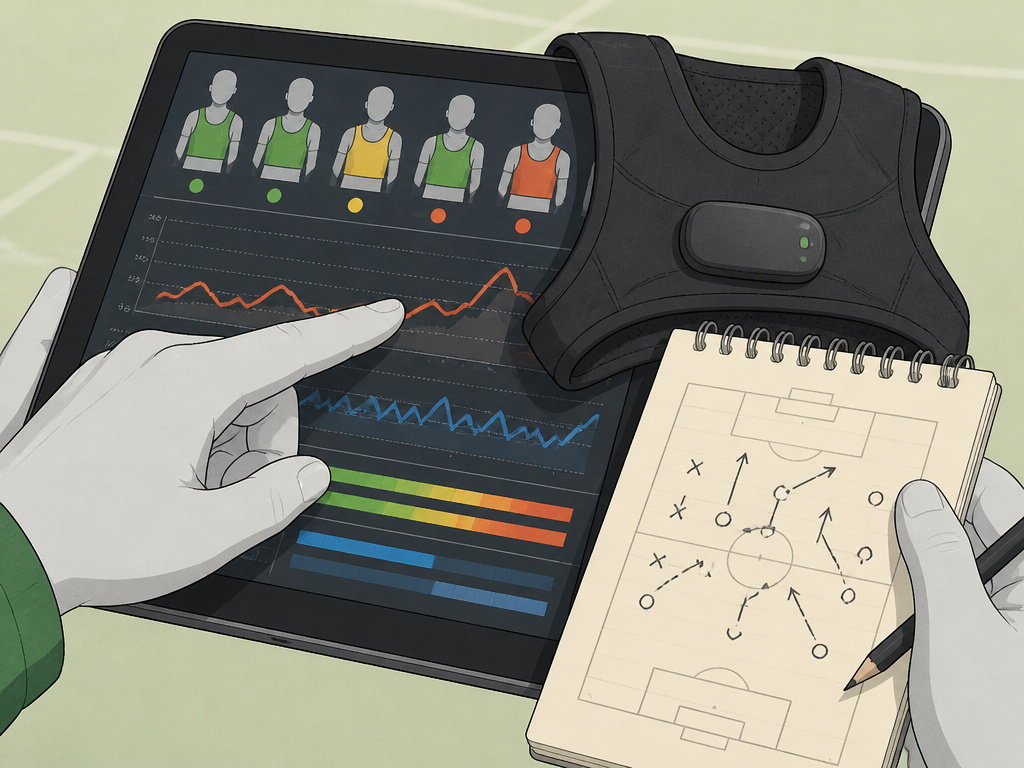
So a club has the vests, they’re certified, the kits fit. What now? The numbers flood in: total distance, high-speed running distance, acceleration/deceleration counts, metabolic power, heart rate zones. This performance analysis is the payoff.
The data can spot a player who is quietly accumulating fatigue before they feel it themselves. It can show that a tactical shift in the second half increased the workload on the full-backs by 30%. It is objective evidence in a world of subjective opinion.
But it has blind spots. It can’t measure decision-making, communication, or leadership. It can’t tell you if a player is hiding from the ball or making clever runs that aren’t found. The numbers are a powerful tool in the box, but they aren’t the only tool. Trust the eye test, then check it against the numbers.
The Main Brands and What They Offer
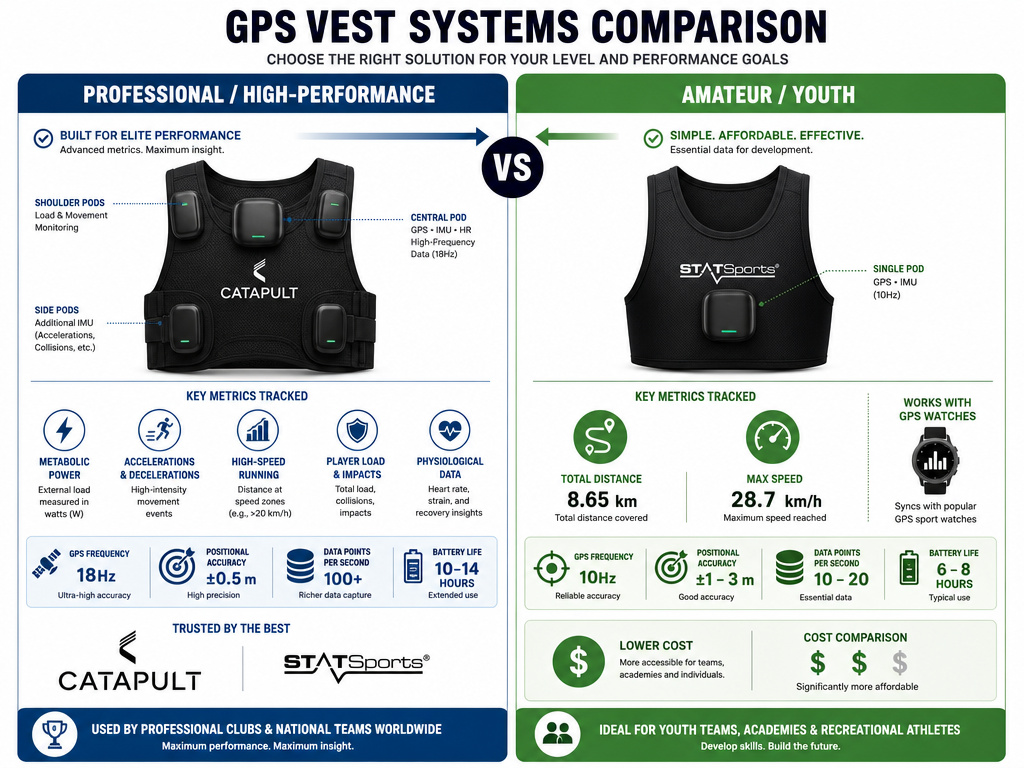
The market is led by specialists whose wearable soccer technology is built for the rigours of professional sport. Two names dominate the conversation.
Catapult is perhaps the most recognised, with its Vector series (like the S7) being a staple at clubs worldwide. STATSports is the other giant, having been formally partnered as the official on-field tracking system for U.S. Soccer since 2018. These systems are investments, encompassing the pods, the vests, the base stations, and the sophisticated software to make sense of it all.
For the amateur or youth team, the landscape is different. The principle, however, using evidence to manage workload and reduce injury risk, applies at every level.
| Consideration | Professional/High-Performance | Amateur/Youth |
|---|---|---|
| Primary Need | Precision load management, injury prevention, tactical analysis | Basic workload monitoring, engagement, general fitness tracking |
| Key Metrics | Metabolic power, accelerations >3m/s², heart rate variability | Total distance, max speed, session duration |
| Typical System | Catapult Vector, STATSports APEX (multi-pod, live data) | Consumer GPS watches, lower-cost single-pod systems |
History and adoption in professional football
The use of Electronic Performance and Tracking Systems (EPTS) in professional football has been shaped by formal regulations. FIFA established a Quality Programme requiring devices to be tested and approved before 1 June 2018 for use in official competitions. Governing bodies like The FA specify that any such device must not be dangerous and must meet these programme requirements. Adoption at the highest level was signaled by major partnerships, such as when U.S. Soccer formally partnered with a leading tracking system provider. The rules are clear: competition organisers must ensure the equipment is safe, data is reliable, and devices are not attached directly to the match shirt.
Alternatives to GPS vests (other wearables, video analysis)
While GPS vests are a primary tool, the Laws of the Game strictly limit other electronic or communication equipment on players during matches. Only approved EPTS devices are permitted. This means alternatives like other wearable sensors or communication gear are not allowed in competition under current rules. For teams seeking additional data, video analysis from fixed cameras around the pitch remains a crucial and non-invasive alternative. This method provides tactical information without any player-worn equipment, complementing the physical metrics gathered from the vests during training and approved match use.
Frequently Asked Questions
Are GPS vests dangerous for footballers?
When used correctly with FIFA-certified equipment, the risk is very low. The documented injuries are primarily minor skin abrasions from vests that are too tight, not from the pod itself. A specific, higher risk exists for goalkeepers using chest-mounted devices during catching practices.
What is the best GPS vest for football?
For professional environments, systems from Catapult (Vector series) and STATSports (APEX series) are the industry standards due to their accuracy, reliability, and robust software. For amateur or youth levels, “best” depends on budget and whether you need the precision of a 1000Hz accelerometer or if a simpler, consumer-grade tracker suffices.
Can players wear GPS vests in official matches?
Yes, but under strict conditions. The competition must approve it, and the devices must be certified under the FIFA Quality Programme for EPTS. The vest must be worn under the jersey, not attached to it, and the competition organiser is responsible for data accuracy and safety.
What’s the difference between a GPS vest and the tracking used in NFL broadcasts?
They are fundamentally different technologies. NFL tracking uses RFID chips embedded in the shoulder pads and antennas around the stadium, providing ultra-precise, real-time positional data for broadcast. Football GPS vests use satellite GPS and inertial sensors, focusing on individual player performance metrics and load, with data typically reviewed post-session.
Before You Go
The vest is just the carrier. The value is in the conversation it starts between the coach, the medic, and the player. It turns “he looks tired” into “his high-intensity distance has dropped 15% this week.” That’s the real shift.
But never let the numbers drown out the game. Use it to keep players fitter for longer, to understand the physical game, and to add a layer of evidence to your planning.
And if you’re a goalkeeper? Just make sure that pod isn’t over your sternum when you’re practicing crosses. Some lessons are better learned from a research paper than a bruised chest.
