
Types of Football Goals Explained: From Pitch to Backyard
This post contains affiliate links. As an Amazon Associate, we earn from qualifying purchases.
Understanding the types of football goals means separating two things: the physical structure you score into and the different ways a goal is scored during a match. The physical goal types are defined by official dimensions, materials, and safety standards like BS EN 748 for goals over 10 kg. The goal-scoring types describe the action, a volley, a penalty, an own goal, that puts the ball in the net.
That distinction matters because confusion between the two is where most casual explanations fall apart. You can’t buy a “header goal” for your garden, but you absolutely need to know if a “portable goal” meets the ASTM F2950 standard before kids use it. This is part of understanding the different types of football goals explained.
What follows is a breakdown of both categories, effectively a guide to the types of football goals explained. We’ll cover the official sizes from The Football Association, the critical safety standards that apply, and the colourful fan vocabulary for different kinds of goals. By the end, you’ll be able to read a product spec sheet and know exactly what you’re getting.
Key Takeaways
- Official physical goal types are defined by exact dimensions and weight: full-size (7.32m x 2.44m), youth, mini-soccer, and small-sided, each governed by standards like BS EN 748 or BS 8462.
- Safety standards split by weight and region: European standard BS EN 748 applies to goals over 10 kg, while the U.S. Standard ASTM F2950-14(2021) covers goals over 40 lb.
- Match goal types describe the play, not the equipment: A “screamer” is a long-range strike, a “tap-in” is a close-range finish, and an “own goal” is when a player scores against their own team.
- For backyard or training use, prioritize portable pop-up goals or lightweight foldable models that are easy to move and store safely.
- Never use metal cup hooks to attach nets; The FA banned them in 2007/08. Use plastic arrowhead hooks, Velcro tapes, or plastic clips instead.
Official Goal Types & Dimensions (The Physical Structure)
This is where the rulebooks live. When a club buys a goal or a council installs one on a public pitch, they follow strict specifications. These aren’t suggestions; they’re functional and safety requirements.
The primary European standard, BS EN 748, applies to portable, freestanding, and permanent socketed football goals having a total weight greater than 10 kg. It covers 11-a-side matches, small-sided and junior football, training, and recreational play. The rules of futsal allow the use of handball goals, with requirements given in EN 749. If a goal weighs 10 kg or less, it falls under a different standard entirely, EN 16664, which is for lightweight goals.
Across the Atlantic, the ASTM F2950-14(2021) standard serves a similar purpose in the U.S., applying to all soccer goals with a total weight greater than 40 lb.
So, what are the official sizes? The Football Association’s guidance lays them out clearly. These are the dimensions you’ll see on professional pitches, in youth leagues, and in official competition rules.
| Type of Football | Goal Size (Width x Height in metres) | Governing Standard (UK) |
|---|---|---|
| Full-size (Eleven-a-side) | 7.32 x 2.44 | BS EN 748 |
| Youth Football | 6.40 x 2.13 | BS 8462 |
| Mini-soccer | 3.66 x 1.83 | BS 8462 |
| Small-sided Football | 4.88 x 1.83, 4.88 x 1.12, 3.66 x 1.83, 3.66 x 1.22, 2.44 x 1.22 | BS 8462 / PAS 36 |
| Futsal | 3.00 x 2.00 | BS 8462 |
A FIFA Quality certified goal frame, like those from manufacturer Sportschaeper, has dimensions of 100 × 120 mm and a wall thickness of 2.5 mm, and features an integrated milled net attachment system where the hooks are part of the frame itself, eliminating protruding parts.
For most of us, the full-size goal is the iconic image in the types of football goals explained. But for youth development, those smaller kids’ goals are non-negotiable. Using a full-size goal with young players distorts the game, it rewards power over precision and makes the goalkeeper’s job nearly impossible. The smaller dimensions of youth soccer goals create more shots, more saves, and more engagement.
When you’re looking at portable soccer goals for a school or club, the product should come with an independent test certificate proving it meets the relevant standard. Don’t just take the supplier’s word for it.
Goal-Scoring Types: The Language of the Game
Now we shift from the hardware to the action. This is the language of commentators, fans, and pundits. These terms describe how the ball hit the net, not what it hit.
We can break these down into a few broad families: techniques, game-situational goals, and the colourful slang fans use.
Technique-Based Goals:
- Volley: Striking the ball before it touches the ground.
- Header: Scoring with the head.
- Bicycle Kick / Overhead Kick: An acrobatic shot where the player kicks the ball backward over their own head.
- Chip: A lofted shot that arcs over the goalkeeper.
- Drive / Screamer: A powerfully struck shot, usually from outside the penalty area.
Game-Situational Goals:
- Penalty: A shot taken from the penalty spot following an infringement.
- Free Kick: A shot taken from a stationary ball after a foul.
- Own Goal: When a player accidentally scores against their own team.
- Winning Goal: The goal that secures a victory.
- Equaliser: The goal that ties the score.
Colloquial & Descriptive Terms:
- Tap-in: A simple, close-range finish.
- Scrappy Goal: A goal scored from a goalmouth scramble, often after a deflection.
- Deflected Goal: A shot that changes direction off a player, often deceiving the keeper.
- Goalkeeper Error: A goal that results from a mistake by the keeper.
Where this goes sideways: Confusing a “volley” (a technique) with an “own goal” (a situation). They are different categories. You can score an own goal with a volley.
The beauty of this language is its immediacy. A “screamer” feels different from a “tap-in,” and the words convey the effort, skill, and sometimes luck involved.
Safety First: Standards, Installation, and Maintenance
A football goal is a piece of sporting equipment, but if it’s not safe, it’s a hazard. The standards we mentioned earlier aren’t just about size; they’re about preventing injury.
The ASTM F2950-14(2021) standard provides crucial definitions that dictate safety protocols:
- Movable Goal: Any free-standing goal designed to be moved. If it can function without anchors, it’s considered movable.
- Permanent Goal: Fixed by concrete or other material and cannot be relocated.
- Semi-Permanent Goal: Designed to be inserted into a ground sleeve or fastened to a structure, allowing for removal.
Why does this classification matter? Because it dictates how you must secure it. A movable goal that isn’t properly anchored is a tipping risk.
Before you start: Always install goals according to the manufacturer’s instructions. A full-sized goal should never be moved by fewer than four adults. Never drag a goal across the ground, as this can damage both the goal and the pitch.
Here are the non-negotiable safety rules, primarily drawn from The FA’s guidance:
- Anchoring is Mandatory: Every movable goal must be securely anchored to the ground when in use. The method, ground anchors, sandbags, or weighted bases, depends on the goal type and the manufacturer’s instructions.
- No Metal Cup Hooks: The FA banned metal cup hooks from the start of the 2007/08 season. Nets should only be attached with plastic arrowhead hooks, Velcro tapes, or plastic clips. Any metal hooks must be removed and replaced.
- Inspection frequency is a point of discussion. The Football Association (FA) recommends inspections at least three times each season. However, a SAPCA presentation citing EN 913:2008 Annex A suggests it is difficult to specify exact intervals, noting a goal in an open public space may need daily inspection, while one in restricted access may need relatively infrequent checks.
- Keep Records: Maintain a log book for each goal and keep inspection records for 21 years. Every goal should have a permanent identification label that must not be painted over or removed.
- Repairs by Professionals: Repairs should only be done by the manufacturer or an authorised agent using correct parts. Any repair that changes the goal’s structural integrity, design, or shape is prohibited.
This might sound like overkill for a backyard goal, but the principles still apply. Ensuring a lightweight goal is stable and checking for wear on net attachments are simple habits that prevent accidents.
Choosing the Right Goal for Your Needs
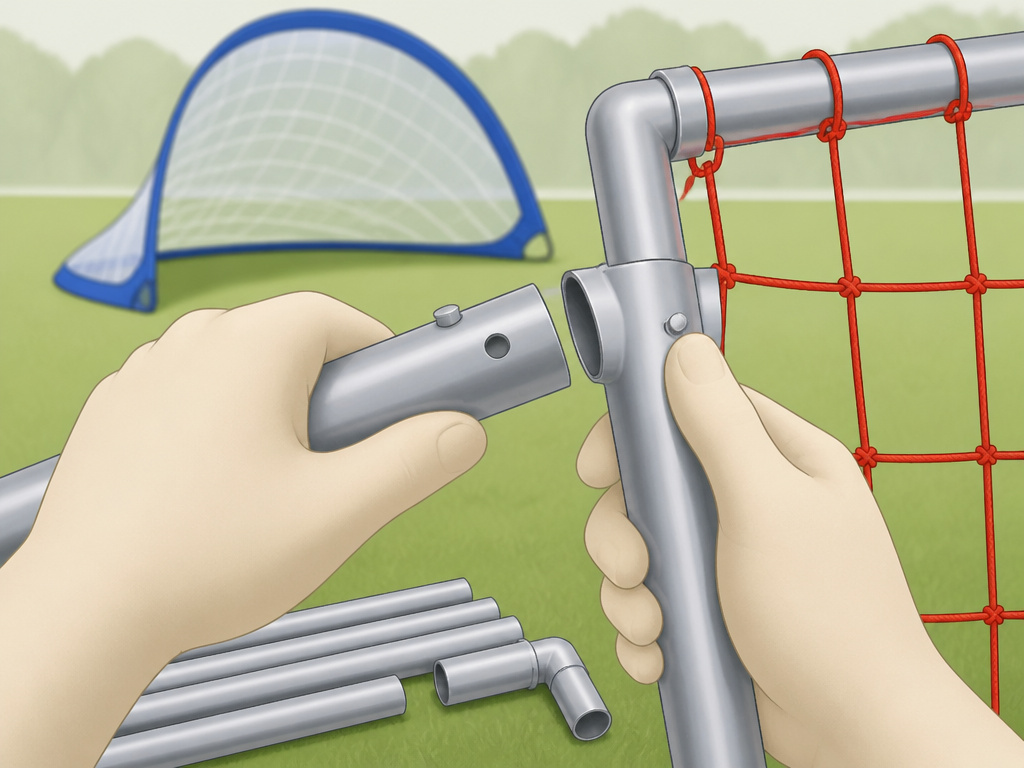
You don’t need a FIFA-certified goal for a kickabout in the park. The right choice depends on three things: who’s using it, where it’s going, and how often you’ll move it.
Match the goal type to the scenario.
| Use Case | Recommended Goal Type | Key Considerations |
|---|---|---|
| Backyard Fun (Young Kids) | Pop-up Goals or small, lightweight plastic goals | Safety, easy storage, soft materials. Look for best soccer goals for kids that are age-appropriate. |
| Backyard Training (Older Kids/Adults) | Portable Goals with metal frames (often foldable) | Durability, proper goal net size, some weight for stability. A best portable soccer goal will balance sturdiness with easy movement. |
| Club/Team Training | Full-size or small-sided portable goals meeting BS EN 748 / ASTM F2950 | Must be anchorable, durable enough for daily use, and have official dimensions. |
| Permanent Pitch Installation | Full-size permanent goals (socketed or concrete-based) | Professional installation following manufacturer specs and safety standards is critical. |
For the vast majority of home users, the sweet spot is a foldable pop-up goal or a sturdy portable soccer goal.
Maintenance, Storage, and Moving Goals
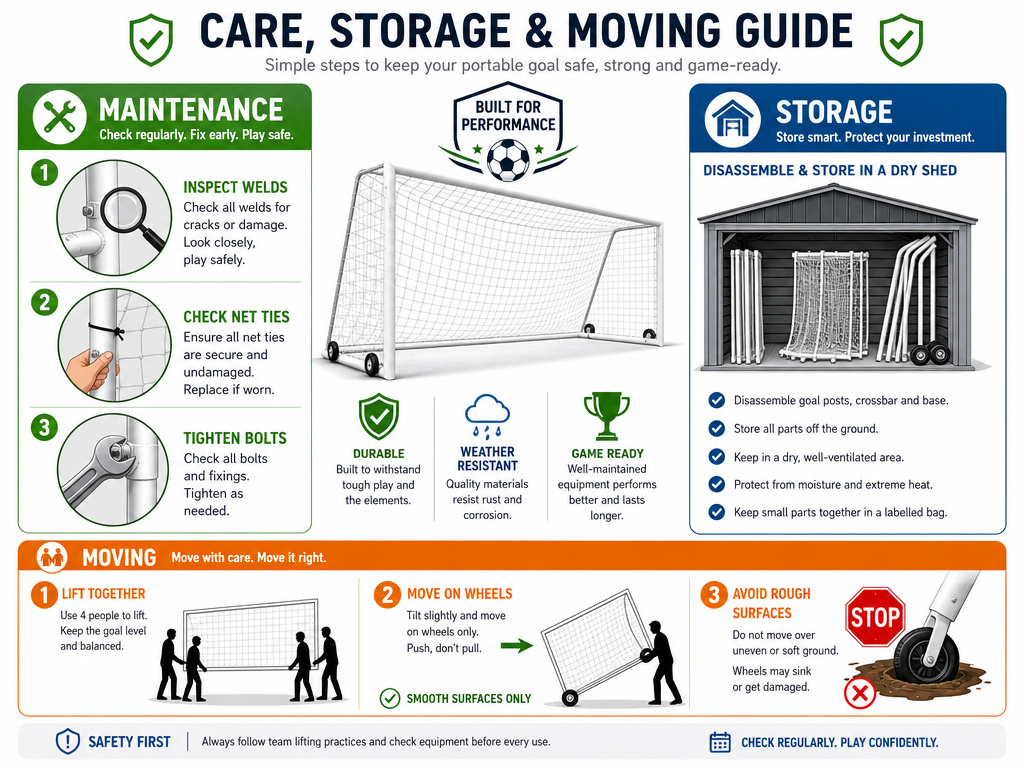
A goal is an investment. Treat it like one, and it will last for years. The ASTM F2950-14(2021) standard requires that goal frame materials be designed to maintain their integrity for outdoor use for a minimum period of five years when maintained according to the manufacturer’s instruction and schedule.
Routine Maintenance Checklist:
- Inspect the Frame: Look for rust, cracks, or bends, especially at welds and joints.
- Check the Net: Look for tears, fraying, or broken ties. A torn soccer net is a trip hazard and defeats the purpose.
- Examine Attachments: Ensure all bolts, screws, and net hooks (plastic only!) are secure and not damaged.
- Verify Anchors: If using ground anchors, check they are not corroded and still grip the soil firmly.
Storage:
If you’re using portable goals, store them. Don’t leave them out over winter. Disassemble foldable goals, dry off any condensation, and store them in a garage or shed. This dramatically extends their lifespan.
Moving Goals Safely:
This is where people get hurt. The FA’s rules are explicit:
- Never drag a goal. Lift it.
- Use enough people. A full-size goal needs at least four adults.
- Use wheels correctly. If your goal has four wheels, push it by the uprights backwards. If it has two wheels, lift the back bar and pull it. If the wheels sink in, stop and lift the goal.
Following the official goal setup and takedown procedure isn’t just about longevity; it’s the safest way to handle heavy, awkward equipment.
Famous examples of different goal types
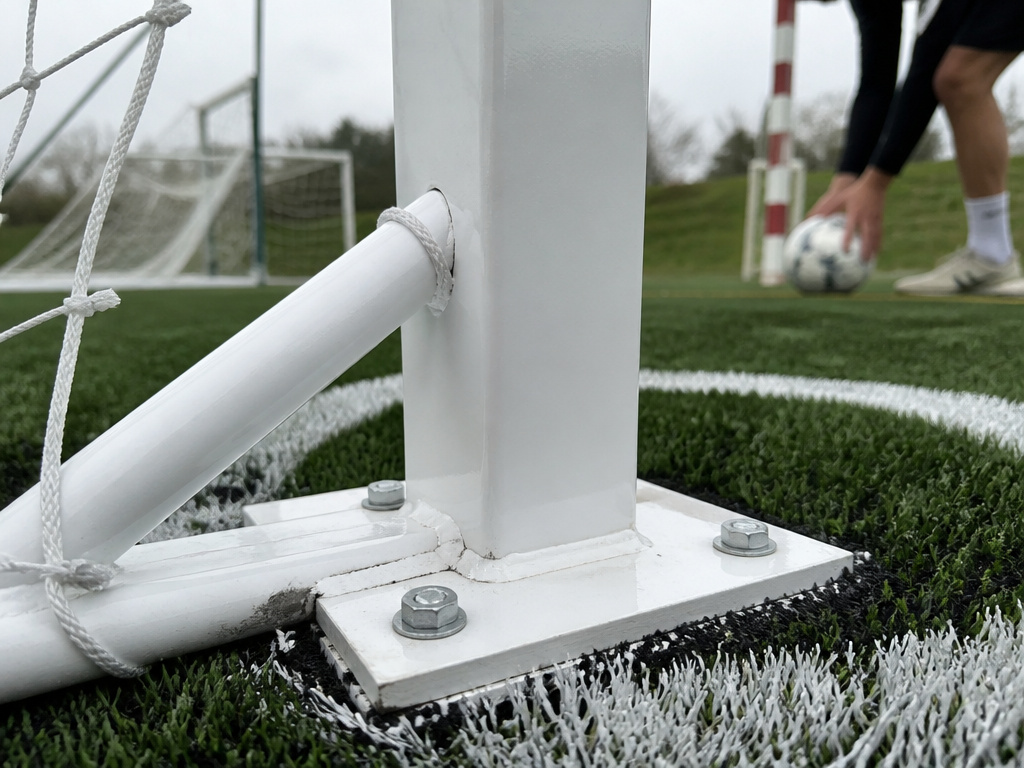
While the fact sheet focuses on specifications, you can see these goal types in action across different levels of play. A full-size, permanent goal meeting the relevant standard is the fixture of professional stadiums, anchored securely and built for long-term use. In contrast, movable or semi-permanent goals are common in community parks and training grounds, designed to be inserted into ground sleeves or moved with care. For futsal, the rules permit the use of specific handball goals. The key for any competitive or training use is that the goal posts fully comply with the required safety standards, and suppliers should provide an independent test certificate to prove it.
Goal celebration
Celebrating a goal is a fundamental part of the game’s joy, but safety around the goal structure itself is paramount. Practical guidance emphasizes that goals should never be climbed on or used as a celebration prop. The framework is designed for a ball to enter the net, not to support the weight of players. Always ensure the goal is securely installed and stable before play begins, following the manufacturer’s instructions. After scoring, celebrate away from the goalposts to avoid any risk of the structure being pulled over or damaged, which could lead to injury.
Historical development of the football goal
The modern football goal has evolved significantly, with a major focus on standardizing safety. Early goals were simple structures, but today’s designs are governed by strict functional and safety requirements. Key developments include the move away from dangerous metal cup hooks for nets, which are now banned, towards safer plastic arrowhead hooks, Velcro tapes, or clips. Standards now define goals as portable, permanent, or semi-permanent based on how they are anchored. The introduction of mandatory permanent identification labels and detailed inspection regimes highlights how safety and accountability have become central to goal design and maintenance over time.
Frequently Asked Questions
What are the different types of goals in football?
There are two main categories. First, the physical goal types: full-size, youth, mini-soccer, small-sided, futsal, portable, and permanent, each with official dimensions. Second, the goal-scoring types: these describe how a goal is scored, like a volley, penalty, header, or own goal.
What are 5 goals called in football?
Scoring five goals in a single match is exceptionally rare. There’s no universally agreed-upon term like a “hat-trick” (3 goals) or a “haul” (4 goals). It’s sometimes called a “glut” or a “five-goal salvo,” but most commentators would simply say “he scored five.”
What is the difference between BS EN 748 and ASTM F2950?
BS EN 748 is the European standard applying to football goals over 10 kg. ASTM F2950-14(2021) is the U.S. Standard applying to goals over 40 lb. They are regional equivalents, both setting safety and performance requirements, but they use different measurement systems and have slight variations in test methods and definitions.
Can I use any net on my soccer goal?
No. You must use a net designed for your goal’s specific size and attachment system. An ill-fitting net will sag, tear easily, or not attach securely. Always check the official goal net dimensions and hook/loop system (e.g., plastic arrowheads vs. Velcro) before buying replacement nets.
Are portable soccer goals safe for kids?
Yes, provided they are the correct size, are always anchored or weighted when in use, and are made from appropriate materials (no sharp edges). Always supervise play. Choose youth soccer goals that are specifically designed and proportioned for children, not just smaller versions of adult goals.
Before You Go
The right goal changes the game. For a local club, that means investing in equipment that meets BS EN 748 and keeping inspection logs for two decades. For a parent, it means choosing a backyard soccer goal that’s safe, sturdy, and the right size for their child’s age.
Remember the split: the goal on the spec sheet is a physical object with a standard. The goal in the highlights reel is a moment of technique, luck, or chaos. One is bought; the other is remembered.
If you’re setting up a pitch, start with the football pitch dimensions and markings to ensure you have the correct layout before you even think about goals. And when you do buy, ask for that test certificate. It’s not bureaucracy, it’s the proof that the goal is built for the game.
