
Goalkeeper Glove Cuts Explained: The 4 Main Types
This post contains affiliate links. As an Amazon Associate, we earn from qualifying purchases.
Goalkeeper glove cuts explain how the latex palm is stitched to the backhand, which changes the fit, the amount of latex touching the ball, and where the seams sit. The four main types are negative (tightest fit, best feel), roll finger (maximum latex contact, roomier), hybrid (a mix of cuts), and flat (roomiest, most traditional). Your hand shape, the surface you play on, and your budget for replacements decide which one wins.
Right, here is the thing about the game. A goalkeeper’s hands are their primary tool, and the glove is the only piece of equipment they actually catch with. The cut isn’t a cosmetic choice. It changes the information you get from a low deflection and the grip you have on a wet cross. Most guides just list the definitions, which leaves you guessing about the real-world consequences—like why a negative cut might split at the seams after a month on 3G, or why a flat cut is the default for a ten-year-old with growing hands. To understand these differences, goalkeeper glove cuts explained.
What follows is a breakdown of the four cuts, the two conflicting sizing methods, and the maintenance routine that matters more than the brand on the wrist strap. We’ll look at the wear patterns each cut is prone to, straight from the retailer care sheets most players never read. By the end, you’ll know which cut fits your hand and your pitch, not just which one your favourite pro wears.
Key Takeaways
- Match the cut to your hand shape: Negative cut suits slim hands wanting maximum feel; flat cut is better for wider hands or youth players. A glove that’s too tight splits at the seams.
- Wear starts from the first session: High-performance latex is soft and will show scuffs immediately, especially on artificial turf. According to retailer Just Keepers Ltd., professional goalkeepers use a pair for a maximum of 6-8 games.
- Negative and roll finger cuts wear quicker: The construction puts more stress on the fingertips and seams. West Coast Goalkeeping notes that negative cut gloves tend to wear a little quicker due to the exposed fingers.
- Use a two-pair system: Invest in a durable pair for training and a softer, grippier pair reserved for matches. Using soft match latex in daily training wears it through in 5-10 sessions.
- Size up, never down: If your measurement falls between sizes, choose the larger one. A slightly big glove is workable; a too-small glove restricts movement and will fail faster.
The 4 Main Cuts and What They Do
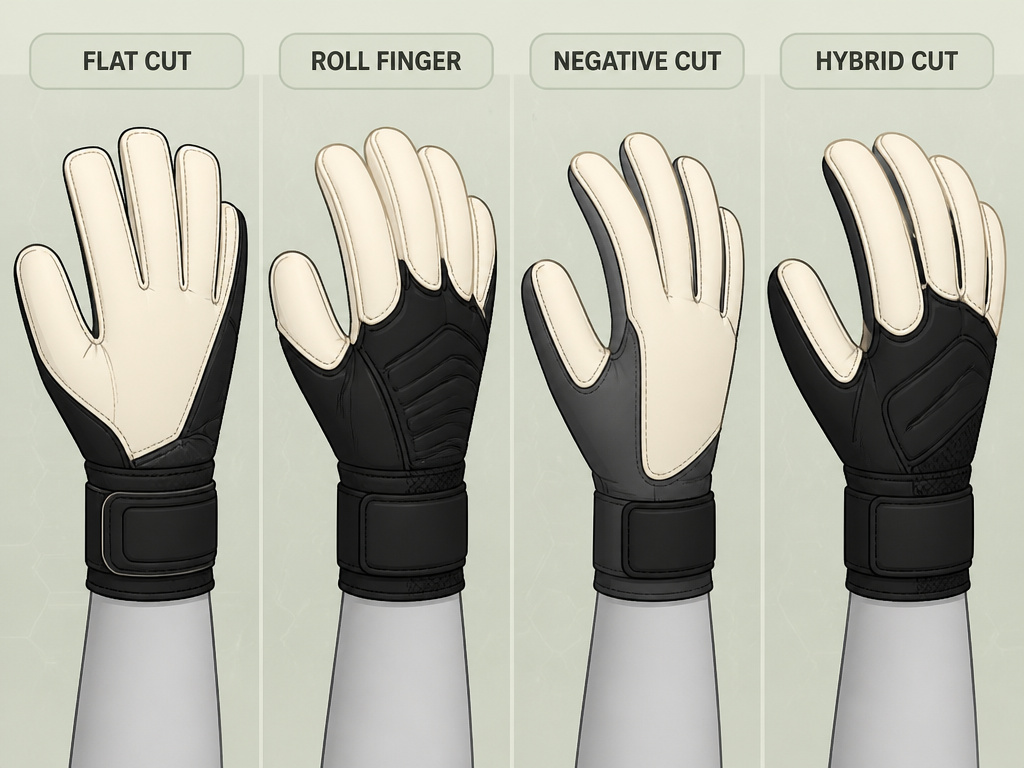
You can group every glove into one of four families based on how the palm is built. The goalkeeper glove cuts explained decides three things: how snug the fit is, how much latex wraps your hand to meet the ball, and where the stitching sits. That stitching location is the difference between a glove that feels like a second skin and one that feels like a padded mitten.
The cut determines how the latex finger gussets are sewn and how closely the glove fits your hand. Negative cut has seams on the inside for a tight, precise feel. Roll finger has latex wrapped around the fingers for maximum contact area. Flat cut uses external gussets for a roomy, traditional fit. Hybrids combine elements of two or more cuts.
Negative Cut: The Precision Instrument
The negative cut moves all the stitching to the inside of the glove. The seams are hidden, so the latex sits directly against your skin. This gives you the tightest, most glove-like fit of any cut.
The appeal is feedback. With less material between your hand and the ball, you get more information on deflections and when you’re cradling a bouncing ball. It’s the cut most senior keepers with slender hands gravitate toward for that reason. The trade-off is durability and comfort. Because the latex is pulled taut, the fingertips and thumbs are under more stress. Retailers like Just Keepers Ltd. Are explicit: “Gloves featuring a ‘Negative Cut’ palm will show wear on the fingertips and thumbs quicker than others.” The seams also come under what they call “immense stress,” which is why burst stitching on the inside of the fingers is a common failure point.
Who it’s for: Keepers with slim, narrow hands who prioritize ball feel above all else and are prepared for more frequent replacements, especially if they train on hard ground.
Roll Finger Cut: The Maximum Contact Wrap
This is the classic. The latex isn’t just on the palm; it wraps entirely around each finger and is stitched directly to the backhand. There are no fabric gussets between the fingers.
That wrap gives you the largest possible surface area of sticky latex meeting the ball. For pure catching security, it’s hard to beat. The fit is snug but rounded, giving a “fuller” feeling on the hand compared to the skinny negative cut. It’s more forgiving for slightly wider hands, but it’s not loose. The main drawback is bulk. All that latex can feel cumbersome, and ventilation suffers. The stitching runs along the outside of the fingers, which can be a wear point. West Coast Goalkeeping notes that roll finger cuts also “tend to wear a little bit quicker than other cuts because of the exposed middle fingers.”
Who it’s for: Keepers who want the highest grip confidence, don’t mind a slightly bulkier feel, and have hands that aren’t extremely wide.
Flat Cut (Regular/Expanse): The Roomy Workhorse
The traditional build. Imagine a single, flat sheet of latex forming the palm. Fabric gussets are sewn between the fingers on the outside of the glove to give it shape.
This is the roomiest cut by a significant margin. The glove slides on easily, and there’s space around the fingers. It’s the default recommendation for beginners, younger keepers with growing hands, and anyone with wide palms. The trade-off is latex contact. Because the palm sits flatter, slightly less of it makes contact with the ball on a catch compared to a roll finger. It’s often paired with more durable, harder-wearing latex, making it a common choice for a dedicated training glove. For a deep dive on the different materials, our guide breaking down the grip versus longevity trade-off of goalkeeper glove latex types is useful.
Who it’s for: Beginners, youth players, keepers with wide hands, and anyone looking for a durable, comfortable training glove.
Hybrid Cut: The Best of Both Worlds?
A hybrid mixes two or more cuts in a single glove. The most common combination is a negative cut on the middle two fingers for a locked-in feel, with a roll finger on the thumb, index, and pinky for extra latex wrap.
Brands have their own proprietary names for these—BioHybrid, Gecko, Negative-Roll. The goal is to give a customized fit, targeting sensitivity where you want it and extra surface area where you need it. The fit can be tricky, as you’re essentially wearing two different cuts on one hand. Sizing is critical. The benefit is a potentially perfect, tailored feel. The downside is complexity; with more seam types and transitions, there are more potential points of failure. If you’re weighing a specific combination, our comparison of negative cut vs roll finger goalkeeper gloves goes deeper into the head-to-head choice.
Who it’s for: Experienced keepers who know exactly what they want from different parts of the glove and are willing to experiment with fit.
Sizing and Fit: A Tale of Two Charts
Here’s where the consensus breaks down. There are two different, conflicting methods for sizing goalkeeper gloves. One uses width in inches, the other uses circumference in centimeters. You need to know which system your chosen brand follows.
| Sizing Method | How to Measure | The Rule | Source |
|---|---|---|---|
| Hand Width (Inches) | Across the palm at its widest point, just below the knuckles. | Take the number in inches and add one. That’s your starting size. | The Soccer Factory |
| Hand Circumference (CM) | Around the widest part of your hand, across the knuckles. | For roll finger or flat cut, add 1 size. For negative cut, order your exact measured size. | The Smarter Play |
The first method is straightforward. A hand measuring 7.5 inches across would start with a size 9. The second method requires a brand’s specific size chart to convert centimeters to a glove size (like 20cm = Size 8). The critical difference is the rule for negative cut: one source says add one, the other says order true to size. When sources disagree, you have to pick a lane. The Smarter Play advises ordering your exact measured size for negative cut, while The Soccer Factory’s ‘add one’ rule applies to all cuts. For all other cuts, many sources suggest the ‘add one’ rule is a safer starting point. No matter what, if you land between sizes, always go up. A slightly large glove is workable; a too-small glove will restrict finger movement and dramatically increase the stress on the seams. For a complete walkthrough, our goalkeeper glove sizing guide has step-by-step instructions.
Common mistake: Buying gloves based on age charts alone. A 12-year-old could have an adult-sized hand width. Always measure.
Durability and Wear: What to Expect and Where
Goalkeeper gloves are consumable equipment. The soft latex that provides incredible grip is also naturally susceptible to abrasion. SCK Goalkeeper Gloves states plainly that gloves “can begin to show signs of wear from the very first session.” That’s normal, not a defect.
The goalkeeper glove cuts explained you choose directly influences where that wear appears and how quickly it progresses. This isn’t guesswork; it’s built into the construction.
| Cut Type | Primary Wear Points | Why It Happens |
|---|---|---|
| Negative Cut | Fingertips, thumbs, internal seams. | Latex is pulled taut, exposing fingertips. Seams are under “immense stress” (Just Keepers Ltd.). |
| Roll Finger Cut | Outer stitching, exposed middle fingers. | Latex wrapping creates abrasion points. Stitching on the outside is vulnerable. |
| Flat Cut | General palm abrasion. | Roomier fit reduces stress on seams, but flat latex sheet takes full impact. |
| Hybrid Cut | Transition points between cuts, various seams. | Complex construction with multiple seam types and stress concentrations. |
The playing surface is the other great accelerator. Every source agrees: gloves are designed for natural grass. Artificial turf (3G/AstroTurf) places a “higher level of stress on them, making stitching failure and latex wear more apparent,” as Just Keepers puts it. If you train on 3G twice a week, your gloves will have a shorter lifespan, full stop. To fight this, you must follow a strict guide on how to clean goalkeeper gloves. Dirt ground into the latex acts like sandpaper.
How to Choose: Matching Cut to Keeper
This isn’t about the “best” cut. It’s about the right cut for a specific keeper in a specific situation. We will break it down by scenario.
For a Beginner or Youth Keeper:
Start with a flat cut. The roomy fit accommodates growing hands and is forgiving. The focus should be on learning technique, not fighting a tight glove. Pair it with a durable latex for training. Finger protection spines are manufactured to reduce the movement of your fingers bending backwards. We cover the full pros and cons of finger save technology separately.
For the Training Workhorse:
You need durability above all. A flat cut or a robust roll finger in a hard-wearing, thicker latex (think 4mm) is the answer. This pair absorbs the daily grind on all surfaces so your match gloves stay fresh. The goal, achievable through sheer toughness, is to make your goalkeeper gloves last longer.
For Match-Day Performance:
This is where feel and grip peak. A negative cut for the slender-handed keeper who wants ultimate control, or a soft-roll finger for the keeper who wants maximum catch security. This pair stays in the bag until kickoff. Never use it on 3G. Ever. To keep that premium grip, avoid household soap and use a dedicated glove wash. Some keepers use a grip spray for goalkeeper gloves, but proper washing and damp storage are more important.
For the Experimenter/Tech Seeker:
Try a hybrid cut like the BioHybrid. West Coast Goalkeeping, which invented it, recommends it for new or younger keepers as a starting point because its pre-curved design promotes a catching shape. It’s a modern, all-in-one solution worth trying if you can’t decide between feel and wrap.
Care and Maintenance: The Lifespan Decider
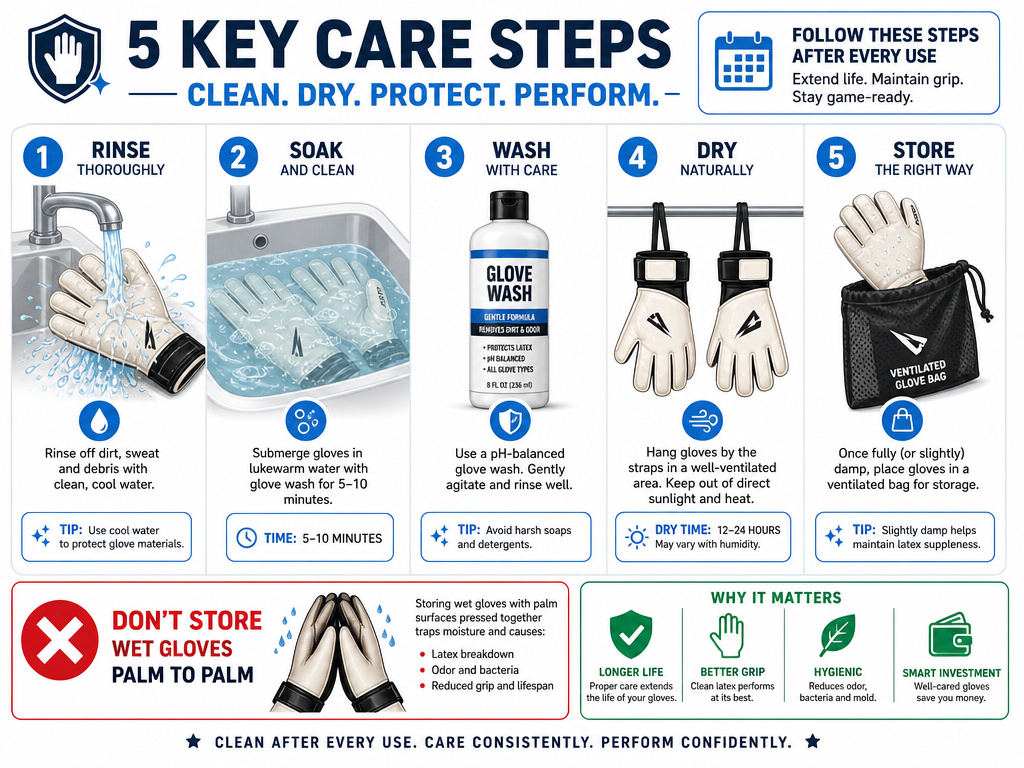
You can buy the most expensive soccer goalkeeper gloves on the market and ruin them in a month with poor care. The routine is simple, but it’s the part everyone rushes.
- Pre-wash before first use. Rinse them in lukewarm water. This activates the latex and washes out factory preservatives.
- Wash immediately after every session. Don’t let mud dry. Fill a sink with lukewarm water, submerge the gloves, and gently squeeze the palms. Do not twist or wring.
- Use a dedicated glove wash. Household soaps and detergents can degrade the latex. A dedicated glove wash cleans without stripping the sticky compounds.
- Dry naturally, away from heat. Hang them by the straps with the fingers pointing down so water drains. Never put them on a radiator, in direct sunlight, or in a tumble dryer. Heat can cause the latex to dry out and crack.
- Store them slightly damp. Before your next session, a light splash of water re-activates the grip. Store them slightly damp in a sealed bag or glove wrap, as recommended by some sources, ensuring they are not sealed when wet to prevent mould.
Where this goes sideways: Storing wet palms together. The latex will fuse and tear when you pull them apart. Always store gloves palm-out or with a cloth between them.
Which Glove Cut is Most Popular?

There is no single most popular cut for all goalkeepers. The choice depends on personal preference and playing style. For new or younger goalkeepers, a hybrid cut that combines features is often recommended as a starting point because it places the hand in a pre-curved position ideal for catching. More experienced keepers may prefer the close-fitting, second-skin feel of a negative cut or the traditional, secure wrap of a roll finger design. The practical answer for many keepers is to own two pairs: a durable pair for training and a softer, grippier pair kept specifically for matches to prolong their lifespan.
Frequently Asked Questions
What is the best cut for goalkeeper gloves?
There isn’t one best cut. The best cut is the one that fits your hand shape and your primary use. For slim hands and maximum ball feel, choose a negative cut. For maximum grip surface and a secure catch, choose a roll finger. For beginners, wide hands, or a durable training glove, the flat cut is the default.
What does negative cut mean on goalkeeper gloves?
Negative cut means the seams are stitched on the inside of the glove’s fingers, so the latex sits directly against your hand. This creates a very tight, second-skin fit that offers excellent ball feel but can wear quicker at the stressed fingertips and seams.
How long should goalkeeper gloves last?
It depends entirely on use. A professional on grass might use a pair for 6-8 matches. An amateur training regularly on artificial turf will see significant wear much quicker than on natural grass. With a two-pair system (tough trainers, soft match gloves) and proper care, you can extend the life of your match gloves for a full season.
Should youth goalkeepers use finger protection?
Removable finger protection (spines) can be useful for younger keepers in older age groups where shot power increases. They help prevent hyperextension injuries and build confidence. However, they do stiffen the fingers and can hinder the development of proper catching technique if used as a permanent crutch. Use them situationally.
Before You Go
The cut is the foundation, but it’s not the whole building. The best glove in the world is the one that fits your hand, survives your pitch, and fits your budget for replacements. Ignore the hype and look at your own situation: measure your hand, look at your training ground, and be honest about how often you’ll wash them.
If you remember one thing, let it be this: buy two pairs. A durable workhorse for the grind of training, and a prized pair you keep for matches. That single habit does more for your Saturday afternoon grip than any brand name or exotic latex ever will. Now, which cut are you leaning toward? I’ve argued for the humble flat cut as a starting point for years, but I know a keeper who swears a tight negative cut changed his game. Let me know which hill you’re prepared to die on.
