
How Footballs Are Made: The Step-by-Step Process
This post contains affiliate links. As an Amazon Associate, we earn from qualifying purchases.
That final pressure spec isn’t a guess. Wilson’s own manufacturing blog states the molding pressure and the game-ready inflation for the NFL ball. Get it wrong by even a couple PSI, and the ball’s flight and grip change. The whole process, from the stamping of the Horween leather to the final hand-lacing, is built around controlling those variables, which is a key part of how footballs are made.
What follows is a walkthrough of the materials, the step-by-step build in an NFL factory, and how the standards for a World Cup ball differ from how footballs are made for the NFL. We’ll also cover how to pick a ball that lasts and the one maintenance mistake that ruins the feel faster than anything else.
Key Takeaways
- NFL footballs are hand-stitched from four cowhide panels sourced from Chicago’s Horween Leather Company, with 10-12 balls yielded from a single hide.
- The final shape is set in a pressure mold at 120 PSI before being reduced to the playing pressure of 13 PSI for the NFL “Duke.”
- For soccer, the highest FIFA Quality Pro certification demands a ball lose no more than 15% of its pressure over 72 hours and pass rebound tests at both 20°C and 5°C.
- Butyl rubber bladders are used in quality balls for superior air retention, while latex bladders offer a softer feel but leak faster.
- Hand-stitching with waxed thread creates the most water-resistant seam, outperforming machine stitching or thermal bonding for match-level durability.
From Pig Bladder to Prolate Spheroid: A Brief History
The “pigskin” nickname isn’t marketing, but the modern process of how footballs are made is radically different. In the 1800s, the game literally used an inflated pig’s bladder as the ball, often encased in a leather shell for shape. It was unpredictable, prone to soaking up water, and frankly, a bit grim. The switch to vulcanized rubber bladders in the late 19th century was the first real revolution, it gave the ball a reliable, airtight core and a consistent shape.
That shape settled into what we now call a prolate spheroid for American football. It’s not a sphere; it’s oblong with pointed ends. A NASA aerodynamics expert called it a “historical accident,” but it’s a happy one. The shape and the pebbled leather surface help air flow stay attached to the ball longer as it spins, reducing drag and helping those long passes stay tight. Soccer balls took a different path, evolving from irregular leather panels to the iconic 32-panel (12 pentagons, 20 hexagons) design that approximates a sphere.
The Anatomy of a Modern Football
Before we get to the factory floor, it helps to know what you’re building. Every football is a sandwich, and the ingredients matter.
The outer cover is the touch point. For the NFL and top-tier soccer balls, it’s still full-grain cowhide leather, prized for its grip and feel. Cheaper and most recreational soccer balls use synthetic materials: Polyurethane (PU) or Polyvinyl Chloride (PVC). PU is softer, more durable, and performs like leather. PVC is stiffer, cheaper, and often used for promotional or low-end training balls. The cover isn’t one piece; it’s made of multiple panels stitched or bonded together.
Under the cover sits the lining. This is usually several layers of cotton or polyester fabric that add structure and shape, preventing the ball from becoming a wobbly balloon.
At the heart is the bladder. This is the inflatable rubber balloon that holds the air. The two main types are latex and butyl rubber. Latex is stretchier and gives a softer, more responsive “feel,” but it loses air faster, often needing a top-up before every game. Butyl is less permeable, holding air for weeks or months, which is why it’s the standard for quality match balls. The valve is the final piece, with silicone-treated valves on premium balls making inflation easier and sealing tighter.
The part nobody mentions: A ball with a latex bladder might feel beautiful fresh out of the box, but if you leave it in your garage for a month, it’ll be flat. A butyl bladder in a decent training ball will still be playable.
The 7-Step Process for an NFL Football
The Wilson factory in Ada, Ohio, is the only place that makes official NFL game balls. Here’s how they turn sheets of leather into “The Duke.”
-
Cutting the Panels. Leather arrives weekly from the Horween Leather Company in Chicago. It’s stamped to create the pebbled texture and embossed with tiny Wilson ‘W’s for authenticity. Quality control auditors mark any natural flaws, veins or scars, before the leather is pressed to stamp NFL logos and cut into the four classic, leaf-shaped panels. One cowhide yields about 10-12 footballs.
-
Sewing the Shell. Stitchers, who train for up to six months, sew two panels together to form a half-shell, then sew the two halves together using heavy, brown polyester thread. The crucial detail: they sew the ball inside-out. This hides the seam on the inside, making the exterior smoother and the seam itself more durable against abrasion.
-
Turning. This is the most physically demanding step. The sewn, inside-out ball is steamed to make the leather pliable. A turner then forces the ball right-side out onto a metal pole, using a pneumatic hammer to help work the stiff, pointed ends through. A skilled turner can do this in about 30 seconds. They finish by rolling the seams on the pole to flatten them.
-
Inserting the Bladder. A urethane bladder is inserted through the lacing hole. This is a precise fit, too loose and the ball will wobble; too tight and it will strain the seams.
-
Lacing. This is done entirely by hand. A worker places the ball in a vise and uses an awl to pull the lace, a polyester cord wrapped in moldable plastic, through each of the four holes. The laces are then tied off and trimmed.
-
Molding and Inflating. The ball is placed into a metal mold that closes around it. It’s then inflated to a massive 120 PSI (per Wilson’s blog). This pressure sets the leather and gives the ball its final, perfect prolate spheroid shape. After molding, the air is evacuated, and the ball is inflated to its official playing pressure.
-
Final Inspection and Weighing. Every ball is weighed and inspected. At Wilson, they once tried using digital scanners to find leather defects, but found the machines were “slower and not as accurate as the human eye.” Balls are checked for weight, circumference, seam integrity, and lace tightness. Rejects might have stamp alignment errors, skipped stitches, or misshapen tips.
Hand, Machine, or Glue: How Footballs Are Built
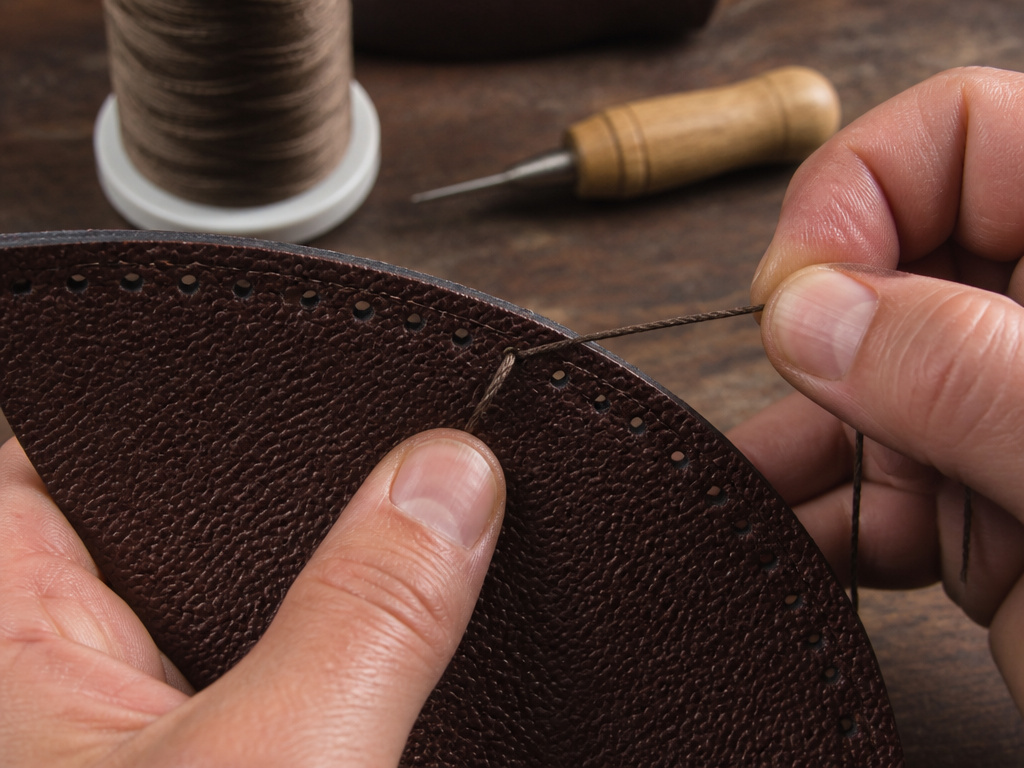
Not all balls are crafted like the NFL Duke. The method used to join the panels defines the ball’s feel, price, and lifespan. This is the core of modern ball construction.
| Construction Method | How It Works | Best For | Water Resistance |
|---|---|---|---|
| Hand-Stitched | Panels sewn together inside-out with waxed polyester thread by a skilled stitcher. | Professional match balls (NFL, FIFA Quality Pro), premium training balls. | Excellent (waxed thread repels water). |
| Machine-Stitched | Panels sewn by automated sewing machines. | Mid-range training balls, recreational balls. | Good, but seams are usually tighter with hand-stitching. |
| Thermal Bonding | Panels glued together with heat and pressure, creating a seamless surface. | High-performance match balls (e.g., modern Adidas Champions League ball). | Superior (no seams for water to penetrate). |
Hand-stitching is the gold standard for durability and repairability. A single stitcher in Sialkot, Pakistan, a city that produces an estimated 70% of the world’s hand-stitched soccer balls, can take about three hours to complete one ball. The waxed thread is key; it swells when wet, further sealing the seam.
Thermal bonding, used for balls like the Adidas Champions League final ball, eliminates seams entirely. The panels are fused to the lining with heat and adhesive. This creates a perfectly smooth surface for consistent aerodynamics but makes the ball unrepairable if the bond fails.
The choice often comes down to tradition versus technology. The NFL insists on hand-stitching for feel and heritage. Top-level soccer often goes thermal for precision. For a deeper dive into the pros and cons of each, our guide on construction methods breaks it down.
Where this goes sideways: Choosing a thermally bonded ball for weekly matches on a rough, gravel-strewn pitch. That seamless surface is great for flight, but one sharp rock can slice a panel, and you can’t stitch it back together. A hand-stitched ball can be re-sewn.
The Rules: NFL vs. FIFA Standards
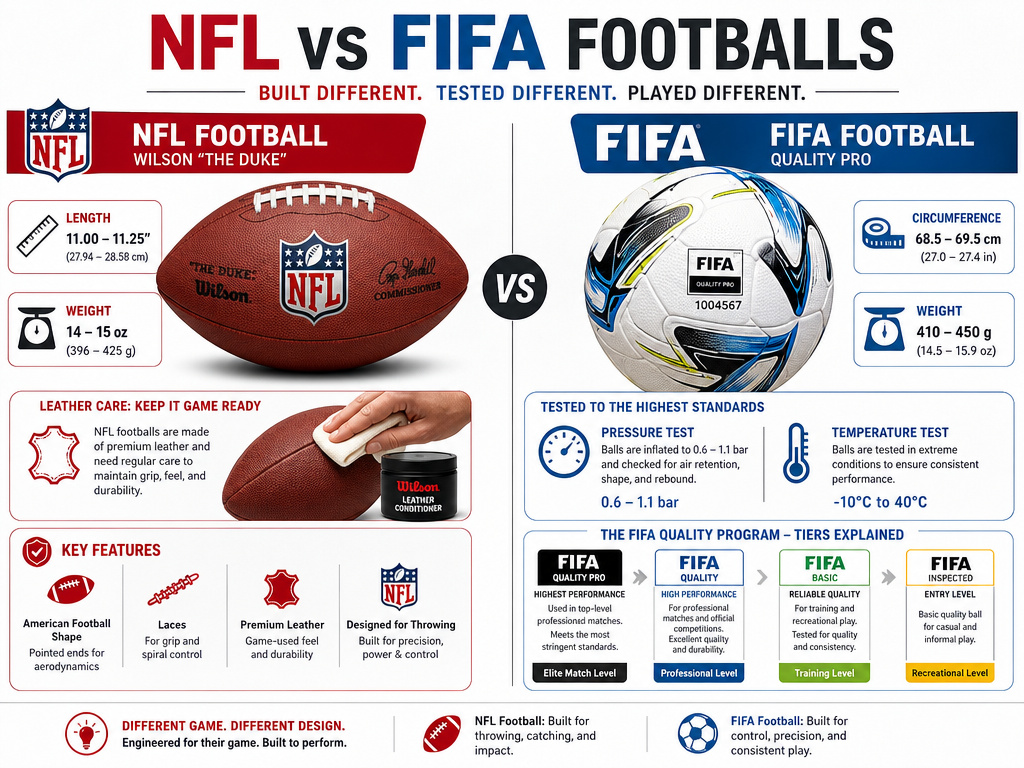
A league’s rulebook dictates how its balls are made. The differences are in the details.
NFL Specifications: The Wilson “Duke” is the only game ball. Its specs are defined by the league: long axis 11 to 11.25 inches, short axis 28 to 28.5 inches, weight 14 to 15 ounces. The leather must be a specific grade, and the pebbling has a regulated depth. Every team gets 780 new Dukes for a season, which equipment managers then “break in” to the quarterback’s preference using conditioners and even a special gritty mud for grip.
FIFA Specifications: Soccer ball standards are tiered. The highest, FIFA Quality Pro, is for World Cup and top professional matches. It has the tightest tolerances:
- Circumference: 68.5 – 69.5 cm
- Weight: 420 – 445 grams
- Pressure Loss: Max 15% over 72 hours
- Rebound: Must meet a minimum height at both 20°C and 5°C, acknowledging a ball behaves differently in cold weather.
The lower FIFA Quality and FIFA Basic marks allow slightly wider size ranges and greater pressure loss (20% and 25%, respectively). This tiered system helps you understand what you’re buying, a FIFA Quality Pro ball is built for 90 minutes of elite play, while a Basic mark is for casual use. Understanding these FIFA standards is the first step in choosing a serious ball.
How to Choose and Care for Your Football
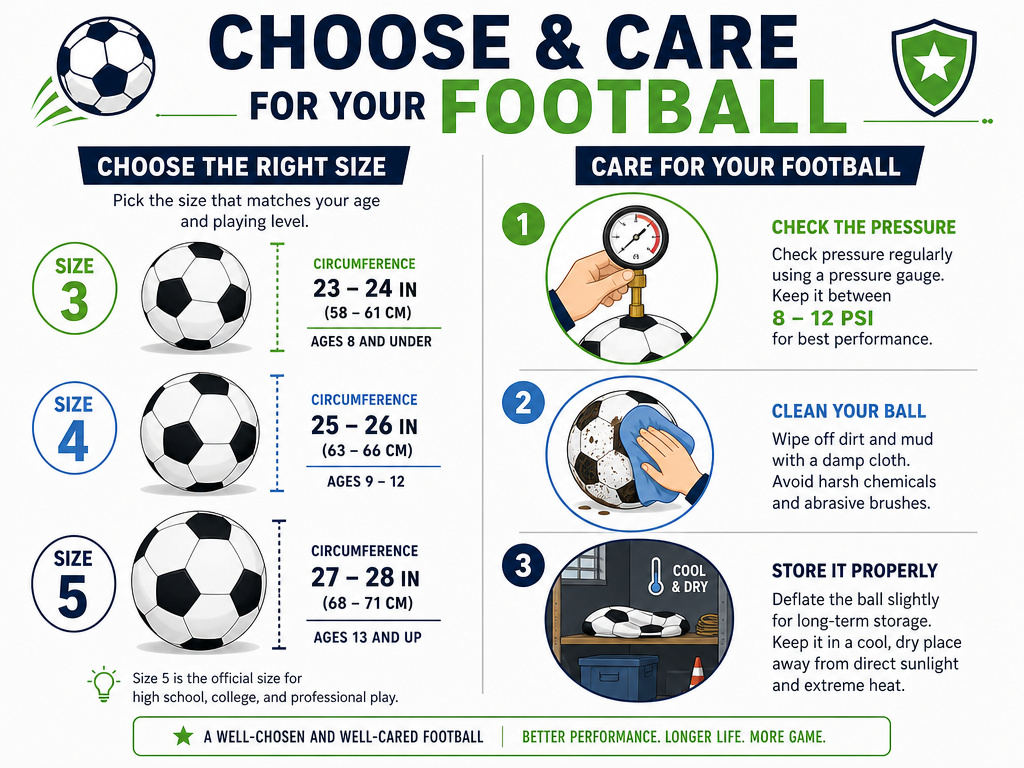
You don’t need an NFL Duke for a kickabout in the park. Matching the ball to its use saves money and improves the experience.
First, get the size right. This isn’t one-size-fits-all.
- Size 5 (Official): For adults and players aged 12+. Circumference ~69 cm.
- Size 4: For players aged 8-12. Circumference ~64 cm.
- Size 3: For young children under 8. Circumference ~58 cm.
Our full football size guide has the complete breakdown. Next, match the construction to the surface. A thermally bonded ball is great for clean grass pitches. For asphalt, concrete, or a muddy field, a machine-stitched or durable hand-stitched ball with a tough PU cover will last seasons longer.
Maintenance is simple but non-negotiable:
- Inflate to the correct pressure. Check the printed spec on the valve or ball. An over-inflated ball is hard to control and stresses seams; an under-inflated ball won’t travel true. Use a pump with a pressure gauge.
- Clean it after use on wet or muddy ground. Wipe with a damp cloth and mild soap. Never use harsh chemicals or submerge it.
- Store it deflated, in a cool, dry place. This reduces constant pressure on the seams and bladder.
Avoiding that last step is the most common mistake. Leaving a ball fully inflated in a hot car trunk or a freezing garage week after week degrades the materials faster than anything else. For a step-by-step routine, see our guide on cleaning a football.
How NFL Footballs Differ from Other Footballs
An NFL football is visually distinct, lacking the white stripes found on many college or recreational balls. This clean, dark brown leather is a deliberate choice for visibility against varied backgrounds. The most significant hidden difference is the presence of an embedded chip. This technology is used for precise tracking of the ball’s position and movement on the field, providing data for broadcast graphics and advanced analytics. While the fundamental shape and construction follow the same principles, these specific features are tailored to the professional league’s needs for performance measurement and its iconic visual identity.
How Many Footballs Are Made Each Year
The scale of football production is vast, with specialized factories operating year-round to meet global demand for the sport. Production runs are planned far in advance of major events like the Super Bowl, where a large, fresh supply of game balls is required. These facilities produce footballs in massive batches, with rigorous quality control checks on each one to ensure it meets exact specifications. The entire process, from cutting panels to final inspection, is designed for high-volume output without sacrificing the handcrafted details that define a ball meeting exact specifications.
Frequently Asked Questions
Are footballs still made from pig skin?
No. The “pigskin” nickname comes from the 1800s when balls were made from actual inflated pig bladders. Modern American footballs are made from cowhide leather (for professional balls) or synthetic materials. Soccer balls are almost exclusively synthetic (PU or PVC) at all levels.
What’s the difference between a match ball and a training ball?
Match ball is built to the highest specification (like FIFA Quality Pro) for consistent performance in a single game. It often uses premium materials and construction but may sacrifice some durability. A training ball is built for repeated use over months or years, with tougher materials that can withstand daily wear. You can explore the match vs training differences in more detail.
How many footballs are made for the Super Bowl?
The NFL provides 108 official Wilson Duke footballs for each Super Bowl. These are all made in the Ada, Ohio factory alongside the thousands of other balls produced for the regular season.
Why are so many soccer balls made in Pakistan?
The city of Sialkot, Pakistan, has been a center for sports manufacturing since the early 20th century. It developed a generational workforce skilled in hand-stitching and built a complete vertical supply chain. Today, it’s estimated to produce 60-70% of the world’s hand-stitched soccer balls, supported by FIFA-licensed factories and ethical production agreements.
Can you repair a football?
It depends on the construction. A hand-stitched ball can often be re-stitched if a seam comes loose. A thermally bonded ball cannot be repaired if the bond fails or a panel is cut, as there are no seams to work with. Machine-stitched balls can sometimes be repaired, but the machine-made stitch pattern can be hard to replicate by hand.
The Bottom Line
The journey from a flat sheet of leather to a spiraling touchdown pass is a testament to controlled craftsmanship. The specs, from the 120 PSI mold to the 15% pressure loss limit, aren’t arbitrary. They’re the guardrails that provide consistency, the thing that lets a quarterback or a striker trust their tool without thinking about it.
For your own game, that means ignoring the replica marketing and buying for your pitch. A solid training ball with a butyl bladder and PU cover will outperform a glossy, overpriced match ball on most Saturday mornings. And always store it deflated. That one habit extends a ball’s life more than any other.
The beauty of the modern football is that this precision is now accessible. You don’t need a Wilson Duke to feel quality. You just need to know what to look for in the different types of footballs on the shelf.
