
Thermal Bonded vs Hand Stitched Footballs: How to Choose
This post contains affiliate links. As an Amazon Associate, we earn from qualifying purchases.
In the thermal bonded vs hand stitched footballs debate, thermal bonded balls fuse panels with heat for a seamless, water-resistant surface and truer flight, while hand stitched balls use reinforced thread for superior durability on rough pitches and a traditional, repairable feel. For most modern professional match play, thermal bonded is common; however, some sources note hand-stitched balls are also considered best for match balls and offer a traditional feel preferred by many professionals.
The manufacturing specs behind the thermal bonded vs hand stitched footballs choice define the ball’s entire life. You are not just picking a feel; you are choosing a set of physical properties that hold up against specific tests, like the FIFA Quality Pro standard’s ≥2,000 impact cycles for shape retention or its 72-hour pressure test.
What follows are the numbers, the trade-offs, and the factory-floor realities of thermal bonded vs hand stitched footballs that separate marketing from performance. We will break down water absorption rates, the real cost drivers, and which construction actually survives a season on a hard ground.
Key Takeaways
- Thermal bonding creates a virtually seamless surface with water absorption under 0.5%, making it the choice for wet conditions and consistent flight.
- Hand stitching uses 5-ply polyester or Kevlar-blend thread for repairable seams and wins for durability on rough, hard pitches.
- To meet the FIFA Quality Pro standard, a ball must pass seven rigorous tests, including a circumference of 68.5–69.5 cm and surviving ≥2,000 impact cycles.
- For brands and bulk buyers, thermal bonded construction typically carries a 20–35% higher unit cost and a lower minimum order quantity (300 pcs at Findup Sports) than hand stitched (500 pcs).
- Your surface decides: choose thermal bonded for professional matches on good pitches; choose hand stitched for training on abrasive ground.
The Core Construction Difference
One method uses heat and pressure; the other uses needle, thread, and a specific kind of hand-work you can still find in a few cities. It is not just about looks.
Thermal bonding happens inside a spherical mould. Pre-shaped panels, with edges coated in a heat-activated adhesive, are placed inside. The mould then closes and cures the ball under 6–8 bar of pressure at 110–130 °C, fusing the panels into a single, seamless shell. The outer skin is typically a 1.0 – 1.4 mm microfiber PU or TPU, backed by 3–4 layers of cotton-polyester cloth for shape. The result has no stitches. It is a smooth, monolithic surface.
Hand stitching is a slower, tactile process. Artisans join pre-punched panels using 5-ply polyester or Kevlar-blend thread. A single 32-panel match ball requires 690–720 stitches, and each stitch is tensioned to approximately 45 kg (99 lbs) of force. This creates a deep, reinforced seam. The same high-grade microfiber PU outer skin is used, but the joining method is entirely mechanical.
The Technical Snippet: Thermal bonding applies 6–8 bar of pressure at 110–130°C to fuse pre-glued panels in a mould, eliminating seams. Hand stitching tensions 5-ply thread through pre-punched holes, with each of the 690–720 stitches in a 32-panel ball pulled to ~45 kg of force, creating a raised, reinforced seam.
This foundational difference dictates everything that comes next: how the ball moves through air, how it soaks up water, and how long it lasts when you kick it against a wall.
Performance & Feel: The On-Pitch Difference
The first touch tells you everything. A thermal bonded ball arrives with a softer, more uniform impact. The seamless surface means your foot or head meets consistent resistance, with no raised seam to create a weird bounce or spin. This is why manufacturers like Findup Sports state thermal-bonded construction wins for flight consistency. The aerodynamics are simply cleaner.
A hand stitched ball delivers a distinct, traditional feedback. You feel the seams. That texture gives players, especially in wet conditions, a tangible reference point for control and spin. Passes feel more deliberate; a well-struck cross has a specific, satisfying thud.
The numbers behind these sensations are precise. To earn a FIFA Quality Pro certification, the standard for top-tier professional matches, a ball must pass a battery of tests. These are not guidelines; they are pass/fail thresholds.
| FIFA Quality Pro Test | Requirement | Why It Matters |
|---|---|---|
| Circumference | 68.5 – 69.5 cm | Ensures uniform size for consistent play. |
| Weight | 420 – 445 g | Affects flight dynamics and player feel. |
| Sphericity | ≤ 1.5% deviation | Guarantees a true, non-wobbling roll. |
| Rebound (2m drop) | 135 – 155 cm | Dictates bounce height and response. |
| Water Absorption | ≤ 10% weight gain | Limits water uptake that adds weight and slows the ball. |
| Loss of Pressure (72 hrs) | ≤ 20% | Tests the bladder and valve seal integrity. |
| Shape Retention | ≥ 2,000 impact cycles | Measures durability against repeated force. |
Both construction methods can hit these marks, but they get there differently. The rebound test is particularly telling. A ball dropped from two meters must bounce between 135 and 155 cm. The internal construction, the lamination layers and bladder placement, has to be perfect to stay in that band every time.
Where this goes sideways: Choosing a ball based only on “pro feel.” A thermal bonded match ball feels incredible on a pristine Premier League pitch. That same ball on a rock-hard, uneven Sunday league field will feel completely different, and might not last the season.
Water Resistance & Durability
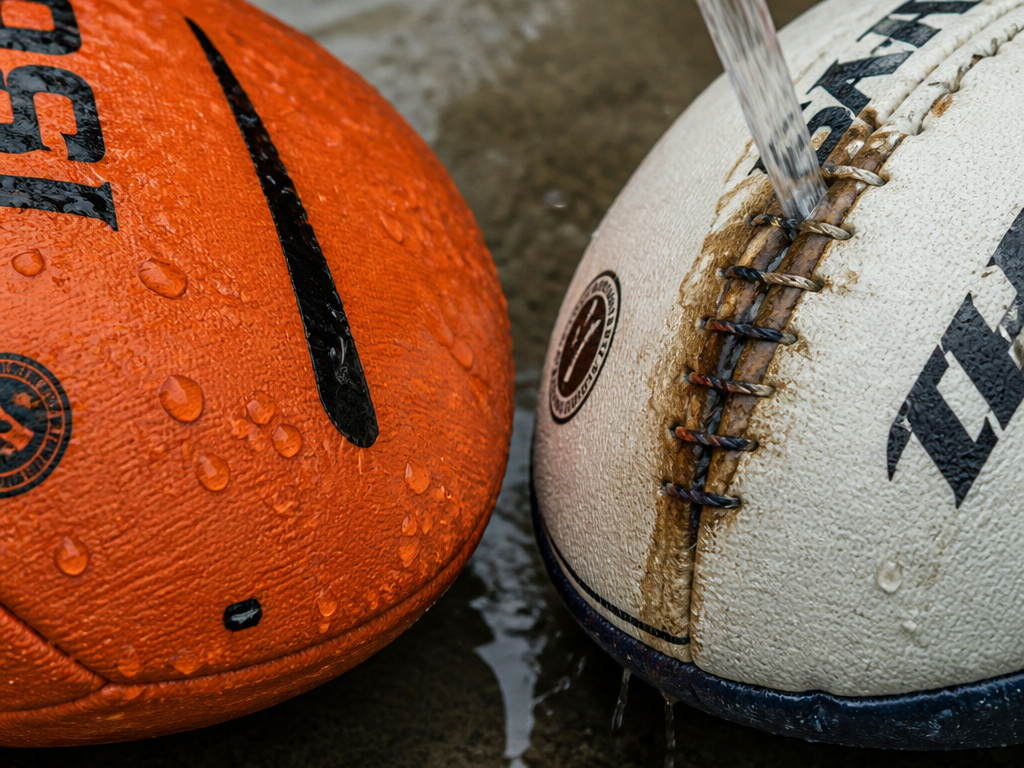
This is where the trade-off becomes stark, and where the factory data cuts through the hype. The difference is not minor; it is measured in multiples.
According to factory tests from Findup Sports, thermal bonded football water absorption is <0.5%. The bonded seams are essentially waterproof. Water beads up and rolls off. A hand-stitched football, however, has water absorption of 5–10%. The needle holes and thread wick moisture, and the ball can gain noticeable weight in a downpour. For a match ball vs training ball decision in wet climates, that number is the deciding factor.
But durability is not just about shedding water. It is about surviving impact. Here, the sources present a clear disagreement you need to know about.
One Findup Sports blog states plainly that for durability on rough pitches, hand stitched wins. Another page from the same manufacturer says thermal-bonded balls have ‘long life,’ implying general durability. This is a point where sources disagree on the primary durability advantage.
Think about the type of damage. Think about the type of damage. On a consistent, high-quality grass pitch, both are durable. On a gritty, artificial turf or a hard, uneven ground, the abrasive surface scuffs and wears at the ball’s skin. The stitched ball’s seam is a raised, reinforced ridge, it takes the abrasion. The thermal bonded ball’s seamless surface presents a larger, flat area to be worn down. If the bonded seam does fail, the ball is non-repairable. A hand-stitched ball has repairable seams.
Common mistake: Assuming “more expensive” equals “more durable.” On a rough pitch, the cheaper-to-produce hand-stitched ball will often outlast the premium thermal-bonded one. You are paying for flight consistency and water resistance, not necessarily toughness.
For a deep dive on what makes a ball last, our review breaking down soccer ball materials and construction goes further.
Cost, Lead Times & Buying for Your Needs
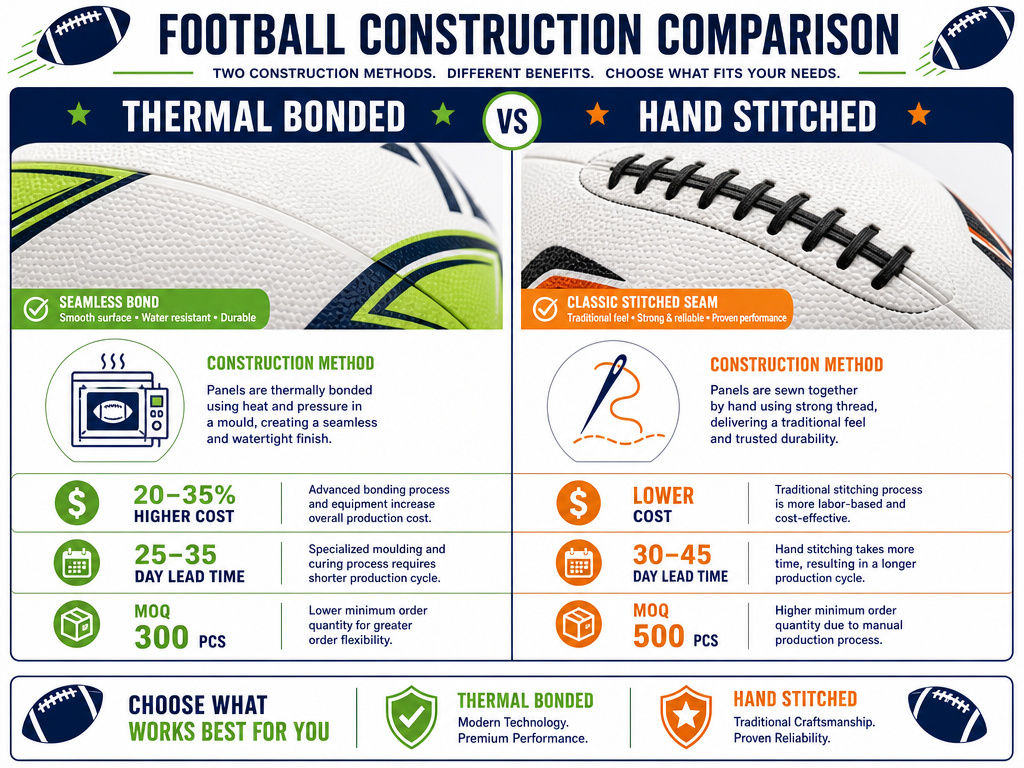
If you are buying one ball, price is a simple check. If you are a club, brand, or distributor, cost is a complex equation with at least five levers. The factory breakdowns show what you are actually paying for.
The unit cost for thermal bonded footballs is typically 20–35% higher than for hand-stitched balls at similar quality levels (e.g., both using Japanese microfiber PU). Why? The thermal bonding process requires expensive moulds and controlled curing ovens. The lead time for thermal-bonded footballs is 25–35 days, while hand-stitched footballs take 30–45 days to produce. The hand-work simply takes longer.
For bulk buyers, Minimum Order Quantities (MOQs) matter. At Findup Sports, the MOQ for thermal-bonded is 300 pieces, while the MOQ for hand-stitched is 500 pieces. This reflects the different production setups.
| Consideration | Thermal Bonded | Hand Stitched | Best For |
|---|---|---|---|
| Primary Strength | Flight consistency, water resistance | Durability on rough ground, repairability | Wet matches vs. Hard training pitches |
| Cost Driver | Mould and oven investment | Skilled labour and time | Budgets prioritizing tech vs. Toughness |
| Typely Use Case | Professional match play, premium retail | Training, mid-tier retail, hot/dry climates | League matches vs. Club training bags |
| Logistics | Lower MOQ (300 pcs), shorter lead time | Higher MOQ (500 pcs), longer lead time | Smaller brands vs. Larger, established clubs |
So, which should you choose? The manufacturer’s own guidance is pragmatic:
- Promotional and entry-level ranges → machine-stitched.
- Training and mid-tier retail → hand-stitched.
- Premium retail, club match balls and league-quality → thermal-bonded.
Most private-label brands run a two-tier lineup: a hand-stitched trainer and a thermal-bonded match ball. This covers all the bases. For a broader look at the different types of football construction, from machine-stitched to hybrid, our guide on football types explained provides context.
Your playing surface is the ultimate guide. A thermal-bonded Select Numero 10 or Adidas Champions League replica is perfect for well-kept grass. For the community pitch with its share of stones and hard patches, a robust Mitre or hand-stitched training ball is the smarter investment. It is not about good and bad; it is about right and wrong for the job.
The Manufacturing Ecosystem: Sialkot’s Role
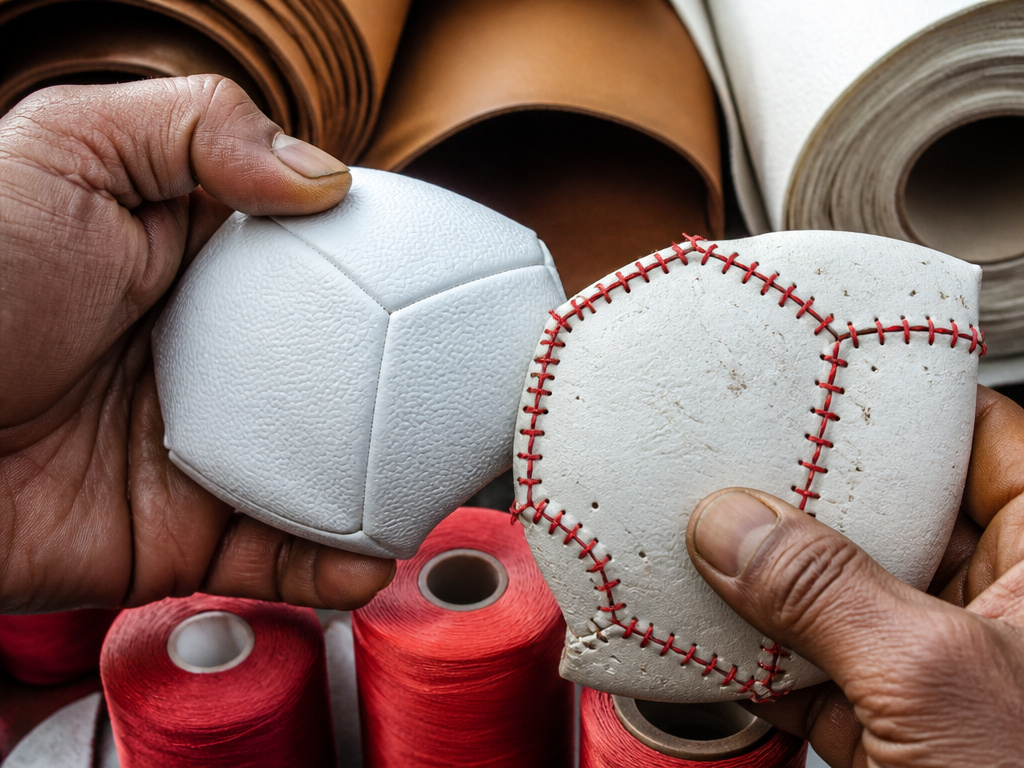
You cannot talk about hand-stitched footballs without talking about Sialkot, Pakistan. This city holds a 60–70% share of global hand-stitched football production. The trade has been passed down since the 1920s, creating a generational workforce with a specific, hard-earned skill set.
The entire supply chain is there: rubber for bladders, rolls of PU, spools of thread, printing facilities, and packaging. This vertical control is why the football manufacturing process can be so efficient and why FIFA-licensed factories cluster there. It is also a city under a microscope. Since the 1997 Atlanta Agreement, the industry has been independently monitored to ensure child-labour-free production, a critical fact for any brand considering OEM production.
This ecosystem explains the lead times and costs. When you order hand-stitched balls, you are paying for that skilled labour. When you order thermal-bonded, you are paying for the technology that augments it. Understanding the football manufacturing process, as detailed in our guide on how footballs are made, turns a purchase from a transaction into an informed decision.
How long does it take to make and get each type?
Production lead times differ. For thermal-bonded footballs, the manufacturing lead time is 25–35 days. For hand-stitched footballs, it is 30–45 days. The minimum order quantity for thermal-bonded balls is typically lower than for hand-stitched. This means a thermal-bonded order can be smaller and its production lead time is typically shorter. When planning for a season or a product launch, these timelines affect inventory and availability. Thermal-bonded construction is often used for premium retail and club match balls, while hand-stitched is common for training and mid-tier retail.
What about machine-stitched footballs?
Beyond thermal-bonded and hand-stitched, machine-stitching is a third major construction method. It serves a distinct market segment. Promotional and entry-level football ranges should use machine-stitched construction. This method balances cost and basic performance for casual use or giveaways. It sits below hand-stitched training balls and far below premium thermal-bonded match balls in a product lineup. A common strategy for brands is a two-tier offering: a hand-stitched trainer and a thermal-bonded match ball, with machine-stitched covering the most affordable tier.
Frequently Asked Questions
What is the main advantage of a thermal bonded football?
Its main advantage is a seamless surface, which results in extremely low water absorption (<0.5%) and more consistent, truer flight in the air. This makes it the standard for modern professional match balls, especially in wet conditions.
Are hand stitched footballs better for match play?
They can be, but it depends on the match context. Hand stitched balls offer the traditional match-ball feel and superior durability on rough or hard pitches. Many professionals still prefer this feel. However, for elite-level play on perfect pitches where flight consistency is paramount, thermal bonded has become the norm.
Which type of football is more durable?
On smooth surfaces, both are highly durable. On rough, abrasive surfaces like hard ground or artificial turf, hand stitched footballs generally have the edge due to their reinforced, repairable seams. Factory data notes hand stitching “wins” for durability on rough pitches.
Can you repair a thermal bonded football?
No. If the bonded seam of a thermal bonded football fails or the skin splits, it is not repairable in a way that restores its original integrity or performance. Hand stitched balls, with their external stitching, can be re-stitched to extend their life.
What does FIFA Quality Pro mean?
FIFA Quality Pro is the highest certification for footballs, indicating they have passed rigorous lab tests for size, weight, sphericity, rebound, water absorption, pressure retention, and shape retention (≥2,000 impacts). It is the standard required for all top professional competitions. Our guide on the FIFA Quality Pro standard explained has the full details.
Is a more expensive football always better?
Not necessarily. A more expensive thermal bonded ball is better for specific things: flawless flight and water resistance. A less expensive hand-stitched ball is often the better, more durable choice for training and play on rough surfaces. Pay for the performance you actually need.
The Bottom Line
Do not buy a ball for its logo or its price tag. Buy it for your pitch and your purpose.
If your Saturday morning involves a soft, watered grass pitch and you want every pass to slice the air the same way, the thermal bonded route is your answer. Look for top-performing footballs with that construction in our best footballs review. If your games are played on a surface that resembles concrete more than carpet, and you need something that will survive the season, invest in a hand-stitched trainer. Durable training soccer balls, as highlighted in our best practice soccer balls guide, are built for that abuse.
One final, tangible check: inflation. Both types are shipped deflated to 30% of match pressure to protect the shape. When you pump it up, use a pressure gauge. An over-inflated ball becomes a rock; an under-inflated one turns sluggish. That basic bit of maintenance matters more than any marketing claim. Get that right first, then worry about the stitches.
