
Firm Ground vs Artificial Grass Boots: Key Differences
This post contains affiliate links. As an Amazon Associate, we earn from qualifying purchases.
Firm ground vs artificial grass boots comes down to matching the soleplate to the pitch. Firm ground boots use longer, often bladed studs for traction on natural grass, while artificial grass boots use shorter, more numerous conical studs to spread load on synthetic turf. For most players, a dedicated AG boot is safer for modern 3G/4G pitches, as wearing FG boots on artificial grass can increase knee injury risk and void warranties.
The firm ground vs artificial grass boots question isn’t just about grip. It’s about how the stud interacts with the ground beneath it. On grass, a blade slices in and releases. On artificial turf, that same blade can plant in the rubber infill and hold, which is where the trouble starts.
What follows is a breakdown of the physics, the injury risks the charts skip, and a straight-talking guide to picking the right tool for your pitch. This section explains the visual tells, the warranty fine print, and when a hybrid boot actually makes sense.
Key Takeaways
- Match the letters on the box to your primary pitch: FG for firm natural grass, AG for modern 3G/4G artificial grass. It’s the single most important gear decision you’ll make.
- Wearing FG boots on AG is a documented knee-injury risk. The longer bladed studs can lock in the rubber infill, creating rotational forces your knee isn’t designed to handle.
- Check your warranty. Some retailers, as noted by BOOTHYPE, will not honour it if they identify black scuff marks from AG pellets on an FG soleplate.
- For growing junior players, never compromise. Elite Champions Coaching advises a dedicated AG boot for artificial grass to protect developing joints.
- Sources disagree on the best single boot for mixed use: Elite Champions Coaching states an AG boot is the better single compromise, while Pro:Direct Soccer suggests MG makes plenty of sense.
The Physical Difference: Studs, Pattern, and Plate
Look at the bottom of the boot. That’s where the entire firm ground vs artificial grass boots conversation lives. The soleplate, its studs, their pattern, and the material itself, is engineered for a specific surface interaction.
According to BOOTHYPE, According to BOOTHYPE, FG soleplates have a medium number of studs of medium length. ProSoccer notes they often use bladed or mixed conical/bladed studs. The bladed stud is the key. It’s designed to slice into natural turf for explosive traction in a straight line. The problem? On artificial grass, that blade doesn’t slice. It can plant in the rubber infill and hold.
A Firm Ground (FG) soleplate typically features a mix of bladed and conical studs of medium length, designed to penetrate and release from natural soil. An Artificial Grass (AG) soleplate uses a higher count of short, uniformly conical or hollow studs to distribute pressure and reduce stud-lock on synthetic turf with rubber or sand infill.
AG boots use many short, hollow or conical studs. The goal isn’t deep penetration; it’s load distribution. More studs spread your weight, and their rounded shape is less likely to grab and hold in the synthetic fibres. This design, as noted by UAEFootball.org, often uses more resilient rubber or reinforced TPU to resist melting from the heat of coarse turf.
The feel is different, too. An FG boot on its proper surface gives you that confident, anchored sensation for pushing off. An AG boot on turf feels more like a stable platform, you get grip without the aggressive bite. Trying to use one on the other’s surface is how you end up with a boot that either slips or won’t let go.
Why the Wrong Boot on Artificial Grass is a Knee-Problem
This is the part most buying guides gloss over. It’s not just about comfort or boot wear; it’s a biomechanical risk, especially for knees.
On natural grass, when you turn, the FG stud releases from the soil. On artificial grass, the same stud can sink into the rubber infill and lock. Your foot stops rotating. Your knee, which is connected to your foot, tries to keep moving with your body’s momentum.
Where this goes sideways: Using FG boots on modern artificial grass. The bladed stud can plant in the rubber infill and hold during a turn, creating knee-loading rotational forces that strain ligaments. For juniors, coaches advise not risking it.
That loading pattern is a textbook mechanism for non-contact knee and ankle injuries. Coaching resources like Elite Champions Coaching highlight this as a particular risk for junior players whose joints are still developing. The advice is blunt: don’t risk it. For growing juniors, get a dedicated AG boot.
The surface matters, too. A worn-down 3G pitch with flattened fibres offers less cushion, making the stud-lock effect even more pronounced. The stud-lock effect can be more pronounced depending on field conditions. That slight loss of give turns the surface into a more rigid trap for an aggressive stud.
The Surface Dictates the Boot (And Maybe Your Wallet)
Your playing schedule is the ultimate guide. You match the boot to the pitch you’re on most often, not the one you wish you were on.
| Your Primary Pitch | First-Choice Boot | Why It’s The Pick | Risks of the Wrong Boot |
|---|---|---|---|
| Dry, Firm Natural Grass | FG (Firm Ground) | Studs penetrate for optimal traction. | Slippage on turf; accelerated wear. |
| Modern 3G/4G Artificial Grass | AG (Artificial Grass) | Short studs distribute load, reduce stud-lock. | Loss of traction on grass; potential knee strain from FG boots. |
| Mixed Schedule (Grass & 3G) | AG or MG (Multi-Ground) | AG is the safer compromise; MG is designed for both. | FG boots are high-risk on turf. AG boots may lack bite on soft grass. |
| Older Sand-Filled Astro (2G) | TF (Turf) | Rubber nubs grip hard surface without damage. | Studded boots slip and can damage the carpet. |
Start with the surface used most often. If the majority of your season is on club 3G pitches, you need an AG boot. If you’re a Saturday league player on natural grass, FG is your default. This simple match is the core of any good boot types explained guide.
The financial side has a hidden clause. That warranty card in the box? It likely requires using the boot on its intended surface. BOOTHYPE reports that some retailers will refuse a warranty claim if they see the tell-tale black scuff marks from artificial grass rubber pellets on an FG soleplate. They can tell. That’s a costly mistake.
FG/AG Hybrids: The Practical Compromise?
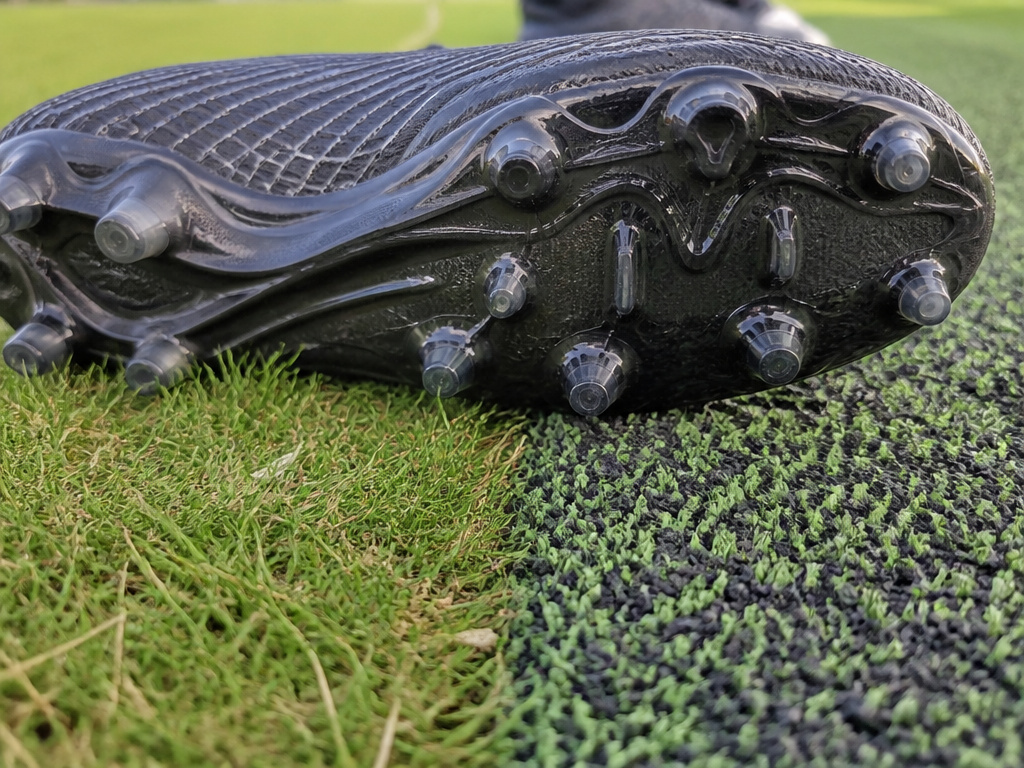
Manufacturers know players often face mixed surfaces. The response is the hybrid boot, like the PUMA ULTRA PRO FG/AG. Puma explicitly markets it as “Suitable for use on both firm natural surfaces and artificial grass (4G).”
So, does it work? The experience is mixed. Reviewers at BOOTHYPE were initially apprehensive about hybrid soles, fearing the studs looked too long for AG. Testing often reveals a middle ground: the traction is “surprisingly not too aggressive” and works adequately on both surfaces, but it’s a master of none.
If you genuinely split time evenly between firm grass and quality 3G, a hybrid or a cautious AG boot choice makes practical sense. As Pro:Direct Soccer’s guide notes, if you’re regularly moving between surfaces and only want one pair, “MG makes plenty of sense.” The key is managing expectations. You won’t get elite FG traction on soft grass, nor will you get the perfect pressure distribution of a top AG boot on turf. It’s a compromise that prioritises convenience and cost over peak performance on either surface.
For a deep dive on the pros and cons of these middle-ground options, our guide to FG, AG, and SG boots breaks it down further.
A Buyer’s Walkthrough: From Pitch to Purchase
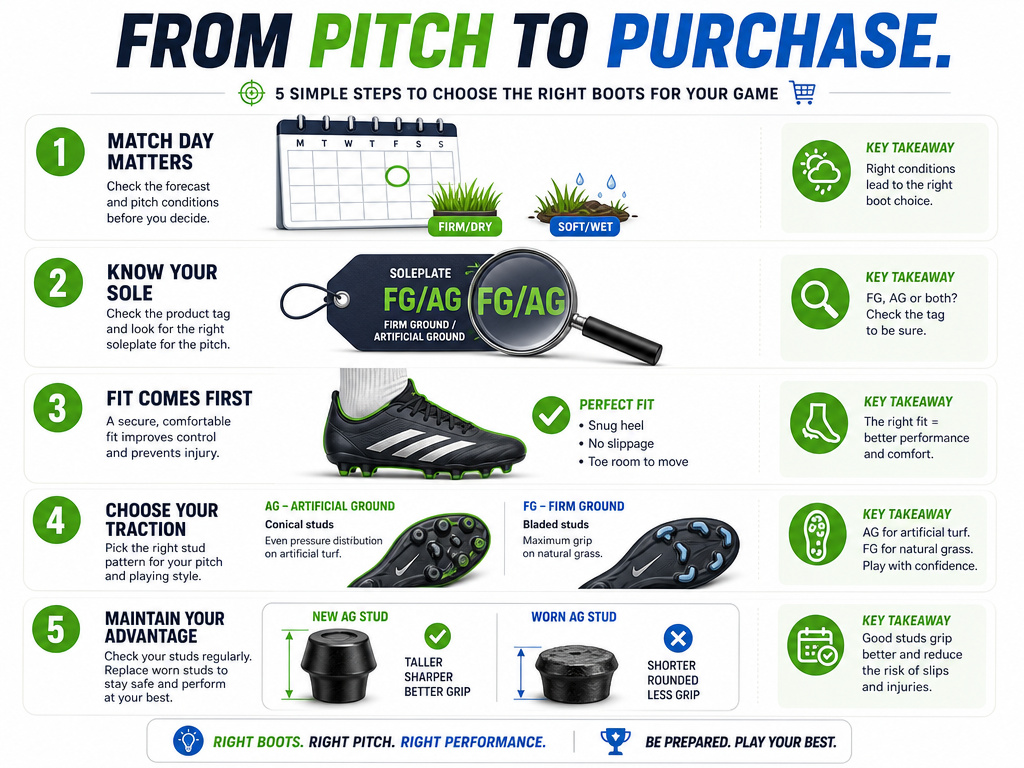
Forget the marketing hype about carbon fibre and speed skins for a second. The buying process should be a straight line from the pitch to the soleplate.
- Audit Your Schedule. Look at your last month. Was it 80% grass training? 100% 3G matches? Be honest. The majority surface wins.
- Read the Fine Print. Before falling for a colourway, find the manufacturer’s surface recommendation on the product page. It’s always there.
- Prioritise Fit. A perfectly matched boot that doesn’t fit is useless. A slightly less-optimal boot that fits like a glove will always play better. Our boot fit guide covers this in detail.
- Consider the “Second Pair” Rule. If your schedule is a true 50/50 split between pristine grass and modern turf, owning two specialised pairs is the professional approach. It’s an investment in performance and injury prevention.
- Inspect the Studs. Even with the right boot, worn-down studs lose their design properties. Check them regularly. A rounded-over AG stud loses its pressure-dispersing shape.
When researching specific models, look beyond the top-tier elite versions. A mid-range boot in the correct stud configuration will serve an amateur player far better than the most expensive boot on the wrong surface. Our reviews of the best FG cleats and best AG shoes focus on performance where it matters.
How do Turf shoes fit into the boot discussion?
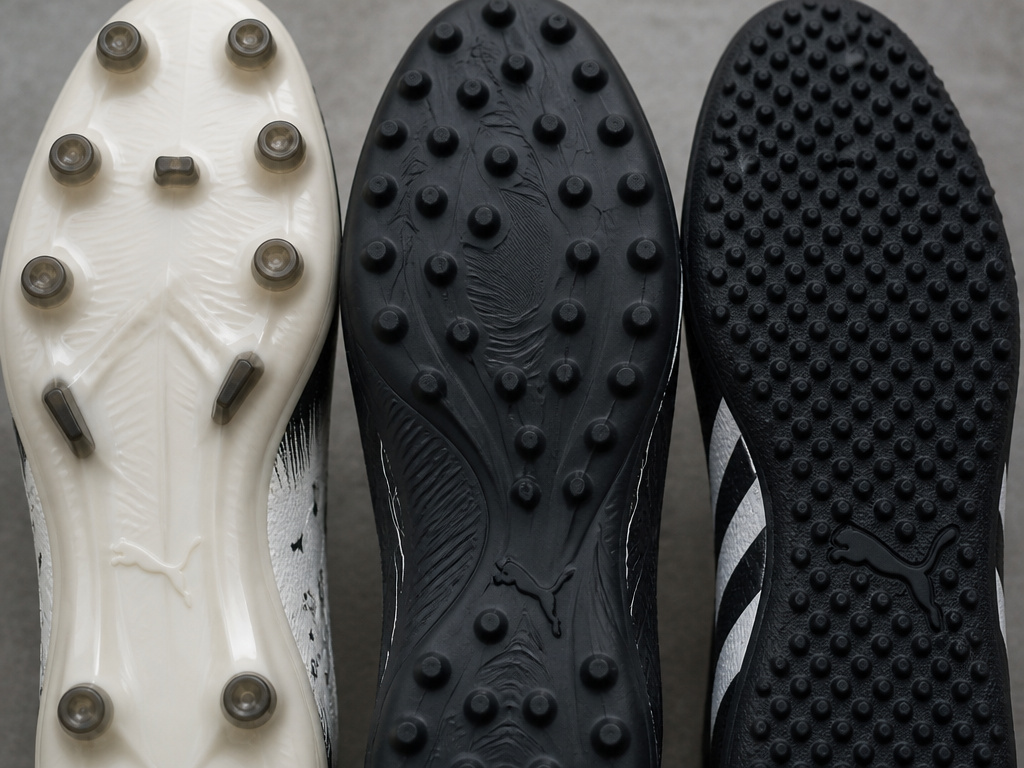
While firm ground and artificial grass boots are the main categories, there is a third type for a specific surface: the Turf shoe. The discussion often centers on FG and AG because they are designed for the primary competitive surfaces of natural grass and modern 3G/4G artificial grass pitches. Turf shoes, with their many short rubber nubs, are built for hard, short-pile artificial surfaces like those found in gyms or some older recreational fields. They are a distinct tool for a distinct job, separate from the performance and safety considerations of using FG or AG boots on their intended pitches.
What is the difference between AG and Turf shoes?
AG boots and Turf shoes are designed for different types of artificial surfaces. AG boots are for modern, long-pile synthetic pitches, often called 3G or 4G, which have a rubber infill. They use many short, conical studs to spread the load and grip without grabbing. Turf shoes are for hard, short-pile artificial surfaces with little to no infill, like those on concrete or in indoor facilities. They have a dense pattern of small rubber nubs for grip on a hard, unforgiving base. Using an AG boot on a true turf surface may not provide enough grip, while using a turf shoe on a 3G pitch offers insufficient stability and traction.
Frequently Asked Questions
Can I wear firm ground boots on artificial grass?
Sources disagree on whether FG boots can be safely used on AG. ProSoccer and Elite Champions Coaching advise against it due to injury risk, while Puma markets specific FG/AG boots as suitable for both, and Soccer Family Guide states there is no blanket yes or no.
What happens if I wear artificial grass boots on natural grass?
It depends on the condition of the pitch. On firm, dry natural grass, AG boots with their shorter studs will work but may offer less bite for sharp cuts and acceleration. On soft or wet grass, they will struggle to penetrate, leading to a loss of traction. As per the UAE Football boot selection guide, matching the boot to the surface is always the recommended starting point.
Are MG and AG boots the same thing?
Not exactly. AG (Artificial Grass) boots are designed specifically for synthetic turf. MG (Multi-Ground) boots are a hybrid category designed to be a passable option on both firm grass and artificial surfaces. An MG soleplate is a deliberate compromise, while an AG soleplate is a specialist tool.
How do I tell if my boots are FG or AG just by looking?
Flip them over. FG boots typically have fewer, longer studs, often with a mix of blade and cone shapes. AG boots will have a higher number of studs that are all short, uniform, and almost always conical or rounded. The difference in stud count and length is usually obvious in a side-by-side comparison.
Do professional players wear FG boots on artificial grass?
Sometimes, yes. They often have customised soleplates, access to pristine pitches, and physiotherapists on standby. This does not make it a safe idea for amateur or youth players. Their risk calculus, with careers and contracts on the line, is different from yours. Do not copy a pro’s boot choice without understanding the context.
The Bottom Line
Here’s the simple rule: the pitch chooses the boot. If you play on artificial grass more than once a week, buy an AG boot. The potential knee strain and warranty void aren’t worth the hassle.
For parents of junior players, the rule is even simpler. Listen to the coaching advice: get a dedicated AG boot for artificial grass pitches. Their developing joints don’t get a second chance.
And if you’re still staring at two pairs, one FG and one AG, remember that the best boot in the world is the one that fits your foot and fits your pitch. Everything else, the brand, the colour, the athlete endorsement, is just noise. Find a pair that matches the letters on the box to the ground under your feet, and you’ve already won.
