
FG vs AG vs SG Football Boots: The Pitch-by-Pitch Guide
This post contains affiliate links. As an Amazon Associate, we earn from qualifying purchases.
FG boots are for firm, dry natural grass, with longer, often bladed studs for traction. AG boots are for artificial turf, with shorter, more numerous conical studs to reduce joint stress. SG boots, with 6-8 metal screw-in studs, are for soft, muddy natural pitches. The wrong choice risks injury and voids your warranty.
The difference is a design contract between your foot and the ground, not merely letters on a box. A bladed stud bites into soil; on synthetic turf, that same bite can lock your foot while your knee twists. The choice between fg vs ag vs sg football boots is defined by the numbers on a spec sheet, which tell you which contract you’re signing (see our guide to firm ground vs artificial grass boots).
What follows: the sourced specs that define each type, the real injury data that complicates the safety warnings, and a straight-talking guide to the fg vs ag vs sg football boots question for the pitch you actually play on. By the end, you’ll know why a Puma Ultra Ultimate MG isn’t just marketing, and when a $50 pair of conical studs beats a $250 pair of blades from our list of the best football boots.
Key Takeaways
- Match the soleplate to your primary surface. Using FG boots on artificial grass voids the manufacturer’s warranty and, according to biomechanical studies, increases rotational forces on the knee.
- AG boots like the Nike AG-Pro use short (8.5 mm), hollow studs to diminish hard shocks through your joints on unyielding turf. FG boots like the Adidas Predator Elite use studs designed to penetrate firm ground.
- SG boots are a specialist tool for wet, muddy grass, with 6-8 metal studs you can change from 12mm to 18mm. They’re overkill and dangerous on firm or artificial surfaces.
- The community and science sometimes disagree with strict manufacturer rules. Many players use conical FG boots on new AG pitches, and field studies show conflicting injury risk data.
- For mixed surfaces, a Multi-Ground (MG) boot like the Puma Ultra Ultimate MG (11mm studs) is a legitimate hybrid designed for both firm ground and artificial grass.
The Core Specs: Studs, Length, and Materials
Forget the acronyms for a second. Look at the bottom of the boot. The stud pattern, length, and material are the entire conversation. This is where a 2013 study in the Journal of Sports Sciences found that bladed stud configurations provided superior traction on dry, firm ground. It’s also where independent testers at Lab 42 measure pressure distribution and rotational release.
Here’s the breakdown in numbers, straight from the manufacturer spec sheets.
| Boot Type (Example Model) | Stud Count & Shape | Typical Stud Length | Primary Stud Material | Designed Surface |
|---|---|---|---|---|
| FG (Adidas Predator Elite) | 11 studs | Varies | Rubber/plastic | Firm, natural grass |
| AG (Nike Mercurial AG-Pro) | 38 studs, circular pattern | 8.5 mm (average) | Hollow aluminum & TPU | Artificial Grass (3G/4G) |
| SG (Nike Tiempo Legend SG) | 6-8 studs, conical | 12 mm – 18 mm (replaceable) | Metal (aluminum/steel) | Soft, wet, muddy natural grass |
| MG (Puma Ultra Ultimate MG) | Mix of conical and bladed | 11 mm | Reinforced TPU/rubber | Firm Ground & Artificial Grass |
The Nike AG-Pro soleplate features a pattern with 38 studs averaging 8.5 mm in length. The hollow, circular aluminum and TPU construction is designed to diminish hard shocks through your joints on artificial turf.
That table presents a physics problem, not just a list. More studs (like the AG’s 38) spread your weight over a larger area, reducing pressure on any single point, crucial on a surface that doesn’t give. Fewer, longer studs (like the FG’s 11) concentrate force to pierce and grip the ground. Get this wrong, and you feel it. A firm-ground boot on astroturf sends a jarring shock up your leg with every step; the surface doesn’t compress, so your joints do (understand the key Astro turf vs indoor differences).
Which brings us to the first major fork in the road.
FG Boots: The Firm Ground Standard
Firm ground boots are the default, the workhorse. They assume a well-kept natural grass pitch that’s dry or slightly damp. The goal is penetration and grip without sinking.
The Adidas Predator Elite FG uses a “FACET FRAME” outsole with 11 strategically placed studs, a top pick among the best cleats for firm ground. This isn’t random. Those blade angles are engineered for explosive acceleration and sharp cuts on a surface that gives way. The Nike Mercurial Superfly 9 Elite FG takes a different material approach, using a glass fibre reinforced nylon (Pebax®) plate. The studs themselves are a high-abrasion rubber compound.
These boots are light, the Puma FUTURE 7 ULTIMATE FG clocks in at about 185g for a UK size 9. They are designed for firm, natural grass surfaces.
Where this goes sideways: Using a bladed FG boot on artificial grass. The studs can grip the synthetic fibers and rubber crumb too aggressively, a phenomenon called ‘stud fixation.’ Your foot stops, your body twists, and the load transfers to your knee or ankle.
The performance claim is backed by data. That 2013 Journal of Sports Sciences study and Lab 42 testing both support bladed studs for firm ground traction. But the moment the pitch changes, the equation flips. This is where the most heated arguments in boot forums begin.
AG Boots: Designed for the Unforgiving Pitch
Artificial grass doesn’t forgive. It’s a carpet of plastic blades over rubber crumbs and sometimes sand, laid on concrete or asphalt. It’s abrasive and unyielding. AG boots are the direct engineering response.
The design principles are total opposites of FG. Short studs (8.5mm on the Nike AG-Pro) prevent excessive penetration. Numerous studs (again, 38 on the AG-Pro) distribute load. Conical shapes allow for smoother rotational release, your foot can pivot with less chance of catching. The hollow construction of the studs on boots like the AG-Pro is a shock-absorption feature.
The stated reason from retailers like Unisport is stark: using FG boots on AG is “really dangerous” and voids your warranty. The logic is clear: longer, bladed FG studs risk causing that stud fixation.
But here’s the complicating layer from the research. A biomechanics review on Science for Sport cited studies showing no statistically significant difference in non-contact lower extremity injury rates between AG and FG boots on artificial turf in actual field studies. The mechanical risk exists in the lab, but the epidemiological evidence is thinner.
So who’s right? The lab test showing higher rotational forces, or the field study showing no significant injury spike? Honestly, both. The lab measures a real physical phenomenon. The field study includes thousands of variables, player technique, pitch quality, luck. I trust the physics enough to never wear bladed FG boots on AG. But I also know the community isn’t crazy for questioning the absolute danger level.
SG Boots: The Muddy Weekend Specialist
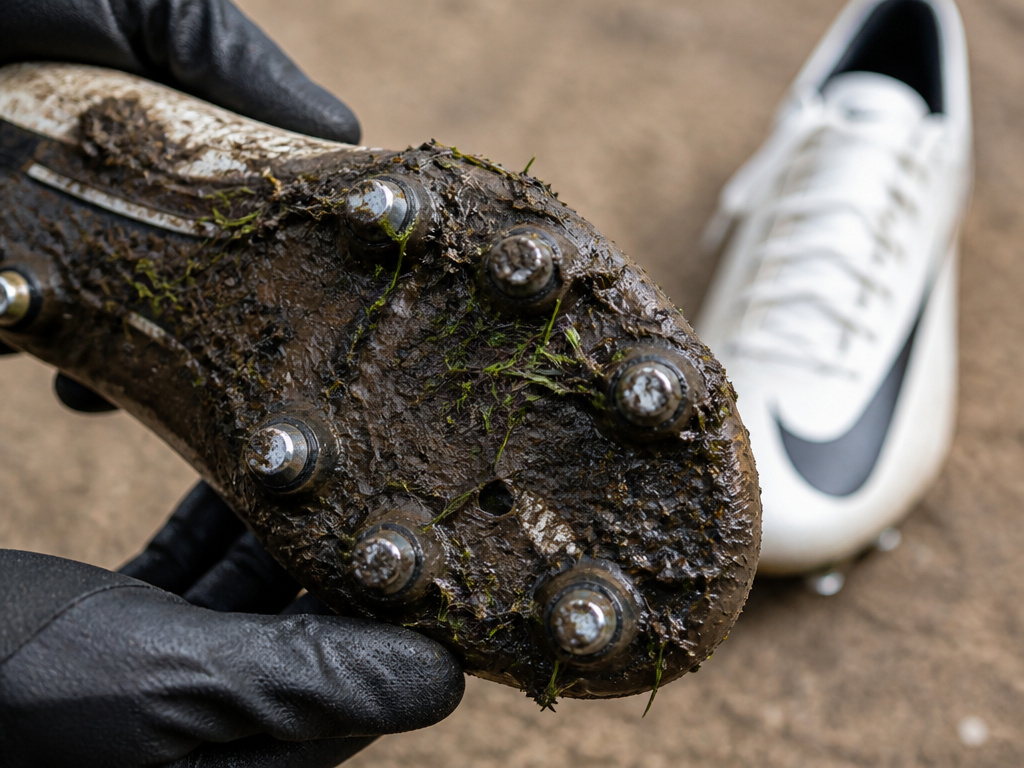
SG boots are the least common and most specialized tool in the bag. You see them in the Premier League on a rainy day at Stoke. The pitch is soaked, the grass is long, and traction is a memory.
These boots have 6-8 metal, screw-in studs. The metal (usually aluminum) provides the bite that plastic can’t on a slick, muddy surface. The length is adjustable, you can swap studs from 12mm to 18mm depending on how soft the ground is. Professional reviews call them “essential for maintaining stability and preventing slip” in elite, wet conditions.
For everyone else? They’re probably overkill.
Common mistake: Thinking SG boots are just “better” FG boots. They’re not. On firm or artificial ground, metal studs are a liability. They don’t flex, they concentrate pressure on tiny points, and they can slip on hard surfaces. They’re for one job.
Most amateur players will never need a pair. A modern AG or MG boot with conical studs will handle damp natural grass just fine. Buying SG boots for anything other than consistently soft, muddy pitches is like buying a snowplow for a climate that gets one frost a year.
The Real-World Debate: Can You Use FG Boots on AG?
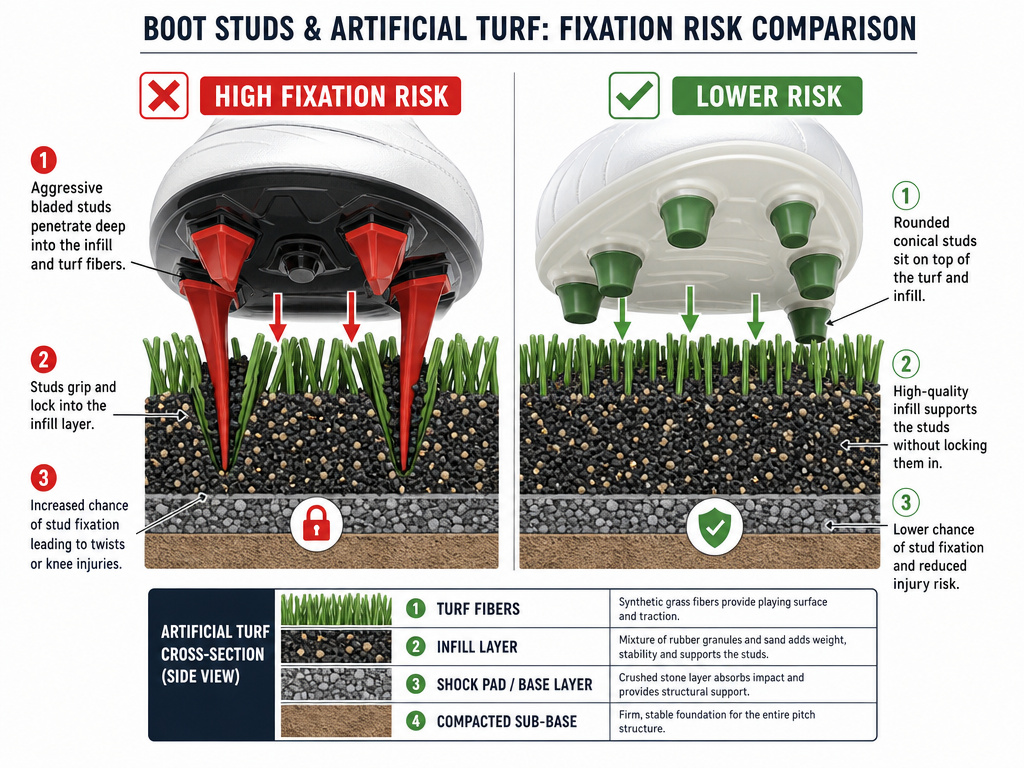
This is the million-dollar question in every forum thread. Many manufacturers and retailers give a hard “no,” stating it voids the warranty and risks injury, while Puma engineers its Ultra Ultimate MG soleplate for use on both firm ground and artificial grass. A common community line, especially on places like Reddit’s r/bootroom, is a nuanced “sometimes,” with many experienced players reporting using specific FG models on high-quality AG pitches without issue.
The disagreement hinges on two things: stud pattern and pitch quality.
Many experienced players report using FG models with fully conical studs on newer, high-quality AG pitches without issue. They’re not using bladed Predators. The conical shape allows for easier release, mitigating the fixation risk. They also contest the durability warning, saying wear is more about the specific rubber compound and infill level than the FG label.
| Position | Claim | Who Says It |
|---|---|---|
| Against FG on AG | High injury risk from stud fixation; voids warranty; premature wear. | Manufacturers, major retailers (Unisport). |
| For Certain FG on AG | Conical-stud FG boots are fine on good AG; injury risk is overstated; wear depends on model. | Football boot community forums, experienced players. |
The truth lives in the middle. A bladed FG boot on a cheap, worn-out AG pitch? That’s asking for trouble. A conical FG boot on a pristine, FIFA-quality 3G pitch? The real-world risk drops significantly. The warranty is still void, though. Manufacturers don’t make exceptions.
This gap between the blanket rule and practical experience in the fg vs ag vs sg football boots debate is why the hybrid category exists.
The Hybrid Solution: Multi-Ground (MG) Boots
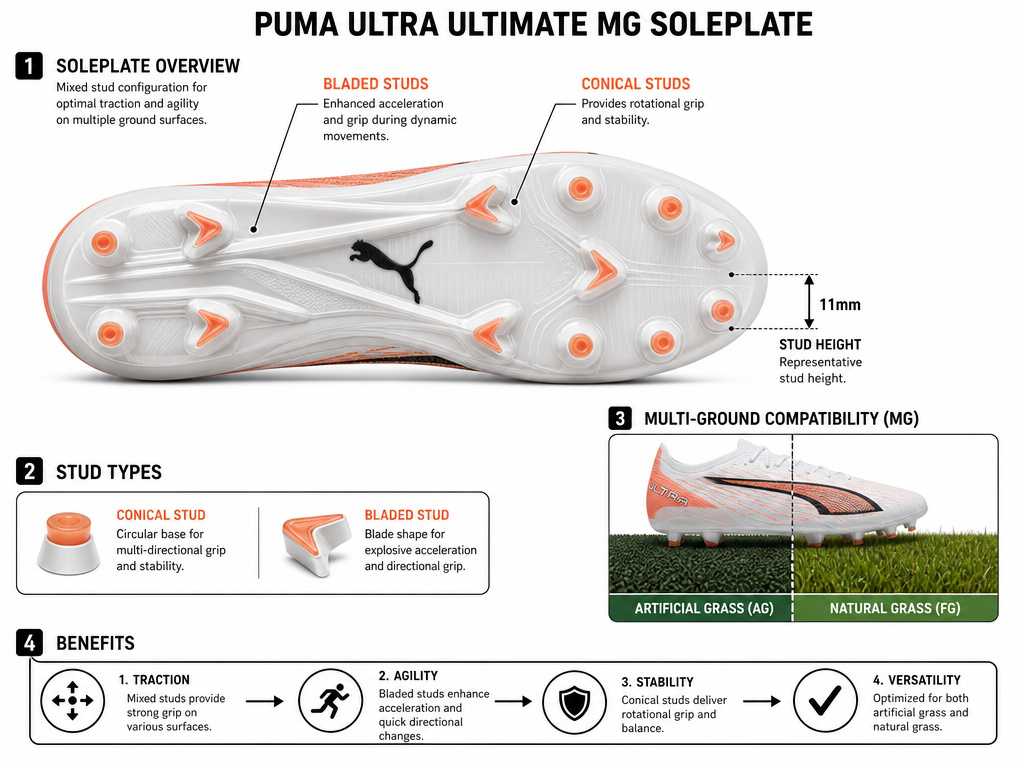
When the community bends the rules, manufacturers eventually create a new category. Enter Multi-Ground boots, like the Puma Ultra Ultimate MG. Puma explicitly engineers this soleplate for use on “firm ground AND artificial grass.”
It’s a blend. The studs are a mix of conical and bladed shapes, and the length is a midpoint at 11mm. Puma explicitly engineers this soleplate for use on “firm ground AND artificial grass.” It’s the manufacturer’s answer to the player who has one training night on AG and a weekend match on grass.
Are they perfect? No. They’re a compromise. On perfect firm ground, a dedicated FG boot might feel more responsive. On deep-pile AG, a dedicated AG boot might cushion better. But for the player who faces mixed surfaces weekly, an MG boot is a legitimate, warranty-safe solution that beats trying to guess if your conical FG boots will pass muster.
It also highlights a key point: the line between “FG” and “AG” is a spectrum defined by stud shape and length. Once you see that, the choice gets clearer.
How to Choose: A Pitch-Conditions Checklist
Stop thinking “FG or AG?” Start diagnosing your pitch. Here’s the sequence I use, and it hasn’t steered me wrong since my knee-ache episode.
- Identify the Primary Surface. Is it natural grass or artificial turf? If it’s turf, is it a new, lush 3G pitch or an old, thin carpet? Your answer points directly to AG or MG boots for turf, FG for grass.
- Assess the Condition. If it’s grass, is it hard and dry (FG), or soft and muddy (SG)? For 90% of amateur games, if it’s wet enough to consider SG, the match is probably called off.
- Check Your Stud Pattern. If you’re considering using an existing boot on a different surface, look at the studs. Are they sharp blades or rounded cones? Cones are more versatile.
- Be Honest About Frequency. How often do you play on this surface? If you’re on AG twice a week, invest in proper AG boots like the Nike AG-Pro soleplate (as on the Mercurial Vapor 15 Elite AG-Pro). Your joints and the boot’s lifespan will thank you.
- Consider a Hybrid. If your week splits between surfaces, a dedicated MG boot is a smarter buy than trying to stretch a specialist boot beyond its design.
I wore my bladed FG boots on a 3G pitch for a month of five-a-side. My knees ached, and the outsole looked chewed up by the abrasive turf. Switching to a pair with AG studs fixed the knee ache within two weeks. The lesson was physical, not theoretical.
Frequently Asked Questions
Are FG or SG boots better?
Neither is universally “better.” FG boots are better for firm, dry natural grass. SG boots are better for soft, muddy natural grass. It’s a tool-for-the-job question. Using SG boots on firm ground is uncomfortable and risky; using FG boots in deep mud is ineffective.
Do professional footballers wear SG or FG?
They wear whatever the pitch conditions demand. On a dry day at a modern stadium, you’ll see almost exclusively FG boots. On a wet, wintery day on a heavily watered pitch, many will switch to SG boots for the extra traction. They have the luxury of multiple pairs.
Does Messi wear FG or SG?
Like most elite players, Lionel Messi primarily wears FG boots, as most top-level matches are played on pristine, firm natural grass surfaces. He would switch to SG if conditions were exceptionally wet and soft.
Can I use SG boots on FG?
You should not. SG boots have long, metal studs designed to sink into soft ground. On firm ground, they don’t penetrate properly, reducing stability. The metal studs can also slip on hard surfaces and transmit a lot of impact to your feet and joints.
Before You Go
The boot doesn’t make the player, but the wrong boot can break one. The specs tell a clear story: match stud length and shape to surface give. If the ground gives (soft grass), use longer studs to bite. If it doesn’t (artificial turf), use shorter, more numerous studs to spread the load.
The one inflexible rule is the warranty. Use FG boots on AG, and you own any breakdown. Everything else, the injury debates, the hybrid solutions, flows from reading the pitch first and the label second. When in doubt on mixed surfaces, go conical, or go MG.
Now, check the bottom of your boots. What story do the studs tell?
