
How to Build Confidence in Football: A Practical Blueprint
This post contains affiliate links. As an Amazon Associate, we earn from qualifying purchases.
Confidence in football isn’t about feeling invincible; it’s a specific, trainable state of belief in your ability to execute a task under pressure. A meta-analysis of 41 studies (1986-2020) found the overall confidence-performance relationship in sport is small (r = 0.25), and in team sports like football, it’s even smaller (r = 0.14). That means confidence is one modest ingredient in performance, not the magic potion it’s often sold as. The real work is building a durable version rooted in controllable actions, not fleeting results.
That “r = 0.14” figure is the most important number in this conversation. It tells us confidence in football has a small, positive relationship with performance (r = 0.14). The rest comes from skill, tactics, fitness, and a hundred other split-second factors. So chasing a nebulous “winning mentality” is a dead end. A key challenge is how to build confidence in football: the goal is a reliable, task-specific belief that you can make the next pass, win the next tackle, or take the next shot, regardless of the scoreboard.
What follows breaks down where that belief actually comes from, how to strengthen it deliberately, and why some popular advice sets players up for a rollercoaster. We’ll move from the research to the pitch, focusing on the controllable levers you can pull today.
Key Takeaways
- Build on controllable sources like your preparation and technique; confidence tied to the score or an opponent’s mistake is fragile and creates a “yo-yo” effect.
- For young academy players (ages 10-11), coach and teammate feedback is a disproportionately powerful confidence source, more so than for adults.
- Structured Psychological Skills Intervention (PSI) programs work, an 8-week study with 55 development league players showed significant gains in mental toughness and decision-making.
- Your pre-match routine isn’t superstition; it’s a rehearsed script for your nervous system, reducing the number of decisions you have to make under pressure.
The Data-Driven Starting Point: What Confidence Actually Does
You’ve heard it a thousand times: “It’s all in the head.” “They wanted it more.” “Belief wins matches.” The problem is, the data paints a more nuanced, and frankly, less dramatic, picture.
An NIH review of confidence-performance relationship analysed 41 studies from 1986 to 2020. The headline finding was a correlation coefficient of r = 0.25 between self-confidence and athletic performance. In plain language, that’s a small, positive relationship. It exists, but it’s not the dominant force.
The overall relationship between self-confidence and sport performance is small in magnitude, with a correlation coefficient of r = 0.25. The relationship is stronger in individual sports (r = 0.29) than in team sports like football (r = 0.14).
The number drops when we zoom in on football. While the meta-analysis found the link in team sports is roughly half as strong (r = 0.14) as in individual sports (r = 0.29), some research, such as that by Craft et al., has reported the opposite, that the relationship is stronger in open-skill sports like football. Why? In a team game, your performance is tangled with ten others’. A midfielder can play a confident, perfect game and still lose 3-0. The feedback loop is noisy. Your confidence is also buffeted by uncontrollables: a teammate’s error, a dubious refereeing decision, the weather.
This isn’t an argument to ignore confidence. A marginal gain of even 2% is worth chasing at the elite level. But it reframes the job. You’re not searching for a mystical boost. You’re engineering a reliable psychological state that survives the chaos of a match, which is the core of how to build confidence in football. The first step is knowing what to engineer it from.
What To Build Your Confidence On (And What To Avoid)
Not all confidence is created equal. Some types shatter at the first sign of trouble; others bend but don’t break. The distinction comes down to a simple filter: is your confidence source something you control?
Fragile Confidence is anchored to external, uncontrollable outcomes:
- The Scoreboard: “I’m playing well because we’re winning 2-0.” This evaporates if the opponent scores.
- Opponent Quality: “I feel good because their winger is slow.” What happens when you’re subbed onto a faster one?
- Vague Praise: “The manager said I was ‘brilliant’ last week.” It’s nice, but it’s not a repeatable process.
The Football Mental Health Alliance calls this the “yo-yo effect.” Your belief goes up and down with events you cannot influence, leaving you emotionally exhausted by halftime. I’ve watched players who start a game buzzing because of an early goal turn sullen and hesitant after a conceded equaliser, their entire psychological foundation was built on sand.
Durable Confidence is built on internal, controllable processes:
- Preparation: “I’ve rehearsed this penalty routine 50 times this week.”
- Technical Execution: “I know my passing technique is solid, so I trust I can hit that channel.”
- Physical Readiness: “My fitness testing shows I can sustain this press for 90 minutes.”
- Role Clarity: “I know exactly what my job is when we lose possession in their half.”
This is the confidence you can bank on. It might waver, but it has a foundation you can return to. It’s why the boring, repetitive drilling of basic techniques isn’t just about muscle memory, it’s depositing psychological capital, a fundamental lesson in how to build confidence in football. Every clean strike of a pass in training is a brick in a wall that won’t crumble when the crowd is screaming.
The Controllables: A Practical Blueprint
If durable confidence comes from control, your training plan should be a confidence-building checklist. This moves you from theory to the Monday night training session.
1. Own Your Preparation
Your pre-match routine is a rehearsed script for your nervous system. It shouldn’t be a collection of superstitions, but a sequence of actions that signal “game time” to your brain. The goal is to eliminate unexpected decisions.
- Physical: A consistent dynamic warm-up you’ve done a hundred times.
- Mental: Five minutes of quiet focus, visualising your first three touches.
- Tactical: A final, brief review of your individual defensive and offensive triggers.
Skipping or rushing this because you’re “pumped up” invites anxiety. Anxiety is just your brain detecting a lack of preparation. A solid routine is the antidote to pre-match nerves.
2. Design Confidence-Building Drills
Generic rondos and passing patterns have value, but you need drills that simulate pressure and provide clear success markers.
- Pressure-Repetition Drills: Instead of taking 20 uncontested shots, set up a drill where you receive a pass under light pressure from a defender before shooting. The pressure isn’t to stop you, but to replicate the match-day need to stabilise yourself before executing.
- Small-Sided Games with Constraints: Play a 4v4 where the only way to score is a one-touch finish. It forces quick, decisive action in tight spaces. Success isn’t winning the game, but executing the constraint cleanly three times.
- The “Three Good Things” Rule: After any drill or training segment, mentally note three things you did correctly. Not “I was great,” but “My first touch was into space,” “My communication was clear,” “I recovered my position quickly.” This builds a library of specific, evidence-based mini-wins.
3. Reframe Your Self-Talk
The voice in your head is your most constant coach. Most players’ default commentary is brutally negative and catastrophising. The trick isn’t to force fake positivity (“I’m the best!”), but to make the voice a technical observer.
- Catastrophic: “I just missed a sitter. I’m useless. The manager will sub me.”
- Technical: “I opened my body too early on that finish. Next time, I’ll keep my shoulder over the ball.” The second statement is actionable. It identifies a controllable error and immediately suggests a correction. It turns a failure into a problem with a solution, which is the essence of mental resilience in football.
The Age Factor: Confidence Isn’t One-Size-Fits-All

A ten-year-old in an academy and a twenty-five-year-old professional need confidence for the same game, but the sources that feed it are dramatically different. Ignoring this is why generic advice often falls flat.
Research on elite youth players (ages 10-11) shows their confidence is hyper-sensitive to social feedback. For them, a specific, encouraging word from a coach or a “nice pass!” from a teammate isn’t just encouragement, it’s a primary pillar of their belief. Their “pre-training/competition emotions” are also a major theme, meaning how they feel on the car ride to the ground sets the tone.
For senior players, while feedback still matters, confidence should be migrating inward to the controllable sources we discussed: preparation, technical mastery, role understanding. A pro shouldn’t need the manager’s halftime pep talk to believe in their ability to make a five-yard pass.
| Age Group | Primary Confidence Sources | Key Strategy for Coaches/Parents |
|---|---|---|
| Youth (≤13) | Coach/teammate feedback, pre-game emotions, fun/enjoyment. | Provide specific, positive reinforcement (“Great decision to pass there”). Focus on effort over outcome. |
| Teen/Adult | Mastery of technique, quality of preparation, role clarity, past success evidence. | Facilitate self-review. Ask “What did you do well?” instead of just giving praise. Develop structured pre-performance routines. |
The takeaway? Telling a nervous kid to “just back yourself” is meaningless. They need the external validation to build the internal evidence. With an adult, constantly propping them up with praise can prevent that essential migration to self-reliance.
When It Goes Wrong: Rebuilding and The Power of PSI
Everyone has a bad game. A horrible mistake. A run of form where nothing clicks. This is where fragile confidence disintegrates, and durable confidence gets tested. The recovery process is a confidence-building drill in itself.
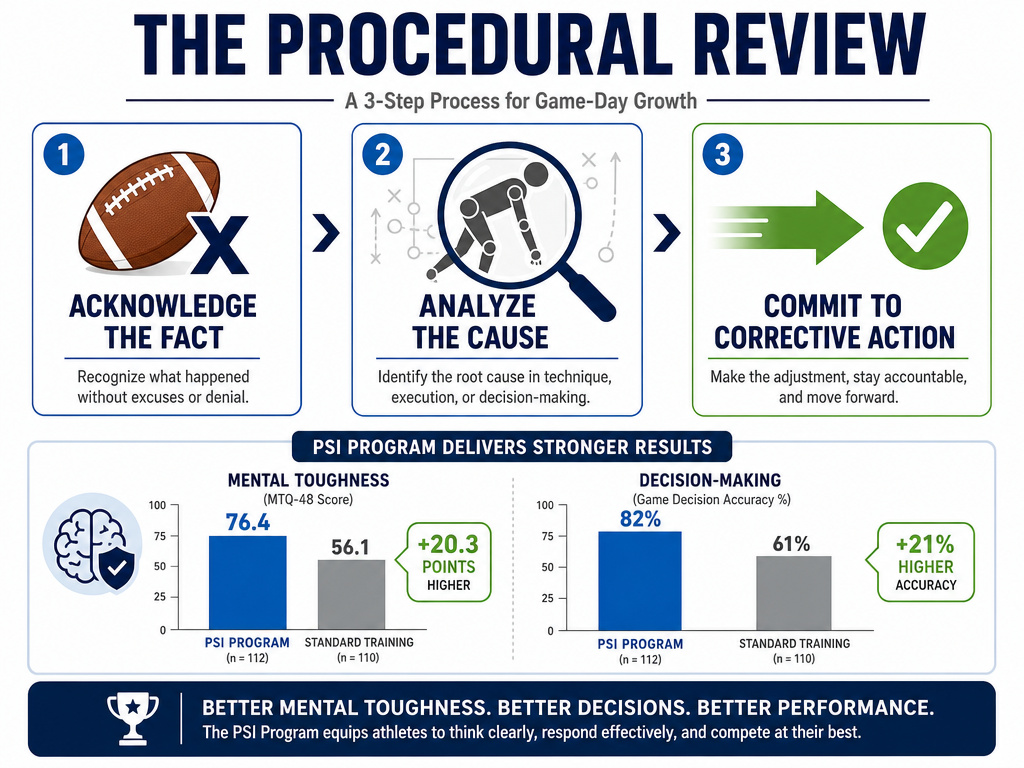
The cycle after a mistake is predictable: error → negative self-talk → anxiety → increased risk of another error. The break point is the self-talk. Your job is to insert a procedural review between the error and the narrative.
- Acknowledge the Objective Fact: “I gave the ball away in midfield.”
- Analyse the Cause (Without Judgment): “I misjudged the weight of pass because I was on my back foot.”
- Commit to a Corrective Action: “Next time, I’ll set my body before I play the pass.”
This is the core of bouncing back. It stops the story from becoming “I’m having a nightmare” and turns it into “I made one error with a identifiable cause.”
For systematic development, the evidence points squarely to structured programs. A 2026 peer-reviewed football mental skills study took 55 players from Turkish Football Federation Development Leagues. One group did standard training; the other added an 8-week Psychological Skills Intervention (PSI) program covering goal-setting, imagery, and self-talk. The PSI group showed statistically significant improvements in mental toughness, decision-making, and tactical skills.
The program worked because it was deliberate practice for the mind, not just hopeful positive thinking. It’s the difference between wishing you were calmer and actually practicing visualization exercises to see yourself staying calm.
How to Build Confidence Through Small Goals in Football
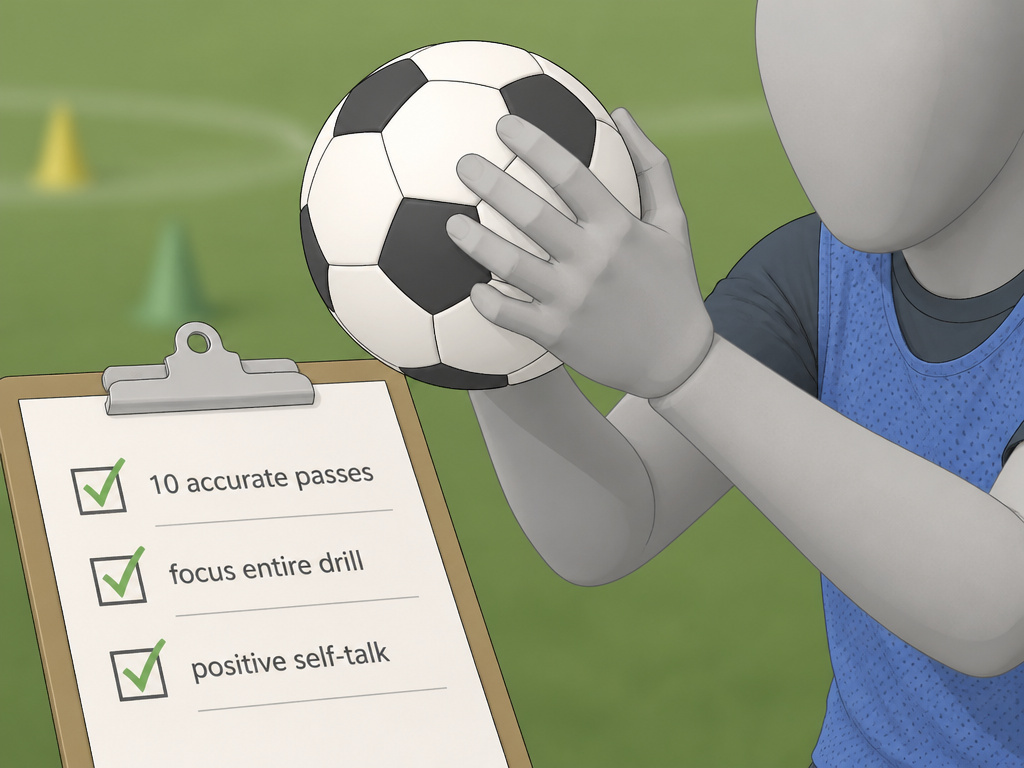
Research shows the link between confidence and performance in team sports like football is modest. This means confidence is just one piece of the puzzle, not the whole game. To build it reliably, focus on what you control. Set goals that are about your own process and improvement, not just the final score or beating an opponent. A study found that confidence tied to uncontrollable outcomes is fragile and leads to a ‘yo-yo’ effect. Break your development into small, daily wins. Aim to complete a certain number of accurate passes in a drill, or maintain focus for a full practice segment. These self-referenced goals create a stable foundation for your belief.
Does a Confidence Journal Work for Football Players?
Structured psychological skills programs, which include techniques like goal setting, have been shown to significantly improve mental toughness and decision-making in football players. A confidence journal is a practical way to apply this. It shifts your focus from uncontrollable outcomes to your own progress and positive actions. After each session, briefly note a tactical skill you executed well, a decision you made, or positive feedback you received from a coach or teammate. This practice, especially for youth players who are highly attuned to such feedback, helps solidify evidence of your capability. Over time, this recorded log becomes a concrete reminder of your growth, reinforcing a more resilient state of confidence.
Frequently Asked Questions
What’s the biggest mistake players make when trying to build confidence?
The most common error is linking confidence directly to uncontrollable outcomes like the scoreline or an opponent’s error. This creates fragile, “yo-yo” confidence that crashes with every setback. Sustainable belief is built by focusing on your own controllable actions, such as the quality of your preparation or the execution of a specific technique, regardless of the external result.
Can a pre-match routine really make a difference?
Absolutely. An effective routine is not mere superstition; it acts as a rehearsed script for your nervous system. By creating a consistent sequence of actions and thoughts, it reduces the number of decisions you have to make under pressure, allowing you to start the match in a focused and familiar state, which directly supports task-specific belief.
How important is feedback for a player’s confidence?
Its importance varies. For younger academy players, constructive feedback from coaches and teammates is a disproportionately powerful source of belief. For all players, feedback that focuses on effort and controllable process factors is far more effective for building durable confidence than feedback that only praises or criticizes the outcome.
Are mental skills programs actually effective for footballers?
Yes, structured interventions work. Research, such as an 8-week study with development league players, shows that dedicated Psychological Skills Intervention (PSI) programs can lead to measurable gains in areas like mental toughness and in-game decision-making. This confirms that the mental side of performance can be trained systematically, just like physical skills.
Before You Go
Confidence can’t be directly ordered up. You can’t directly order it up. You can only create the conditions where it’s likely to grow. Stop chasing the feeling and start building the structure that supports it.
That structure has three pillars: evidence (from your preparation and past successes), process (a focus on controllable actions), and deliberate practice (for your mind as well as your body). The research is clear, the link between confidence and performance in football is modest, but it’s real. And because it’s modest, it responds best to quiet, consistent engineering, not grand motivational speeches.
Your first step this week isn’t to “be more confident.” It’s to pick one controllable thing, your first touch, your communication, your recovery run, and master it in training until you have undeniable proof you can do it. That proof is the only kind of confidence that matters when the pressure is on and the score isn’t going your way. Everything else is just noise.
