
How Does Stoppage Time Work in Football? A Worked Example
This post contains affiliate links. As an Amazon Associate, we earn from qualifying purchases.
Stoppage time works in football like this: the referee tracks all playing time lost in each half, the fourth official shows the minimum added time at the end of the final minute, and the referee can increase that figure but never reduce it. The shown number is a floor.
The word “minimum” carries most of the weight in the answer to how does stoppage time work in football. The board reflects the referee’s estimate at the end of the final minute, and anything that happens afterwards can push the real finish later. So the half ends when the referee decides it ends, not when the board runs out.
What follows: the causes Law 7.3 lists, a worked example built on IFAB’s own scenario, how to read 90+3 on the board, the difference from extra time, and why UEFA and the Premier League disagree about exactness.
Key Takeaways
- Law 7.3 makes the referee allow for all playing time lost in each half, and goal celebrations are named as a cause.
- The board number is a minimum. The referee can lengthen it and cannot shorten it.
- IFAB’s own example: 3 minutes shown, then a 5-minute injury stoppage near the end. The answer is 3 minutes played, not 8.
- A first-half timekeeping error can’t be repaid by changing the length of the second half.
- Sources disagree on how exact added time should be. UEFA called the English approach “absurd” and won’t use it.
How Does Stoppage Time Work in Football? Law 7.3 Lists the Causes
Law 7.3 says the referee makes allowance in each half for all playing time lost in that half, and IFAB’s Law 7 text is where the whole system starts. The clock runs through every pause, which is how does stoppage time work in football in practice: the referee tops it up at the end of the half.
Law 7.3 of the Laws of the Game requires the referee to allow, in each half, for all playing time lost in that half. Causes include medical stoppages that competition rules permit, goal celebrations, and time-wasting. The fourth official then shows the minimum additional time at the end of the final minute.
The Premier League’s 2024/25 policy spells the list out: substitutions, injuries, wasting time, disciplinary sanctions, medical stoppages, VAR delays and goal celebrations. Add time lost to substitutions and injuries, and a busy half leaves the referee with a long list to total.
| Cause | What the sources say | Who says it |
|---|---|---|
| Drinks break | Should not exceed one minute | IFAB Law 7.3 |
| Cooling break | Ninety seconds to three minutes | IFAB Law 7.3 |
| Goal celebration | Counts, since it often costs significant time | IFAB Law 7 FAQ |
| Ball kicked out deliberately | Throw-in to opponent, time lost still counted | IFAB Law 7 FAQ |
| Video review | Counted once, no double counting | Premier League |
That last row matters. The league also counts VAR checks and delays only once, so a review doesn’t inflate the total twice.
Here’s the oddity in the second row of the FAQ. A player who deliberately kicks the ball out with force while it is in play concedes a throw-in to the opponent. The opponent gets a throw-in, and the referee still banks the lost seconds.
A Worked Example From IFAB: Three Minutes Shown, Five-Minute Injury
Right, so. Picture the closing seconds of a second half. The home crowd is whistling for the end, the referee has settled on three added minutes, and then a player goes down and stays down.
IFAB poses exactly this case in its Law 7 FAQ. Here’s the sequence:
- The referee decides on three minutes of additional time for the end of the half. That’s the number the fourth official will show; skip this step and you’ve nothing to measure the rest against.
- A few seconds before normal time ends, play stops for an injury lasting five minutes. Assume it simply tacks on and you’ll expect eight minutes.
- Play restarts. IFAB says the “original” three minutes are shown and played, because a stoppage longer than the remaining time doesn’t extend it to match.
Where this goes sideways: Adding a late stoppage’s length to the board number. Under IFAB’s example, a 5-minute injury stoppage does not turn 3 minutes into 8, and a fan who expects 8 will think the whistle came 5 minutes early.
Two more rulings from the same FAQ round out the picture. If a penalty is scored directly at the end of the second half, the goal stands and the final whistle follows with no kick-off. And the referee can’t repay a first-half timekeeping error by changing the length of the second half.
Odd? A bit. Clean? Very.
How Do You Read 90+3 and Know When the Match Really Ends?
Opta’s data puts the average Premier League match at 100 minutes 35 seconds across the first 70 matches of 2025-26. So “90 minutes” is a label, not a running time. If you want the full picture of how long a match lasts, remember that half-time can run up to 15 minutes too.
The notation is simple. In 90+3, the 90 is the end of regulation and the 3 is minutes into additional time. Watch for the fourth official stepping to the touchline and lifting the electronic board at the end of the final minute. That raised board is your cue.
Here’s how to use it:
- The board is a minimum. Further delays can push the finish later.
- The number can go up. It can’t come down.
- Only the referee’s whistle ends the half, and the referee can increase the added time but never reduce it.
Stay with me on this one. When the board goes up at 90+3, don’t mentally set an alarm for exactly three minutes. Watch the stoppages instead.
Stoppage Time and Extra Time Never Overlap
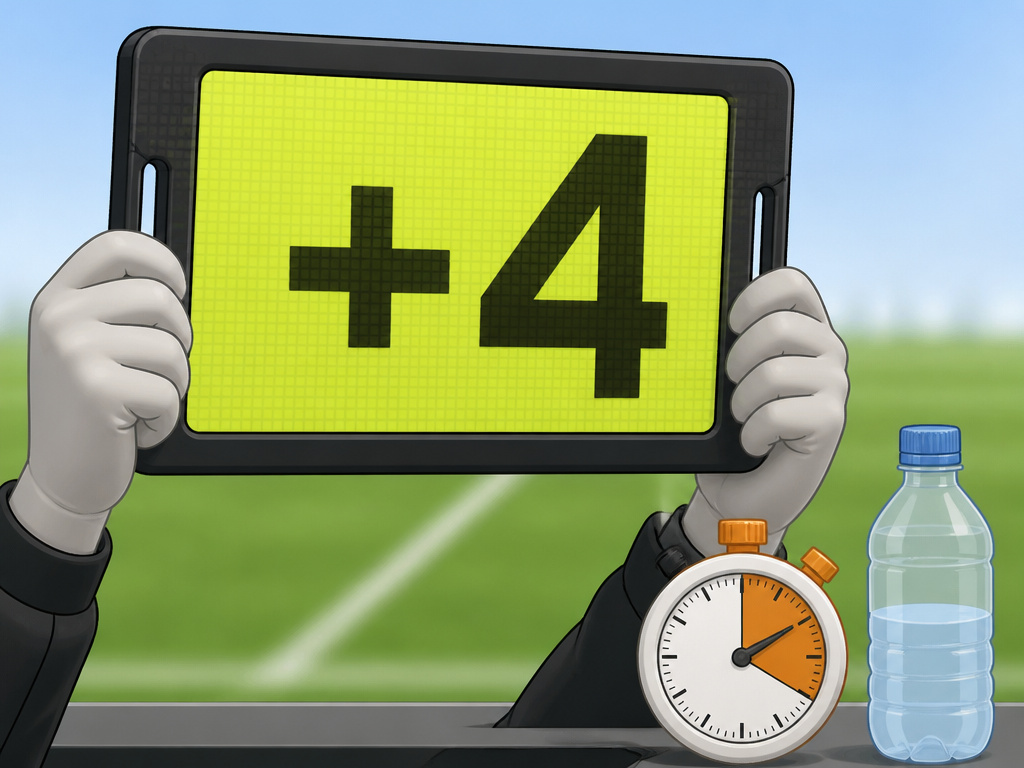
Stoppage time tops up a half. Extra time is a separate period of play that follows when a knockout tie is level. One repays lost seconds; the other creates new playing time.
The Laws do link them in one small way. Drinks breaks should not exceed one minute under Law 7.3. Competition rules decide whether any of this applies.
The board shows the least you’ll get, never the most.
Why UEFA Called the English Exact-Time Approach Absurd
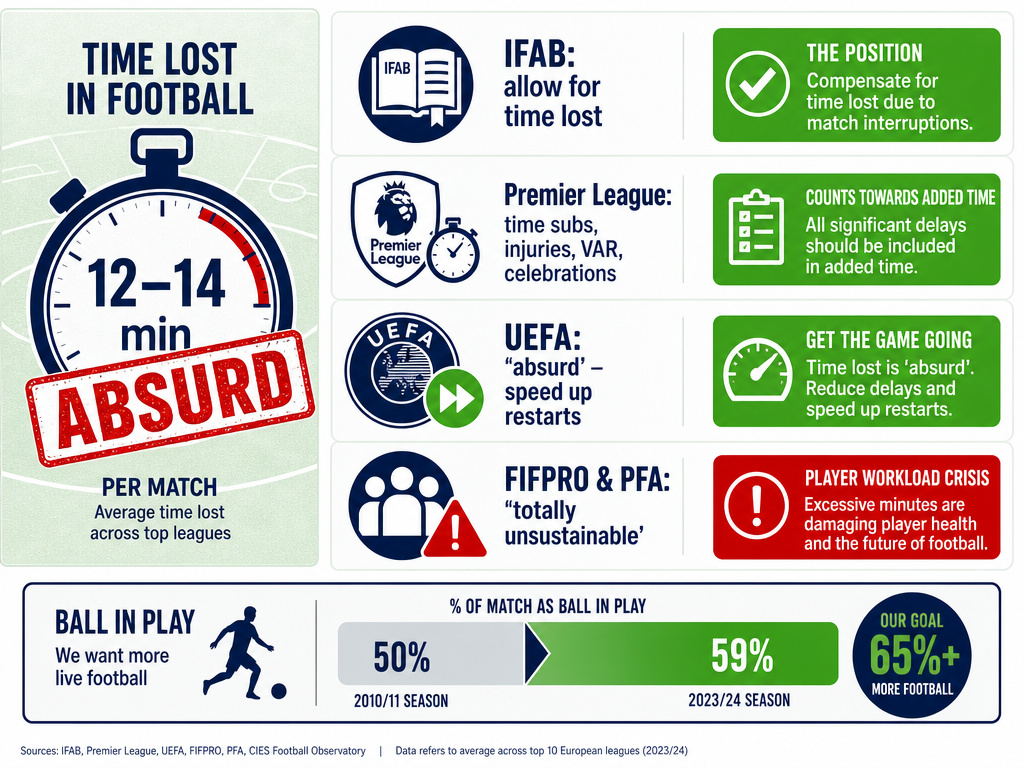
Zvonimir Boban, UEFA’s chief of football, used one word for England’s new added-time rules: “absurd”. The Premier League’s 2024/25 policy has referees allow for the time lost to goal celebrations, substitutions and injuries.
Boban’s objection was player welfare, with “almost 12, 13, 14 minutes” being added. Roberto Rosetti, UEFA’s chief refereeing officer, backed him: “We tell our referees to speed up the restart of play instead of focusing on stoppage time.” He said UEFA had worked for five years to raise ball-in-play time.
The ESPN report on Collina added time covers a separate case for more added time.
| Voice | Position | Source |
|---|---|---|
| IFAB | Allow for time lost, goal celebrations included | Law 7.3 and FAQ |
| Premier League | Time substitutions, injuries, VAR, celebrations | 2024/25 policy |
| UEFA | Exact-time rules are “absurd”; speed up restarts | Boban, Rosetti |
| FIFPRO and PFA | Welcomed UEFA; called English approach “totally unsustainable” | FIFPRO, Molango |
I side with the restart-speeding camp. Add a minute for every slow throw-in and you’re treating the symptom. Fix the delay and the minutes at the end shrink on their own.
So who’s right? The sources don’t settle it. IFAB’s wording favours counting lost time carefully, UEFA’s guidelines favour faster restarts, and each competition chooses its own approach.
Ball in Play vs Clock: What the Premier League Numbers Show
Three numbers tell the story from Opta’s analysis of 2025-26 after 70 matches:
- 55:00 average ball-in-play time (54.7% of match time), against 56:59 the previous season.
- 100:35 average total match length, against 99:44 the season before.
- 45:35 of delays and pauses per game, up from 42:45.
Read together, those figures say the clock is running longer while the ball is in play for less of it. The extreme case so far: 13 minutes 43 seconds of second-half stoppage time in one game, with the ball in play for just 45 minutes 55 seconds (42%) of the match.
Throw-ins are getting slower too. Opta’s analysis puts the average at 17.7 seconds this season, up from 15.6 in 2024-25.
The sources also disagree on past seasons, though only slightly. The Premier League’s own figures give 56:58 for 2024/25, 58:10 for 2023/24 and 54:57 for 2022/23. Opta gives 56:59, 58:11 and 54:49. Treat the gap as a measurement difference, not a contradiction.
The 2026/27 Fixes Aimed at Stoppages
IFAB’s 140th AGM took place in Hensol, Wales on 28 February 2026 and approved measures to reduce both the number and the duration of stoppages. It followed last year’s eight-second goalkeeper restriction with its visual five-second countdown. Three changes matter most for stoppage time.
Throw-ins and goal kicks: the five-second countdown
When a throw-in or goal kick is deliberately delayed, the referee whistles, signals and starts a visual five-second countdown. If the throw-in isn’t in play when it ends, the opponent gets it from the same position. If a goal kick isn’t in play, the opponent gets a corner.
Substitutions: ten seconds to leave
Once a substitution is signalled or the board is shown, the player coming off has ten seconds to leave. Miss that and the substitute can’t enter until the first stoppage after one minute (running clock) following the restart. IFAB’s Law 12.4 wording also lists delaying leaving the field when substituted among the cautionable delays.
Skip this if: you’re only watching casually. If a goalkeeper being substituted exceeds ten seconds, the replacement still comes on without delay, and the outgoing keeper is cautioned.
Injuries: one minute off the field
An injured outfield player who stops play or gets treated on the pitch must leave and stay off for one minute (running clock) after the restart. The exceptions, per IFAB Circular 34, are:
- A goalkeeper injury
- A collision between a goalkeeper and an outfield player
- A collision between players on the same team
- A severe injury, such as a head injury, a cardiac issue or a seizure
- An injury from a foul where the opponent is cautioned or sent off
- An injured penalty taker
A head injury still requires one minute off. Competition organisers may let a player return sooner in bleeding cases or a quickly cleared potential head injury.
The start date depends on who you ask. IFAB’s circular says the 2026/27 clarifications are effective for all competitions starting on or after 1 July 2026. Concacaf says its changes came into effect on July 1, 2026 but apply to its sanctioned competitions starting as of July 20, 2026.
What is the difference between stoppage time and extra time?
Stoppage time, also called additional time, belongs to the regular match. Under Law 7.3 the referee makes allowance in each half for the playing time lost in that half, and the fourth official shows the minimum additional time at the end of the final minute. When that time has been played, the half ends. The referee can increase the figure during play, but never reduce it.
Extra time is a separate stage. It only arrives in knockout games that are still level after the full match, when the competition rules need a winner. Further periods are played, and if the teams are still level after those, a penalty shootout decides it. So stoppage time tops up a half, while extra time is a new part of the game that exists only to break a tie.
How many minutes of stoppage time are usually added?
The Laws give no fixed figure, so the amount you see on the board comes from what happened in that half rather than from a target. The Premier League says its referees allow for time lost to substitutions, injuries, time wasting, disciplinary sanctions, medical stoppages, VAR delays and goal celebrations. A tidy half with few breaks earns a short board. A half full of treatment, cards and delays earns a longer one.
Second halves tend to carry the bigger numbers, because that is where many substitutions and tactical delays gather. The competition matters too. UEFA tells referees to speed up restarts instead of chasing stoppage time accuracy, so the same match could show a different figure depending on who runs the tournament. Treat the board as a minimum, since the referee can add to it.
What is the longest stoppage time ever in football?
The Laws do not name a ceiling. The referee can increase the minimum shown on the board but cannot reduce it, so a half with enough lost time can run on for a long while. This article does not name a record holder, because a record claim needs a verified source and the sources used here do not provide one.
What they do show is how far recent top-flight games have stretched. The most second-half stoppage time in a 2025-26 Premier League game so far was 13m 43s, and the ball was in play for only 45m 55s (42%) of that match. UEFA’s Zvonimir Boban said 12, 13 or 14 added minutes raise player welfare concerns, which is why UEFA declined to follow the English exact-time approach. Long additions are possible, and they stay controversial.
Frequently Asked Questions
What is stoppage time in football?
It’s the extra time a referee adds to the end of each half to make up for playing time lost. The causes include medical stoppages, goal celebrations and time-wasting. The fourth official shows the minimum figure at the end of the final minute.
Why doesn’t the referee just stop the clock?
Football’s Laws handle lost time by adding it at the end of each half instead. Law 7.3 has the referee make allowance in each half for all playing time lost in that half. The referee can increase the added time but not reduce it.
What is the longest stoppage time ever?
The Laws wording quoted here sets no cap, so there’s no official maximum. The most second-half stoppage time in a 2025-26 Premier League game, as of Opta’s analysis after 70 matches, was 13 minutes 43 seconds.
How do you know how much stoppage time is left?
Read the fourth official’s board at the end of the final minute. A “90+3” means three minutes of additional time. Remember the figure is a minimum, and only the referee’s whistle ends the half.
Can the referee add more time than the board shows?
Yes. Law 7.3 says additional time may be increased by the referee but not reduced. A first-half error can’t be fixed by changing the second half’s length.
The Bottom Line
Next time you wonder how stoppage time works in football, count the visible delays in each half and compare your tally to the board. Then check the final whistle. That one habit makes the system click.
Here’s the threshold worth remembering. A late stoppage longer than the remaining added time doesn’t extend the shown figure, so in IFAB’s example, 3 minutes shown stays 3 minutes played.
One concession: the approach varies by competition. The Premier League times each event, while UEFA tells referees to speed up restarts. If you’re watching a European night and an English afternoon, expect different feelings about the same number.
