
How to Chip a Goalkeeper: Step-by-Step Mechanics
This post contains affiliate links. As an Amazon Associate, we earn from qualifying purchases.
To chip a goalkeeper, you need to lift the ball softly and quickly over their advancing body as they come off their line. The technique relies on a precise, angled strike with the instep or toe under the ball’s center, not power. The goal is to make the ball rise and drop just under the crossbar, giving the keeper no time to recover.
That’s the textbook answer. But watch any Sunday league match and you’ll see the real challenge: the keeper isn’t a statue. They’re reading your body shape, guessing your move, and their dive can cover the entire six-yard box in a heartbeat. A chip isn’t a trick shot; it’s a decision you make in the half-second after you’ve already committed to shooting. The key is knowing precisely how to chip a goalkeeper. Get it right, and it’s the most satisfying goal there is. Get it wrong, and you look like you’ve kicked a balloon to the corner flag.
What follows is a breakdown of not just the how, but the when and the why. We’ll walk through the mechanics, the mental triggers, and the specific drills that turn this high-risk move into a reliable tool. We’ll also look at it from the other side of the ball, how a keeper spots and stops a chip, because understanding that makes your decision twice as sharp.
Key Takeaways
- The chip is a touch-and-lift motion, not a swing. Contact the center-bottom quadrant of the ball with a stiff, angled ankle.
- The best moment is when the keeper commits forward, usually after you’ve sold a low, hard shot with your body shape.
- Practice the chip under fatigue and pressure. A clean technique in drills falls apart the first time a defender is on your back.
- Most chips fail because of poor weight distribution. Leaning back even slightly sends the ball sailing over the bar.
- For video game players (FC 26), the chip is a timed button tap, not a power bar. It’s about rhythm, not force.
The Anatomy of a Perfect Chip: It’s All in the Ankle
Everyone remembers the famous chips. Dennis Bergkamp, Lionel Messi, Francesco Totti. What you don’t see is the microscopic detail: a locked ankle and a foot that acts like a ramp, not a club.
The foot doesn’t follow through in a big arc. It jabs downward and forward, almost stopping at the point of contact. You’re not trying to generate height with a big scoop; you’re using the ball’s own position and the angle of your foot to create lift. It’s a finesse shot in every sense.
A proper chip uses the instep or the toe to strike the bottom center of the ball with a stiff, angled ankle. The leg swing is short and controlled, focused on precision over power, with minimal follow-through to keep the ball’s trajectory low and dipping.
Where this goes sideways: Leaning back. It’s the natural instinct when you want to lift something, but it’s a death sentence for a chip. Your body weight must stay over the ball, or at least neutral. Lean back, and you expose the bottom of the ball too much. The shot balloons, loses all pace, and gives the keeper an age to backpedal and catch it. I’ve seen more chips balloon over the bar from a three-yard breakaway than I’ve seen successful ones.
The Step-by-Step Mechanics of a Chip Shot
The movement can be broken down into pieces. This isn’t a slow-motion tutorial; it’s the order of operations your brain should run through when the chance appears.
- Approach at a controlled speed. You can’t chip effectively at a full sprint. Your last touch should set the ball slightly ahead of you, not stuck under your feet. This gives you the space to get your foot under it.
- Plant foot beside the ball, not behind it. Your non-kicking foot needs to be planted about level with the ball, pointing toward your target. If it’s too far behind, you’ll lean back. Too far ahead, and you’ll stub the shot into the ground.
- Lock your ankle and point your toes down. This is the essential point. A floppy ankle is a dead giveaway and kills accuracy. Keep your toes pointed toward the ground throughout the strike.
- Strike the center-bottom of the ball. Aim to make contact with the lower half of the ball, using the inside of your laces or even the very tip of your toe. The contact should be a crisp, jabbing motion, not a sweep.
- Minimize your follow-through. Your kicking leg should not swing through in a full arc. Think of it as a punch or a poke. The power comes from the snap of your ankle and knee, not a big wind-up.
The part nobody mentions: The sound. A well-execited chip has a faint, hollow thump, it’s the sound of the ball compressing slightly against the ground as your foot drives it down before it spins up. A mis-hit sounds like a slap or doesn’t make much noise at all. Listen for that clean thump in practice.
When to Use It: Reading the Goalkeeper’s Move
The technique is useless if your timing is wrong. The chip is a reactive decision, not a premeditated one, born from the split-second calculus of how to chip a goalkeeper. You don’t run through on goal thinking “I’m going to chip.” You run through on goal thinking “I’m going to score,” and the keeper’s movement tells you how.
The golden trigger is when the keeper commits their weight forward. This usually happens in two ways:
- The Charging Keeper: They rush out to narrow the angle, often going into a spread-eagle or low block. Once their momentum is carrying them forward and down, a chip over their head or shoulder is the natural counter.
- The Low-Stance Keeper: They stay big but lower their center of gravity, preparing for a hard, low shot to either side. Their weight is on their toes, not their heels. A quick, subtle lift can beat them before they can spring upward.
Common mistake: Chipping a keeper who is backpedaling or standing tall. A keeper on their heels can adjust, jump, or even catch a softly lifted ball. The chip works against momentum, not against a keeper who is stable and ready.
How does this connect to the rules? A goalkeeper’s decision to charge is governed by their need to release the ball within six seconds once they have control with their hands. A keeper under pressure might rush a throw or kick, creating the kind of chaotic, high defensive line that leaves them exposed to a quick break and chip. Their urgency can be your opportunity.
Practice Drills That Build Confidence
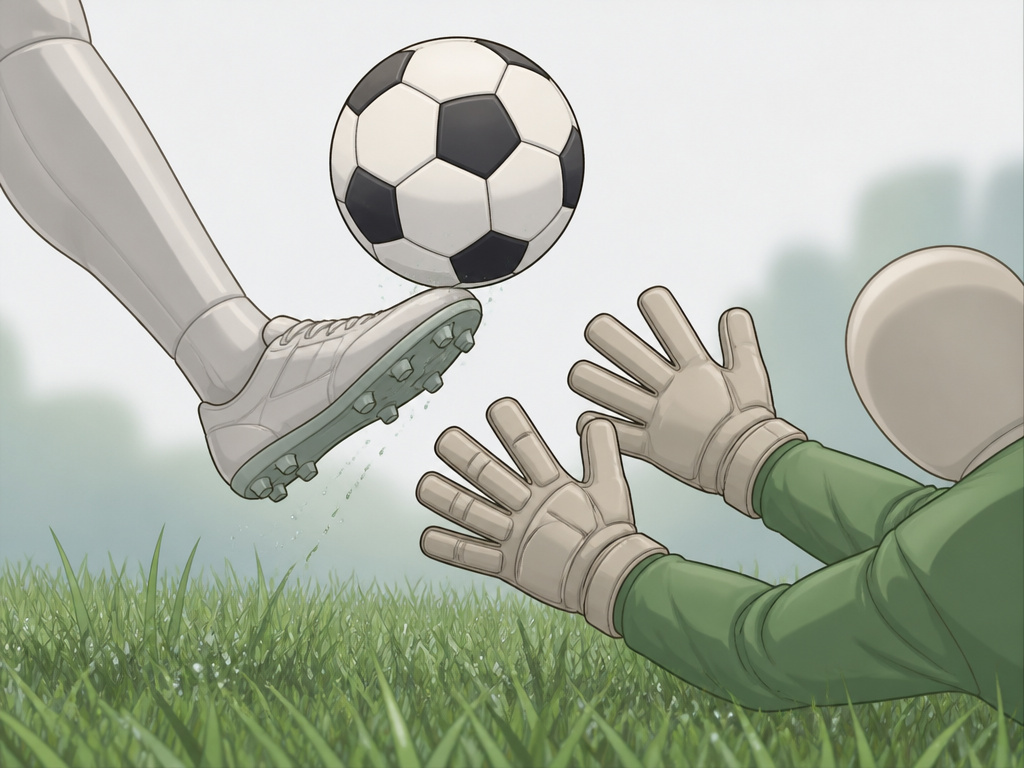
You can’t practice chips in a vacuum. Static shooting teaches you the motion, but the game happens at speed, with pressure, and often on tired legs. These drills bake the decision into your muscle memory.
The Pressure Cooker Drill:
Set up a small goal (or two cones) at the edge of the penalty area. Have a teammate or coach play you a through pass. As you receive it, a defender (or a passive obstacle) applies light pressure from behind or the side. Your task is to chip a goalkeeper who starts on their line and is instructed to come hard at you 7 out of 10 times. The defender forces you to take your first touch away from pressure, which often sets up the perfect chip angle.
The Angle and Fatigue Drill:
Place cones at key points around the penalty area to create angled shooting positions. Start at the corner cone, sprint to the penalty spot, receive a pass, and chip. Immediately sprint to the top of the D, receive another, and chip again. Repeat for 5 sets. This trains you to execute the technique when your heart is pounding and your legs are heavy, the exact conditions of a late-game breakaway.
| Drill Name | Focus | Common Failure & Fix |
|---|---|---|
| Pressure Cooker | Decision-making under defensive pressure | Rushing the technique. Fix: Take a settling touch first, then execute. |
| Angle & Fatigue | Executing technique while exhausted | Sloppy plant foot placement. Fix: Consciously shout “plant!” to yourself as you arrive. |
| Keeper’s Choice | Reading the goalkeeper’s movement | Telegraphed body shape. Fix: Practice selling a low shot before chipping. |
What most people get wrong: Practicing only on a perfectly manicured pitch with a brand-new ball. Try it on a slightly longer, wetter grass where the ball won’t skip. Try it with a ball that’s a bit soft. The technique adjusts. Your foot has to be even more precise under the ball to get the same lift.
The Goalkeeper’s Perspective: How to Defend Against a Chip
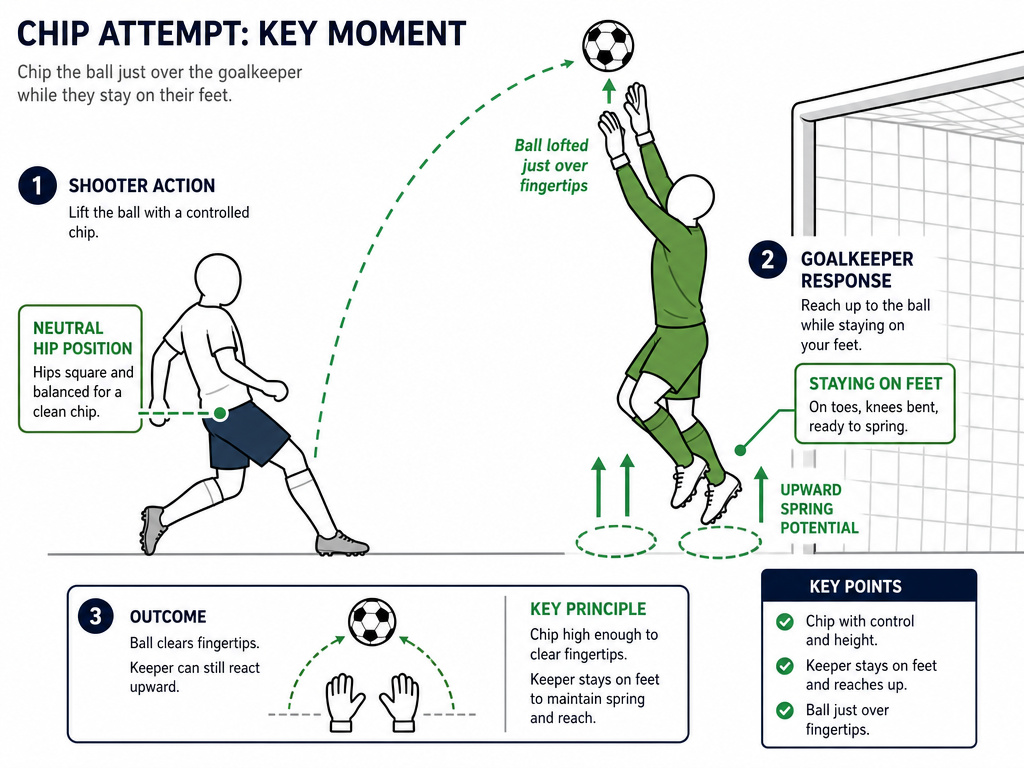
To really master the chip, you need to understand how a keeper thinks about the threat of how to chip a goalkeeper. It makes your own decisions clearer and your execution sharper.
A goalkeeper is reading your hip and shoulder position. If you open your hips early to show the inside of your foot, they’re preparing for a placed shot or a pass. A chip, however, often requires a more closed, neutral hip position to get under the ball. Some keepers are trained to watch the shooter’s head, if you look up at the goal, you might be placing; if your eyes drop to the ball late, you might be trying to lift it. Their primary defensive tactic is to stay on their feet as long as possible, though sources disagree on charging rules: the USSF states a keeper in possession cannot be charged, while some senior referees argue a keeper may be fairly charged like any other player when not in hand possession.
Their primary defensive tactic is to stay on their feet as long as possible. Once a keeper goes to ground, the chip is the easiest finish in the book. They are taught to narrow the angle, make themselves big, but to delay the dive until the last possible millisecond. This is why selling a fake shot, a slight drop of the shoulder as if you’re going low, is so effective. It triggers their dive, commits their momentum, and opens the space above them.
This connects directly to the goalkeeper positioning fundamentals. A keeper who is well-positioned, not over-committed, and on their toes is a nightmare to chip. Their training focuses on cutting down angles while maintaining the ability to spring upward or backward. When you’re through on goal, your first mental check should be their stance. Are they set and balanced, or are they leaning, charging, or flat-footed? Your answer dictates your shot.
Chipping in Video Games (FC 26)
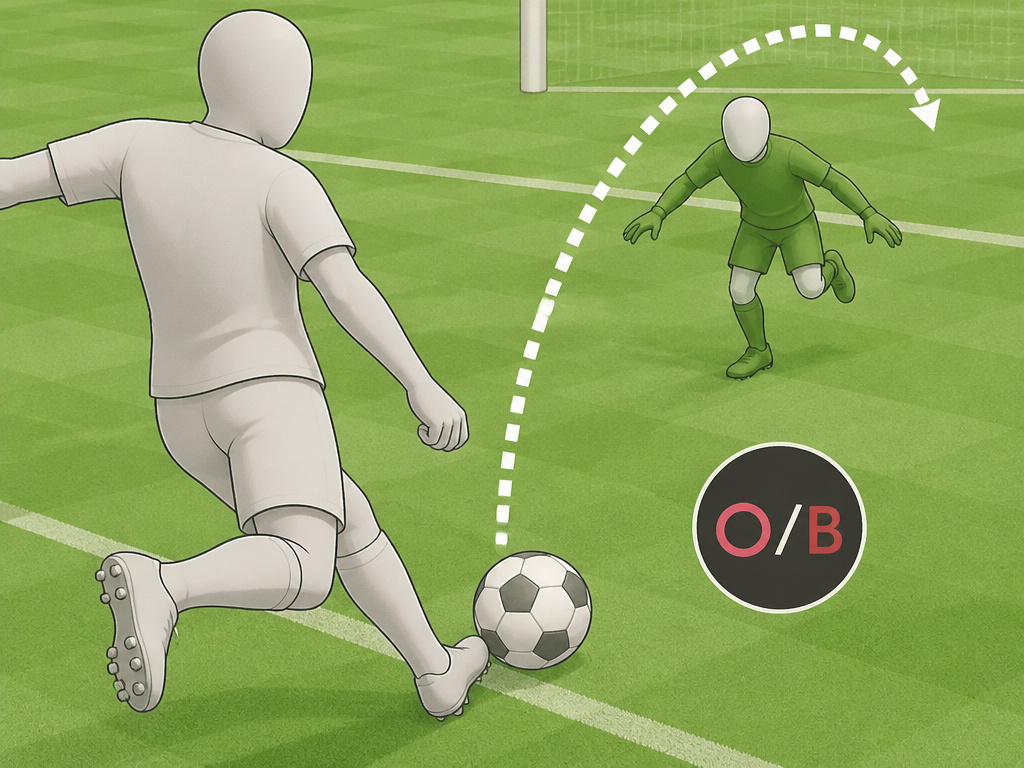
For many, the virtual pitch is where they first try this skill. The principles are the same, but the inputs are different. In FC 26 (and most football games), the chip shot is performed by tapping the shot button (usually Circle/B) lightly, rather than holding it for power.
The timing is everything. Press the chip button just as your player is about to make contact with the ball, not during the run-up. Holding the button too long, even for a chip, will result in a lofted shot that often goes over the bar. It’s a quick, rhythmic tap.
The game’s mechanics also reward realism. Chipping a keeper who is rushing out is highly effective. Trying to chip a keeper who is planted on their line is far more likely to be saved or to miss. Use it as a situational tool, not a go-to move.
Equipment Considerations: Does Your Gear Matter?
A little. The right tools won’t teach you the skill, but they can remove variables.
- Cleats: You want a cleat with a clean, flat striking surface on the instep. Modern synthetic leather boots provide this. Avoid overly textured or heavily padded strike zones, as they can deaden your feel for the ball. A traditional leather boot often gives the best “touch” for delicate work.
- Ball Pressure: A properly inflated ball is crucial. An under-inflated ball is dead and won’t spring up off your foot; you’ll feel like you’re kicking a bag of sand. An over-inflated ball is too bouncy and will fly off uncontrollably. For consistent chipping, check the pressure.
This isn’t about buying an advantage. It’s about consistency. Practicing with the same ball at the same pressure means one less thing changing between your training sessions and match day.
Common Mistakes and How to Fix Them
We can diagnose the usual errors. I’ve made every single one.
- Skying the Ball Over the Bar: This is almost always caused by leaning back. Your body weight must stay over the ball. Focus on keeping your chest and head forward, even if it feels unnatural.
- Hitting a Weak “Poppy” Chip: This happens when you strike too far under the ball. You essentially scoop it, generating backspin but no forward momentum. It floats gently to the keeper. Contact should be slightly more through the center of the ball.
- Telegraphing the Shot: You wind up like you’re taking a big shot, alerting the keeper. The chip should be disguised. Use the same run-up and body shape as a low drive, only changing your foot action at the last moment.
- Using It When It’s Not On: The chip is a high-risk, low-percentage shot compared to a low drive across the keeper. Don’t force it. If the keeper hasn’t given you the trigger (committing forward), take the higher-percentage option.
Frequently Asked Questions
How do you chip the goalkeeper in FC 26?
In FC 26, tap the shot button (Circle on PlayStation, B on Xbox) lightly and quickly. Don’t hold it down to charge power. The ideal timing is right as your player’s kicking foot is about to make contact with the ball. It works best against a keeper who is rushing out.
Is goalkeeper the hardest position?
It’s uniquely challenging. The margin for error is zero, the physical demands are specific (explosive power, handling), and the psychological pressure is immense. Studies even show goalkeepers have different injury patterns, with about one-third of shoulder injuries causing time loss over 28 days, and they suffer frequent fractures and dislocations in fingers and wrists. It’s not harder, but it’s a completely different skill set.
At what age do goalkeepers peak?
Goalkeepers typically peak later than outfield players, often in their late 20s to early 30s. The position relies heavily on experience, decision-making, and positional understanding, which compensate for any slight decline in raw athleticism. Some of the world’s best keepers have had their finest seasons well into their 30s.
What’s the difference between a chip, a lob, and a dink?
Chip is a shot over an advancing goalkeeper, struck with a stabbing motion to create a dipping trajectory. A lob is a longer, lofted pass or shot, often from distance, using more of a sweeping motion. A dink is a very soft, close-range chip, usually executed with the toe, often when the keeper has gone to ground. The chip is the specific finishing technique; the lob is a broader category of aerial play.
Before You Go
The chip is a weapon of precision, not panic. Its success hinges on a single moment: reading the keeper’s commitment and having the technical nerve to choose the soft lift over the hard blast. It feels audacious because it is. But it’s not magic.
Spend your next training session not just hitting chips, but watching for the trigger. Have a teammate play keeper and charge you ten times in a row. Your job isn’t to score every time, but to recognize the moment the option appears. That recognition, more than anything, is what turns a hopeful scoop into a deliberate, game-winning finish.
And if you’re a keeper reading this? Stay on your feet. Make them earn it.
