
How to Improve Vision in Football: Step-by-Step
This post contains affiliate links. As an Amazon Associate, we earn from qualifying purchases.
To improve vision in football, you must train both your physical eyes and your perceptual brain. The latest research points to structured, football-specific Sport Vision Training (SVT) protocols, like an 8-week program using tools like BlazePod®, which can significantly sharpen reaction time and oculomotor skills. But the foundation is still built on the pitch through deliberate scanning, body positioning, and constrained games that force better decisions under pressure.
A 2025 BMC Sports Sci Med Rehabil study found an 8-week SVT protocol improved upper-limb visuomotor reaction time but not lower-limb times, and boosted saccadic precision without touching pursuit accuracy. That specificity is the whole game, your training must match the visual-motor task you’re trying to improve. This is the core of how to improve vision in football. General eye exercises won’t cut it.
What follows is a roadmap. We’ll separate 20/20 eyesight from football vision, unpack the specific skills that matter, and walk through a progressive training plan that blends on-pitch drills with the latest science-backed techniques. By the end, you’ll have a clear path from where you are to seeing the game a half-second faster.
Key Takeaways
- Football vision is perception and decision-making, not just 20/20 eyesight. It’s your brain’s ability to read the game.
- A 2025 study showed an 8-week, field-based Sport Vision Training protocol can improve upper-limb reaction time and saccadic precision in young players.
- The single most important on-pitch habit is scanning over your shoulder before you receive the ball, it buys you vital decision-making time.
- Peripheral vision drills and small-sided games are the most effective tools for transferring trained skills to actual match performance.
- To beat the ‘freeze,’ adopt a simple mental rule: “Scan, decide, execute” on a two-touch limit until the instinct becomes automatic.
What Is Football Vision, Really?
It’s not about having perfect eyesight. Plenty of top players wear contacts or glasses. Football vision is your brain’s ability to take in the chaotic visual information on the pitch, the positions of 21 other moving bodies, the ball’s spin, the spaces opening and closing, and turn it into a correct decision, fast.
Think of it as your processing software. Your eyes are the camera, but your brain is the computer running the code. A 2024 study in Ophthalmic and Physiological Optics found that manipulating visual processing speed during training could improve skills like dynamic visual acuity. That’s the software upgrade we’re after.
Common mistake: Confusing visual acuity with game vision. You can have 20/20 sight and still be a slow decision-maker because you’re not training the perceptual-cognitive link.
The foundation is built on three layers: your physical visual skills (like dynamic acuity and peripheral awareness), your scanning and body positioning habits, and your cognitive ability to anticipate play. Miss one layer, and the whole system cracks under pressure.
The 4 Visual Skills You Can Actually Train
Not every aspect of vision is equally trainable. The science is clear on which ones respond to targeted work. A useful framework comes from a visual requirements overview, which breaks down the essential visual skills for soccer.
| Visual Skill | What It Is | How It Helps in Football | Is It Trainable? |
|---|---|---|---|
| Dynamic Visual Acuity (DVA) | Seeing detail in moving objects clearly. | Tracking a fast, dipping ball or an opponent’s footwork. | Yes. A 2024 study showed a 6-week Okkulo system intervention led to an 8.4% improvement in dynamic visual acuity. |
| Peripheral Awareness | Monitoring activity outside your direct line of sight. | Seeing a overlapping fullback or a checking striker without turning your head. | Yes. Drills that force you to identify targets in your periphery show measurable gains. |
| Saccadic Precision | Speed and accuracy of rapid eye jumps between fixation points. | Quickly scanning from a teammate to a passing lane to an opponent. | Yes. The 2025 BMC study found SVT improved this specific oculomotor function. |
| Visuomotor Reaction Time (VMRT) | Time from seeing a stimulus to initiating a physical response. | Reacting first to a loose ball or a goalkeeper’s parry. | Partially. The same study found improvement in upper-limb VMRT, but not lower-limb. |
The takeaway? You can sharpen the tools, but you have to use them in football-specific ways. Training your eyes to track a moving light is one thing; using that improved tracking to control a bouncing ball under pressure is another, which is a core part of how to improve vision in football.
Your On-Pitch Foundation: Scanning and Body Shape
All the visual training in the world is useless if you don’t build the right habits during play, which is the central challenge of how to improve vision in football. This is where the art meets the science, and it’s essential.
Scanning is the bedrock. It’s the deliberate act of looking over your shoulder, checking the space, and reading defenders’ positions before you receive the ball. The best midfielders scan repeatedly in the seconds before possession arrives. It turns reaction into premeditation. If you want a deep dive on building this habit, our guide on improving your scanning breaks it down step-by-step.
Body shape is scanning’s physical counterpart. It means receiving the ball “open,” with your hips angled toward the field so you can play forward immediately. Receive with your back foot, and half your options are already visible. Close your body, and you’re playing blind, with a large blind spot behind you.
Where this goes sideways: Checking your shoulder but seeing nothing. Your eyes glaze over the scene without actually processing the information, the positions of markers, the space, the pressure. Effective scanning means looking with intent.
A simple drill to cement both: In a rondo, you can impose a two-touch limit. Your first touch must be into space, and you must call out the color of a cone placed in your periphery before you pass. It forces the scan, the open body, and the quick decision.
A Progressive 6-Week Training Plan
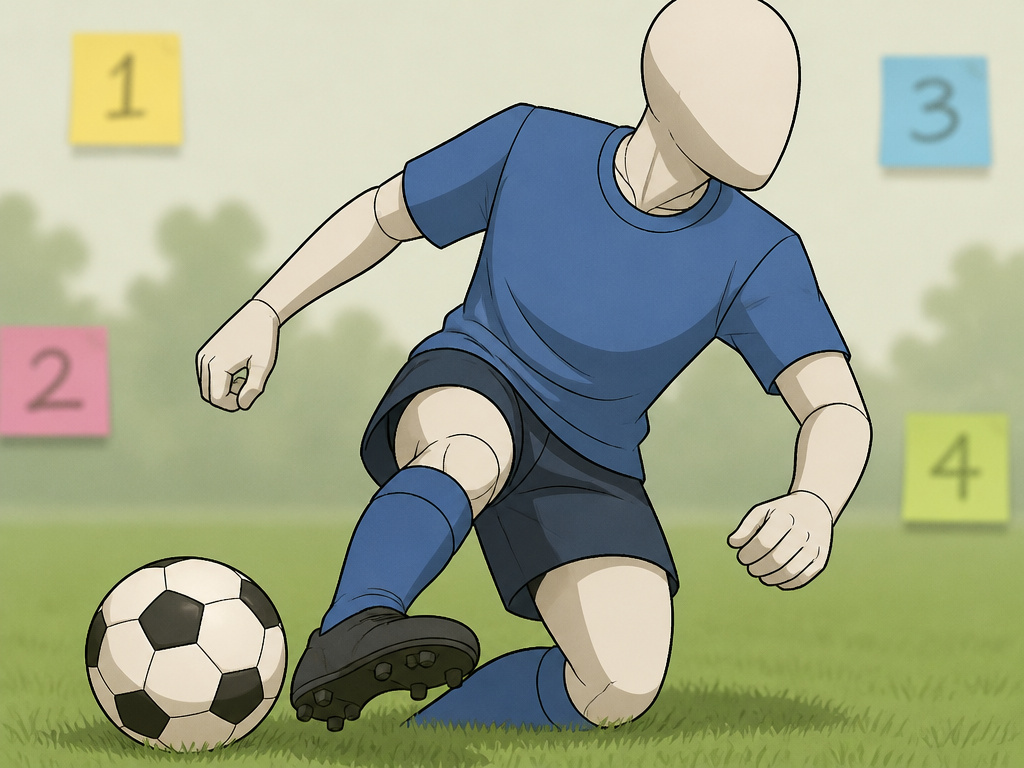
This plan blends on-pitch drills with accessible, science-inspired SVT exercises. It’s periodized, like the peer-reviewed vision training protocol from the 2025 study, which used 4 microcycles over 8 weeks.
Weeks 1-2: Foundation & Awareness
- On-Pitch: 15 minutes of pure scanning drills. In pairs, pass and move. The receiver must shout “left,” “right,” or “center” based on a coach’s held-up cone before controlling the ball.
- SVT Element: “Peripheral Number Call.” Stick numbered post-its in your periphery while watching TV. Glance away from the screen, call a number, and verify. Do this for short sessions regularly.
- Small-Sided Game: 5v5 on a narrow, long pitch. The constraint forces more vertical scanning and long-range passing decisions.
Weeks 3-4: Integration & Reaction
- On-Pitch: “Two-Goal Game.” Play a small-sided game with multiple goals to target. You must scan and identify which goal is least defended before shooting. Adds decision-making to finishing.
- SVT Element: Use a reaction light system like BlazePod® or even a simple app. Set two lights in front of you. React and touch the one that lights up. Work in 40-second intervals with 20 seconds of rest, mirroring the work-rest ratio from the research.
- Small-Sided Game: Use a small-sided game with a touch limit to force quicker decisions. Forces others to scan and decide faster.
Weeks 5-6: Pressure & Automation
- On-Pitch: “Decision Rondo.” Use a rondo with active defenders and a cognitive task. The defenders are active, and the possessors must complete a minimum of 5 passes before playing a through-ball to a target player outside the circle. High cognitive load.
- SVT Element: Combine elements. Do a peripheral call task while juggling a ball, or react to a light cue then perform a specific turn.
- Small-Sided Game: Full-sized 7v7 or 8v8. No artificial constraints. The goal is to see if your scanning and decision-making hold up under match conditions.
The periodization is key. You’re building complexity week by week, moving from isolated skill to integrated performance.
Beating the ‘Freeze’: A Mental Protocol for When You’re Under Pressure
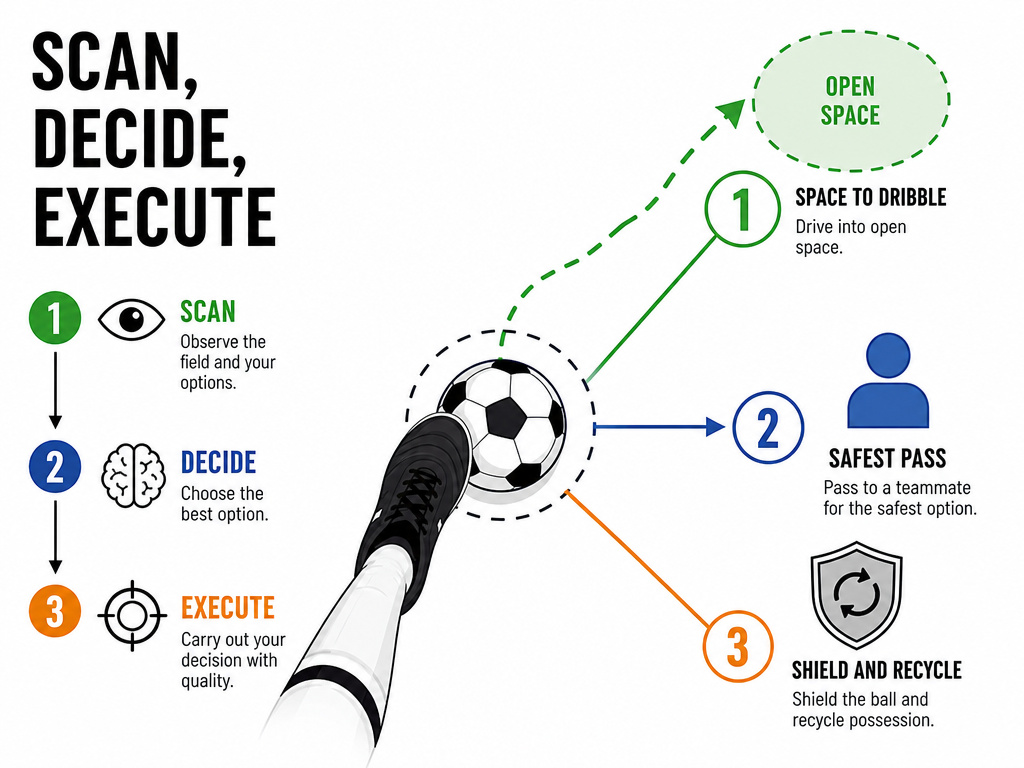
You’ve trained the skills. Now the ball is at your feet, a defender closes in, and your mind goes blank. This is the ‘freeze’ moment forum threads are full of. Beating it requires a mental rule so simple it overrides the panic.
The rule is “Scan, Decide, Execute” on a two-touch limit.
- Scan: Your first touch is away from pressure. As you take it, your head is up. You’re not looking for ‘a pass’, you’re looking for one of three pre-defined options: (1) the safest available pass, (2) the space to dribble into, (3) the opportunity to shield and recycle.
- Decide: Before your second touch, you’ve chosen. No hedging. The safe pass is fine. Indecision is the enemy.
- Execute: Your second touch is the pass, the dribble, or the shield. Commit.
This isn’t passive thinking. It’s an active command you give yourself in the half-second you have. It turns a paralyzing array of choices into a manageable flowchart. This kind of structured decision-making is the core of a high football IQ.
Position-Specific Priorities
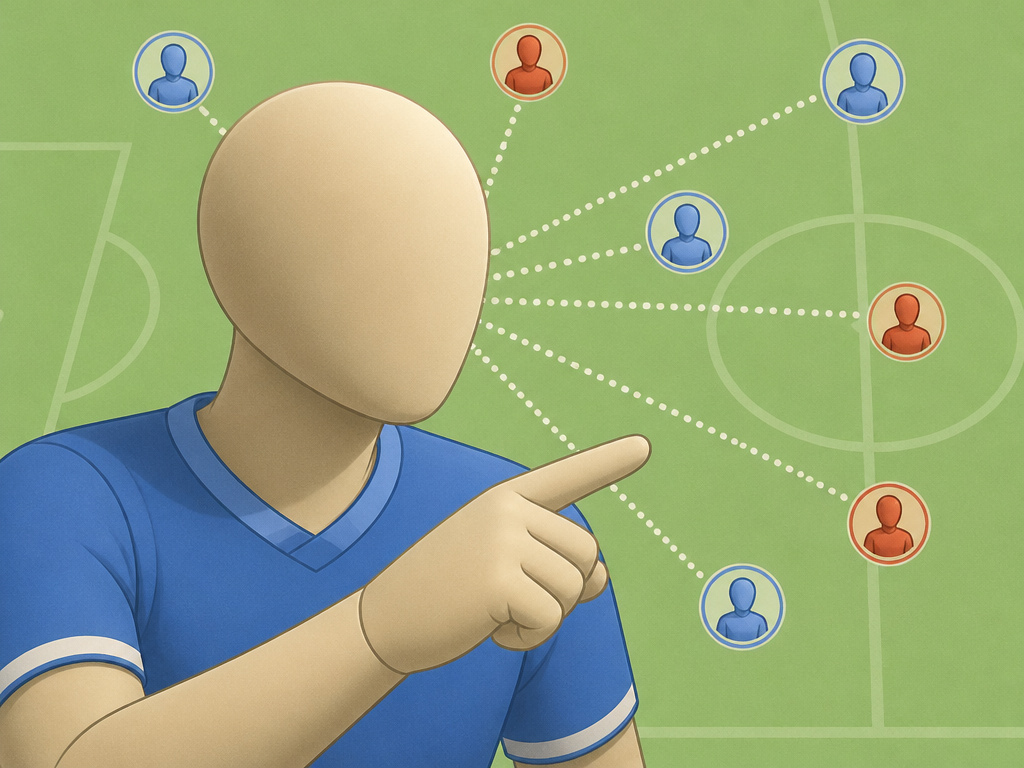
Your role on the pitch dictates what you need to see. A goalkeeper’s visual world is different from a striker’s. Tailor your focus.
- Central Midfielders: You are the team’s eyes. Your priority is spatial mapping. Constantly scan to know where every teammate and opponent is relative to space. Train with exercises that force 360-degree awareness. Your developing spatial awareness is your most valuable asset.
- Center-Backs & Defensive Midfielders: Your key skill is anticipating triggers. Watch the opponent’s hips, their first touch, the passer’s eyes. Train by watching video and pausing just before a key pass, predict where it will go.
- Wingers & Fullbacks: Your game is about peripheral threat detection. You need to see the overlapping run while also watching your marker. Use drills where you must track a central target while identifying colored cones in your wide periphery.
- Strikers: You live for split-second recognition of defensive line movements and goalkeeper positioning. Train your dynamic visual acuity with ball-tracking drills and practice shooting while processing a keeper’s shift in weight.
How to Measure Your Progress
You can’t manage what you don’t measure. Use both subjective and objective checks.
- Film Yourself: Watch back portions of a match or scrimmage. Note whether you scanned before receiving. Chart your body shape on receipt. It’s brutally honest feedback.
- Simple Reaction Tests: Use a free online reaction time test periodically. While it’s a general measure, a trend of improvement suggests your nervous system is getting faster.
- Decision Audits: In training, have a coach or teammate give you feedback on your decision speed and quality after each drill. Track the average over weeks.
- The ‘Feeling’ Test: The best metric is often internal. Does the game feel slower? Do you feel less surprised by opponents’ movements? That’s your perceptual software upgrading.
How to use video analysis to improve vision
Video analysis is a powerful tool for developing football vision. By reviewing footage, you can train your brain to recognize patterns and make faster decisions. Studies show that structured video-based training can improve decision-making, response times, and reactive agility in young athletes. Focus your analysis on specific in-game situations. Watch clips to identify passing options you missed, track player movements off the ball, and analyze the cues that precede key events. This deliberate practice helps you build a mental library of scenarios, allowing you to process visual information more efficiently during actual play.
Frequently Asked Questions
How do I improve my vision in football?
Improve your football vision by deliberately training both your visual skills (like peripheral awareness with drills) and your cognitive habits (like scanning before every reception). Integrate these into small-sided games that force quicker decisions. Research-backed Sport Vision Training protocols, which often use reaction lights, can accelerate gains in specific areas like visuomotor reaction time.
How to get 20/20 vision again?
This is a question for an optometrist. Football vision is about perception and decision-making, not visual acuity. If you suspect your eyesight is blurry, get a professional eye exam. For on-pitch performance, wearing proper prescription glasses or contacts designed for sport is the solution, not hoping for a natural fix.
Do athletes have 20/20 vision?
Not necessarily. Many elite athletes have less-than-perfect eyesight and use corrective lenses. What separates them is superior dynamic visual acuity, peripheral processing, and anticipation, skills honed through thousands of hours of sport-specific practice, not innate perfect sight.
Can you play football with bad eyesight?
Yes, absolutely, as long as it is properly corrected. The key is using the right protective eyewear or contact lenses as prescribed. Playing with uncorrected blurry vision is a severe disadvantage and a safety risk, as it directly impairs your ability to judge the ball, other players, and distances.
The Bottom Line
Improving your vision in football is a deliberate project, not a wish. It starts with understanding that you’re training your brain more than your eyes. The research gives us a blueprint: targeted, football-specific visual-motor training works, but it must be layered on top of rock-solid fundamental habits like scanning and open-body receiving.
Forget the highlight-reel passes for a second. The vision that wins games is often invisible, the check over the shoulder that happens three passes before the assist, the peripheral glimpse of a runner that seeds an idea, the calm decision under pressure that comes from a pre-rehearsed mental rule. That’s the vision you can build.
Start this week with one thing: in your next training session, commit to scanning over your shoulder every single time the ball comes to you, even if you’re just knocking about. That one habit is the first step to seeing the game differently.
