
How to Start a Grassroots Football Club: Step-by-Step
This post contains affiliate links. As an Amazon Associate, we earn from qualifying purchases.
To start a grassroots football club, you must first affiliate with your local County Football Association through the FA’s Whole Game System. This registration is mandatory and provides access to insurance, league entry, and player registration. Before that, form a committee with at least a Chairperson, Secretary, and Treasurer, draft a simple constitution, and open a club bank account. For any club with a youth section, appointing a qualified Club Welfare Officer is an essential safeguarding requirement. For adult clubs with players under 18, it is strongly recommended.
The process is less about passion and more about paperwork. The administrative steps have a specific order, and getting them wrong means your team can’t play sanctioned matches. A key guide is understanding how to start a grassroots football club. It’s the difference between a recognised football club and an uninsured group of strangers on a public pitch.
What follows is the real sequence for how to start a grassroots football club: forming your legal backbone, navigating the FA’s digital portal, securing a pitch before they’re all gone, and building a budget that doesn’t rely on hope. We’ll walk through each stage with the specific rules, costs, and timelines that the official guides actually state.
Key Takeaways
- Affiliation through the FA’s Whole Game System is your first formal step and is required before any sanctioned match can be played.
- Your club must have at least three committee officers: a Chairperson, Secretary, and Treasurer – the Secretary handles all FA and league communication.
- For clubs with any under-18 players, appointing a Club Welfare Officer with an FA DBS check and specific training is mandatory, not optional.
- Secure your winter training venue months in advance – demand for indoor and all-weather facilities far outstrips supply once the season starts.
- Build your first budget around affiliation fees, referee costs, and pitch hire; player subscriptions alone rarely cover the bills.
The Legal and Administrative Backbone
A football club is a small organisation. Treat it like one from day one. That means giving it a basic structure so the entire operation doesn’t collapse if one volunteer burns out. The foundation is three things: a committee, a constitution, and a bank account.
When considering how to start a grassroots football club, you don’t need to incorporate as a limited company immediately. Most new clubs begin as an unincorporated association. It’s the simplest structure. Your constitution is your rulebook – it defines the club’s purpose, how the committee is elected, and how finances are handled. The Football Association provides template constitutions, and using one is the fastest path. This document is what your bank will ask for when you open a club account, which must be separate from any personal accounts. Mixing funds is the quickest route to confusion and accusations of mismanagement.
Common mistake: Running everything through a founder’s personal bank account. It blurs lines, complicates grant applications, and looks deeply unprofessional to potential sponsors. Open a dedicated club account as soon as you have your constitution signed.
The Four Mandatory Committee Roles and Their Jobs
The Kent FA and Amateur FA guides are clear: your club needs to fill three core officer roles. One person can technically hold multiple roles, but it’s unsustainable. Spread the load.
| Role | Core Responsibility | The Detail Everyone Misses |
|---|---|---|
| Chairperson | Chairs meetings, leads decision-making. | They set the monthly agenda. A vague agenda leads to meetings that run 90 minutes and decide nothing. |
| Secretary | The primary contact for the County FA and league. | They must check their email and the FA Whole Game System daily during the season. Missed communication means missed fixtures or fines. |
| Treasurer | Manages all club finances. | Their job isn’t just to collect subs; it’s to present a clear financial report at every committee meeting so everyone knows the runway. |
| Club Welfare Officer | Mandatory for youth sections; recommended for adult clubs with U18s. | They need an FA Enhanced DBS Check and specific FA training before any sessions begin. |
The Secretary’s role is pivotal. This person will manage your club’s affiliation with the County FA via the FA’s Whole Game System, register players, and deal with league correspondence. If they aren’t organised, the club grinds to a halt.
Affiliation: Your Gateway to the FA System
This step is mandatory. Affiliation to your County FA is what makes you an official football club under The FA’s umbrella. It’s done annually through the FA’s Whole Game System, a single online portal for all administration.
The process registers your club, your teams, and your officials. More importantly, it provides the pathway to public liability and personal accident insurance. Without this insurance, you cannot hire pitches from most councils or enter a league. The Kent FA notes there is “no fixed date” for affiliation opening, but it’s usually around the start of June for the following season. However, the Amateur FA guide advises contacting leagues from January, while the Kent FA notes affiliation usually opens around the start of June. This discrepancy is key.
Contact your target league as early as possible. Affiliation is one step; getting a team accepted into a league is another. Leagues have limited spaces. Your perfectly affiliated club is useless if there’s no league to play in. Have a second-choice league in mind.
Safeguarding: The Absolute Priority
If your club will include any players under the age of 18, safeguarding is not a box to tick. It is the foundation of a safe environment. The requirement is binary: you must appoint a Club Welfare Officer.
This role has defined prerequisites that take time to complete. According to the Sportplan guide, the officer must complete the FA Safeguarding Children course and the FA Welfare Officer workshop. Any official in regulated activity also requires an FA Enhanced DBS check processed specifically through The FA, not a generic certificate.
The Kent FA breaks down the courses clearly:
- Player Welfare Course: Free, 45 minutes.
- Online Safeguarding Children Course: £30, 2 hours.
- Online Welfare Officer Course: £25, 2 hours.
These courses aren’t expensive, but they take time. Factor this into your pre-season timeline. You cannot run a single training session for youth players until this is in place. For a broader look at creating the right environment, our guide on how to be a supportive football parent covers the sideline culture that supports this work.
Securing Your Pitch and Venue

You have a committee, you’re affiliated, and your safeguarding is set. Now you need somewhere to play. This is often the hardest logistical hurdle.
First, contact your local council’s sports department or private pitch providers. Be ready to specify the pitch dimensions and goal sizes you need, especially if you’re starting a mini-soccer team. The Sportplan guide explicitly warns to confirm these specs match the format you’re playing.
The real crisis point is winter. Grass pitches become waterlogged or frozen. The Sportplan guide highlights a critical step: secure an indoor or all-weather training venue for winter, and book it months ahead. Demand massively outstrips supply. If you wait until October to look, you will be left without a training space for months. This is a physical reality that breaks teams.
The First-Year Budget Table
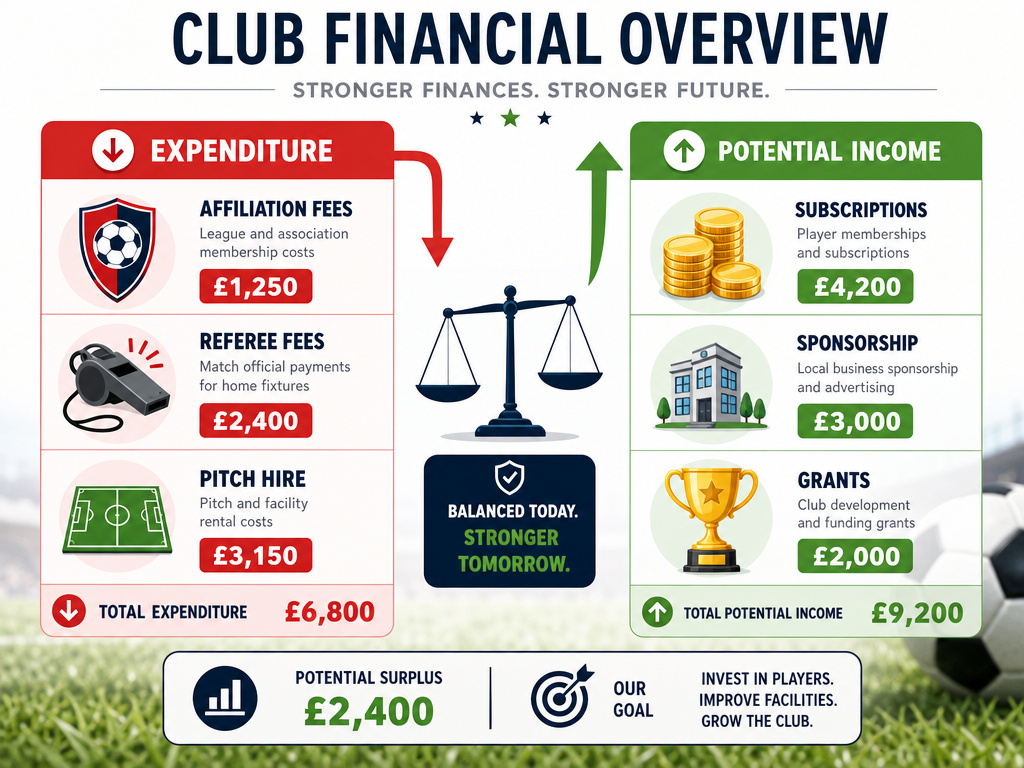
Dreams are free; football is not. A sustainable club needs a realistic budget. The Kent FA guide lists clear expenditure and income sources. Here’s what that looks like for a typical new adult or youth team.
| Expenditure | Estimated Cost (Annual) | Notes |
|---|---|---|
| County FA Affiliation & Insurance | Varies | Mandatory. Varies by county and number of teams. |
| League Entry Fees | Varies | Set by the league. A non-returnable deposit is common. |
| Referee Fees (per match) | Set by the league | Your biggest recurring match-day cost. Budget for 20+ games. |
| Pitch Hire (per match) | Varies | Can be weekly or paid as a season bundle. |
| Winter Training Venue Hire | Varies | The major variable. Could be weekly hall rental for several months. |
| Basic Equipment (balls, cones, kit) | Varies | One-time startup cost. See our picks for best bulk soccer balls for club teams. |
| Potential Income | Estimated Amount | Notes |
| Player Subscriptions | Varies | Typically the club’s main income source. Collecting this reliably can be challenging. |
| Sponsorship | Varies | A local business sponsor for kit is a common source. |
| Grants | Varies | Available from County FAs, Football Foundation, local councils. |
| Fundraising Events | Variable | Requires volunteer time and effort to organise. |
The treasurer’s main job is to ensure the income column covers the expenditure column. Most new clubs undercharge players and overestimate sponsorship. Be conservative. Understanding how football clubs make money at the professional level reveals principles that apply at the grassroots too: diversify your income streams.
Player Recruitment and Building a Squad
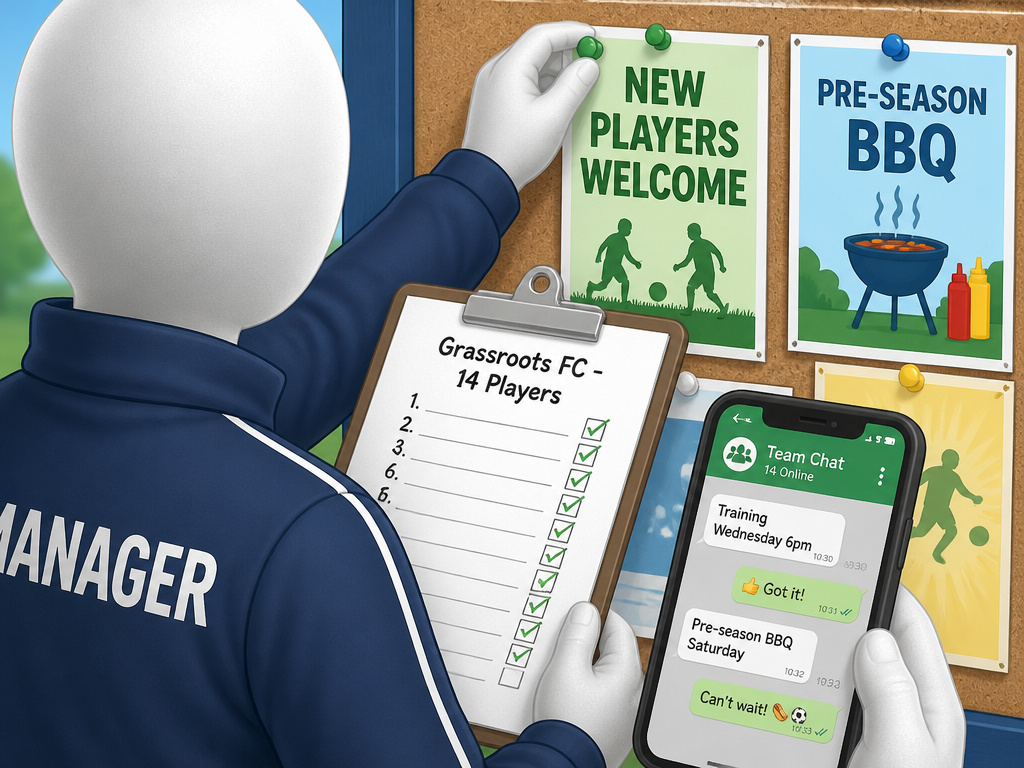
You need players. For an adult team, the Amateur FA guide recommends a minimum squad size of at least 14 players to account for injuries, holidays, and general availability. For a youth team, aim for a squad of 12-15 to allow for managing playing time and development.
Recruitment is more than just numbers. It’s about setting the club’s culture from the first meeting. Be clear about expectations: cost, commitment, training attendance. Use a free tool like WhatsApp or a dedicated sports app for communication, but ensure any app used for youth teams has guardian visibility for safeguarding.
The difference between a team that folds in November and one that lasts is often the social bond. Organise a pre-season meet-up that isn’t football. A barbecue or a quiz night costs little and builds the connections that keep players turning up on a cold, rainy Tuesday.
Navigating League Entry and Administration
You’ve contacted leagues early. You have your squad. Now you enter the administrative rhythm of the season. This falls almost entirely on the Secretary.
- Player Registration: All done via the Whole Game System. You’ll need player details, a photo, and for youth players, proof of age.
- Fixture Management: The league will issue fixtures. The Secretary must communicate these immediately to the manager, players, and ensure the pitch is booked.
- Match-Day Logistics: Who brings the nets? Who pays the referee? Who lines the pitch if needed? Assign these roles.
- Discipline: The Secretary will receive any charges from the County FA for red cards or misconduct. They must coordinate the response.
This is the grind of organizing a tournament every single week. It’s why the committee is essential. One person cannot do it all.
The Long-Term Goal: FA Accreditation
Once you have a season under your belt, consider working towards FA Accreditation (formerly the Charter Standard). This is a quality mark that shows you meet The FA’s standards in coaching, safeguarding, and club management.
It’s not required to start. But it reassures parents, can improve your chances of securing better pitches, and opens doors to specific grants. It’s the natural evolution from a startup team to an established community club. The path involves ensuring your coaches have the right qualifications, your welfare processes are robust, and your club governance is transparent.
How to create a club constitution and rules
Your club’s constitution is its rulebook. It defines how the club is run and makes you a formal organisation. You must appoint a Chairperson, Secretary, and Treasurer as a minimum. If you have a youth section, appointing a Club Welfare Officer is mandatory. For elections, nominations for the committee must be submitted at least 21 days before your Annual General Meeting. Any resolution to be voted on at an AGM also requires written notice at least 21 days in advance. Written notice for any General Meeting must be sent to members at least 14 days beforehand. Remember that members under 18 years old cannot vote in these meetings.
What kit and equipment does a football club need
Your budget needs to cover purchasing kit, balls, cones, and nets. Start by confirming the pitch dimensions and goal sizes match the format you’re playing, especially for mini-soccer. For training, consider securing an indoor or all-weather venue for the winter months when grass pitches are often unusable. Demand for these winter slots is high, so venues get booked up months in advance. Plan your purchases and bookings early to ensure your team has what it needs when the season starts.
How to handle club communication and social media
Clear communication keeps your club running. Use your constitution to define how meetings are called and how members are notified. For public relations, think about your club’s identity. The County FA must agree on your club’s name and will not allow one that is similar to an existing club’s name. It is recommended to have several different name options in mind as a contingency. When communicating with potential sponsors or members, having a clear structure and a defined budget can help present your club as a serious and organised venture.
Frequently Asked Questions
Can I start a club with just one team?
Yes. Many grassroots clubs begin as a single adult Sunday league team or one youth age group. You still need the full committee structure and must affiliate. The process is the same whether you have one team or ten.
How much does it cost to start a grassroots football club?
You cannot fix a single number, as costs vary by region and league. However, your first-year setup will likely require between £1,000 and £3,000 before a ball is kicked. This covers affiliation, insurance, basic kit, equipment, and pitch deposits. This is why a detailed, conservative budget is your most important financial tool.
Is a Club Welfare Officer needed for an adult team?
If your adult team has any players under the age of 18, the Kent FA and AFA strongly recommend appointing a Welfare Officer. For a purely over-18 adult team, it is not mandatory, but implementing basic safeguarding principles is still considered best practice.
What if our chosen league rejects our application?
This is common, especially in saturated leagues. Have a second and third choice league identified. Use the rejection as feedback. Ask why – was it a lack of history, facility issues, or simply no space? Address the reason and apply elsewhere. Persistence is part of the football club ownership journey, even at this level.
What’s the difference between recreational and travel football?
This is a fundamental choice that affects cost and commitment. Recreational football is typically local, less expensive, and focuses on participation. Travel (or competitive) football involves more travel, higher costs, and a greater focus on results and development. Understanding the travel football vs recreational decision early will shape your club’s identity and budget.
Before You Go
Starting a club is an act of optimism. You’re building a community. The paperwork, the budgets, the endless emails – they exist to protect that community and give it a stable floor to grow from.
Your first season will teach you more than any guide. You’ll forget to order a match ball. A referee won’t turn up. The pitch will be double-booked. It happens. The measure of a club isn’t a perfect debut, but whether you learn, adapt, and still have a group of people wanting to play football together the following weekend.
Keep your initial ambitions tight. Focus on doing the simple things well: clear communication, fair coaching youth football practices, and financial transparency. That’s how a one-season team becomes a ten-year institution. The framework from the US Soccer Federation youth club guide emphasises planning for sustainability from day one, a principle that translates perfectly to any grassroots project. Get the foundations right, and the rest is just football.
