
How to Coach a Football Team for Beginners: Step-by-Step
This post contains affiliate links. As an Amazon Associate, we earn from qualifying purchases.
Coaching a football team for the first time is about matching three things to your players: their age, their existing experience, and a session plan simple enough to survive your own nerves. For a junior group (U7-U12), start with a 60-minute session built around a 10-minute arrival game, two short practices, and a 20-minute match. Your job in week one isn’t to teach tactics—it’s to learn names, assess the group, and run something that can’t go too wrong.
That 60-minute framework is a starting grid, not a prison sentence. The real skill is knowing when to stick to the plan and when to tear it up because the activity just isn’t working. A core part of how to coach a football team for beginners is developing that flexibility, as it is the difference between a session that flows and one that grinds to a halt.
What follows is the gear you need, the essential first steps like safeguarding, and a walkthrough of that first session minute-by-minute. We’ll also cover the two competing philosophies for your debut match day and what to do when the standard advice doesn’t fit your group.
Key Takeaways
- Your first session needs just the essential items: a bag of balls (one per player if possible), 20–30 flat cones, two sets of bibs, mini goals, water, a first-aid kit, and the parents’ contact details. Over-preparing with complex gear is a distraction.
- Week one is diagnostic. A session that feels “too easy” is far better than one that’s too ambitious. Your goal is to learn names and gauge energy, not execute a perfect session plan.
- For U7-U12, build around a 60-minute plan: a 10-minute arrival game, two short practices, and a 20-minute game. For U6-U8, cut the total to 45 minutes.
- Communicate early and require honesty. Set a hard deadline for players to withdraw from matches and share team selections well ahead of time. This prevents most weekend chaos.
- If an activity fails, stop and move on. This is a formal principle from the Special Olympics football coaching guide, and it applies to every beginner coach.
Before You Start: The Non-Negotiables
You need two things squared away before you even think about drills. First, a safeguarding certificate. This is typically mandatory before you start, full stop. Your club will tell you how to get it. Second, find out who your club’s welfare officer is. They are your go-to for any safeguarding questions or concerns. This isn’t optional paperwork—it’s the foundation of trust.
Before you start: You will typically need a valid safeguarding certificate before you start. Your club’s welfare officer is your first point of contact for any player well-being concerns. Skipping this step risks the safety of your players and your position.
Most leagues also require a basic coaching qualification. Here’s the part that calms new coaches down: you don’t need the badge before your first session. Most volunteer coaches learn the qualification content alongside, not before, their first sessions. Don’t let “I haven’t done my badges yet” stop you from starting. The pathway to become a coach is designed for learning on the job.
What Actually Matters in Your First Week
Forget tactics. Forget complex technique. Week one has three jobs: learn every player’s name, get a sense of the group’s collective energy, and run something so simple that nothing can go catastrophically wrong.
A session that’s “too easy” in week one is far better than one that’s too ambitious. You can always add complexity once you know your group. If you run a drill that baffles them, you’ve lost their attention and your own confidence. Start with a basic dribbling square. Let them play a small-sided game. Observe who is confident with the ball, who hangs back, and who listens when you talk. That’s your data.
This diagnostic approach conflicts with another reputable source (Football Coach Hub) that prescribes a strict, timed 60-minute plan for how to coach a football team for beginners. Which path you choose depends on your own confidence and the vibe you get from the kids on day one.
The 60-Minute Session Blueprint for U7-U12
If you want a concrete plan, here it is. This structure from Football Coach Hub works for most groups from U7 to U12. It lasts 60 minutes: a 10-minute arrival game, two short practices, and a 20-minute game.
Part 1: The Arrival Game (10 mins)
For an arrival dribbling game, mark a 20 x 20 yard square with cones. As each player arrives, give them a ball and have them dribble freely inside the square. Keep your coaching points short: “small touches,” “heads up,” “use both feet.” You can walk through as a ‘shark’ to tap balls out, which adds fun and urgency. The sound you want is the constant, light tap-tap of a ball being controlled, not the thud of a big kick.
Part 2: Two Short Practices
Part 3: The Game (20 mins)
Split into small teams (3v3 to 5v5). Use bibs and mini-goals or cones. Let them play. Your main role here is to praise effort and brave decisions more than results. Rotate teams quickly so nobody waits long.
A 60-minute session for U7-U12 comprises a 10-minute arrival game, two short 15-minute practices, and a 20-minute small-sided game. This balanced structure maximizes engagement and touches while providing clear coaching moments.
This is one type of training session structure. It’s excellent if you need a script. But remember the rule from the Special Olympics guide: if an activity isn’t working, stop and move on. Your blueprint is a servant, not a master.
The Essential Kit Bag (And What to Skip)

Over-preparing is a beginner’s trap. You do not need a van full of equipment. Here is the exact list for a first session, sourced from coaching guides:
| Item | Quantity / Spec | Why It’s Essential |
|---|---|---|
| Footballs | One per player, if possible | Maximizes touches, reduces queueing. |
| Flat Cones | 20–30 | For marking grids, goals, and gates. |
| Bibs | Two sets (e.g., 8 red, 8 blue) | Instantly creates teams for games. |
| Mini Goals | 2 pairs | Gives small-sided games a clear objective. |
| Water | A large container or bottles | Hydration is a safety and performance must. |
| First-Aid Kit | Basic kit with ice packs | For managing minor bumps and scrapes. |
| Parent Contact Details | Printed list with phone numbers | Critical for emergencies and communication. |
That’s it. Fancy agility ladders, colored discs, and elaborate goal targets can come later. This kit fits in one large bag. The night before, pack it all and plan where each activity will go on the pitch. Arriving early to set up is the single biggest boost to your confidence.
Age-Appropriate Coaching: What Not to Do
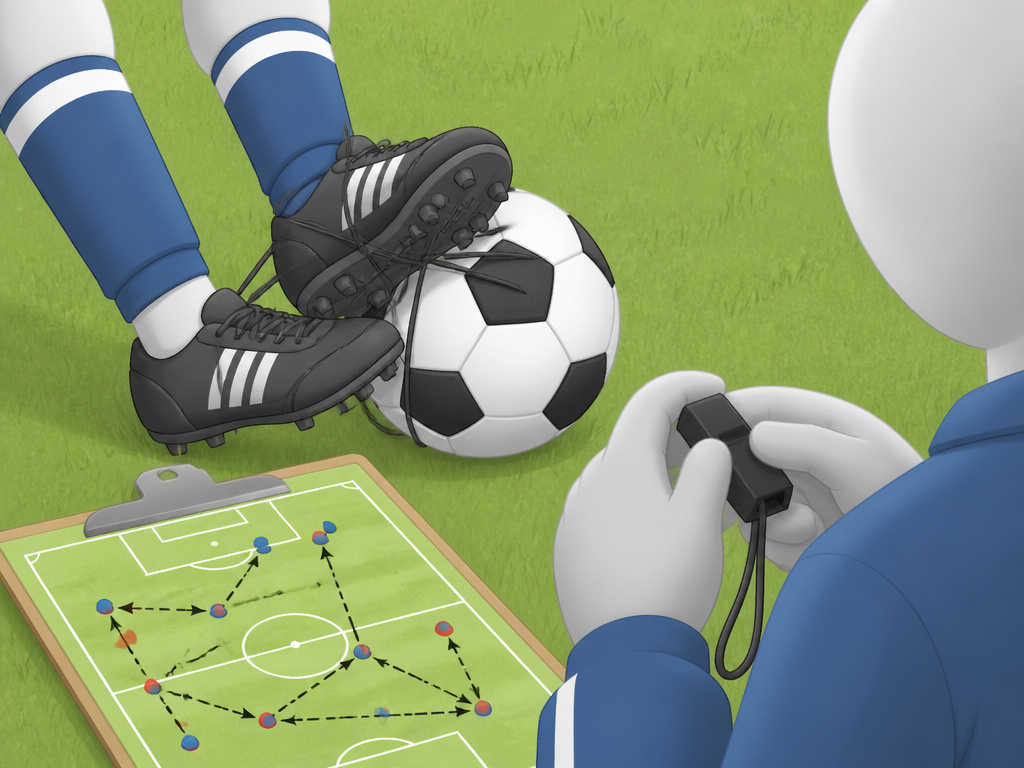
Your biggest mistakes will come from asking players to do something their brains aren’t ready for. The US Youth Soccer coaching manual calls these “developmentally inappropriate” activities. They break the session and frustrate everyone.
- U6 (Under 6): Asking a player to stay in a specific position like “right back” is pointless. They follow the ball in a swarm. Encouraging them to pass usually fails. Let them dribble and shoot.
- U8 (Under 8): Attempting to teach a wall-pass (a one-two) is inappropriate. They cannot think a pass ahead of the ball yet. Focus on basic ball mastery in fun, game-like scenarios.
- U7-U8: This is the age where players can begin to understand the concept of working with a teammate. Simple partner activities, like the passing gates drill, work here.
The principle for how to coach a football team for beginners shifts as they get older. Children at age nine and ten may have been playing soccer for half of their lifetime. They’re ready for more structured passing drills and basic tactical concepts. Your coaching philosophy must bend to their stage, not the other way around.
Your First Match Day: Calm vs. Competence
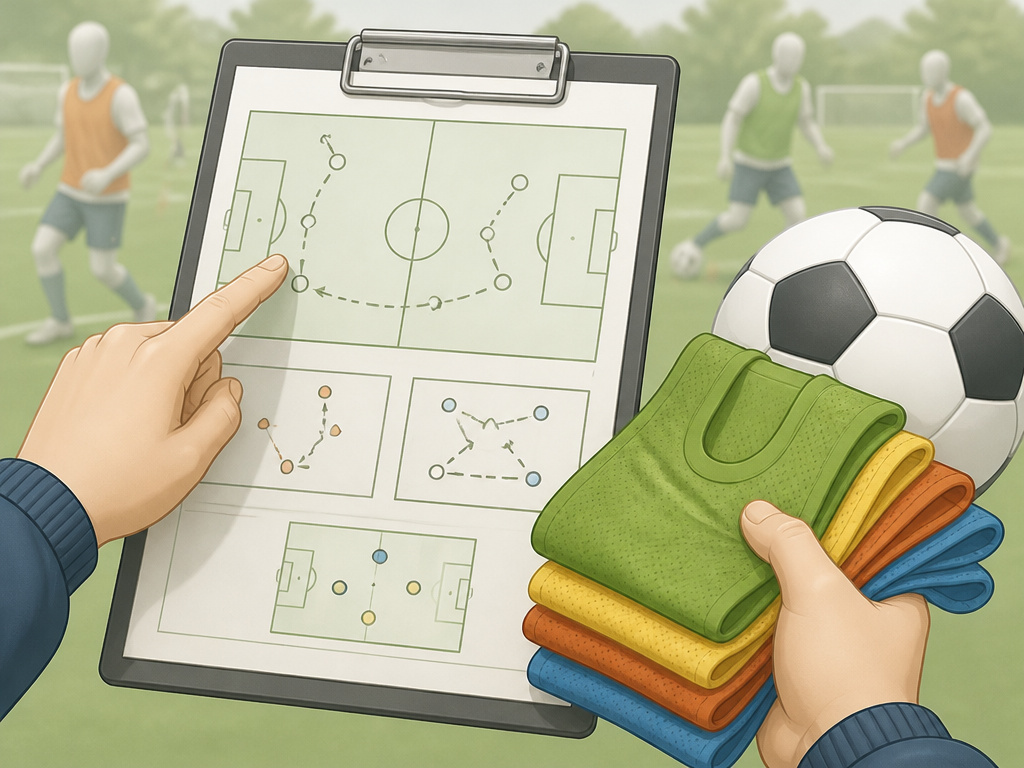
Match day feels huge. There’s a result, other parents watching, and an opposing coach who may have been doing this for years. Two credible sources give you opposing priorities for this moment.
The FA Guide emphasizes ruthless organizational competence. It outlines administrative duties: communicate selection early, collect match fees on the day, wash the kit, submit the match report on time. The implication is clear: if you’ve got nine players, no goalie, and flat footballs, your tactics are irrelevant.
The Simple Drills guide prioritizes psychological calm. It advises you to arrive early to warm up without rushing, decide your team and substitutions before kick-off, and pick just one or two things to say at half-time. Its stance is blunt: players remember a calm coach far more than a tactically perfect one.
These represent two credible philosophies for match day: The FA Guide emphasizes organizational competence, while Simple Drills prioritizes psychological calm. Handle the admin the day before so you can be calm on the day. Use session templates to pre-plan your warm-up. Have a clear plan for managing playing time to avoid sideline disputes. That organizational work buys you the mental space to be the calm presence on the touchline.
When the Standard Plan Doesn’t Fit: Adapting for All Players
Sometimes, the standard progression fails. The most important lesson for a beginner coach is knowing when to abandon the plan. This isn’t a failure—it’s a core skill.
The Special Olympics coaching guide makes this a formal rule: “If an activity is not working, even after you have tried to modify it, then stop! Move on to something else.” This applies beyond disability football. If your carefully planned drill is met with confusion or disinterest, scrap it. Switch to a simple game. The goal is a positive experience, not checking a box.
This also means accepting that mastering a skill may not be immediate. Your role is to guide the process, not demand the outcome. This requires a flexible session structure that allows for quick changes. Have a backup activity in your pocket for every drill you plan.
Building Your Coaching Over the First Season
Think in phases. Week one is diagnostics. The first month is about building routine with beginner drills. Your first season is about survival and learning.
That’s when shape and character are revealed. It’s better data than any highlight reel.
At the end of the season, write a short, honest note to parents. Summarize what the team worked on, what improved, and a thank you. Do the same for yourself: what worked, what you’d change, which sessions the players loved. You won’t remember these details by next August, and next season’s version of you will need those notes.
How to teach fundamental football skills
Focus on age-appropriate fundamentals. For very young players, asking them to stay in a specific position or pass the ball is developmentally inappropriate. They learn by exploring the game without fear. Around age seven or eight, players can begin to understand basic teamwork. Keep instruction positive and practical. Negative comments or over-coaching will only discourage children from continuing to play. Remember, mastering a skill may not be immediate. The primary goal is enjoyment, as this increases the likelihood players will stay in the game.
Developing a basic football playbook
Your playbook must match your players’ developmental stage. Attempting to teach complex tactics like a wall-pass to players who cannot think ahead of the ball is inappropriate. Start simple. For younger groups, prioritize activities that let them experiment with the ball and understand space. As players gain experience, you can introduce basic concepts of working with a teammate. Avoid perfectionism, which is a bigger barrier than any gap in football knowledge. If a drill or concept isn’t working after you try to modify it, stop and move on to something else.
Getting a football coaching job and certifications
Start by contacting your local club. You will typically need a safeguarding certificate before you begin, so ask about that process immediately. Also, find out who the club’s welfare officer is. Do not let a lack of formal qualifications stop you. Most volunteer coaches learn the required qualification content alongside their first sessions, not before. Your first week is about learning names and assessing the group’s energy, not proving your tactical knowledge. A session that is too easy in week one is far better than one that is too ambitious.
Frequently Asked Questions
What is the 70/30 rule in coaching?
Confidence first.
How do you turn a losing team into a winning team?
For beginners, shift the definition of “winning.” Frame success around controllable metrics: completing five passes in a row, making three tackles in a game, or improving from the first half to the second. Use your team talk to highlight these small wins. Culture beats tactics at this level.
What should a football coach not do?
Do not over-coach during play. Constant shouting prevents players from learning to read the game themselves. Do not make negative comments about effort; it only discourages children from continuing. Do not teach developmentally inappropriate skills (like complex passing to U6s). Do not skip the safeguarding process.
How long does it take to learn to coach football effectively?
Football Australia notes it takes around ten solid years of effort and practice for a player to learn the game, mastering perhaps one or two positions. Coaching the whole team is more complex. Give yourself at least three full seasons to move from beginner to competent. Your first season is about building a safe, fun environment where kids want to come back.
The Bottom Line
Your first session needs just seven items in a bag. Your first week needs just three objectives: names, energy, and a plan that can’t fail. The 60-minute blueprint is your script, but the Special Olympics rule is your escape clause: if it’s not working, stop and move on.
The long-term goal isn’t a trophy. Few players continue beyond high school. The goal is that all players learn life lessons from their experience. Your role is to facilitate that in a safe, positive environment. Everything else—the drills, the tactics, the match day prep—is just a tool for that. Start there, and you can’t go wrong.
