
Football Turf Injury Risks Explained: What the Data Says
This post contains affiliate links. As an Amazon Associate, we earn from qualifying purchases.
Football turf injury risks are real and concentrated. For professional American football, artificial turf significantly increases the risk of severe, season-ending injuries to the knee and ankle. An NFL study found the odds of season-ending surgery were 60% higher on turf compared to grass. ACL tears and Achilles tendon ruptures, in particular, are statistically more likely on synthetic surfaces. However, the risk profile is not universal, it varies dramatically by sport, level of play, and even player position.
That 60% figure for season-ending surgeries is the headline, but it’s the starting point. The story gets more detailed, and more useful, when you look at the type of play, the quality of the surface, and what happens when a cleat meets the ground. This isn’t just about professional athletes. The same mechanics affect a teenager on a worn-out municipal field, just with less oversight and worse equipment. The football turf injury risks explained here apply to all levels of play.
What follows is a breakdown of the data from the NFL, NCAA, and global football studies. We’ll look at which specific injuries spike on turf, the biomechanical reasons why, and how the risk changes for different sports and positions. By the end, you’ll be able to read past the simple “turf vs. Grass” debate and understand the specific conditions that tip the scales toward danger.
Key Takeaways
- NFL data is clear: the odds of a season-ending surgery are 60% higher on artificial turf, with ACL and Achilles injuries showing statistically higher rates.
- The increased risk is strongly linked to noncontact injuries and how turf interacts with cleats, creating greater torque and strain on the lower extremity.
- Risk is not equal across all sports or levels; NCAA football shows elevated risk on turf, while some soccer meta-analyses show a more complex picture.
- Surface quality and maintenance are critical, older, poorly maintained community turfs likely pose a greater risk than FIFA-certified professional pitches.
- Footwear matters. Using long-cleated shoes designed for grass on artificial turf may increase injury risk.
What Does the NFL Data Show?
The most compelling and consistent evidence comes from the National Football League, where player movements are tracked and injury reports are meticulous. The numbers tell a specific story about severity.
A National Football League injury study covering the 2022-2024 seasons delivered the starkest finding: players had a 60% higher odds of sustaining an injury that required season-ending surgery on artificial turf compared to natural grass. This wasn’t a minor bump. It was a clear, quantified elevation in career-altering events.
The 2022-2024 NFL data analysis, published in a peer-reviewed journal, concluded: “Injuries on artificial turf versus natural grass during the 2022-2024 National Football League seasons… Odds of season-ending surgery were 60% higher on turf compared to grass. (OR 1.60; 95% CI, 1.28-1.99).”
Earlier research aligns. A 2012-2016 NFL study found lower extremity injuries occurred at a rate 16% higher per play on synthetic turf. Crucially, that study noted the higher rate was “notably stronger for noncontact/surface contact injuries.” The game isn’t getting more violent on turf; the surface itself is changing the equation for injuries that happen during cuts, plants, and accelerations.
Which injuries are we talking about? The UCSF news report on a related study pins it down. Researchers focused on lower-body injuries, reasoning that upper-body issues like finger fractures wouldn’t be surface-driven, and found two standouts. ACL injuries were the most common injuries requiring surgery, with “statistically higher rates” on artificial turf. Achilles tendon injuries requiring surgery were also “more likely to occur on field turf.”
The NFL Players Association has used this data to advocate for grass fields. Half of NFL stadiums still use artificial turf. The debate isn’t academic; it’s a public health line drawn between cost, convenience, and quantified risk.
Does the Risk Apply to All Football?
Here’s where the picture gets messy, and where shouting “turf is worse” misses crucial detail. The risk profile changes completely when you shift from American football to global football (soccer), and from the professional level to amateur play.
Take the Finnish Premier Division study from 2019. It followed elite male footballers and its title indicates ‘no increased injury risk’, with an incidence rate ratio for all injuries of 1.1. However, NFL studies show a 16% higher rate of lower extremity injuries per play on synthetic turf. But dig into their tables, and patterns emerge that echo the NFL concerns, just with less certainty due to smaller sample sizes.
| Injury Type | Artificial Turf (per 1000 hrs) | Natural Grass (per 1000 hrs) | Incidence Rate Ratio |
|---|---|---|---|
| All Injuries | 27.2 | 23.9 | 1.1 |
| Muscle/Tendon Strains | 13.4 | 9.0 | 1.5 |
| Lower Limb Injuries | 23.9 | 16.9 | 1.4 |
| Noncontact Injuries | 9.2 | 5.0 | 1.9 |
The overall number is a wash, but look at muscle strains and noncontact injuries. The rates are higher on turf. The confidence intervals (0.8–1.7 for all injuries, 0.9–3.9 for noncontact) straddle the line of “no difference,” but the point estimates are all above 1.0, suggesting a trend. It’s not the slam-dunk 60% increase from the NFL, but it’s a whisper of the same mechanism.
The biggest divergence is in a Lancet systematic review of football injuries, which concluded the overall incidence was actually 14% lower on artificial turf. This contrasts with NFL-specific studies which show higher injury rates on synthetic turf. This meta-analysis included 22 studies across all levels. The main point? Context obliterates simple rules. The surface is one variable in a storm of others: sport, age, intensity, and, critically, the quality and maintenance of the turf itself.
The Why: Biomechanics and Cleat Release
Data tells you the what. Biomechanics explains the why. The football turf injury risks explained come down to two interrelated factors: force absorption and cleat release.
Natural grass gives way. When a player plants a foot to cut, the grass and soil underneath deform slightly. This tiny bit of “slip” or “give” absorbs some of the rotational force that would otherwise travel up the leg. Artificial turf, especially older or poorly maintained varieties, does not absorb force as effectively. The energy from the plant foot goes straight into the joint.
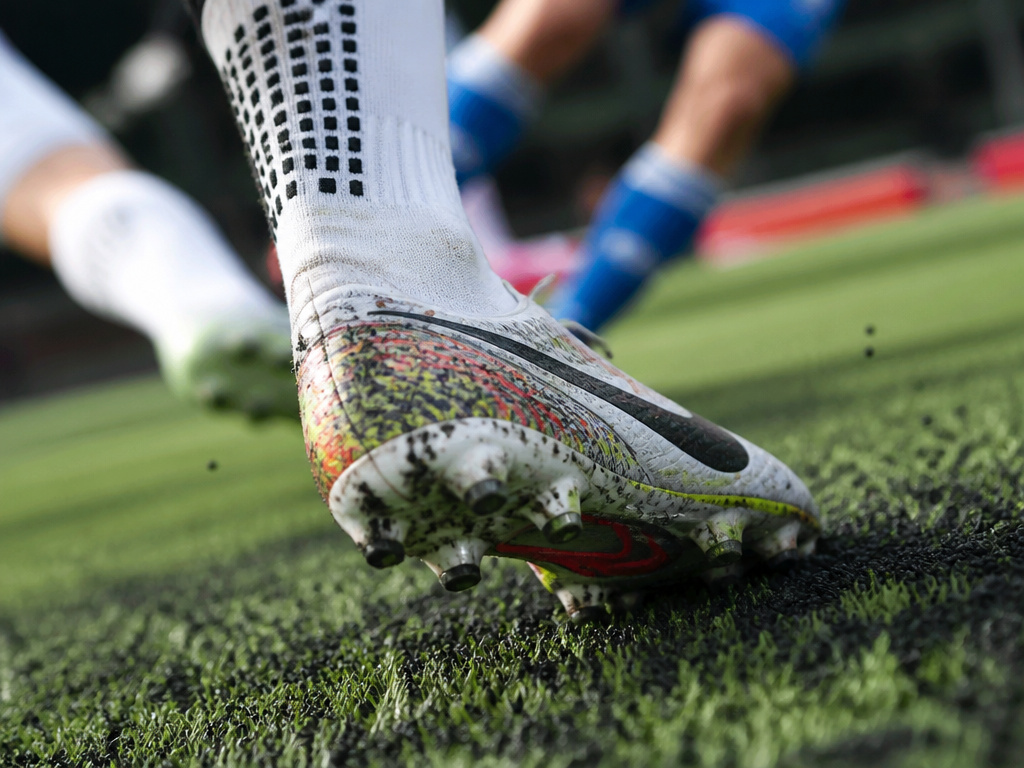
The cleat release is the other half. On grass, cleats penetrate and then release from the soil relatively cleanly. On many artificial surfaces, the cleat can grab the synthetic fibers and the rubber infill material more aggressively.
Where this goes sideways: The cleat sticks in the turf just a fraction of a second longer than the body expects. The knee or ankle continues to rotate over a fixed foot, and the ligament, usually the ACL or the Achilles, takes the full strain.
This creates what biomechanists call increased torque. It’s a twisting force. Your body is engineered to handle a certain amount of torque from cutting on a natural, variable surface. Artificial turf, with its consistent, high-traction surface, can generate torque that exceeds those tolerances. This is why noncontact injuries, the ones where no one touches the player, show such a pronounced increase in the data.
Position, Sport, and Level: Who’s Most at Risk?
Not every player faces the same odds. The research points to specific groups who should be most vigilant.
- Forwards in Football/Soccer: The Finnish Premier Division study found a startling disparity for forwards. Injury incidence for strikers and wingers was 33.8 per 1000 hours on turf versus just 9.9 on grass. The high-speed, explosive cutting these players do seems to be the perfect storm for turf-related risk.
- NCAA Football Players (Lower Divisions): An NCAA American football study found that athletes in Divisions II and III experienced ACL injuries at a higher rate on artificial turf. The theory is that these programs may have older turf systems and less access to top-tier maintenance and footwear.
- Female Soccer Players: A 2022 meta-analysis found female soccer players had a significantly higher risk of ACL injury in games on artificial turf versus natural grass. The same analysis found no significant difference for male players. The reasons are likely multifactorial, involving anatomical, hormonal, and neuromuscular differences.
The level of play is a huge filter. Some professional turfs, like those in the Finnish Premier Division, are built to standards like the FIFA Quality Pro Standard and are meticulously maintained. The community field your local youth club uses on a Tuesday night is a different beast. As the UCSF commentary notes, “older, less tended-to turfs that many youth clubs play on are likely to pose even greater risks.”
Can You Mitigate the Risk on Turf?
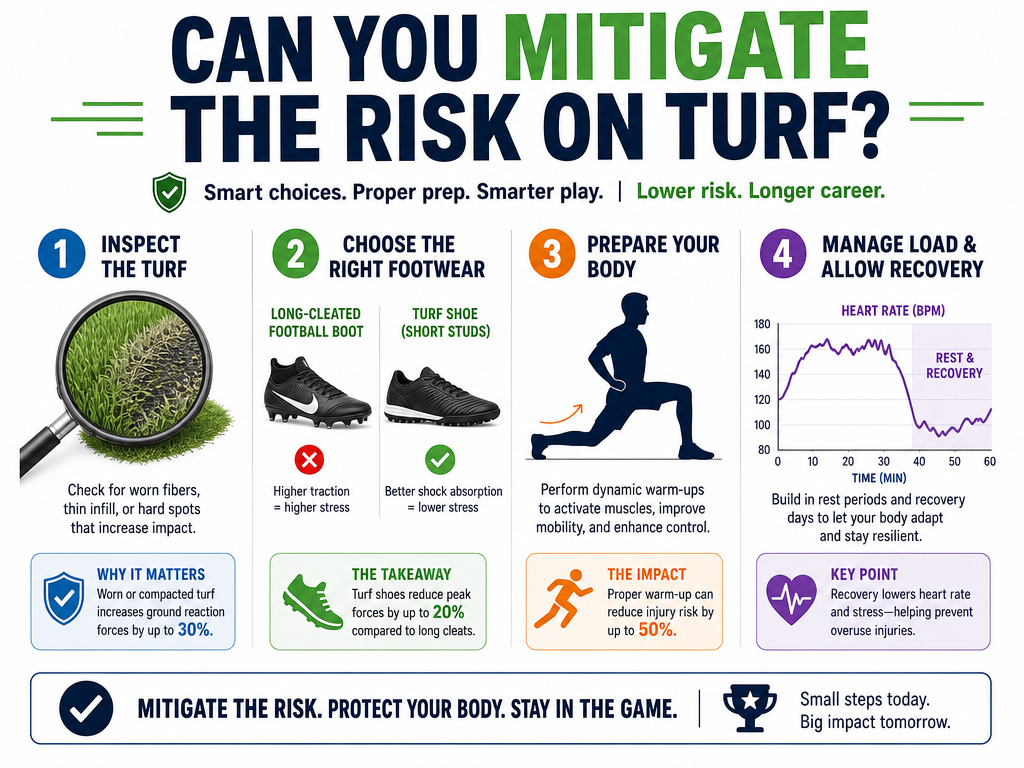
You can’t always choose the surface. If you’re playing on artificial turf, these steps can reduce your risk. They won’t eliminate it, but they shift the odds back in your favor.
- Audit the Surface. Before training or a match, walk the field. Look for bare patches, matted-down fibers, or hardened areas. A pitch that feels like concrete underfoot is a major red flag. This is the single most overlooked step in injury prevention.
- Opt for turf shoes or molded cleats designed for artificial ground. This is essential. Using long, traditional cleats designed for soft ground on turf increases the “grab” and torque. Opt for turf shoes (with many short rubber studs) or molded cleats designed for artificial ground. The UCSF report states plainly that “playing with long-cleated shoes designed for grass on artificial turf may put the player at a higher risk for injury.”
- Incorporate a Neuromuscular Warm-Up. Programs like the FIFA 11+ program are proven to reduce injury rates. They train the muscles around the knee and ankle to fire correctly during unexpected movements, which can help stabilize a joint when the surface betrays you.
- Listen to Your Body. Fatigue dramatically increases injury risk. On a high-traction surface, a tired muscle is slower to react and protect a joint. If you’re exhausted, your cutting technique deteriorates. That’s when noncontact injuries happen.
If you do sustain a common injury like an ACL injury or a meniscus tear, the return to play process is paramount. Rushing back on any surface is dangerous; rushing back onto turf without full strength and proprioception is asking for a recurrence.
The Grass Ceiling: A Note on Surface Quality
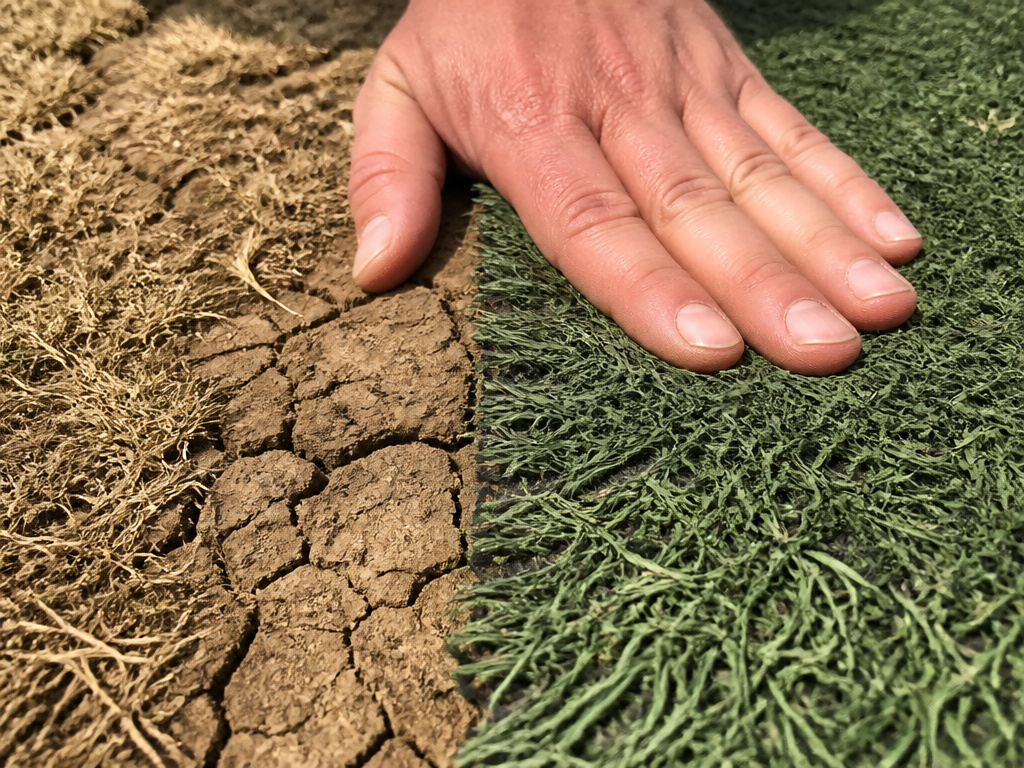
A final, critical layer: not all grass is safe, and not all turf is dangerous. A rock-hard, sun-baked natural pitch can be just as risky as a cheap turf field.
The ideal is a well-maintained natural grass pitch. But if artificial turf is the only option, the quality of the installation and the rigor of the maintenance schedule are everything. A comparison of playing surfaces must include these variables. When communities or schools choose turf for its durability and low maintenance, they must also commit to the budget and schedule for proper upkeep. Failing to do so turns a cost-saving measure into a liability.
What do the research studies and meta-analyses say?
Research on turf injury risk presents a complex picture, with findings that can appear contradictory. The most consistent evidence of higher risk comes from studies of American football. A 2012-2016 NFL study found lower extremity injuries per play were 16% higher on synthetic turf, with the odds of season-ending surgery 60% higher compared to grass in a 2022-2024 study. Studies also note statistically higher rates of severe injuries like ACL and Achilles tendon tears requiring surgery on artificial surfaces. In contrast, a 2024 meta-analysis of 22 football (soccer) studies found the overall incidence of injuries was 14% lower on turf than grass, which disagrees with NFL-specific studies showing higher rates. This analysis suggested professional players had a lower injury incidence on turf, while no significant difference was found for amateur players. The discrepancy highlights how sport, level of play, and injury type influence the risk. For example, a 2022 meta-analysis found female soccer players had a higher ACL injury risk in games on turf, while no significant difference was seen for male players.
How can athletes prevent injuries on turf?
Understanding the football turf injury risks explained is key to prevention. The surface does not absorb force as well as natural grass, placing more strain on knees and ankles. It also does not release cleats as easily, which can increase torque on the lower extremities during cuts and pivots. To mitigate this, athletes should ensure they are wearing footwear appropriate for the specific surface; using long-cleated shoes designed for grass on turf may increase injury risk. Pay close attention to field conditions, as older, less maintained turfs likely pose greater dangers. Focus on technique for changes of direction to avoid excessive strain, and prioritize a thorough warm-up that prepares muscles and tendons for the unique demands of the harder, less forgiving surface. Noncontact injuries show a notable increase on turf, so controlled movement is essential.
Frequently Asked Questions
How much more likely are you to get injured on turf?
For professional American football players, the odds of a season-ending injury requiring surgery are 60% higher on artificial turf compared to natural grass, according to a 2021-2022 NFL study. For other sports and levels, the risk is more variable and often lower, but a trend toward increased noncontact lower-limb injuries exists.
Why do NFL players get hurt more on turf?
Biomechanical studies point to two main factors: artificial turf does not absorb force as well as grass, sending more shock into joints, and it often does not release cleats as easily. This “cleat grab” creates excessive torque on the knee and ankle during cutting movements, leading to noncontact ligament tears.
Are you more likely to tear your ACL on turf or grass?
In the NFL and for female soccer players in games, the evidence says yes, you are more likely to tear your ACL on artificial turf. NFL data shows statistically higher rates of ACL injuries requiring surgery on turf. The risk appears most pronounced in high-speed, cutting actions.
Does the type of artificial turf matter?
Absolutely. Modern, third-generation turfs built to standards like FIFA Quality Pro, with adequate rubber infill and proper underlying shock pads, are designed to mimic grass more closely. Older, worn-out, or poorly maintained turfs with compacted or missing infill pose a much greater injury risk. The quality of the surface is a major variable that generic “turf vs. Grass” debates often ignore.
The Bottom Line
The risk isn’t a myth. For an NFL player making a cut at full speed, the difference between grass and turf can be the difference between finishing the game and needing reconstructive surgery. The 60% higher odds of a season-ending injury is a number that should command attention.
But that number is not a universal verdict. It’s a specific finding for a specific sport at the highest level of physical intensity. For a Sunday league player or a youth team, the calculus is different. The quality of the local pitch, whether it’s grass or turf, becomes the dominant factor. A pristine artificial surface may be safer than a lumpy, waterlogged grass field.
Your move, then, is to become a student of the surface you’re about to play on. Check it. Feel it. Choose your footwear for it. And understand that the most dangerous field isn’t defined by its material, but by its neglect. The data gives us the warning; our job is to apply the context.
