
Mid Block in Football Explained: Coach the Rivière Drill
This post contains affiliate links. As an Amazon Associate, we earn from qualifying purchases.
A mid block in football is a defensive tactic where a team, out of possession, forms a compact shape with its players stationed primarily in the middle third of the pitch. The core objective is to deny the opposition space and passing lanes through the central channels, forcing play wide while conserving energy and waiting for a trigger to press and win the ball back.
That definition covers the consensus. The debate starts when you try to pin it down to a measurement. Some systems define it by where most of your players are, others by where your deepest defenders sit. That difference changes everything from your training drills to your scouting reports. A clear mid block in football explained is one where the team defends in the central third of the pitch.
What follows is a walk through the two main definitions, the physical and mental demands on players, and the real-world data from teams that made the mid-block a weapon. By the end, you’ll spot the difference between a disciplined block and a disorganised one from the stands.
Key Takeaways
- FIFA officially defines a mid-block as having at least eight outfield defenders in the middle (or middle+defensive) third, requiring horizontal lines and a stationary period of 1.6 seconds within a 2.0-second window.
- The tournament-average compactness for a mid-block at the 2022 World Cup was 27.2m long by 40.1m wide – roughly a 30-yard by 44-yard box on the pitch.
- Teams use it more when winning or drawing, as seen with Morocco (38% of out-of-possession time) and Croatia (25%) during their successful World Cup runs.
- Defending in a mid-block is mentally tiring due to constant decisions about when to press, drop, or track runners – a fatigue often overlooked in favour of physical strain.
- Forcing play wide is the primary aim, which is why Liverpool Women’s 74% mid-block efficiency prevented opposition progression past the midfield third 74% of the time.
What the Data Says: FIFA’s Official Mid-Block Definition
Forget punditry for a second. If you want the rulebook definition, go to the organisers of the biggest tournament. The FIFA Football Language technical documents lay out nine distinct out-of-possession phases, and the mid-block is one of them. Their criteria for data collection are brutally specific.
A phase is logged as a mid-block only when four conditions are met simultaneously. First, at least eight outfield defending players must be in the middle third, or the middle and defensive third combined. Second, those players (except the highest one) must form recognisable horizontal lines. Third, the team must have been stationary – no major shuffling – for at least 1.6 seconds during the previous 2.0 seconds. Fourth, at least four defending players must be visibly organized behind the ball. The phase ends if any of these criteria fails for just 0.4 seconds within a 2.0-second window.
The FIFA Football Language states a mid-block phase requires at least eight outfield defending players in the middle third (or middle+defensive third), those players forming horizontal lines, the team being stationary for 1.6 seconds within a 2.0-second window, and at least four defenders organized behind the ball. The phase breaks if these conditions aren’t met for 0.4 seconds.
This explanation covers the practical application of the mid block in football, detailing how every match at the 2022 World Cup was coded. The average compactness for a team in a mid-block during that tournament was 27.2 meters in length and 40.1 meters in width. To translate, that’s a defensive shape covering an area roughly 30 yards long by 44 yards wide. Croatia’s bronze-medal side mirrored that average almost exactly (27.3m x 40.1m). Argentina, the champions, operated a slightly larger block (29.1m x 40.5m). France were narrower (38.4m wide) but just as long. The most compact? Saudi Arabia, whose famous win over Argentina was built on a stifling 22.5m x 39.6m block.
The data shows patterns, too. Teams spent more time in a mid-block when they were winning or drawing. The longer they stayed in one, the more compact they became. And the willingness to use it varied wildly – Morocco led the World Cup, spending 38% of their out-of-possession time in a mid-block, while Spain used it just 9% of the time.
The Other Definition: Data Models and the “Deepest Three”
Not everyone uses FIFA’s labour-intensive camera tracking. Another common method, used by data firms like SkillCorner and cited in outlets like The Athletic football tactics analysis, simplifies things. Here, a ‘mid block’ is denoted by the average position of the deepest three defensive players being within the middle third of the pitch.
This definition is cleaner for data collection but captures a different picture than the typical mid block in football explained. It focuses on the team’s defensive line, not the concentration of all outfield players. Under this model, Crystal Palace had the highest share of time in a mid-block in the Premier League (44%), while Manchester City led in high-block time (23%).
So which is right? Both are, for their own purposes. FIFA’s definition describes a collective team posture – a snapshot of shape. The data model’s definition tracks the defensive line’s location – a measure of field position. A team can have its deepest three in the middle third (a data-model mid-block) while also having fewer than eight players there (not a FIFA mid-block). This is the kind of detail that separates a casual tactical label from a scouting report.
| Definition Type | Key Metric | Primary Use | Example |
|---|---|---|---|
| FIFA Football Language | ≥8 outfield defenders in middle/middle+defensive third; horizontal lines; stationary. | Official match analysis, coach education, tournament reports. | World Cup 2022 data showing Morocco’s 38% usage. |
| Data Model (e.g., SkillCorner) | Average position of deepest 3 defenders is in the middle third. | League-wide analytics, performance benchmarking, media analysis. | The Athletic’s report on Crystal Palace’s 44% share in the Premier League. |
High Block vs. Mid Block vs. Low Block: Choosing Your Lane
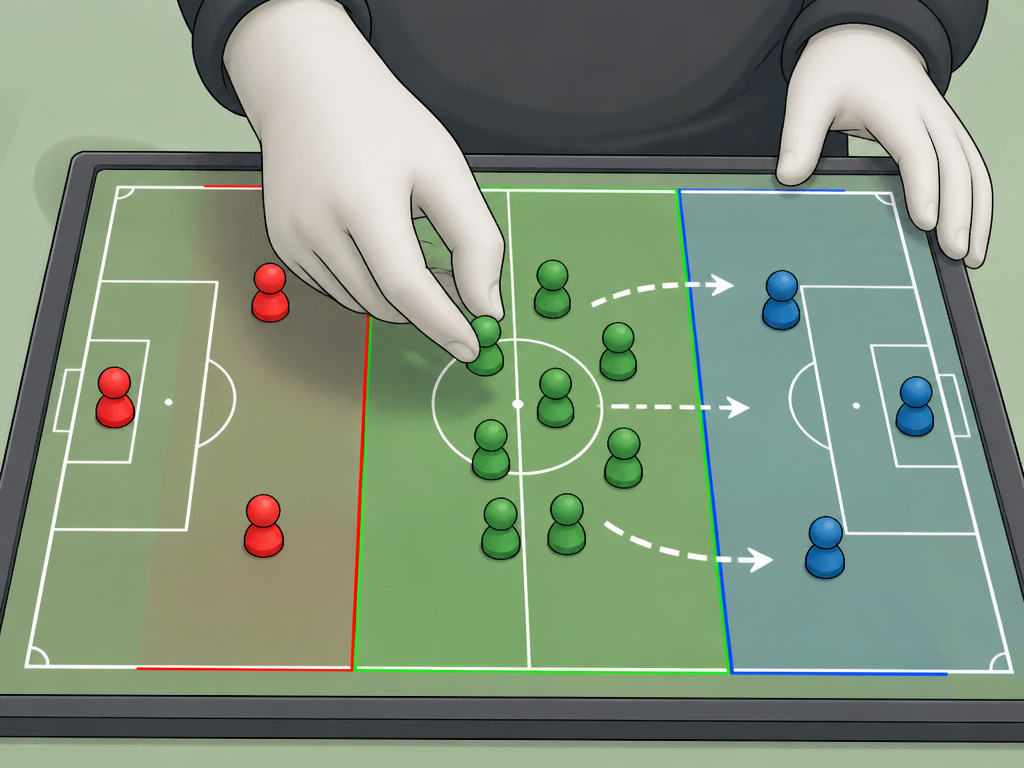
Every team defends somewhere. The choice between a high, mid, or low block is defined by selecting where on the pitch to engage the opponent and what risks to accept.
A high block (or high press) engages the opponent in their own defensive third. It’s aggressive, physically exhausting, and aims to win the ball back immediately in dangerous areas. The trade-off is the space left behind – a single bypassing pass can spring a counter-attack against a stretched defence. Manchester City spent 23% of time in a high block, the largest share in the Premier League.
A mid block, as we’ve detailed, sets up shop in the middle third. It’s the strategic middle ground. You’re not chasing the opposition’s centre-backs, but you’re also not camped on the edge of your own box. The aim is to be compact, force the play wide, and press on a specific trigger – a loose touch, a pass into a marked midfielder, or the ball going wide to a full-back. This is the balance most teams seek. It’s less physically draining than a constant high press but more proactive and dangerous than a pure low block.
A low block sees the team defend deep, usually with eight or more players in the defensive third, close to their own penalty area. The priority is extreme compactness, denying any space in behind, and frustrating the opposition into taking low-percentage shots or crosses. It’s often (mistakenly) labelled as negative. When done well, it’s a deliberate trap, conserving energy and launching rapid counter-attacks. Sunderland, for example, spent 30% of their time in a low block in the Premier League – the highest share.
The choice between these pressing strategies hinges on your team’s strengths, the opponent’s weaknesses, and the game state. Are you protecting a lead? A mid or low block conserves energy. Is the opposition’s playmaker most dangerous between the lines? A mid-block can smother that space.
Player Roles and the Mental Grind
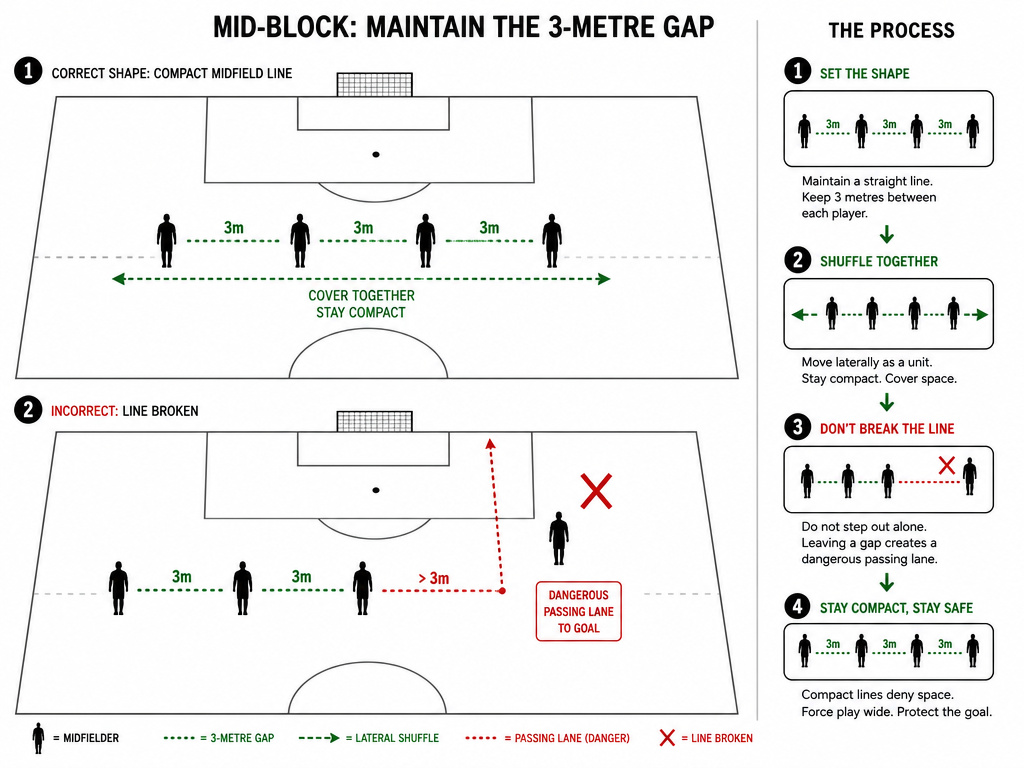
Implementing a mid-block isn’t just about drawing lines on a whiteboard. It places unique demands on each position, and the mental fatigue can be as crippling as the physical.
The forward line’s job is often misunderstood. They are not there to chase centre-backs. As the FIFA Training Centre session by Said Chiba emphasises, the centre-forward “must not overcommit.” Their role is to screen passes into the opposition’s midfield, curving their runs to block central passing lanes while keeping the defensive shape intact. It’s a game of patience and angles, not sprints.
Midfielders are the engine room of the block. They must stay compact, shuffling laterally as a unit to protect the central channel. The distance between them is critical – the Chiba session recommends “around 3 metres” from nearby teammates. This closeness eliminates the “pockets” where creative number 10s love to operate. One midfielder steps to press the trigger; the others shuffle across to cover.
Defenders, particularly the central ones and defensive midfielders, are the organisers. They see the whole pitch and must communicate constantly, instructing the line when to step up, drop, or shift. The defensive line height in a mid-block is typically around 20-30 yards from the 18-yard box, but this varies. They are responsible for maintaining the offside trap and ensuring the team moves as one connected unit.
Where this goes sideways: A midfielder breaking the line to press a lost cause. One player rushing out of the 3-metre gap destroys the compactness, opens a passing lane, and forces a teammate into a desperate recovery sprint that often ends in a foul or a chance conceded.
And then there’s the mental toll. The FA Bootroom notes that “defending in a mid-block can be mentally tiring.” Every player is constantly processing: Should I press? Can I win it? Do I drop? Is that runner mine? This decision-making under tension, repeated for 90 minutes, wears players down as surely as a high-press marathon. Coaches who teach a mid-block must drill these decisions until they become instinct, otherwise the shape frays under pressure.
Why Teams Choose It: Control, Energy, and Counter-Attacks
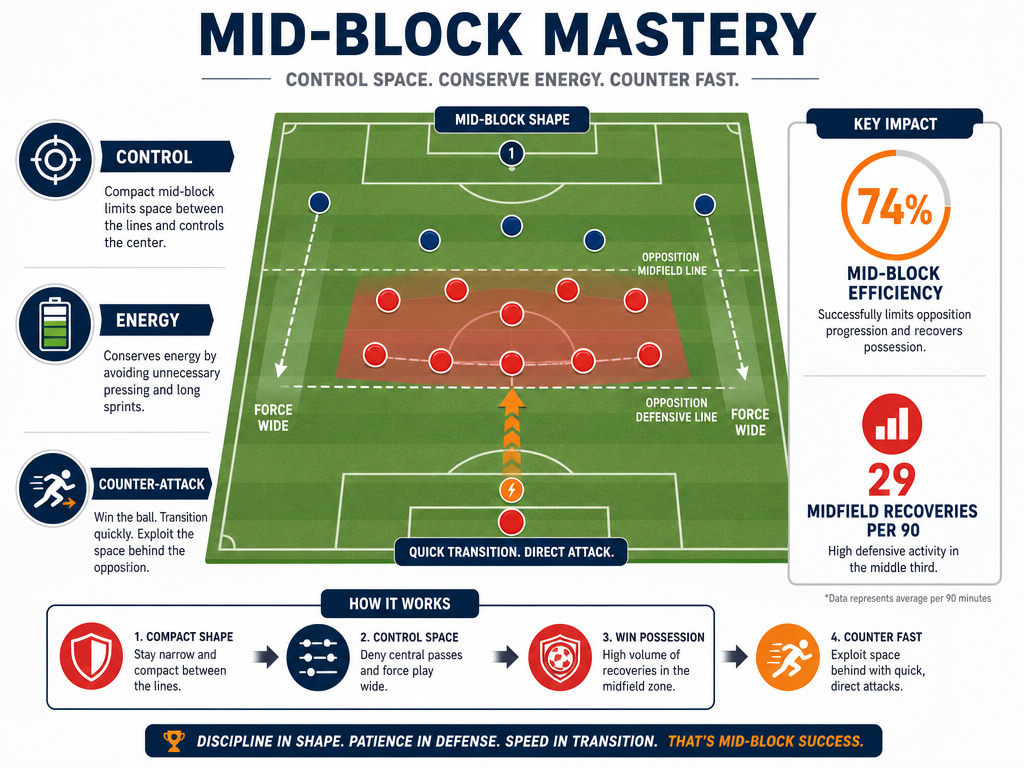
So why go through the hassle? Because the benefits, when executed well, are profound. The England Football Learning analysis lists them clearly: control, energy conservation, and counter-attacking opportunity.
First, control. A compact mid-block dictates where the opponent can have the ball. You are essentially saying, “You can’t play through the middle. Take it wide.” This neutralises teams built around a central playmaker. It forces them into their Plan B, which is often less effective. Liverpool Women’s data is telling: with a 74% mid-block efficiency rate, they forced the majority of their defensive duels into wide areas, where their wing-backs could engage.
Second, energy conservation. Not every team can press like Liverpool 2019 or Manchester City 2023. A mid-block allows a team to stay organised, slide across the pitch, and press only on favourable triggers. This “rest defence” mode is sustainable over a long season or a tournament. Morocco’s World Cup run, playing seven matches, was built on this principle. You can’t press high for 90 minutes, seven times, with a three-day turnaround. But you can stay compact.
Third, counter-attacking potential. By drawing the opposition forward into the space you’ve ceded in their half, you create room behind their defensive line. Winning the ball in the midfield third – as Liverpool did 29 times per 90 minutes in their analysed season – instantly puts you on the front foot with runners breaking into space. The transition from a solid mid-block to a launching counter-attacks is one of the most dangerous weapons in football.
Coaching It: The “Rivière” Drill and Common Mistakes
Theory is one thing. Getting 11 players to do it is another. The FIFA Training Centre provides a practical session from coach Said Chiba, built around a drill called “the Rivière.”
You start with a warm-up, then split into a 4v3+3 exercise. Four defenders form a line in a central zone, with two teams of three attackers positioned on either side. The attackers aim to pass the ball through the zone to their teammates on the other side. The defenders must move as a unit, maintaining their horizontal line and those 3-metre gaps, closing down passing lanes and forcing the ball wide. No tackling is needed initially; the objective is purely spatial control and coordinated movement.
The session progresses to a 10-a-side game on a small pitch, emphasising the same principles collectively, before finishing with an 11v11 match. The core coaching points throughout are patience, communication, and compactness.
Common mistakes ruin the system before it starts. The first is a lack of defensive cover. If one player steps out to press, another must immediately cover the space they left. If that chain breaks, the block is punctured. The second is poor communication, leading to some players pressing while others drop, creating fatal gaps between the lines. The third is impatience – lunging at a centre-back who is comfortable on the ball, only to be bypassed and leave the team numerically disadvantaged.
Common mistake: Coaching the trigger but not the reset. Teams practice pressing the ball, but not the coordinated drop and re-shape into a compact block after the press is beaten. The result is a one-shot press: if it doesn’t win the ball, the team is disorganised and vulnerable for the next 10 seconds.
Your choice depends on your players’ attributes and the opponent’s vulnerabilities.
How to train a mid-block
Training a mid-block focuses on teaching players to move as a compact unit and make collective decisions. Drills should reinforce the formation of horizontal lines, with players except the highest positioned to maintain a block. A key objective is to get ten players behind the ball and hold that shape patiently, allowing the opposition to pass in front. Coaches must design exercises where the defending team waits for a specific trigger, like a poor touch or a backward pass, before pressing as a group. Emphasise that players, especially the centre forward, must not overcommit. Use practice games to condition the mental discipline required, as this structure is mentally tiring due to the constant scanning and communication needed to keep short distances between players.
Frequently Asked Questions
What is the main goal of a mid-block in football?
The primary goal is to deny the opposition the central areas of the pitch. By forming a compact shape in the middle third, the defending team forces the attacking team to play the ball out to the wings, where passing options are more limited and pressing traps are easier to set. This control allows the defending team to conserve energy and choose the moment to win the ball back.
What’s the difference between a mid-block and a low-block?
The difference is the defensive line’s starting position and the team’s collective depth. A mid-block defends primarily in the middle third, with the defensive line around 20-30 yards from its own goal. A low-block defends deep in the defensive third, with the line much closer to the penalty area. A mid-block is more proactive and better for launching counter-attacks, while a low-block prioritises extreme defensive security and frustrates the opponent.
Which formations work best with a mid-block?
Structurally, any formation that can create two or three tight, horizontal lines works. Formations that can create tight, horizontal lines, such as a 4-4-2, are often used for a mid-block. A 5-3-2 or 5-4-1 provides an extra central defender, enhancing compactness. The key isn’t the formation number, but the distances between the players within it.
How do you attack and break down a mid-block?
Breaking down a disciplined mid-block requires patience and specific tools. Common strategies include: using quick, one-touch passing combinations around the edge of the block to pull it out of shape; hitting early, diagonal switches of play to exploit the time it takes for the block to shift across; having a creative player who can receive between the lines with their back to goal and turn; and utilising set-pieces, which offer a static moment to attack the organised defence.
Why is the mid-block so popular in modern football?
It strikes a sustainable balance. The high press is physically unsustainable for most teams over a full season and leaves massive space in behind. The pure low-block is often seen as too reactive. The mid-block offers a middle path: it allows for proactive defending, energy management, and dangerous transitions. Data from the Premier League and World Cup shows its widespread use among teams at all levels, from title contenders like Manchester City to organised underdogs like Morocco.
The Bottom Line
The mid-block is a tactical framework requiring extreme discipline, clear communication, and shared patience. The difference between Morocco’s heroic World Cup run and a team that simply sits deep isn’t the label; it’s the coordinated movement, the understanding of triggers, and the collective willingness to wait.
Watch for the 1.6 seconds of stillness FIFA tracks. That’s the tell. When a team shifts from frantic recovery into a settled, connected shape, you’re seeing a mid-block click into gear. That’s when the real game – the game of control – begins.
Don’t judge a defensive shape by how deep it is. Judge it by what it invites the opponent to do, and what it plans to do next. The best blocks, mid or low, are always asking a question. The compact ones just give you less time to answer.
