
How to Defend as a Team in Football: The FIFA Methodology
This post contains affiliate links. As an Amazon Associate, we earn from qualifying purchases.
To defend as a team in football, follow FIFA’s progressive methodology: start with individual skills in 1v1 scenarios, progress to coordinated small-group defending, and finally integrate those principles into a full-team unit focused on compactness, pressure/cover/balance, and controlled transitions. The system is built on protecting space first, not just chasing the ball. Understanding how to defend as a team in football is the ultimate goal of this process.
That distinction between protecting space and marking a man is the entire pitch. A unit that defends space adjusts together as the ball moves, sliding across the field like a single organism. The moment one player steps out of sync, a passing lane opens. FIFA’s framework drills this coordination from the ground up, turning reactive chasing into proactive control.
What follows: the three-stage path from individual basics to a connected eleven, the specific drills that forge compactness, the critical post-possession decision, and the common errors that break even the best-laid defensive plan.
Key Takeaways
- Team defending is a space-first philosophy. Position by the ball and your teammates, not just your direct opponent.
- The pressure/cover/balance triangle is essential. The closest player presses, the next provides tight cover, the furthest balances the shape.
- On losing the ball, you must instantly decide: immediate counter-press to win it back, or recover into a compact defensive block.
- Compactness between defensive lines is critical; if the gap grows, the opposition will find space. Any more and the opposition plays through you.
- Drills must progress from individual to team scenarios. You cannot coach a coordinated high press before players can win a 1v1 duel.
The Three-Stage FIFA Methodology
Most coaching articles jump straight to team shape. They miss the foundation. FIFA’s Talent Coach programme establishes a required sequence: you cannot build a coordinated unit without first ensuring each player understands their role in isolation, then in small groups, and finally within the full team structure.
Stage one is individual defending. Before a back four can step up in unison, each defender must know how to influence a single attacker. Stage one focuses on body shape, controlling distance, and directing play away from dangerous central zones, not on heroic tackles. In a 1v2 scenario, which the FIFA methodology treats as a distinct skill, the objective shifts to delaying the attack, protecting central spaces, and limiting clear passing and dribbling opportunities. You’re teaching patience and spatial awareness, not just aggression.
Stage two introduces small-group coordination. This is where the famous defensive principles of pressure, cover, and balance are forged. In a 2v2 or 2v3 drill, players learn the choreography: the closest defender presses first, the second provides close cover to deny through balls, and if there’s a third, they balance the shape. The FIFA small-group drills explicitly train players to communicate based on the pressure on the ball to decide whether to track runners or switch markers. Get this wrong in a small area, and it will collapse catastrophically on a full pitch.
Stage three integrates units into a full-team block. Now you connect the defensive lines. Drills focus on horizontal compactness (a back four shifting together) and vertical compactness (the distance between the defensive and midfield lines). The final objective is a team that defends across three connected lines, with every player understanding how their movement affects the space behind and beside them.
The technical snippet: Zonal defending is a collective approach where positioning is guided by the ball, teammates, and protected spaces, not individual opponents. It requires defenders to maintain compact distances, shift collectively as the ball moves, and apply coordinated pressure. The FIFA methodology progresses this from 1v1 fundamentals through small-group coordination to full-team integration.
This progression seems slow. It is. Trying to implement a high press before mastering the fundamentals of how to defend as a team in football is like building a roof before laying the foundation. The wall will buckle under the first cross.
Pressure, Cover, Balance: The Non-Negotiable Triangle
Forget formations for a moment. The core mechanism of any team defence, from a high press to a low block, is the relationship between three roles: the player applying pressure, the player providing cover, and the player ensuring balance.
The first defender’s job is to press with short, dynamic steps. The first defender must press with a controlled approach that allows for deceleration and change of direction, blocking a forward pass as the primary aim, not with a full-speed sprint. The covering defender’s position is everything. They must stay close enough to prevent a split pass or a give-and-go, but not so close that one through ball beats them both. The FIFA coaching point is precise: the covering defender should maintain a distance that allows support if the first defender is beaten.
The third defender, often the furthest from the ball, provides balance. Their role is to cover space on the weak side and be ready to shift if the play switches. When this triangle is maintained, pressure, close cover, weak-side balance, the attacking team’s options shrink to low-percentage long passes or risky dribbles. This is how you force the attacking team into traps, a key objective in the FIFA session plans.
| Defender Role | Primary Action | Key Coaching Point (FIFA) |
|---|---|---|
| First Defender (Pressure) | Apply controlled pressure, block forward passing lanes. | Take short, dynamic steps to be able to decelerate and change direction. |
| Second Defender (Cover) | Provide close support, deny through balls. | Maintain a distance that allows support if the first defender is beaten. |
| Third Defender (Balance) | Cover space on the weak side, provide defensive depth. | Stay connected and cover space on the weak side when the ball is wide. |
Break this triangle, and you break the defence. A common mistake is the second defender getting drawn toward the ball, leaving a vertical passing lane open right down the middle. You see the goal a minute later.
Compactness & Shifting as a Unit
If pressure, cover, and balance are the engine, compactness is the chassis. It’s the single most important visual cue for a well-drilled team. Compactness means two things: the distance between players in the same line (horizontal) and the distance between your defensive lines, like the back four and the midfield (vertical).
One FIFA defensive movement exercise positions 4 midfielders about 6 metres in front of the defence. In a match, that distance might vary, but the principle is absolute: if the gap grows, the opposition will find a player in that pocket of space. Your team’s shifting is what maintains this compactness. As the ball moves, every player in the unit must move in relation to it, like a single sheet sliding across the pitch.
Common mistake: Anticipating a pass out wide and stepping toward it, which opens the centre of the pitch. The FIFA plan explicitly warns defenders not to do this at the risk of creating a central passing lane. Watch the ball, and shift together to cover the wide space as a unit.
This is where communication becomes physical, not just verbal. A defender doesn’t need to shout “shift left!” if the entire line is already moving in unison because they’re all reading the same trigger: the ball moving to the left flank. That kind of silent understanding is drilled through repetitive, small-sided games that force coordinated movement.
The Critical Transition: Counter-Press or Recover?
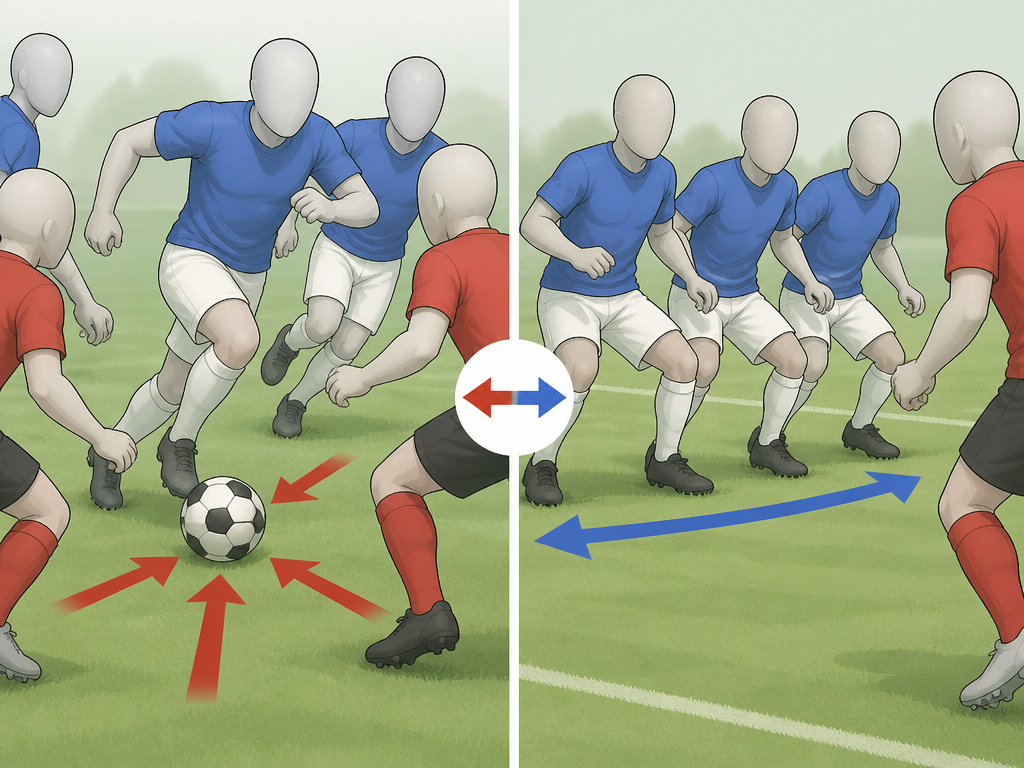
Here’s the bit most people miss. Team defending focuses on the two seconds after losing the ball, not just on being in your defensive shape. This is the defensive transition, and FIFA’s zonal defending methodology presents it as a binary, game-defining decision.
When possession is lost, players must instantly assess one question: can immediate pressure prevent the opposition from progressing or help us regain the ball right now? If the answer is yes, you trigger a counter-press. This is the famed gegenpressing moment. The nearest player closes down, supported by teammates, aiming to win the ball back in the opponent’s half before they can organize an attack.
If immediate pressure isn’t possible, maybe the ball is launched long, or your players are out of position, the priority flips. Now, the absolute directive is to recover into a compact defensive shape. Sprint back, get goal-side of the ball, reconnect the defensive lines, and regroup. Trying to press high when your team is scattered is suicide; it just stretches the gaps wider.
This decision isn’t coached as a vague “work hard.” It’s a specific, scenario-based understanding drilled into players. Do we have numbers around the ball? Is our body shape ready to press? If not, the trigger word is “Recover!” Everyone drops.
Forcing Mistakes and Setting Traps
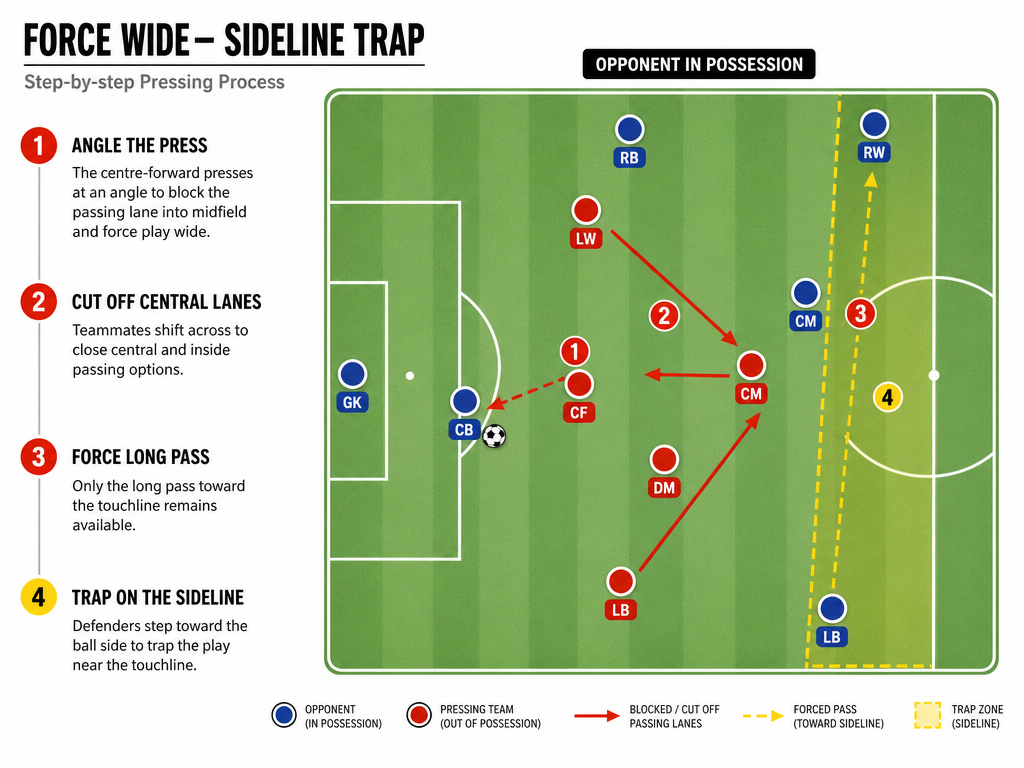
A great defence isn’t just resilient; it’s provocative. It doesn’t only absorb pressure; it guides the attack into areas where the ball can be won. The FIFA session plans are full of these proactive coaching points. The pressing team needs to force the attacking team into playing long passes or making risky runs.
How? By blocking the obvious, comfortable passing lanes. If a centre-back has the ball, your centre-forward should close them down with an angle that forces a pass toward the touchline or a hopeful long ball. Your wide attackers move in unison to block passes to the full-backs. You’re herding the attack, not just reacting to it.
This is where the concept of rest defence, your team’s defensive structure while in possession, feeds into your out-of-possession strategy for how to defend as a team in football. If you lose the ball while your full-backs are high, you’re instantly vulnerable. But if you lose it with your midfielders positioned to cover those spaces, your transition to a defensive shape is already half-complete. Good team defending starts before you even lose the ball.
The 5 D’s of Defending (Delay, Deny, Direct, Dispossess, Deflect)
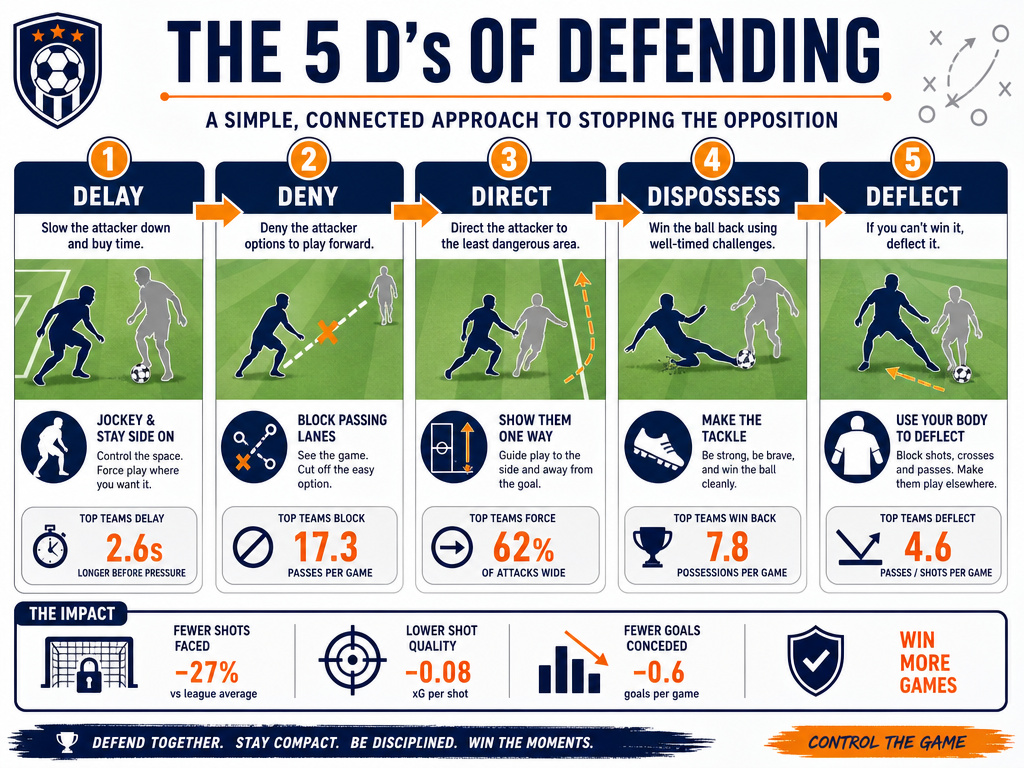
While not explicitly laid out in the FIFA sources, the “5 D’s” framework is a brilliant grassroots coaching tool that perfectly aligns with the principles we’ve covered. It gives players a simple, actionable checklist.
- Delay: Slow down the attacker’s progress. Don’t dive in; jockey and shepherd them, buying time for your teammates to recover.
- Deny: Prevent the forward pass. Use your body shape to block the passing lane into the most dangerous central spaces.
- Direct: Channel the attacker away from goal, usually toward the touchline or onto their weaker foot. This is the core individual skill from Stage 1 of the FIFA method.
- Dispossess: Win the ball. This is the tackle or interception, but it only comes after the first three D’s have created a favorable situation.
- Deflect: If you can’t win it cleanly, block the cross or shot. Get a body in the way.
This sequence turns defending from a desperate lunge into a controlled process. It teaches that jockeying is not passive; it’s the first, most active step in winning the ball back as a team.
Common Team Defending Mistakes & Fixes
You can drill all the right principles and still see them break down on Saturday. Here’s where the real coaching happens, in correcting the repetitive errors.
Mistake 1: The lines break apart. The midfield and defence get separated by 25 yards. The fix is a simple condition in training: if the space between the lines exceeds 15 yards, blow the whistle and reset the play. Players quickly learn to feel that distance.
Mistake 2: Pressing in isolation. One player zooms out to press the centre-back, but the forward line doesn’t move with them. The fix is the “unison press” drill from the FIFA plan, where the front three must move as one to block passes. No individual heroics.
Mistake 3: Switching off at restarts. The ball goes out for a throw-in, and defenders relax. The Elite Soccer session imposes a three-second rule: on any restart, the defending team has three seconds to recover back into their defensive shape. Make it a mandatory team rule.
Mistake 4: Poor communication under pressure. Silence leads to two players marking one man. Drill small-group scenarios (2v2, 3v3) where players must constantly verbalize who is pressing and who is covering. “I’ve got ball!” “Cover left!”
Most of these are failures of coordination, not failures of effort. The fix is rarely yelling “try harder.” It’s designing a drill that makes the correct action the only possible action.
Adapting Team Defence to the Opponent’s Formation
Your 4-4-2 mid-block might work perfectly against a standard 4-3-3. But what if they play a 3-5-2 with wing-backs? The cookie-cutter approach fails here. Team defending is a reactive, adaptive system.
Against a back three, your pressing triggers change. Do you press the wide centre-backs and risk leaving the central one free? Or do you let them have the ball wide and compact the middle? The FIFA sessions don’t prescribe one answer, but they train the decision-making process. Your wide attackers might need to jump from the opposition full-back to the centre-back based on a trigger from your central midfielder.
This is advanced, but it starts with video analysis. Show your team: “This is their shape. When their left centre-back has the ball, that’s our trigger for the forward to curve his run and show him inside, where our midfield trap is set.” You’re not just teaching a system; you’re teaching how to read the game.
Proven Drills for Building a Cohesive Unit
Theory is useless without the mud and cones. Here are three drills sourced directly from the FIFA Training Centre and Elite Soccer that build the skills we’ve discussed.
1. The High-Press & Mid-Block Drill (FIFA):
- Setup: Use one half of a full-size pitch, marking the end of the half 10m in from the halfway line. Play 7 attackers plus a goalkeeper against 6 defenders.
- Procedure: The attacking team builds from the keeper. The defending team applies a high press in a mid-block.
- Coaching Focus: Unison pressing from the front three, midfield restructuring when the ball reaches a full-back, and the transition decision on regaining possession.
2. Four-Zone Defensive Game (Elite Soccer):
- Setup: A practice split into four 10-yard zones. * Procedure: The team in possession must pass the ball below head height.
- Procedure: The team in possession must keep the ball below head height at all times.
- Coaching Focus: Denying the switch of play, screening by centre-forwards, and the three-second recovery rule on any restart.
3. 6v6 Low-Block with Transition (FIFA):
- Setup: Half a pitch, 6 attackers vs. 6 defenders in a low-block drill.
- Procedure: Attackers try to disrupt the low block.
- Coaching Focus: Compactness of the two defensive lines, patience in the block, and quality of possession on the counter.
Where this goes sideways: Running these drills without the progressive build-up. Trying the 11v11 high-press drill before your players can handle the 2v2 covering drill is a recipe for frustration and conceded goals. Stick to the sequence.
Drills are repeated rehearsals of the exact movements and decisions you want on match day, not just for fitness. The more specific the drill, the more specific the improvement.
How to Defend Set Pieces
Effective set-piece defense relies on collective organization and communication.
Role of Different Positions in Team Defense
Each position has a specific function in a cohesive defensive unit. The centre-forward initiates the press, closing down the centre-back to force them into traps. Wide attackers move in unison to block passes to full-backs. Midfielders must form a compact line, positioned close to their opponents; if the ball reaches a full-back, the nearest midfielder engages while the far-side midfielder tucks in centrally. Defenders shift together as a unit; if one steps out, the others follow. The goalkeeper supports by moving with the defensive block. The second defender always provides close cover, denying through balls.
Frequently Asked Questions
What are the 5 D’s of defending in football?
The 5 D’s are a coaching framework: Delay, Deny, Direct, Dispossess, and Deflect. They provide a sequential thought process for defenders, emphasizing controlled positioning and shepherding before committing to a tackle. It aligns perfectly with FIFA’s focus on protecting space and directing play away from danger.
What is the most important principle of team defending?
Compactness. Without compact distances between players and between defensive lines, all other principles, pressure, cover, communication, collapse. A compact unit reduces the space the opposition can play in, forcing errors and making your defensive actions more coordinated and effective.
How do you coach a team to defend together?
Start with FIFA’s three-stage methodology. Begin with individual 1v1 and 1v2 defending skills. Progress to small-group (2v2, 2v3) scenarios to drill pressure, cover, and balance. Finally, integrate these into full-unit and team exercises, always focusing on compactness and coordinated shifting. Use conditioned games with specific rules, like the three-second recovery rule.
What’s the difference between a high press and a low block?
High press aims to win the ball back immediately in the opponent’s half, using aggressive, unison pressure from the front line. A low block, or deep block, focuses on defending closer to your own goal, maintaining extreme compactness between lines, and forcing the opposition to play in front of you. The choice depends on your team’s fitness, tactical philosophy, and the opponent’s strengths.
How do you defend against a team that switches play quickly?
The antidote to quick switches is ultra-compactness and rapid horizontal shifting. Drill your team to shift as one unit the moment the ball moves, with the far-side defender responsible for providing balance. Condition practices where the opposition earns double points for a successful long switch, forcing your team to prioritize closing those passing lanes.
The Bottom Line
Team defending is a learned skill, not a natural instinct. It requires a shared vocabulary, pressure, cover, balance, compactness, and hundreds of repetitions to turn that vocabulary into muscle memory. The best defensive teams aren’t the ones with the fastest defenders; they’re the ones where every player knows exactly where to be in relation to the ball and each other before the opponent even receives the pass.
Start small. Master the 1v1. Then the 2v2. Let the complexity grow organically from there. The pitch will test your structure soon enough. When it does, you won’t be relying on hope. You’ll be relying on a system built pass by pass, drill by drill.
