
Centre Back Role in Football: The Demands You Don’t See
This post contains affiliate links. As an Amazon Associate, we earn from qualifying purchases.
The centre back role in football is defined by three core demands: managing space through positional play, distributing the ball to build attacks, and executing sudden, intense physical actions that depend entirely on the team’s tactical formation. A 2022 Bundesliga study found centre backs in a back-three (3-4-3, 3-5-2) covered significantly higher sprinting distances than in a back-four, while their physical demands in worst-case scenarios peak during the 15–30 minute match period.
That gap between apparent calm and explosive action is where the role’s complexity lives. You can watch a centre-back for eighty minutes and see a player covering ground, organising the line, and recycling possession. Then, a single minute will demand three sprints to cover a channel, a recovery run, and a clearing header – that’s the worst-case scenario modern tracking data quantifies.
What follows: the sourced numbers that reframe the position, the formation choices that dictate a player’s job, the technical evolution from stopper to playmaker, and the practical, gritty details of how to actually play the role without getting exposed.
Key Takeaways
- Central defenders average 9,598 meters per match, but their most punishing work happens in short, intense bursts, with sprint distance spiking in a back-three.
- Technical performance is formation-dependent: passes and possessions drop in 4-3-3 and 4-2-3-1 systems, but UCL data shows defenders are key organisers.
- The 15–30 minute match period is a critical window for centre backs, where their 1-minute worst-case scenario (WCS) physical demands peak.
- Modern coaches demand a complete defender – a player who solves defensive problems with positioning first, then builds play with progressive passing.
- A centre-back partnership is less about matching styles and more about complementary skills that cover each other’s tactical exposure points.
The Numbers Don’t Lie
Forget the old clichés about stoppers and sweepers. Modern tracking data gives us a thermal image of the position, and the heat map is surprising.
A systematic review in Sports Medicine synthesised data from numerous studies. It found central defenders covered an average distance of 9,598 metres per match. That’s the headline number. The range, from 7,525 to 10,627 metres, tells a more important story: the job is not uniform. External defenders covered an average of 10,457 metres per match. So, the old “centre-backs don’t run much” line has a kernel of truth on total distance, but it misses the point entirely.
The physical profile of a central defender is not defined by total metres covered, but by the frequency and intensity of short, explosive actions required to maintain defensive integrity, particularly in transition. Their average pace is lower, but their peak moments are among the most intense on the pitch.
The real story is in the peaks, not the averages. A study of the 2023/24 Spanish First Division, using TRACAB Gen5 tracking across 380 matches, measured worst-case scenario (WCS) demands. It found centre backs exhibited significant differences in total distance covered during their most intense 1-minute periods compared to all other positions. This wasn’t uniform either. During match minutes 15–30, these differences were most pronounced for actions exceeding 85% of their peak 1-minute WCS. Your body doesn’t feel an average. It remembers the three sprints you had to make in the 22nd minute to stop a counter, when your legs were still finding their rhythm.
Why does this matter for a player or coach? Training must mirror this reality. Endurance is the baseline, but the ability to repeat high-intensity actions – a sharp turn, a recovery sprint, a contested leap – with minimal recovery is the differentiator. If your pre-season is all long runs, you’re preparing for the wrong match.
Modern Formation, Modern Athlete
The biggest myth about the centre back role in football is that it’s a stable, predictable job. Your tactical formation isn’t just a shape on a whiteboard; it’s a job description that rewrites your physical and technical workload.
Consider the 2022 PMC study on center-back workload, which analyzed the 2018/19 Bundesliga. It asked a simple question: how does formation change what a player does? For centre backs, the answer was dramatic. When teams played with a back-three (like a 3-4-3 or 3-5-2), the centre backs’ sprinting distance was highest compared to when they played in a back-four. The effect size range was 0.13 to 1.27, which in plain terms means the difference wasn’t minor – it was substantial.
Think about the why-layer. In a back-three, the wide centre-backs have to cover the space a full-back would usually patrol. They get pulled into wide channels, engage wingers earlier, and often have to make recovery runs from more advanced starting positions. The middle centre-back becomes a true sweeper, responsible for sweeping up behind those aggressive wider partners. It’s a role that demands more lateral speed and explosive recovery, not just vertical dominance.
Conversely, the same study found technical performance – measured in short/middle passes and ball possessions – for centre backs was lower in 4-3-3 and 4-2-3-1 formations compared to others. In these formations, technical performance for centre backs was lower compared to others. The centre-back’s passing lanes into midfield are often blocked, forcing longer, riskier passes or recycling possession sideways. Their job shifts from progressive distributor to security guard, and the data reflects that with fewer touches and simpler passes.
So, if you’re a player, your week should change based on your opponent’s expected formation. Preparing for a back-three battle means more repeated sprint work. Preparing to break down a 4-2-3-1 low block means extra time on line-breaking passes and disguised switches of play. A one-size-fits-all training plan is a plan to be exposed.
From Stopper to Playmaker: The Technical Evolution
The centre back role in football has moved. Where once a successful clearance was the end of the action, now it’s often the start of one. The data shows a clear, if sometimes contested, shift.
Tactalyse, a football analysis platform, states that generally speaking the centre-backs have the most passes in a game, though other sources note their passing workload can be lower in certain formations like 4-3-3 and 4-2-3-1. This aligns with a visible evolution. Rio Ferdinand, at Manchester United in the 2006-07 season, became the first defender to break into the Premier League’s top 10 for completed passes with 1,662. That was a signal. Now, it’s an expectation.
But sources don’t always agree, and that disagreement is instructive. A UEFA Champions League technical analysis of 1,000 matches from 2009–2017 concluded central defenders achieved “good performance in variables related to passing and organising.” It found the smallest technical performance difference was between central defenders and full-backs. Yet, the Bundesliga formation study we just discussed shows that in a 4-3-3, their passing numbers drop. So which is it?
Both. The modern centre-back is expected to be a primary passer, but the system they play in either enables or restricts that. A team that builds through the centre-backs, like Manchester City with Rúben Dias or Arsenal with William Saliba, will see their defenders top the passing charts. A team that uses a more direct style, or one that congests the centre of the pitch against them, will suppress those numbers. The expectation is the capability, not the automatic output.
“The centre-back position has evolved a lot… Going from a position that’s only there to defend, kick balls away, or give them to a midfielder, centre-backs are now expected to start attacks or buildups as well.” – Tactalyse analysis.
This changes the profile of a recruit. Clubs don’t just look for a tackler anymore. They look for a player who can read the first line of pressure and knows when to speed up the game with a line-breaking pass or slow it down with a secure recycle. It’s why a player like John Stones can transition into a defensive midfielder during possession – the skillsets have converged. It also creates a new type of vulnerability: a centre-back who is poor in possession is a pressing trigger for the opposition, turning your own build-up play into a high-risk situation.
The Partner, The Line, The Communication

Playing centre-back is a solo job performed as a duet. Your relationship with your partner dictates the success of the entire defensive unit.
The classic partnership model was the “stopper and cover” – one aggressive, one sweeping. That’s still useful, but modern partnerships are more nuanced. It’s about complementary skills that cover systemic weaknesses. If one centre-back is exceptional in the air but lacks recovery pace, his partner needs that speed. If one loves to step into midfield with the ball, the other needs the discipline to hold the line and maintain team defending shape. A common amateur mistake is pairing two players who are identical, which just doubles down on the same weakness.
The offside line is your best friend and your most fragile asset. Leading that line is a non-verbal conversation between the centre-backs and the goalkeeper. One player usually takes charge, judging the moment to step up based on the passer’s body shape, the receiver’s run, and the midfield pressure. The other must move in perfect sync, half a second late and you play the striker onside. This requires thousands of shared minutes to build the instinct, or relentless, clear communication to simulate it.
The part nobody mentions: A centre-back’s most important communication often happens when he’s not under pressure. Directing a full-back to tuck in, telling a defensive midfielder to drop, organising the line for a set-piece – this proactive chatter prevents fires instead of fighting them.
This extends to managing the entire defensive block. When a full-back pushes high, who covers the space? Often, it’s the nearest centre-back shifting wide, with the defensive midfielder dropping into the back line to keep compactness. If that midfielder doesn’t drop, the centre-back has to scream for it. The position has become as much about orchestrating others as it is about individual defending, a principle deeply tied to cover and balance.
Profiles, Not Prototypes
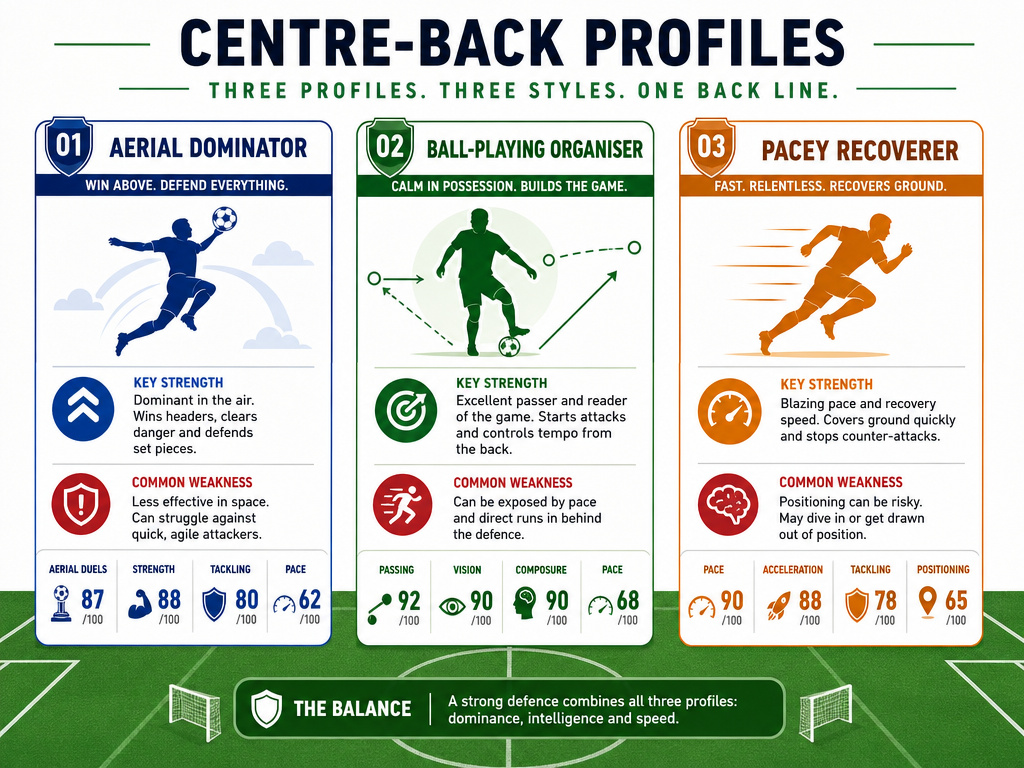
We need to retire the idea of a “perfect” centre-back prototype. The role has splintered into specialised profiles that fit specific tactical puzzles.
You have the dominant aerial defender – your Virgil van Dijk, Harry Maguire archetype. Their primary weapon is command of the box, winning every cross and turning defence into attack with a single header. Their weakness can be space in behind, which requires a deep line or a very fast partner.
The ball-playing organiser is the tempo-setter. Think Thiago Silva in his prime, or Marquinhos. Their value is in their distribution, their composure under a high press, and their ability to break lines with a pass. They might not be the most physically dominant, so they need protection in duels.
Then there’s the pacey recoverer – a Raphaël Varane, José María Giménez. Their superpower is erasing mistakes, both their own and their teammates’. They allow a team to play a higher line because they can turn and chase down a through ball. Their challenge can be in sustained physical duels with a target man.
Modern systems often mix and match. A back-three might use one of each: a dominant header, a ball-player, and a recoverer. A back-four partnership might pair a ball-player with a pacey recoverer. The key is understanding that each profile solves a different problem, and a coach chooses the pairing based on the problems they expect to face. Is the opposition a crossing team? You need the aerial dominator. Do they press ferociously? You need the ball-player.
| Centre-Back Profile | Primary Strength | Common Weakness | Best Fits |
|---|---|---|---|
| Aerial Dominator | Command in the box, defensive headers | Mobility, recovery pace | Teams facing many crosses, low-block systems |
| Ball-Playing Organiser | Line-breaking passes, composure under press | Aerial duels, physical battles | Possession-based teams, high-line systems |
| Pace Recoverer | Recovery speed, 1v1 defending in space | Aerial presence, distribution under pressure | High defensive lines, systems vulnerable to counters |
This fragmentation is why it’s so rare to find a truly “complete” defender. The last centre-back to win the Ballon d’Or was Fabio Cannavaro in 2006, a player whose game was built on flawless timing and positioning rather than overwhelming physical gifts. Today, the demands are so varied that excelling in all facets is extraordinary.
Common Mistakes and How to Fix Them
Watch any amateur or youth game, and you’ll see the same centre-back errors on repeat. They’re not failures of effort; they’re failures of understanding.
Ball-watching. The defender fixates on the ball and loses track of his mark, who makes a blindside run. The fix is constant scanning – checking your shoulder every few seconds to map the movement around you. It’s exhausting mental work, but it’s essential.
Following the runner into nowhere. A striker drops deep into midfield, and the centre-back follows, leaving a huge gap behind him for another attacker to sprint into. The rule is simple: if the runner is going into an area already covered by a midfielder, pass him on and hold your position. Maintain the defensive line.
Clearing to danger. Under pressure, a defender boots the ball straight up the middle of the pitch, where it’s often collected by an opposing midfielder who can restart the attack. The golden rule for clearing crosses: try to put it back where it came from. A cross from the right flank should be cleared towards the right touchline. It’s the safest area, buys time for your team to regroup, and is a coached fundamental at the highest level.
Poor partnership communication. Both centre-backs jump for the same ball, or both hesitate, leaving a free header. Assign clear roles for set-pieces and open play. One attacks the ball, one cleans up. One leads the line step, the other follows. Talk, even if it’s just a shout of “away!” or “mine!”.
These mistakes are amplified by fatigue, which often peaks in that 15–30 minute window the Spanish First Division study highlighted. This is when concentration can dip just as the game’s intensity rises. Coaches should tailor their touchline reminders to these periods, and players must develop the self-awareness to simplify their game when tired – safer passes, more conservative positioning.
Training the Modern Centre-Back
Drills need to move beyond simple passing grids and heading practice. They must simulate the specific, chaotic demands of the position.
Worst-Case Scenario Replication. Use drills that mimic the peak physical moments from the data. For example: a 1v1 duel followed by an immediate recovery sprint to intercept a pass into a second attacker, repeated with short rest. This builds the specific endurance for those critical match minutes.
Scanning Under Pressure. Set up a possession drill in a confined space where the centre-back receives the ball under light pressure. His objective isn’t just to complete a pass, but to verbally identify the positions of two specific target players before he receives the ball. This forces the habit.
Clearing Decision Game. As shown in a YouTube analysis drill, create a small-sided game where defenders get a point only if their clearance from a cross lands in a designated “safe zone” (like the flank). If it goes centrally, the attackers get a chance to score. This rewards technique under fatigue.
Partner Understanding Drills. Simple, repeated patterns with your regular centre-back partner: shadow play without an opponent, working on line-step timing, cover positions, and verbal/non-verbal signals. This builds the unspoken understanding that saves a thousand words during a match.
The goal isn’t to create a robot. It’s to automate the basics so the player’s mind is free to solve the complex, unpredictable problems that win games. That means drilling the safe clearance, the scan, the cover position until they’re instinct, leaving mental capacity for reading the opponent’s striker, the midfielder’s body shape, and the goalkeeper’s positioning.
Set-piece roles (defensive and offensive)
During set-pieces, a centre back’s responsibilities are split. Defensively, they are primarily tasked with marking the opposition’s most dangerous aerial threats in the penalty area, requiring strength, timing, and positional awareness to clear the ball. Offensively, they become a target for corners and free-kicks, using their height and heading ability to score goals. Their movement in the box must be decisive to lose their marker. On defensive set-pieces, organisation is key; they often direct teammates to cover zones and pick up runners. On attacking plays, they must also be ready to react quickly if the ball is cleared, transitioning back to their defensive shape to prevent a counter-attack.
Frequently Asked Questions
Is centre back a good position in football?
It’s a fantastic position for a certain type of player. It offers immense tactical responsibility, the chance to be a leader on the pitch, and a role that has evolved to include creative passing. However, it’s also high-pressure – a single mistake is often catastrophic – and the physical demands, especially in specific formations, are more explosive and intense than many realise.
Is CB the hardest position in football?
“Hardest” is subjective, but it’s a strong contender. The mental load is enormous. You are the last line of defence, the organiser of the back line, and often the starter of attacks. You must be physically strong, aerially dominant, quick, and technically proficient. Few positions demand such a broad spectrum of skills at such a high stakes level.
What is the weakest position in football?
There’s no inherently “weak” position. Every role has its value. However, a player who lacks the specific attributes for their position is a weakness. A slow centre-back in a high-line system is a liability. A full-back who can’t contribute to attack in a progressive team is a weak link. The weakness is in the mismatch between player profile and tactical demand, not the position itself.
What is the rarest position in football?
The classic sweeper or libero is now exceptionally rare at the top level. This was a central defender who played behind the main defensive line, free to sweep up through balls and often start attacks. Modern high defensive lines and zonal marking systems have largely absorbed its functions into the roles of the centre-backs and goalkeeper.
The Bottom Line
The centre-back role is no longer just about defending. It’s a hybrid position defined by three pillars: positional intelligence to manage space, technical security to build attacks, and specific physical preparedness for the formation you play in. The data shows the job is defined by peaks, not averages – by the worst-minute scenarios that decide games.
If you’re learning the position, start with your feet. Can you pass accurately under no pressure? Then under light pressure? Then with a striker closing you down? That progression is your technical roadmap. Then, work with a partner until your movement is synchronised. Finally, get your fitness to a point where you can repeat high-intensity actions in the 15th, 75th, and every minute in between.
The last centre-back to win the Ballon d’Or did it in 2006. The next one will be a player who excels not just in one of these pillars, but in the difficult integration of all three.
