
Goalkeeper Penalty Line Rule Explained: The One-Foot Test
This post contains affiliate links. As an Amazon Associate, we earn from qualifying purchases.
The goalkeeper penalty line rule explained simply: the keeper stays on the goal line, between the posts and facing the kicker, until the ball is kicked. At that moment, at least part of one foot must touch, be in line with, or be behind the line. Save it after stepping off early, and the kick is retaken.
The word “behind” only arrived in 2022/23. Before then, the Premier League says a keeper with one foot in front of the line and one behind it was committing a technical offence under the old wording, while IFAB’s Law 14 FAQ says that keeper has not committed an offence. If you learned this rule from watching football a few seasons ago, some of what you know is out of date.
Below you’ll find the exact wording, the ruling for every possible outcome of the kick, the 2019 VAR row that turned a quiet law into a headline, the shootout quirks, and the US high school version that lets keepers lunge.
Key Takeaways
- A keeper who steps off early and the shot misses or hits the frame only faces a retake if the offence clearly impacted the kicker.
- A first offence brings a warning only. Any further offence in the same game, including on the retake itself, is a yellow card.
- When keeper and kicker offend at exactly the same time, the kicker is punished: a yellow card and an indirect free kick to the defence.
- Shootouts wipe the slate. Warnings and yellow cards from the match don’t carry into kicks from the penalty mark.
- US high school rules (NFHS) allow forward movement as long as both feet don’t leave the line, but they say nothing about a foot behind it.
What Does Law 14 Require at the Moment of the Kick?
IFAB’s Law 14 fixes the keeper in one place. IFAB is the International Football Association Board, the body that writes the Laws of the Game.
Under IFAB Law 14, the defending goalkeeper must remain on the goal line, facing the kicker and between the goalposts, until the ball is kicked. At the moment of the kick, at least part of one foot must be touching, in line with, or behind the goal line. Sideways movement along the line and arm movement are permitted.
That last clause carries the weight. Before the kick, the keeper is pinned to the line. At the instant of contact, the test shrinks to part of one foot, and nothing else about the body matters.
The full wording sits in the IFAB Law 14 penalty kick text. It’s shorter than most TV pundits make it sound.
Where the feet have to be
Three positions pass the test: touching the line, in line with it, or behind it. “In line with” covers a foot hovering in the air above the paint. IFAB spelled that out in 2019 when it relaxed the rule.
Watch a keeper’s heels on a penalty and you’ll see them lift and hang just over the white chalk as the kicker runs in. That hover is legal. The back foot can even sit behind the line, inside the goal, while the front foot creeps forward. IFAB’s own FAQ says that keeper hasn’t committed an offence, and play continues.
What the keeper is allowed to do, and what draws a whistle
- Move along the line, jump and wave the arms. IFAB allows all of it, provided the referee doesn’t judge it disrespectful or unfair.
- Hands off the frame. Posts, crossbar and net are all off limits.
- Leave the kicker alone. A keeper who walks up to the kicker to unfairly distract them and delay the kick is cautioned for unsporting behaviour or for delaying the restart.
- Both feet in front of the line when the ball is struck is the offence everyone argues about.
Honestly, I like how little the law fusses over arms and bounce. A keeper can be as theatrical as they like on the line. The referee is watching the feet.
The Goalkeeper Penalty Line Rule Explained, Season by Season
Three rewrites shaped today’s wording: 2019/20, 2020/21 and 2022/23. The rule’s older history runs much further back, but the paperwork I can source cleanly starts in 2019. So that’s where I’ll start.
Law 14 has been planed down like a kitchen door that keeps sticking. Every pass took a little more off the keeper’s restrictions. The edges still catch now and then.
- 2019/20: one foot replaces two. The requirement dropped from part of both feet in contact with the line to only one foot, and that foot could be in the air above it. Miss this change and you’ll still be shouting at keepers for lifting a heel.
- 2020/21: softer sanctions. A keeper offence went unpunished if the kick missed or rebounded from the goal without a keeper touch, unless it clearly affected the kicker. First offences became warnings.
- 2022/23: “behind” joins the wording. The Premier League noted the old text said part of at least one foot “on or above” the line. Under that wording, one foot in front and one behind was a technical offence.
IFAB explained the 2019 shift in IFAB Circular 17. It says the change gave keepers “greater freedom of movement”, and that in return they’re “required to respect the Law”. The IFAB 2020/21 Law changes document then softened the punishment side.
Notice the drift in the wording itself. The 2019 circular says “above”, the pre-2022 text said “on or above”, and today’s law says “touching, in line with, or behind”. Same idea, three phrasings.
Where the “both feet” myth comes from
I’ll own up: for a while after 2019, I was still telling mates in the pub that a keeper needed both feet on the line. I was quoting a dead rule. Circular 17 describes the old requirement as all or part of both feet in contact with the line, so the myth has honest roots.
The opposite myth says one small step forward is fine. It isn’t, under IFAB wording. If both feet are in front of the line when the ball is kicked, the keeper has offended, however tiny the step.
Saved, Scored or Missed: the Result Decides the Punishment
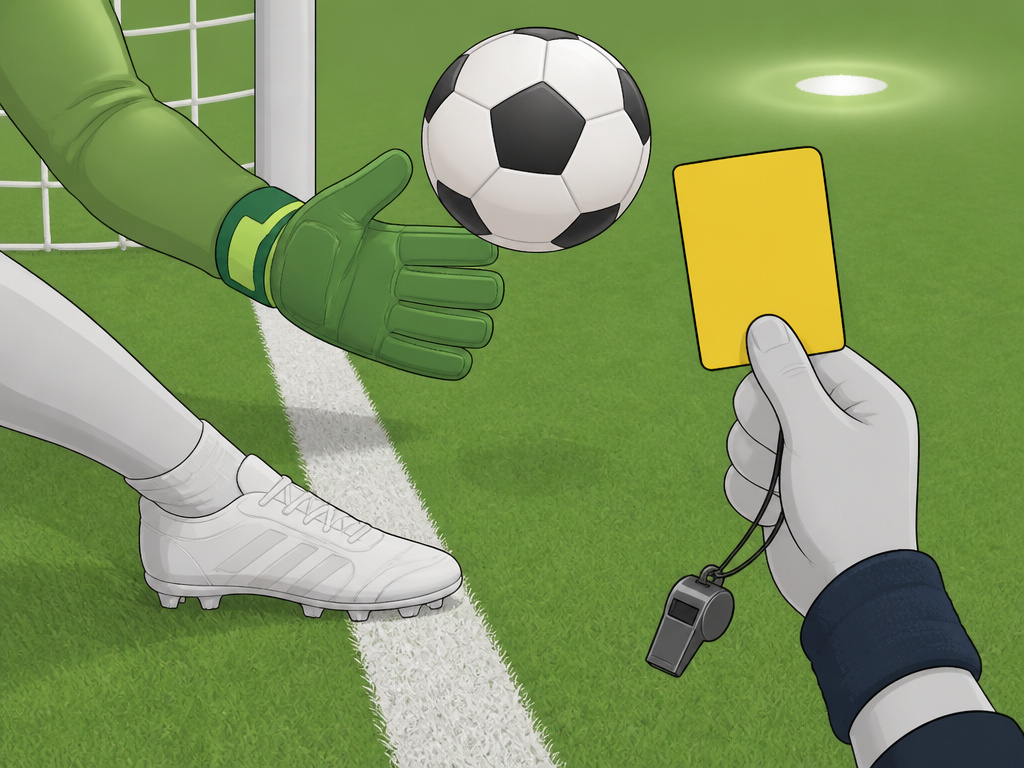
The keeper is a stride off the line when the ball’s struck. The save is brilliant, the away end roars, and then a sharp whistle cuts through it and the referee points back at the spot.
Every keeper offence gets judged against what the ball did next. That’s the clever part of Law 14. An early step only costs the keeper when it could have changed the outcome.
| What happened | Decision | Keeper sanction |
|---|---|---|
| Keeper saves it | Kick retaken | Warning first, then yellow card |
| Saved, attacker scores rebound | Advantage, goal awarded | None |
| Shot misses the goal | Goal kick, unless kicker clearly impacted | If retaken: warning, then yellow |
| Shot hits post, stays out | Play on, unless kicker clearly impacted | If retaken: warning, then yellow |
| Keeper moves crossbar, shot misses | Kick retaken | Warning for first offence |
The rebound row surprises fans most. If the keeper saves after stepping off early and the ball drops to an attacker who scores, the referee plays advantage and gives the goal. No retake means no warning and no card.
The crossbar row is the most physical. Grab the bar before the kick and the frame shudders, the net swaying right in the kicker’s eyeline. IFAB treats that as an offence even when the shot then flies wide.
For misses and shots off the woodwork, Circular 17 says the referee will usually apply the “spirit” of the Law and leave the result alone. The trigger for a retake is an offence that clearly impacted the kicker. I think that test is the smartest line in the whole law. It stops a keeper being punished for a twitch that changed nothing.
Common mistake: Assuming a warned keeper is safe for the rest of the game. The warning is the only free pass, and any later offence in the same match, the retake included, is a yellow card.
IFAB’s 2020/21 practical guidelines hand part of the job to the assistant referee. If the keeper blatantly leaves the line before the kick and no goal is scored, the assistant should indicate the offence according to the referee’s pre-match instructions. That’s the human end of policing goalkeeper encroachment. VAR is the other end, and it’s where 2019 got messy.
Why Does the Kicker Get Booked When Both Players Offend?
You’d expect a keeper caught off the line to pay. When the kicker illegally feints at the same moment, the kicker pays instead.
IFAB’s FAQ covers it directly. The kicker is cautioned and the defending team gets an indirect free kick. There’s no retake, because IFAB treats illegal feinting as a more serious offence than encroachment.
As I read it, the logic holds up. A stop-start feint after the run-up exists to drag the keeper off the line early. So the law punishes the cause, not the reaction.
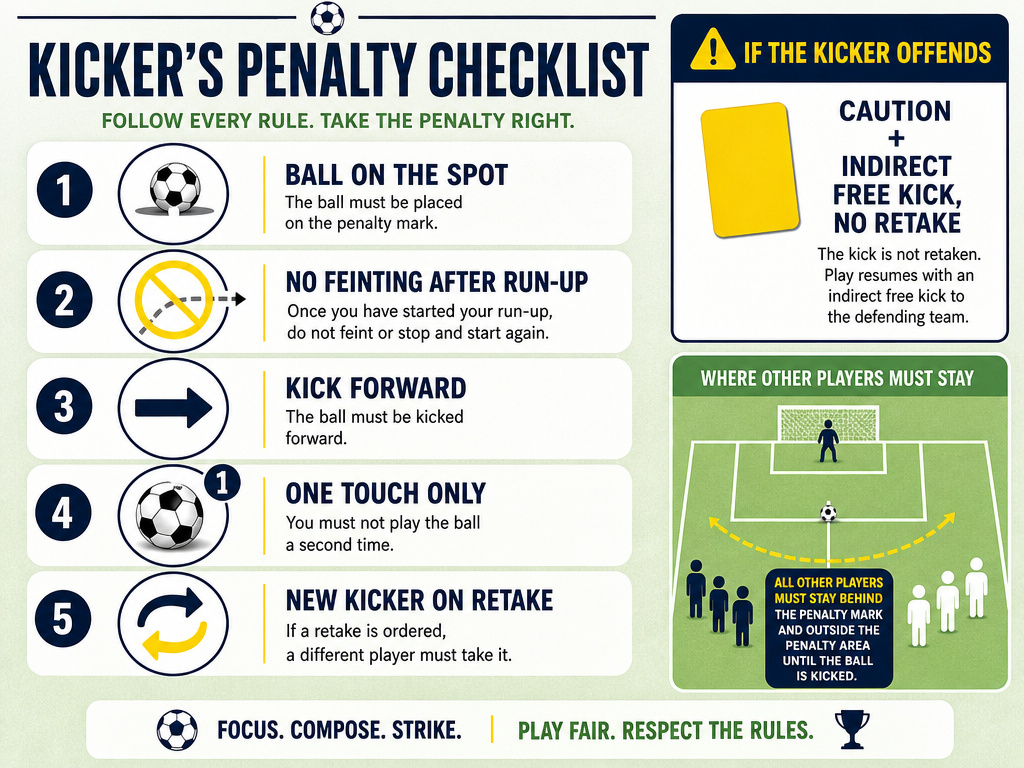
The kicker’s own checklist is short, and every item has caught somebody out:
- Ball on the spot. Part of it must touch or overhang the centre of the penalty mark.
- No stopping to feint once the run-up is complete. Score that way and the goal comes off: indirect free kick to the defence, plus a yellow card.
- Kick it forward. A pass to a teammate is legal.
- One touch only until another player touches the ball. Off the post and straight back to the kicker means an indirect free kick to the defence. An accidental second touch while the keeper had both feet in front of the line and saved gets the kick retaken.
- A new kicker can take a retake, provided the referee clearly knows who it is.
Everyone else: outside the area and behind the mark
Every other player stays inside the field, outside the penalty area and behind the penalty mark until the ball is in play. The lines belong to the area they mark. So a foot resting on the penalty-area line is already encroaching.
Toe on paint counts.
The Premier League’s guidance from 9 September 2024 applies the same reading to the arc, and only penalises encroachment with a material impact on the kick. IFAB’s FAQ gives the classic case. A teammate’s foot touches the line during the run-up, the keeper saves, and that same player scores the rebound. Goal disallowed, indirect free kick to the defence, no card.
2019: Three Retakes and a VAR Split
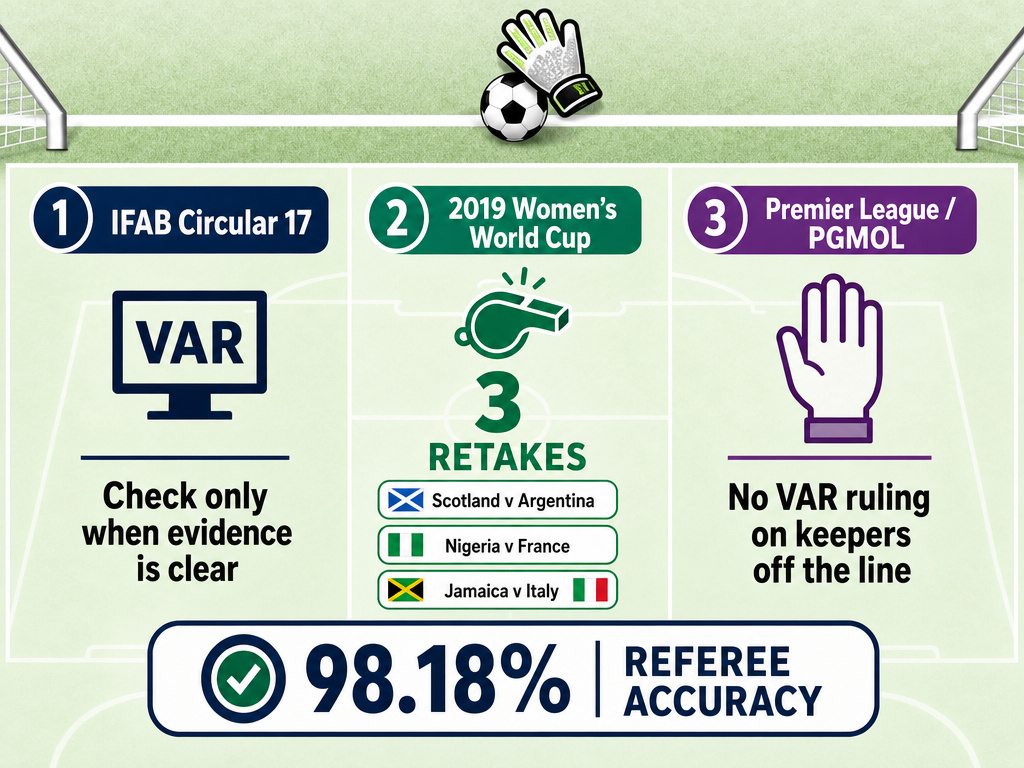
Three penalties at the 2019 Women’s World Cup were retaken after VAR (the video assistant referee) ruled the keeper had no foot on the line. Reports from africanews, Sky Sports and Goal.com list them: Scotland v Argentina, Nigeria v France and Jamaica v Italy.
FIFA’s Pierluigi Collina defended the calls on 27 June 2019. “VAR cannot be blind, cannot ignore,” he said, adding: “It is not a matter of a small encroachment or big encroachment.” The same report carried FIFA’s figure of 98.18% referee accuracy in the group stage with VAR.
English football went the other way. On 20 June 2019, the Premier League and PGMOL, its referees’ body, said VAR wouldn’t rule on keepers straying off their line. The on-field referee would have the final say.
So the sources disagree on how hard to police it:
- IFAB, Circular 17: VAR must check for keeper and kicker offences at penalties. It tells the referee only when the replay evidence is clear, and stays out when camera angle or timing leaves doubt.
- FIFA at the 2019 Women’s World Cup: VAR checked and enforced. Three retakes followed.
- Premier League and PGMOL, June 2019: no VAR ruling on keepers leaving the line.
My honest take: the line-creeping debate gets more airtime than it earns. It blew up during one tournament in 2019. The handling restrictions on keepers shape time-wasting every single week, and hardly anyone talks about those.
I’ll admit I’m an eyes-and-notebook watcher, not a tracking-data analyst. I can’t tell you how often keepers creep across a whole season. I haven’t seen a reliable published count either.
Shootouts Reset the Cards, With One Catch
Shootouts are kinder to keepers. Since 2020/21, IFAB’s Law 10 says yellow cards and warnings from the match don’t carry into kicks from the penalty mark.
UEFA moved early. From 1 June 2020 it applied the change to the rest of that season’s Champions League, Europa League, Women’s Champions League and Youth League. UEFA’s Roberto Rosetti said video technology catches small keeper offences more often, which is why a first offence now earns a warning instead of a caution.
The catch is that two documents give different answers on a first shootout offence. Circular 17 let VAR competitions skip the caution entirely when a keeper’s shootout offence led to a retake. FIFA’s Women’s World Cup and CONMEBOL’s Copa America, Copa Libertadores and Copa Sudamericana got that dispensation first, in June 2019.
It covered shootouts only. Penalties in normal time were never included.
The general law since 2020/21 says warning first, yellow after. If you’re refereeing or watching a specific competition, check which version it has adopted. Both versions agree on one thing: a keeper who keeps offending gets booked for persistent offending or unsporting behaviour.
One early step in a shootout earns a warning. A habit of early steps earns a yellow card.
The High School Version Lets Keepers Lunge
NFHS Rule 14-1-3 governs penalty kicks in US high school soccer. NFHS is the National Federation of State High School Associations, and its 2020-21 rewrite reads differently from IFAB’s.
The NFHS soccer rules changes 2020-21 say the keeper stands with at least one foot on or in line with the goal line, without touching the posts, crossbar or nets. Lateral or forward movement is allowed. The keeper just can’t come off the line with both feet before the ball is in play.
| Question | IFAB Law 14 | NFHS 14-1-3 (2020-21) |
|---|---|---|
| Foot position at the kick | Part of one foot touching, in line, or behind | One foot on or in line |
| Foot behind the line counts? | Yes | Not mentioned |
| Moving forward before the kick | Both feet in front is an offence | Allowed, but not both feet off |
| Touching posts, crossbar or net | Not allowed | Not allowed |
The two books disagree in two places. IFAB counts a foot behind the line, and NFHS doesn’t mention “behind” at all. NFHS also says out loud that forward movement is fine, while IFAB simply checks the feet at the moment of the kick.
Easy to miss: Coaching a high school keeper to plant the back foot behind the line, IFAB-style. The NFHS wording asks for a foot on or in line with the goal line, so that habit leaves the keeper relying on a position the rule never mentions.
One oddity from the same NFHS changes: a ball that deflates during a penalty kick means the kick is retaken.
I’d tell any youth keeper coach to skip the line-cheating tricks entirely. Teach a clean set position and a fast push sideways. Young keepers who learn to steal a step under one rulebook get punished the day they play under the other.
What are the goalkeeper rules in a penalty shootout?
In a shootout the keeper must stay on the goal line, facing the kicker, between the posts until the ball is kicked. When the kick is taken, at least part of one foot must touch the line, be in line with it, or be behind it. The keeper may move along the line and use the arms, as long as nothing looks disrespectful or unfair.
Shootouts run in equal rounds of kicks and then move to sudden death, and each kick is a single attempt, so there is no rebound to chase. If the keeper encroaches and saves, the kick is retaken. The first offence brings a warning and any further offence a yellow card. Cards and warnings from the match do not carry into the shootout, so every keeper starts clean. Some VAR competitions use a dispensation that skips the caution after a retake, but a keeper who keeps offending still gets a yellow. Touching the crossbar so it moves and distracts the kicker also means a retake.
Why does the goalkeeper line rule exist and how has it changed?
The rule keeps a penalty a fair contest. A keeper who creeps off the line shortens the kicker’s window and narrows the angles, so the law gives a clear starting point.
The wording has been trimmed over the years. Until 2019/20 a keeper needed part of both feet on the line. IFAB then reduced that to one foot, which does not need to touch the line and can hover above it. Until 2022/23 the text said part of a foot had to be on or above the line, and the Premier League says that made a keeper with one foot in front and one behind guilty of a technical offence, although IFAB’s FAQ says no offence is committed. The word “behind” was added that season to fix it.
VAR is what made the detail matter. At the 2019 Women’s World Cup, three penalties were retaken after the keeper was ruled to have no foot on the line. In 2020/21 the law added a warning for the first keeper offence. UEFA’s Roberto Rosetti explained that video catches small offences more often, so the first one gets a softer response.
Frequently Asked Questions
Can a goalkeeper come off the line for a penalty?
Keeper can move along the line, jump and wave their arms before the kick. Under IFAB rules, at least part of one foot must be touching, in line with, or behind the line when the ball is kicked. US high school rules allow forward movement too, as long as both feet don’t leave the line before the ball is in play.
Can a goalkeeper stand behind the line for a penalty?
Under IFAB Law 14, yes. A foot behind the goal line counts, and that wording was added in 2022/23. The NFHS high school wording only says “on or in line with”, with no mention of behind.
Does a goalkeeper get a yellow card for moving early?
Not for a first offence in the game, which brings a warning. Any further offence, including on the retake, is a yellow card. In shootouts, match warnings and cards are wiped, but persistent offending still draws a caution.
Can a different player take a retaken penalty?
Yes. IFAB allows the attacking team to change the kicker for a retake, provided the new kicker is clearly identified.
What happens if the kicker slips and touches the ball twice?
If the kicker accidentally kicks the ball with both feet while the keeper has both feet in front of the line and saves, the penalty is retaken.
Before You Go
One test to carry into your next match: at the moment boot meets ball, look for any part of one foot on, over or behind the line. If it’s there, the keeper is legal, however wildly the rest of the body is moving.
Then check the result before you get angry. A save after an early step means a retake. A miss or a shot off the post means nothing happens, unless the step clearly put the kicker off. That second half is the part most fans in the stands forget.
The calculation changes at a US high school game. There, a lunge forward is fine, and the goalkeeper penalty line rule explained above shifts to “one foot on or in line, never both feet off.” Check which rulebook you’re actually watching.
So, should a keeper who saves a penalty after stepping off early get only a retake, or a straight yellow card on the spot?
