
4 Best Football Wrist Braces in 2026
This post contains affiliate links. As an Amazon Associate, we earn from qualifying purchases.
The McDavid Adjustable Wrist Brace is the best overall football wrist brace: a light slip-on with two elastic straps and a neoprene cuff for adjustable support. For molded protection, choose the EvoShield Pro-SRZ 2.0 Wrist Guard; to limit hyperextension, the DonJoy Adjustable Wrist Brace fits best.
Football is hard on the wrist. Falls, blocks, tackles and repetitive throwing all load a joint built from eight small carpal bones, which favors flexibility over durability. The real question is how much support you need and how much motion you can give up, because a linemen’s brace and a quarterback’s wrap are not the same tool.
This guide is research-based. We compared specifications, manufacturer documentation, expert round-ups and common patterns in owner feedback across 4 picks, then sorted them by what each does best.
Top 4 Football Wrist Braces in the Market
Certain content that appears on this site comes from Amazon. This content is provided "as is" and is subject to change or removal at any time.
The Best Football Wrist Braces, Reviewed
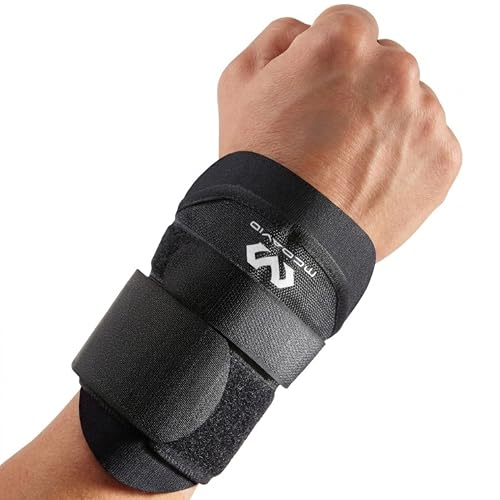
McDavid Adjustable Wrist Brace
What We Like
- Two elastic straps for firm support
- Latex-free neoprene cuff adds compression
- Adjustable insert customizes the fit
- Slip-on design with 0.1 pound weight
Trade-offs
- Neoprene cuff traps heat during long, warm matches
- Thermal neoprene is a poor match for hot-weather play
Two strategically placed elastic straps let you cinch the brace down firmly around the wrist, which is what you want when collisions and hard falls are part of the game. McDavid built this one to handle collision sports, and the manufacturer points to football and other contact environments where hyper-extension is the main worry. That focus makes it best suited to contact-sport athletes who need maximum wrist support.
The latex-free neoprene cuff adds thermal compression, and the adjustable insert lets you dial in the fit rather than accept a one-size shape. At just 0.1 pounds, the brace slips on easily and gives support without bulk, so it should not weigh down the wrist during play. For a lineman, receiver or weekend player, that balance of support and low bulk is hard to beat.
The trade-off is the material. Neoprene holds warmth, so long sessions in hot weather can feel snug and sweaty, and the thermal compression that feels good in cold conditions may be more than you want in summer. Players who run warm should keep that in mind before committing to a neoprene cuff for all-day wear.
Product photos
EvoShield Pro-SRZ 2.0 Wrist Guard

What We Like
- Gel-to-Shell molds to your wrist
- Fully set shield in 30 minutes
- Four sizes covering 5 to 9 inches
- Hand washable, air dry only
Trade-offs
- Needs 30 minutes to set before use
- Small fits only 5-6 inch wrists
- Heavier at 0.2 pounds than McDavid HEX at 0.1
A guard that turns from a malleable gel into a hardened shell in 30 minutes ends up shaped to your own wrist instead of a generic curve, and that is the big draw here. The air-activated material creates a one-to-one fit, so an impact from a fall is meant to deflect and disperse across the whole guard rather than concentrate in one spot. That makes it a sensible pick for skaters and skateboarders who want protection contoured to their own wrist. Sizing is straightforward as well: measure around the wrist and choose from small through extra large, which covers wrists from 5 to 9 inches.
The trade-off is the setup. The molding step takes half an hour, so you can’t grab it and go, and you need to get the fit right while the material is still pliable. Once it sets, the shape is yours, which is great for one wearer but not for sharing. Next to the McDavid HEX High Impact Youth Wrist Guard, which weighs 0.1 pounds against this guard’s 0.2, it is the heavier option. What you get for that extra bulk is a shield made to match your wrist rather than a one-size-fits-most design. Keep it clean by hand washing and letting it air dry.
Product photos
DonJoy Adjustable Wrist Brace

What We Like
- Limits motion in one direction only
- Interchangeable foam inserts adjust support level
- Opposing straps limit brace rotation
- Universal fit works on either hand
Trade-offs
- Blocks one direction only, not full-wrist immobilization
- Foam inserts must be swapped to change support
- Wrap-style design is less compact than McDavid HEX guard
Because this brace is built to limit range of motion in one direction only, such as extension, it lets you restrict the movement that causes trouble while leaving the rest of the wrist free. That makes it a smart choice for a player worried about bending the hand too far back on a block or a fall. The interchangeable foam inserts let you dial support up or down, and the opposing straps stop the brace from twisting around the wrist mid-play. A neoprene lining keeps the inside comfortable against skin.
The biggest trade-off is that this is a targeted brace rather than a rigid shell, so it limits motion in one direction instead of armoring the wrist. If you want a hard, padded guard for heavy impact, the EvoShield Pro-SRZ 2.0 or the McDavid HEX High Impact Youth Wrist Guard is the more protective style. The interchangeable foam inserts let you adjust support, but that means some trial and error to find the right level before you wear it for play or a long work shift. The woven nylon outer shell is built for durability, and the neoprene lining adds comfort against the skin. Because the universal fit works on either hand, one brace covers both wrists. For controlled restriction of extension, flexion, or side-to-side deviation without extra bulk, it is a sensible choice.
Product photos
McDavid HEX High Impact Youth Wrist Guard

What We Like
- HEX closed cell foam padding on the wrist
- Moisture Management Technology moves sweat away
- Machine washable and dryable between games
- Light at 0.1 pounds
Trade-offs
- Youth sizing only, so adult wrists won't fit
- Foam pad only, no adjustable brace-style support
- Sized one-size-fits-most, so fit isn't tailored
Moisture Management Technology is the big draw here, because a guard that moves sweat away is one a young player will actually keep on through a full match. Wet, clammy padding is what makes kids tug at gear and pull it off. Under it sits HEX closed cell foam, which is built to shield the wrist from hard contact in football, basketball and other collision sports. At only 0.1 pounds, it should feel like part of the sleeve rather than a weight on the arm. For a youth player who sweats through every session, this is a sensible, protective choice that suits grassroots weekends well.
The trade-off is that this is a padded guard, not a supportive brace. If you want something you can tighten and adjust to stabilize a sore joint, the McDavid Adjustable Wrist Brace is the better match, since it is made around adjustable support. The HEX guard is also youth-sized in a one-size-fits-most cut, so older teens and adults should look elsewhere. On the plus side, it can go in the washer and dryer, which matters when gear gets muddy and sweaty every week. Parents get easy upkeep, and the player gets cushioning that stays fresh.
Product photos
How We Evaluated Football Wrist Braces
We built this list from product specifications, manufacturer documentation, expert round-ups from brace makers and football gear retailers, and recurring themes in owner feedback. We did not run physical tests, so nothing here is a lab result.
Four criteria mattered most. First, the type of support: adjustable straps, a custom-molded shell, a motion-limiting wrap or simple padding. Second, fit and sizing, since a guard that shifts or pinches is one players leave in the bag. Third, mobility, because a wrist still has to flex enough to catch, throw and carry the ball. Fourth, comfort over a full game, including heat and how easily the gear can be cleaned.
A research-led approach has limits. Fit varies from wrist to wrist, and no brace replaces a diagnosis. If you are returning from a sprain or have ongoing pain, ask a doctor or athletic trainer which level of support is right. Treat bracing as one part of football injury prevention alongside stretching and warm-ups.
What To Look For In Football Wrist Braces
Most football wrist gear falls into four types: strap braces, molded guards, motion-limiting wraps and padded guards. The right one depends on your position, your history with the joint and how much freedom you need in your hands.
Choose the support type first: adjustable straps for general contact, a molded shell for impact, a one-direction limiter for hyperextension, or light padding for youth play. Then check sizing, mobility and how well the material handles sweat and heat.
Support Type
Strap braces such as the McDavid Adjustable Wrist Brace let you tighten or loosen the fit, and the neoprene cuff adds compression. A molded guard like the EvoShield Pro-SRZ 2.0 Wrist Guard gives a harder shell shaped to your own wrist, but it needs 30 minutes to set before first use.
If hyperextension is the worry, a brace that blocks motion in one direction, like the DonJoy Adjustable Wrist Brace, keeps the wrist moving while limiting the bend that causes sprains. Linemen who absorb punch impact on every snap tend to want firmer, adjustable support than receivers do.
Fit And Mobility
Sizing is where many wrist guards go wrong. The EvoShield comes in four sizes covering 5 to 9 inches, with the Small fitting only 5-6 inch wrists, so measure before you order. The McDavid HEX High Impact Youth Wrist Guard is youth-only, so adult wrists will not fit.
Mobility matters just as much. Quarterbacks and receivers need enough wrist flexion for throwing and catching, which favors lighter wraps and slip-on designs over rigid shells. Linemen can accept a stiffer guard in exchange for protection.
Comfort, Heat And Care
Neoprene compresses and warms the joint, but it also traps heat, which can be a drawback in long, warm matches. Padded guards with moisture management, like the McDavid HEX, move sweat away and can be machine washed and dried between games. The EvoShield is hand washable and must air dry.
Wrist protection is also one layer of a larger kit that may include football knee braces, football elbow braces and football arm sleeves, so keep the bulk of each piece in mind.
Before you buy, run through these practical checks:
- Measure your wrist and compare it to the size chart.
- Confirm the guard fits under your gloves without bunching.
- Check that you can still grip and release the ball comfortably.
- Decide whether you need quick, adjustable fit or a one-time custom mold.
- Plan how you will wash and dry it between games.
Rule of thumb: pick the lightest brace that still blocks the motion that hurts you.
Football Wrist Braces Compared
The table below lines up all 4 football wrist braces by support type, weight and best use, so you can see where each one trades protection for freedom.
| Product | Weight | Size/Fit | Material/Padding | Dimensions |
|---|---|---|---|---|
| McDavid Adjustable Wrist Brace | 0.1 pounds | Adjustable insert | Latex-free neoprene | 2.0 x 6.9 x 5.2 inches |
| EvoShield Pro-SRZ 2.0 Wrist Guard | 0.2 pounds | S to XL | Gel-to-Shell | 6.0 x 6.0 x 1.0 inches |
| DonJoy Adjustable Wrist Brace | N/A | Universal, left or right | Neoprene lining | 10.2 x 8.4 x 6.6 inches |
| McDavid HEX High Impact Youth Wrist Guard | 0.1 pounds | Youth, one size | HEX closed cell foam | 5.8 x 4.2 x 1.0 inches |
Frequently Asked Questions
Can you play football with a wrist brace on?
Yes, wrist braces and guards are common in football at many levels. Choose a design that still lets you flex enough to catch, throw or block, and make sure it fits under gloves. If you are wearing one for an injury, check with a doctor or athletic trainer first.
What do football players wear on their wrists?
Players wear several types: adjustable strap braces, compression wraps, padded guards and rigid or molded guards. Quarterbacks often prefer compression wraps for warmth and joint alignment, while linemen lean toward firmer braces. Many players also use football gloves for added hand and wrist protection.
What wrist braces do NFL players use?
Professional players often wear wrist braces to guard against season-ending injuries, especially linemen. The styles range from figure-8 wraps to lineman-specific braces and rigid guards. Which one a player picks depends on position, injury history and how much mobility the role demands.
What is the best wrist brace for hyperextension?
A brace that limits motion in one direction is the most targeted choice. The DonJoy Adjustable Wrist Brace does this with interchangeable foam inserts and opposing straps. The McDavid Adjustable Wrist Brace is also built to reduce exposure to hyperextension injuries common in contact sports.
Do youth players need a different wrist guard?
Often, yes. Youth wrists are smaller, and many adult guards will not fit properly. The McDavid HEX High Impact Youth Wrist Guard is made for youth football or basketball players who sweat heavily and want light, washable padding. It offers cushioning rather than adjustable brace-style support.
The Bottom Line
The McDavid Adjustable Wrist Brace is the best overall choice for football and contact-sport players who want strap-adjustable support in a light, slip-on brace. Its trade-off is heat, so it suits players who can handle neoprene in warm conditions.
If you want protection shaped to your own wrist, the EvoShield Pro-SRZ 2.0 Wrist Guard is the Best Custom-Molded Protection pick. For limiting hyperextension while staying mobile, go with the DonJoy Adjustable Wrist Brace. Young players who sweat heavily should look at the McDavid HEX High Impact Youth Wrist Guard.
Whichever you choose, fit is the deciding factor. A brace that matches your wrist size and still lets you catch and throw will get worn, and that is what keeps it doing its job.
