
Football Stadium Safe Standing Explained: Is It Worth It?
This post contains affiliate links. As an Amazon Associate, we earn from qualifying purchases.
Safe standing in a UK football stadium is a licensed area where fans can legally stand, protected by barriers at every row. It’s governed by the Football Spectators (Seating) Order 2022 and requires clubs to meet 16 strict safety criteria set by the Sports Grounds Safety Authority (SGSA). This is not a return to old terraces; it’s a managed system designed to improve safety in areas where fans were already standing persistently.
The mechanism is simple but critical: a barrier every row stops forward crowd surges. That’s the physical fix. The legal and management framework, the 16 criteria, makes sure the fix works under pressure, with trained stewards, clear ticketing, and ongoing oversight. Without both parts, you just have people standing in seats, which is a different and riskier problem. The concept of football stadium safe standing explained here shows how these elements combine.
What follows: a breakdown of how we got here, the exact rules clubs must follow, what it’s like from a fan’s seat, and why this changes the safety conversation for good.
Key Takeaways
- Licensed safe standing requires meeting 16 SGSA criteria, covering infrastructure, safety management, and local authority consultation, it’s far more than just installing rails.
- The system is designed to prevent progressive crowd collapse by placing a barrier in front of every spectator, a direct lesson from past tragedies.
- As of 1 September 2026, there are 42 grounds which have licensed, safe standing sections.
- Persistent standing in conventional seated areas is a separate safety issue that drains steward resources and can lead to fan conflict; licensed standing is the managed alternative.
- For fans, the matchday experience is one person, one space, you have a designated spot with a barrier, which actually improves sightlines and movement compared to unmanaged standing.
What Is Licensed Standing? The 16-Criteria Rule
Forget the idea that safe standing is just bolting some rails to seats. The official term is “licensed standing,” and it’s a tightly regulated permission slip from the government’s advisor, the Sports Grounds Safety Authority (SGSA). The legal door opened with the Football Spectators (Seating) Order 2022. This law updated the all-seater policy to allow one exception: areas with “seats incorporating a barrier or seats with an independent barrier.”
But getting that license isn’t about just installing the hardware. Clubs must prove they meet 16 separate criteria across four categories: compliance with guidance, infrastructure, safety management procedures, and Safety Advisory Group (SAG) engagement. It’s a full audit.
The SGSA states that standing in a seated area is safe when five conditions are met, including barriers preventing forward movement, seat design allowing free lateral movement, and procedures to manage gangway encroachment, spectator numbers, and behaviour. These are part of the broader set of 16 criteria required for licensed standing.
Here’s where most summaries stop. They’ll mention rails and call it a day. The real weight is in the management criteria that fans never see. For example, the club must have a ticket sales strategy for fans who cannot or do not wish to stand. They must provide a Fan Code of Conduct to all ticket holders for those areas. They must demonstrate compliance with the SGSA’s Persistent Standing Enforcement Approach in the rest of the ground. This isn’t a product you buy off the shelf; it’s a operational system you certify.
The infrastructure itself must comply with Chapter 12 of the Green Guide (the rulebook for stadium safety) and Chapter 2 of SG01: Safe Standing in Seated Areas. Crucially, the design and installation must be tested and signed off by a “competent person.” Early evaluations found handrails coming loose at some clubs, this rule exists because this is still relatively new kit for the UK market, and it needs watching.
TL;DR: Licensed standing is a legal and operational status, not just a type of seat. The rails are the visible part; the 16 criteria are the unbreakable rules that make it safe.
Safe Standing vs. Persistent Standing vs. Old Terraces
These three terms get mashed together constantly. Untangling them is the first step to understanding why this change happened. We’ll compare them directly.
| Term | What It Is | Key Safety Feature | Legal & Management Status |
|---|---|---|---|
| Old Terraces (Pre-1994) | Open, stepped concrete areas with high crowd densities. | None. Prone to crushing and surges. | Banned in top tiers by the Taylor Report after Hillsborough. |
| Persistent Standing | Fans standing for prolonged periods in modern, all-seater areas. | None. Blocks gangways, hampers stewards. | A safety problem. Requires extra stewards and leads to confrontations. |
| Licensed Safe Standing | Designated areas with barriers at every row and dedicated seats. | A barrier in front of each person prevents forward surges. | Legal under the 2022 Order. Requires a club to meet 16 SGSA criteria. |
Persistent standing is the problem that licensed standing aims to solve. The SGSA is blunt about it: persistent standing “requires the deployment of extra stewards and also leads to confrontations.” It’s a drain on safety resources and ruins the day for fans who want or need to sit. A government report noted that while overall reported rates can be low (often under 4% for home fans), this masks specific stands where 25% to 35% of home seats could be occupied by a standing fan at any given time.
The jump from that chaotic, risky reality to licensed standing is massive, a key point in the football stadium safe standing explained framework. It moves fans from an uncontrolled hazard into a controlled environment. The barrier is the star, but the management is the director. This is the core non-commodity point most guides gloss over: safe standing isn’t just safer than a terrace; it’s the safety-approved answer to the unsafe standing already happening in your stadium.
From Tragedy to Trial: A Brief History
You can’t talk about standing in English football without Hillsborough. The 1989 disaster, where 97 Liverpool fans lost their lives on the terraces of Leppings Lane, led to Lord Justice Taylor’s report. His central recommendation: all-seater stadiums for the top two divisions. For decades, “standing” was synonymous with danger and the past.
But fan culture never fully accepted the sit-down mandate. The desire to stand, to be part of a vocal, unified crowd, persisted. Campaigns like the Football Supporters’ Association’s “Stand Up For Choice” gathered momentum. In the 2018 EFL Stand Up For Choice Survey, 94% of respondents supported the introduction of standing areas.
The shift began with evidence. The government commissioned a review, and a trial of safe standing was conducted. The findings were clear: installing barriers in areas of persistent standing had a “positive impact on spectator safety.” It made crowd movements more uniform, improved sightlines for CCTV and stewards, and fans liked it.
A trial was conducted, and Tottenham Hotspur has a 10,000-strong safe standing area. The final report green-lit the wider rollout, culminating in the 2022 legislation. The timeline is a case study in how fan pressure, when backed by rigorous safety research, can change policy.
What’s It Actually Like on Matchday?
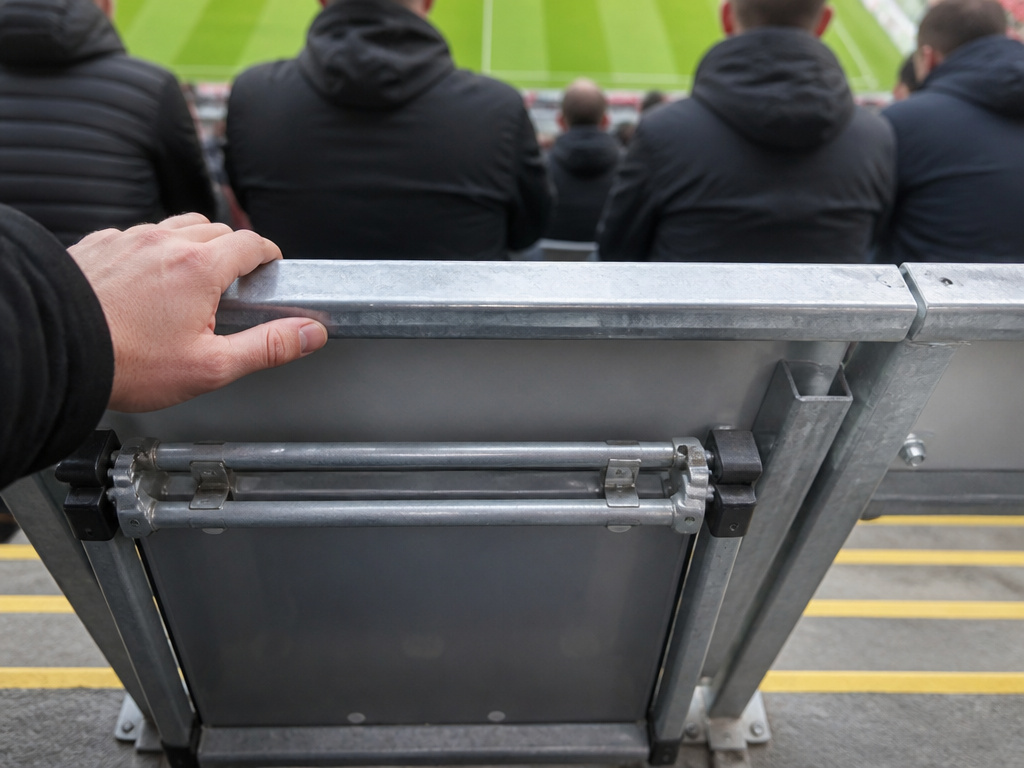
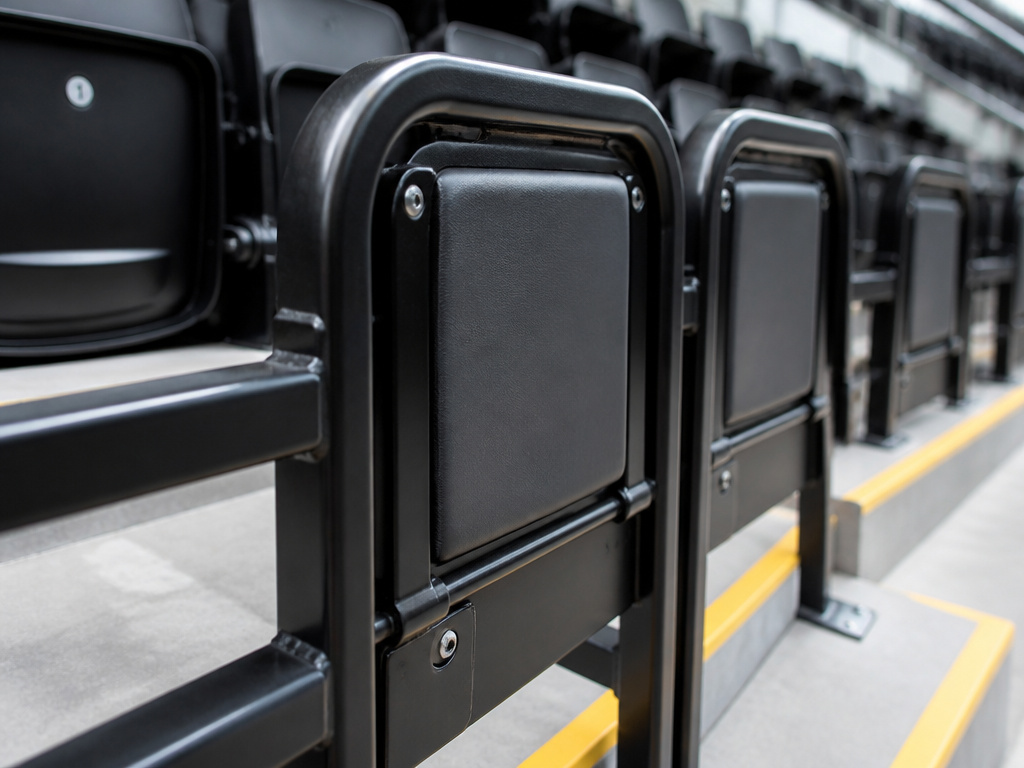
So you’ve bought a ticket for a licensed standing section. What changes? Start with the basics: you have a seat with a number. It might be a “rail seat,” which is a fold-down seat mounted on a robust barrier, or a standard seat with an independent barrier fixed to the floor in front. For a league match, the seat is typically locked upright.
You are strictly one person, one space. Your ticket corresponds to a specific spot, just like a seated ticket. This is a core rule from the UK government safe standing report that prevents overcrowding. The barrier in front of you is about chest-high, cold and solid to the touch.
The biggest difference you’ll feel, as any football stadium safe standing explained guide will note, is in your legs and your sightline. You’re standing for 90-plus minutes, so wear good shoes. But you’re not shuffling or being jostled. The barrier gives you a personal bubble. You can lean on it, and it completely eliminates the domino-effect stumble forward when a goal goes in. Visually, it’s often better. There’s no tall person directly in front of you; the barrier is low, and the stepped rows mean you look over the head of the person in the row below.
Movement is easier. The SGSA’s first condition for safe standing is that the seat and row design allows “free-flowing lateral movement.” In practice, this means getting to your spot or leaving for a halftime pie is less of an awkward, knees-into-seats shuffle. The atmosphere? It’s concentrated. Everyone there has chosen to stand, so the singing and noise are more consistent. It feels more like a traditional “end” than a seated block.
Where this goes sideways: Thinking a barrier alone makes you safe. The safety comes from the whole system, the trained stewards monitoring behaviour, the clear gangways, the controlled entry. A barrier on a poorly managed terrace is just a piece of metal.
Does Safe Standing Increase Stadium Capacity?
This is a fan’s hopeful question and a safety engineer’s detailed calculation. The short, official answer is: not automatically, and rarely as a primary goal.
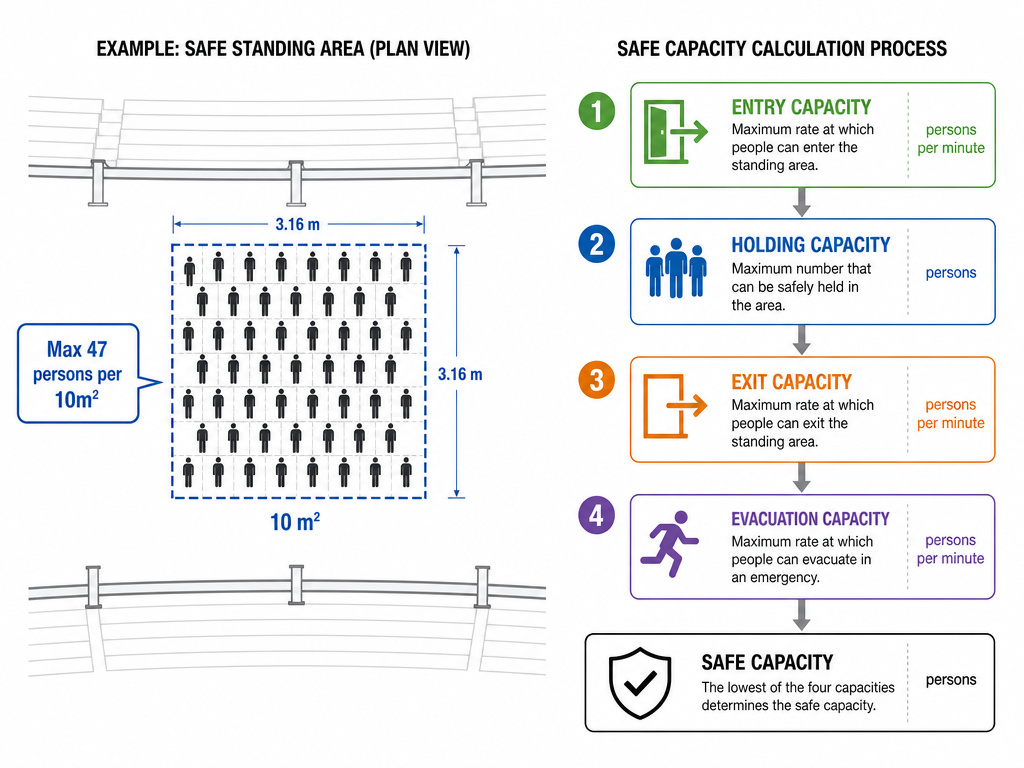
Capacity in UK sports grounds isn’t a single number. The Green Guide defines four separate capacities: entry, holding, exit, and emergency evacuation. Your final safe capacity is the lowest of these four. For standing areas, the “holding capacity” calculation uses available viewing area and a density factor, with a maximum of 47 persons per 10 square metres.
Installing barriers can sometimes reclaim previously unusable space or allow for a slight reconfiguration, but the “one person, one space” rule means you cannot pack people in like the old terraces. In many cases, clubs are converting existing seated rows to standing rows on a 1:1 basis. The main driver isn’t adding more fans; it’s making the existing fans safer and improving their experience.
The Guide to Safety at Sports Grounds is the bible for these calculations. Any capacity increase must be approved by the local authority’s Safety Advisory Group (SAG), which is a core part of the 16 licensing criteria. So while it’s not impossible, it’s a secondary outcome, not the point.
The Arguments For and Against
No major change in football happens without a debate. Here’s the honest rundown.
The Case For Licensed Standing:
- Safety First: It directly addresses the proven risks of persistent standing by providing crowd control infrastructure where none existed.
- Fan Choice & Atmosphere: It legitimises a deep-seated part of fan culture. Surveys show overwhelming support; the 2018 EFL survey found 69% of respondents had a personal preference to stand. It improves atmosphere, which benefits the whole stadium.
- Operational Sense: It allows stewards and police to manage a known, designed environment rather than constantly battling an illegal one. A final report on the trial concluded that barriers or rails in areas of persistent standing delivered a positive impact on spectator safety and improved fans’ match day experience.
- Modern Engineering: The technology is part of a regulated system with specific installation and testing requirements.
The Concerns and Counter-Arguments:
- Cost for Clubs: Installing rail seats or independent barriers is a significant capital investment. This cost is rarely passed on as cheaper tickets.
- Slippery Slope: Some fear it’s the first step back to unsafe, high-density terraces. The regulations are specifically designed to prevent this, but the fear remains for those affected by past disasters.
- Accessibility: Clubs must ensure licensed standing does not impact viewing standards for disabled fans or those in adjacent seated areas. This requires careful planning.
- Enforcement Creep: Will standing gradually spread into non-licensed areas now that it’s “official” somewhere in the ground? The SGSA criteria require clubs to demonstrate compliance with the SGSA’s Persistent Standing Enforcement Approach in the ground’s conventional seated areas.
The balance of evidence from the pilot and early adoption leans heavily toward the benefits. It’s a risk-reduction measure for a risk that was already being taken every matchday.
How does safe standing work in other countries?
The principles of safe standing are not exclusive to the UK. The fundamental idea is that standing is safe when spectators are protected from forward movement by barriers, when seat and row design allows for free-flowing lateral movement, and when robust safety management procedures are in place. These procedures must manage spectator numbers, behaviour, and encroachment onto gangways. Any country or league considering its introduction would need to establish a similar framework where ground management demonstrates how they address such criteria to a relevant safety authority, ensuring the reasonable safety of all people present.
Frequently Asked Questions
What is the difference between rail seats and safe standing?
Rail seats are a specific type of infrastructure used for safe standing. They are seats that fold away and lock upright, integrated into a rigid barrier. “Safe standing” or “licensed standing” is the broader term for the legally approved area, which can use rail seats or standard seats with independent barriers.
Is safe standing allowed in all UK stadiums?
No. It is only permitted in grounds that have applied for and received a license from the SGSA by meeting the 16 criteria. As of September 2026, 42 grounds have this license. Other grounds remain under the all-seater policy.
Can you sit down in a safe standing area?
Yes. The seats must be available for use. In a rail seat section, the seats can be released and folded down, typically for other events like concerts or European matches that mandate seating. The SGSA guidance also stresses that ticket sales must consider those who may wish to sit.
Does safe standing mean cheaper tickets?
Not necessarily. While some fans hoped standing tickets would be lower cost, clubs have largely priced them similarly to equivalent seated tickets. The investment in infrastructure and ongoing safety management means it’s not a cost-saving measure for clubs.
What was the Taylor Report?
The Taylor Report was the official inquiry into the Hillsborough disaster, published in 1990. Its main recommendation was that all clubs in the top two divisions of English football should have all-seater stadiums. This policy remained largely unchanged until the evidence-based introduction of licensed standing from 2022.
Before You Go
The conversation about standing had been stuck for thirty years between memory and law. Licensed standing, governed by the Football Spectators Seating Order 2022, is the evidence-based way out. It doesn’t erase history; it builds a safer present on top of it.
The takeaway isn’t just about rails. It’s about a system. If your club has a licensed area, the safety comes from the invisible work, the trained stewards, the contingency plans, the SAG oversight. That’s what the 16 criteria buy. For a fan, it means you can lose yourself in the moment without literally losing your footing. That’s a victory for safety and for culture, and it’s been a long time coming.
