
How Football Commentary Works: The Live Broadcast Machine
This post contains affiliate links. As an Amazon Associate, we earn from qualifying purchases.
Live football commentary works through a synchronized three-part machine: a commentator in a booth describes the match, a director in an outside broadcast truck selects the camera feeds, and a world feed distributes the combined picture and split audio to rights-holding broadcasters globally. The commentator’s job is to match their words to the director’s pictures, using preparation and real-time cues to build the narrative.
That split between the voice and the vision is the whole game. The pictures tell one story; the voice tells another. When they sync up, you get the magic of a broadcast that feels like a single, seamless story. This is a core principle of how football commentary works.
What follows is a walkthrough of that machine: the preparation that starts days out, the live coordination that happens faster than a counter-attack, and the edge cases, from off-tube commentary to video game recording, that flip the entire process on its head.
Key Takeaways
- A top-flight broadcast uses more than twenty cameras, with a director switching between them live from an outside broadcast truck.
- World feed audio is split: clean stadium effects are on one channel, commentary on another, letting broadcasters mix their own voices.
- Preparation starts five to three days before a match, building player lists, pronunciations, and talking points.
- For video games like EA Sports FC, commentators record 10 different ways of describing common actions, working from imagination, not live footage.
- The goal is to finish commentary to match the on-screen score graphic, which appears about 30 seconds after the referee’s whistle.
The Three-Phase Machine: Booth, Truck, and Feed
The broadcast isn’t inside the stadium. It comes from a row of large vehicles, outside broadcast trucks, or OB trucks, parked in a service area behind the stands. Cables snake from these trucks to every camera and microphone in the ground. This is where the three phases lock together.
First, the booth. The commentary team sits high in the stand with a clear view of the pitch and a monitor showing exactly what the viewer sees. The play-by-play voice describes the action; the analyst, often a former player, explains the why. They share a microphone and, crucially, an earpiece from the producer in the truck below.
The world feed commentator has to finish commentary to match the on-screen score graphic. This graphic is usually shown 30 seconds after the referee has blown for half or full time, so the final words must land precisely as the score bug appears.
Second, the truck. This is the engine room. A director watches a wall of screens, each a different camera feed, and calls the shots in real time. “Take camera four.” The vision mixer executes the switch. For a major event like the 2002 FIFA World Cup, the host broadcaster (HBS) provided a multi-feed based on 26 different cameras. A rights-holding broadcaster like the BBC could choose between 15 different feeds to compose its own program.
Third, the feed. The combined output, the director’s pictures and the balanced audio, is beamed out. In a world feed broadcast, the audio channels are split: clean stadium effects are transmitted on one part, commentary on another. A broadcaster in another country can then use the pictures and stadium effects, while adding its own commentary.
The rhythm between these three parts is everything. The commentator is describing the director’s pictures, not just the match in front of them. Get it wrong, and the broadcast feels disjointed, which is a core failure in how football commentary works. Get it right, and the viewer never notices the seams.
The Unseen Script: Preparation Before the Whistle
Commentary doesn’t start at kick-off. It starts days earlier. According to guides from professional training services like LiveCast Studio, the checklist is methodical and time-bound.
Five to three days before the match, the work is foundational. You confirm the competition is covered by data services, find club media contacts for pronunciations, and note the broader context, league positions, stakes, history. Three to two days out, you build the people list: every player in both squads, with shirt number, position, and a phonetic spelling of their name.
Two days to one day before, you turn that list into usable notes. The key is writing notes on the player, not the match, so they’re reusable. You star the five to eight main characters and craft one or two talking points for each. LiveCast Studio advises putting a source on every fact and flagging any time-dependent claim, like “top scorer,” which must be re-checked on the day.
| Timeline | Core Task | Why It Matters |
|---|---|---|
| 5–3 days before | Confirm data coverage, find contacts, note context. | Avoids being blindsided by missing info or wrong pronunciations. |
| 3–2 days before | Build the full player list with numbers and phonetic pronunciations. | Creates the visual map for identifying players at game speed. |
| 2–1 day before | Write player notes and talking points; flag unverified claims. | Turns raw data into sayable stories ready for air. |
| Day before / Match day | Prepare fill-time items and open questions for your co-commentator. | Provides material for stoppages and creates natural conversation. |
On the day, the final hour is for the team sheet. Line-ups are usually published about an hour before kick-off. You compare them to your list, move non-starters to the bench section, and re-check any time-dependent talking points. You also prepare five to ten fill-time items, stories about the stadium or fixture history, and two or three open questions for your expert.
During the match, your screen needs to show four things at a glance: the score and clock, who is on the pitch, who is on a yellow card, and how many substitutions each side has used. Everything else can wait for a stoppage. It’s a system built to manage chaos with calm, a key part of how football commentary works.
How Do They Know Every Player? The Real-Time Identification System
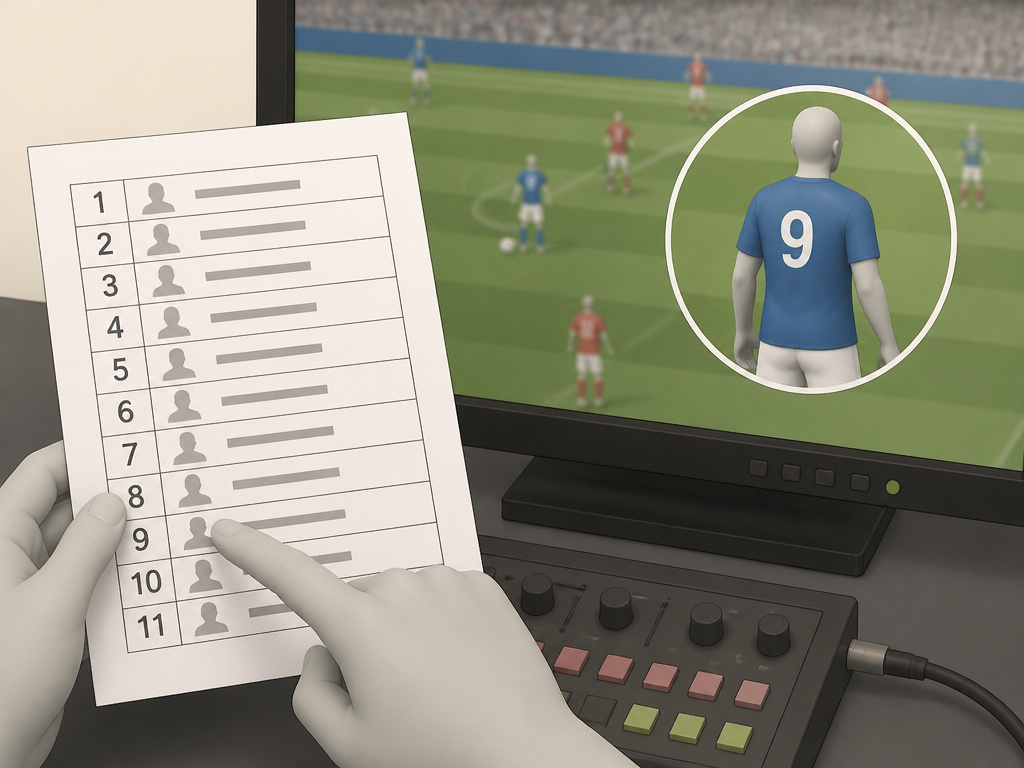
You see a blur of movement 80 yards away. How does the commentator instantly name the player? They don’t memorize 22 faces. They use a system.
The foundation is the prepared list with numbers and positions. On screen, they have a monitor that often includes a tactical feed showing more of the pitch, with player icons and numbers. The real skill is peripheral vision: glancing at the number on the back, matching it to the position on your sheet, and saying the name, all while describing the action.
It’s a learned reflex. The first identifier is almost always the number. “Number nine, drops deep…” Then, if there’s time, the name. “That’s Kane, linking play.” For video games, the process is inverted but just as meticulous. In the early days of Actua Soccer (1995), commentator Barry Davies recorded multiple intonations of each player’s name so it wouldn’t sound repetitive. Modern games like EA Sports FC have a vast library of real players, requiring extensive name recordings.
Common mistake: Relying on memory alone. Without a clear, glanceable system for numbers and positions, even experienced commentators will hesitate or misidentify players under pressure.
The best make it look effortless. It isn’t. It’s a specific visual processing skill, honed by years of matching moving numbers on a pitch to a static list on a page. When you understand that, the speed makes sense.
The Voice as an Instrument: Pitch, Pace, and the Goal Roar
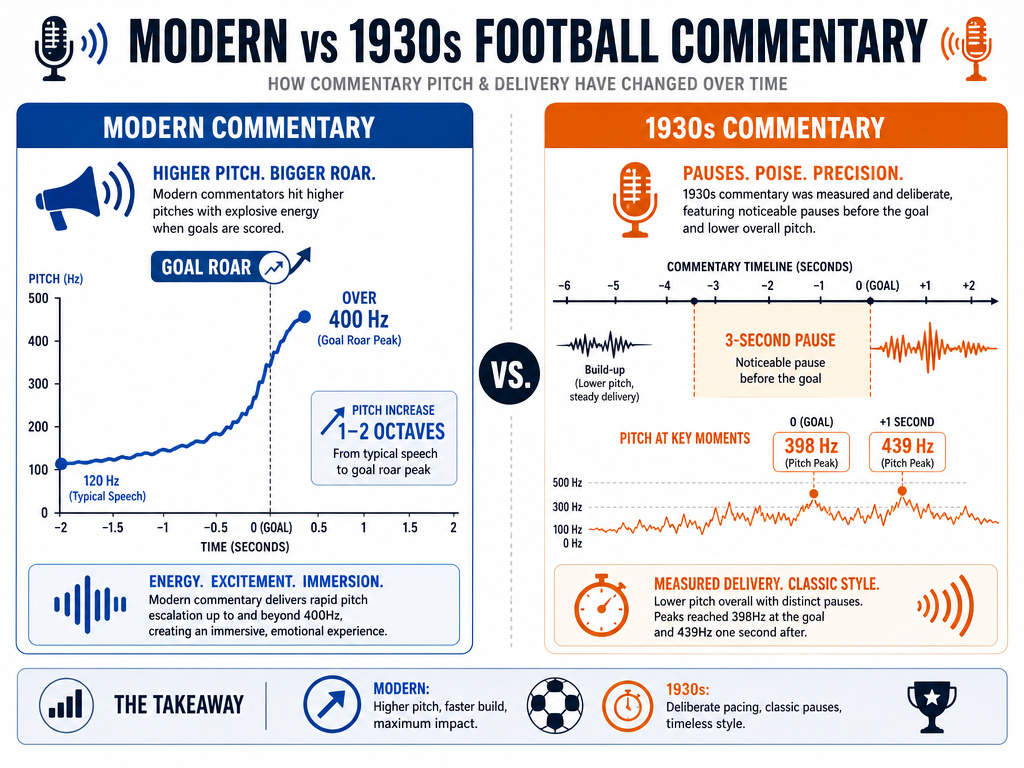
Commentary is a spoken performance with its own musicality. Academic research has mapped its sound. Academic research has found that in live football commentary, affective information is consistently reflected by a pitch rise between one and two octaves during phases of building suspense before a goal. The goal comment itself often hits pitches beyond 400 Hz.
Compare that to a 1930 radio commentary example from the same research. For the first goal, the time between the pre-dramatic phase and the goal consisted of nearly three seconds pause. The goal comments showed maximum pitch values of 398 and 439 Hz. The style was slower, with over-long pauses (more than 2 seconds) that would feel alien today.
Guidelines for pauses vary: for the LFC dataset, professional announcers were told to avoid unnaturally long silences, whereas a 1930 radio commentary example used over-long pauses (more than 2 seconds). Transcribed utterances separated by less than 0.1 second were merged into a single segment to ensure fluidity.
The voice is also a physical tool that needs maintenance. Commentators for EA Sports FC note that during recording sessions, which can last over four or five hours, their voices “have to be perfect.” They use various remedies to keep their vocal cords in consistent shape for the precise work of matching takes.
When the Machine Adapts: Off-Tube and Video Game Commentary
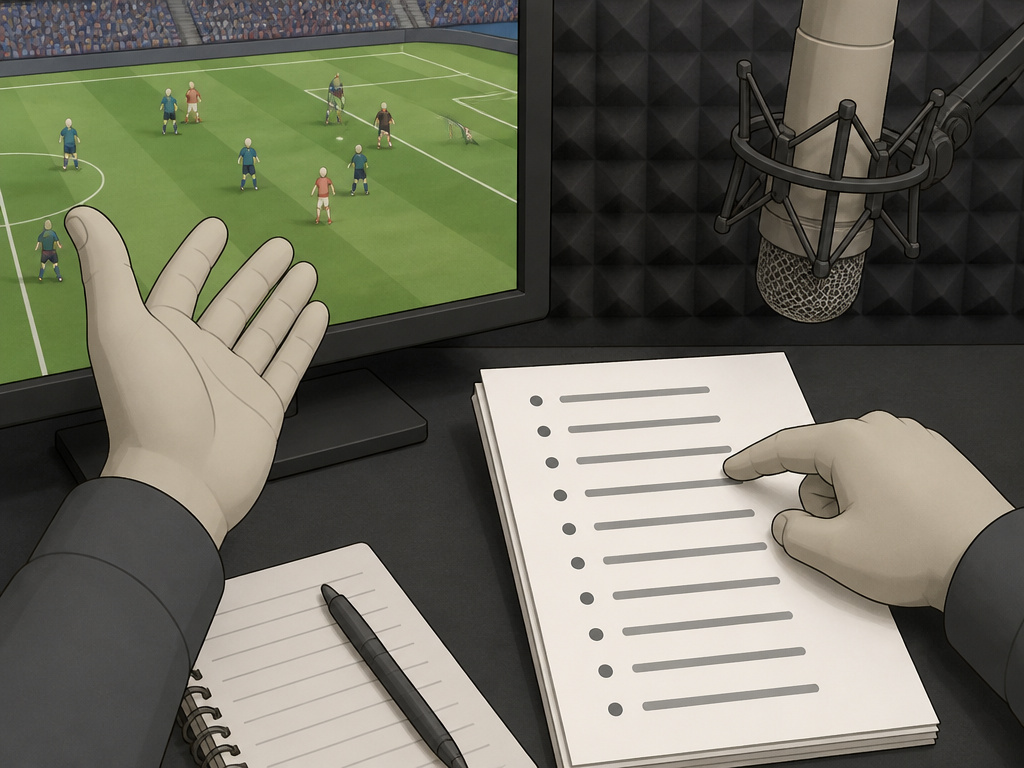
The standard process assumes a booth in the stadium. Two edge cases break that model completely, forcing a different kind of performance.
Off-tube commentary became widespread during the pandemic. The commentator works from a voiceover booth, watching a monitor feed, not the live pitch. The challenge is syncing your emotional reaction to a picture that’s delayed by a second or two and lacks the visceral feel of the stadium. You’re narrating a television show, not an event you’re physically at.
Synthetic commentary for video games is the ultimate inversion. There is no live visual reference. Commentators like those for EA Sports FC record in a studio, picturing actions in their “mind’s eye.” As the game’s producer explained, they must generate “10 different ways” of describing the same common match situation (like “a promising attack”) to avoid repetition for players. The recording sessions are long and technically demanding, focused on creating a library of phrases that an algorithm can trigger appropriately.
Where this goes sideways: For world feeds used by broadcasters on a delay, a commentator might have to pause and restart commentary for the same phase of play using different words. This prevents viewers on a tape delay from feeling the program is restarting when they tune in.
These adaptations show that commentary is fundamentally about matching words to a visual, whether that visual is live, on a screen, or purely in the commentator’s imagination. The core skill, descriptive storytelling, remains the same.
The People in the Booth: Play-by-Play vs. Analyst
The classic pairing is a division of labor. The play-by-play commentator is the narrator. Their job is to describe the action clearly, accurately, and with energy. They set the scene, track the ball, and call the goals. The color analyst or co-commentator is the interpreter. Usually a former player or coach, their job is to explain why something happened, the tactical shift, the technical mistake, the strategic gamble.
Their interaction is a delicate dance. The play-by-play voice fills the open play; the analyst picks their moments, often when the ball goes dead. A producer in their ear helps manage the rhythm, feeding cues and timing reminders. The best pairs develop a shorthand, a conversational rapport that makes the broadcast feel like a natural discussion rather than a rehearsed script.
This partnership is so valued that video game producers try to replicate it. For EA Sports FC, producers have specifically listened to real-life commentaries from their talent to capture their natural back-and-forth rapport for the game. It’s those “little things,” as co-commentator Sue Smith noted, that sell the realism.
How to become a football commentator
Preparation is the foundation. Your work starts days before the match. Begin by researching teams and building a list of key people. Prepare notes, talking points, and several fill-time items to cover quiet moments. Have a few open questions ready for any expert you are working with. When line-ups are announced, update your information. During the broadcast, you must keep track of the score, the clock, who is on the pitch, any yellow cards, and the substitution count. These are the core facts you will need to reference. Practical experience, often starting at local or lower-level matches, is essential for developing the timing and knowledge required for the top level.
The history of sports commentary
Early radio commentary established the basic form, but the techniques have evolved significantly. A study of a 1930 radio broadcast shows the commentator used pauses longer than two seconds, with nearly three seconds of silence before describing a goal. Modern professional guidelines advise against such unnaturally long silences. The emotional delivery has also changed. In that early example, the maximum pitch for a goal comment reached 439 Hz. Contemporary analysis shows that in live football commentary, the pitch during a goal often exceeds 400 Hz, with a rise of one to two octaves during the suspenseful build-up, reflecting a more consistent and dramatic use of the voice to match the action.
Commentary as an art form
Live football commentary is the spoken genre with the world’s largest television audience, and its execution is a crafted performance. The commentator’s voice is a primary tool for conveying drama. Studies show affective information is reflected by a specific pitch rise during phases of building suspense before a goal, with the goal comment itself often occurring at very high frequencies. This vocal control turns narration into an emotional experience. The craft extends to synthetic commentary for video games, where commentators must generate many different ways of describing the same common match situation, requiring creativity and a vast vocabulary to avoid repetition and maintain engagement over long recording sessions.
Frequently Asked Questions
Do the players hear the commentary during the match?
No, players on the pitch do not hear the television commentary. They are focused on the game, the crowd, and their teammates’ instructions. The commentary is produced solely for the broadcast audience.
How much do football commentators get paid?
Salaries vary enormously based on experience, profile, and employer (e.g., a national broadcaster vs. A freelance world feed contractor). Top-tier commentators for major networks can earn high salaries, while those starting out or working for smaller regional feeds earn significantly less. There is no single published rate.
What’s the difference between radio and TV commentary?
Radio commentary is purely descriptive, painting the entire picture with words for a listener who can’t see. TV commentary is complementary; it assumes the viewer can see the action, so the focus is on adding insight, context, and narrative, not just description. The TV commentator can also use more pauses, letting the pictures breathe.
How do commentators handle a boring game?
They rely on their preparation, the fill-time items, player stories, and broader league context they researched before the match.
What technology do commentators use?
In the booth, they have a microphone, a monitor showing the broadcast feed, often a secondary tactical monitor, and a talkback system to hear the director and producer. Off-tube commentators use ISDN lines or IP-based codecs to connect their voiceover booth to the broadcast truck’s audio mix.
Before You Go
The next time you watch a match, listen for the sync. When a replay rolls, does the commentator’s description match the new angle? When a goal goes in, does their voice peak with the crowd’s roar? That’s the machine working.
The real insight is this: the broadcast is a live match analysis built for an audience of millions, not a passive window on the game. Every camera angle, every chosen statistic, every inflection in the commentator’s voice is an editorial choice. Understanding that football broadcasting process, from the data analytics feeding the graphics to the split-second decisions in the truck, doesn’t ruin the magic. It shows you the craft behind it.
And if you ever play a football video game, remember: the commentator telling you it was a terrible shot recorded that line in a silent studio, picturing the scene you just created. That’s a different kind of magic altogether.
