
Football for Adults Beginners Guide: How to Start In
This post contains affiliate links. As an Amazon Associate, we earn from qualifying purchases.
Football for adults is about finding the right entry point, not being the best player on the pitch. The game is built on simple principles: move the ball with your feet, work as a team, and score more goals than the other side. For a beginner, that means starting with small-sided formats like 5-a-side or 7-a-side, where you get more touches and learn faster in a less physically demanding setting. The real barrier is knowing where to begin and having the confidence to show up.
That last part trips up more people than the offside rule. You have a mental picture of what football “should” look like, probably based on a Premier League broadcast. The reality for adult beginners is different, quieter, and far more welcoming. This guide covers that reality: the proven health benefits, the essential gear, the conflicting advice on warming up, and the exact steps to find your first game. It is a football for adults beginners guide.
Key Takeaways
- Start with small-sided football (5- or 7-a-side). You’ll touch the ball much more often than in an 11-a-side game, which accelerates learning and reduces running.
- Follow the American College of Sports Medicine’s 10% rule when increasing your training load to avoid injury. If you play for an hour this week, add only a small amount of time next week, following the 10% rule.
- Your first touch and passing are the skills that matter most. A useful solo practice ratio is 50% control/passing, 25% dribbling, and 25% shooting.
- For a 3G artificial turf pitch, you need moulded studs. Blades and metal studs are usually banned on these surfaces.
- If you’ve been completely inactive, begin with daily 20–30 minute brisk walks for two to four weeks before your first football session to build an aerobic base.
The Health Case for Adult Football
The benefits aren’t just theoretical. A 2015 narrative review in the British Journal of Sports Medicine, often cited in the NIH review of recreational football, lays out the numbers from studies on untrained and middle-aged men. This isn’t about becoming a pro; it’s about what happens to your body when you play regularly.
After 12 weeks of recreational football, participants with type 2 diabetes saw their systolic and diastolic blood pressure drop by 9 and 8 mm Hg, respectively. That’s a significant reduction in blood pressure. VO2 max, a key measure of aerobic fitness, increased by 8% in hypertensive participants after just three months. The game also shifts your body composition: In middle-aged men with type 2 diabetes, total fat mass was 1.7 kg lower after 24 weeks of football training.
The [Bangsbo et al. 2015] review found football training increased bone mineral density in the femoral neck of elderly men by 3.8–5.4% after a year. For an adult beginner, the sport isn’t just cardio; it’s a full-body strengthener that targets heart health, muscles, and bones with every session.
What You Actually Need to Start
You can spend a fortune on gear, but you only need three things for your first session: boots, shin guards, and a ball. Everything else is secondary.
Boots (Cleats): This is your only real investment. For most artificial turf (3G) pitches, you need boots with moulded plastic studs. Blades and metal studs are usually banned on these surfaces because they damage the carpet. Don’t overthink it; a basic pair from a sports retailer will do. The right football boots should feel snug but not tight, with no heel slippage.
Shin Guards: Essential. Even in a friendly game, an accidental kick to the shin is agony and can cause a bone bruise. Go for a simple slip-in guard that fits under your socks. It’s the cheapest and most important protective gear you’ll buy.
Ball: Get a size 5. It’s the standard for adult football. You can find a size 5 training ball for under £20. Having your own means you can practice basic control against a wall anytime, which is how you build that all-important first touch.
For shorts, shirt, and socks, wear whatever is comfortable and allows you to move. A proper football kit can come later. The goal for session one, as any football for adults beginners guide will tell you, is to be physically prepared and mentally present, not to look like you’ve stepped out of a catalogue.
Your First Session and Beyond
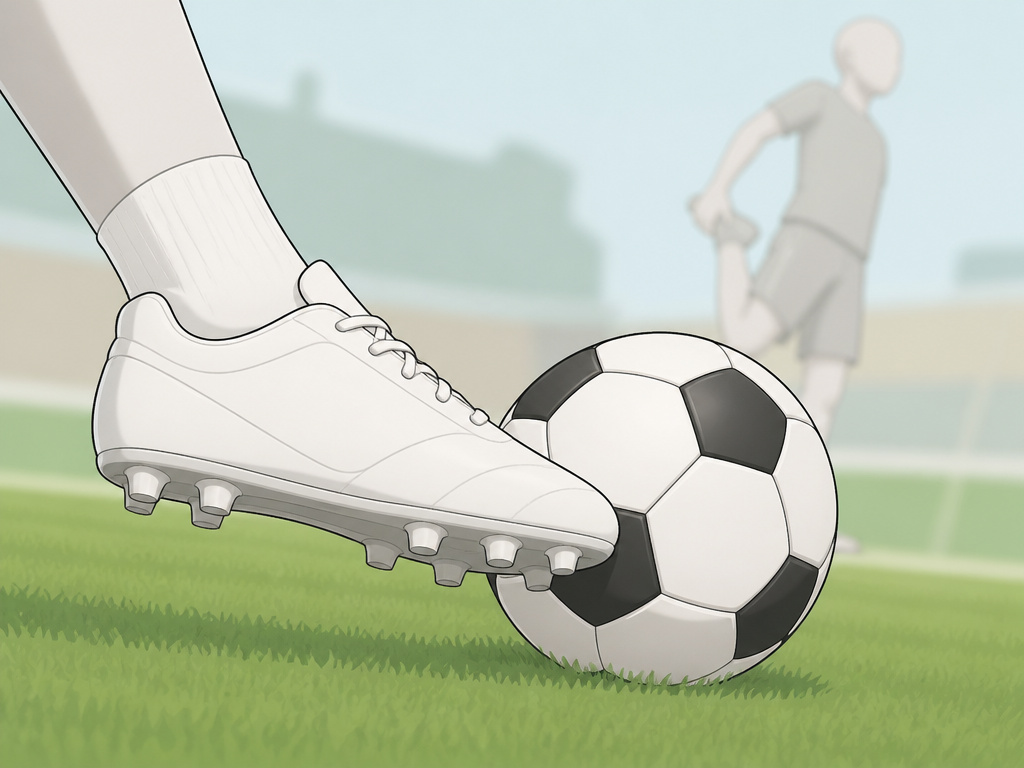
Take a moment. Your first time back will feel fast. The ball will bounce awkwardly, your touch will be heavy, and you’ll be out of breath quicker than you expect. That’s normal. Every single person on that pitch has been there.
A standard beginner-friendly training session usually follows this pattern:
- Warm-up (10–15 minutes): Light jogging, dynamic stretches, and maybe some passing in pairs. This is where sources disagree: the FIFA “11+” injury prevention programme is 20 minutes, while guides like footbolno.com and Accio recommend a 10–15 minute warm-up.
- Technical Drills (20 minutes): Simple exercises focused on control and passing. You might feel clumsy. It doesn’t matter.
- Small-Sided Games (20 minutes): The best part. You’ll play 4v4 or 5v5 in a condensed area. This is where you learn to make decisions under mild pressure.
- Conditioned Game or Fitness (Remaining time): A slightly larger game, often with a specific focus like “two-touch” to encourage quick passing.
Where this goes sideways: Chasing the ball all over the pitch. As a beginner, hold a rough position. Let the game come to you. If you exhaust yourself chasing every pass in the first ten minutes, you’ll be a spectator for the next fifty.
The American College of Sports Medicine recommends increasing your weekly training load by no more than 10% to avoid overuse injuries. If you play for 60 minutes this week, aim for 66 next week. Your muscles will adapt faster than your tendons and ligaments, so patience is necessary.
Finding a Game and a Group
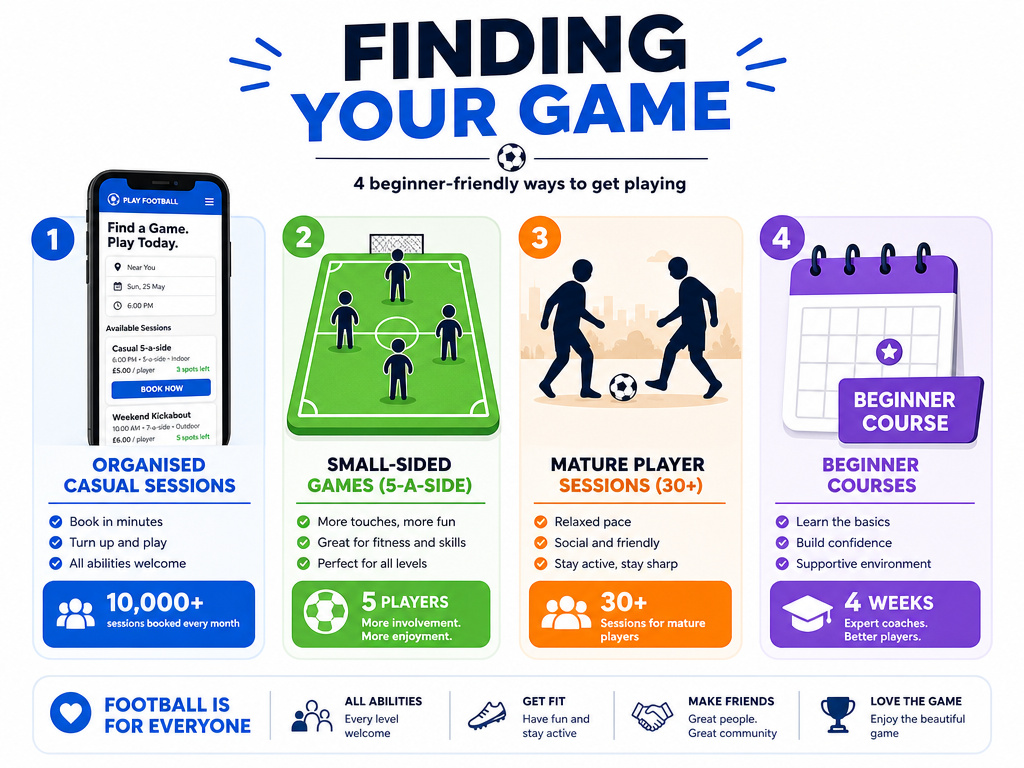
This is the step that stops most people. You don’t need to find eleven friends and book a full-size pitch. The modern landscape for adult beginners is built around accessibility.
| Option | How It Works | Best For |
|---|---|---|
| Organised Casual Sessions | You book individually via a platform (e.g., All About Football). Teams are balanced on the night. | Absolute beginners; no commitment, no need to know anyone. |
| Small-Sided Leagues (5/7-a-side) | Join a local league as a team or a “free agent.” Games are usually once a week. | Those wanting regular, game-focused play with a team feel. |
| Walking Football | Modified rules: no running, no contact. Played with a normal ball. | Older adults or anyone wanting a lower-impact version. |
| “Back to Football” Programs | Courses run by clubs explicitly for adult beginners. | Structured learning in a supportive, graded environment. |
Search for “casual football” or “pick-up soccer” plus your town. Send a message to the organiser saying you’re a complete beginner. That single act filters out the wrong, overly serious groups and almost always gets a friendly, welcoming response. Many clubs now run specific beginner drills sessions for adults who’ve never played.
If your employer has a team, join it. The standard will be mixed, and the priority is usually fun. The social connection alone makes it worth it.
A Realistic Timeline for Progress
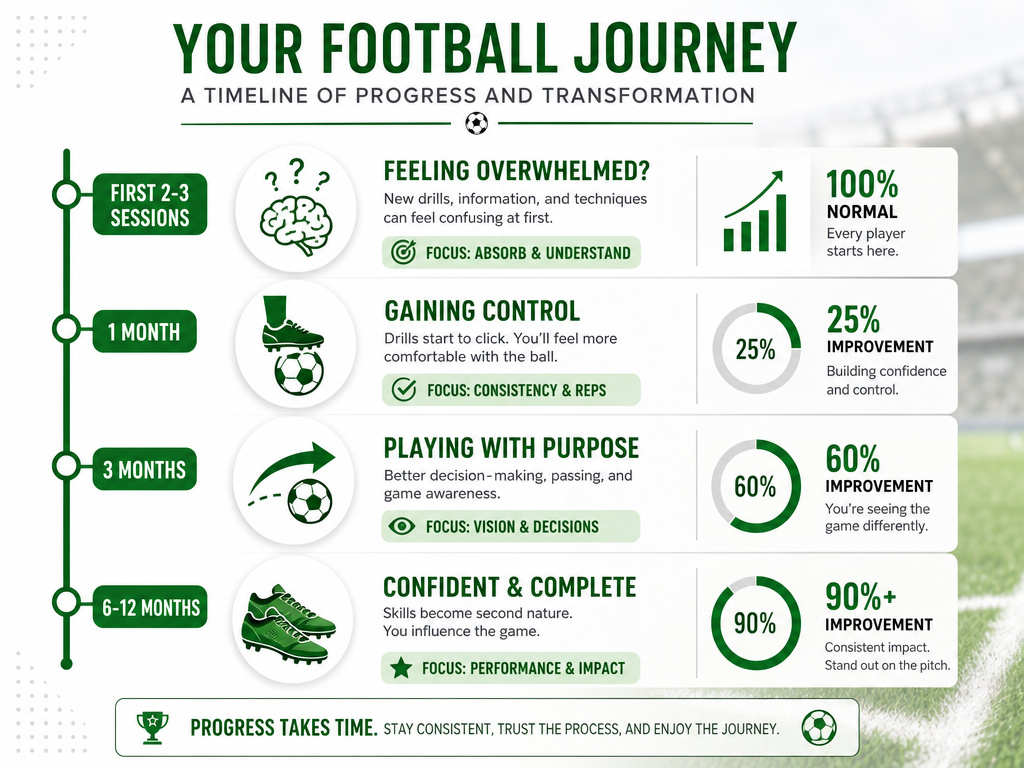
Managing expectations is everything. You will not feel competent after one session. You might not feel competent after a month. The timeline below is a rough guide, grounded in coaching observations rather than miracles.
| Timeframe | What You’ll Likely Experience |
|---|---|
| First 2-3 Sessions | Everything feels fast and confusing. You’ll be acutely aware of your technical mistakes. Focus on effort, not outcome. |
| 1 Month | Basic control improves. You stop chasing the ball relentlessly and start understanding positioning. The game slows down a little. |
| 3 Months | You can make a simple, accurate pass under mild pressure. You contribute to the game instead of just being present in it. |
| 6-12 Months | You’re a functional amateur player. You know where you should be, and your feet sometimes even listen. You have a reliable first pair of boots and a preferred position. |
Adults typically understand the game tactically before their technique catches up. You’ll see a pass that should be made long before your foot can execute it. That gap is frustrating and completely normal. The fix is consistent, deliberate practice drills, not just playing matches.
Basic Football Rules for Beginners
A full football game lasts 90 minutes, split into two 45-minute halves. The primary objective is to score by getting the ball into the opponent’s goal. Play is continuous, but stops for fouls, the ball going out of bounds, or goals. A key restart is the penalty kick, taken from a spot a set distance from the goal line. The flow involves moving the ball up the field through passing and dribbling while the opposing team tries to win possession. Understanding these basics of duration, scoring, and stoppages will help you follow the game’s rhythm.
Understanding Football Positions
Football teams are organized into defenders, midfielders, and forwards, each with a distinct role. Defenders form the last line before the goalkeeper, focusing on stopping attacks and clearing the ball. Midfielders operate in the center of the pitch, linking defense and attack by winning possession and distributing passes. Forwards, or strikers, lead the offensive line with the main task of creating chances and scoring goals. The goalkeeper is the only player who can use their hands within the penalty area. Knowing these general roles helps you understand team shape and where you might fit on the field.
Football Field Dimensions and Markings
A typical adult football pitch is a large rectangular grass or artificial surface. Its standard dimensions are around 110 metres in length and 70 metres in width. The field is marked with boundary lines, a center circle, and two penalty areas at each end. The goal, placed at the center of each end line, is within the penalty area, which is a critical zone for the goalkeeper and for awarding penalty kicks. Familiarizing yourself with the layout, including the halfway line and the corner arcs, is essential for understanding positioning and the rules of play.
Frequently Asked Questions
Am I too old to start playing football?
There is no upper limit for recreational play. People start in their thirties, forties, and beyond. The format adapts to you, if running is too much, try walking football, a low-impact version growing in popularity. The barrier is almost always in your head, not your body.
Do I need to be fit before I join a team?
No. You get football-fit by playing football. If you’ve been completely sedentary, do yourself a favour and build a base with daily 20–30 minute brisk walks for a few weeks first. But waiting until you’re “in shape” is a sure way to never start. The first few sessions will be tiring, and then they won’t be.
What’s the difference between soccer and football?
It’s the same sport. “Soccer” is the common term in the United States, Canada, and Australia. “Football” is used virtually everywhere else. Both terms originated in England in the 19th century. For the purposes of understanding the rules, they are identical.
How long is a football game?
Full professional or adult amateur match is 90 minutes, split into two 45-minute halves. However, the small-sided formats you should start with (5- or 7-a-side) have much shorter games, typically two halves of 20-25 minutes each.
What if I get the ball and panic?
Pass it to the nearest teammate. It is never the wrong answer for a beginner. A simple, safe pass buys you time to think, keeps possession, and builds your confidence. Trying to dribble through three opponents usually ends with you losing the ball and feeling deflated. Keep it simple.
The First Step
The hardest part is committing to the first session. After that, it’s about consistency, showing up even when you’re tired, even when you had a bad game last week. Put it in your calendar like a dentist appointment.
Your biggest enemy is the idea that it’s too late, or that everyone else will be better. They might be, but nobody cares. Adult football, especially at the beginner level, is defined by its welcome. Someone will pass you the ball. Someone will shout “well done” for a simple tackle. The community is already there, waiting for you to turn up.
So find a local beginner’s guide session, message the organiser, and book in. Bring water, your boots, and a willingness to be bad at something in front of strangers for a few weeks. That’s the part everyone misses: being a beginner is the most fun you can have in football, because every single session you get a little bit better.
