
Director of Football Role Explained: How to Choose One
This post contains affiliate links. As an Amazon Associate, we earn from qualifying purchases.
The director of football, also called a sporting director, is the senior executive responsible for a football club’s entire sporting operation. They are the architect of the club’s long-term vision, managing player transfers, overseeing the academy and scouting departments, handling contracts, and ensuring the manager has the resources to succeed. They act as the crucial link between the club’s board and the coaching staff, translating financial strategy into on-pitch philosophy.
That definition covers the job on paper. The real work starts when you ask who they answer to, what happens when the manager disagrees with a signing, and how a club decides whether to hire a former player or a data analyst for the role. The director of football role explained, the title might be modern, but the tension between short-term results and long-term planning is as old as the game itself.
What follows is a breakdown of the role that moves past the job description, a director of football role explained. We’ll look at the specific departments they control, the three most common reporting structures that define their power, and the practical skills that matter more than a famous playing career. By the end, you’ll see the sporting director not as a glorified scout, but as the person who builds the club you watch every weekend.
Key Takeaways
- The role goes by many names, including Sporting Director, Director of Football, Technical Director, General Manager, and Chief Football Officer, but the core function is overseeing all football operations to execute a long-term club vision.
- Their most visible duty is managing the transfer process and player contracts, but their deeper impact is aligning the academy, first-team playing style, and budget.
- The role requires being a diplomatic buffer between the board and the head coach, a skill that often matters more than an elite playing background.
- At the last count, 17 of the 20 Premier League clubs had someone in this role, highlighting its adoption as essential modern football governance.
- Successful sporting directors often come from varied backgrounds; research shows 17 per cent moved into the role from non-technical jobs outside football.
The Sporting Director’s Core Responsibilities in a Modern Club
Forget the idea of a single person just buying players. The sporting director’s job, a director of football role explained, is to make sure every part of the football machine is pointing in the same direction. Picture a club’s academy playing a possession-based 4-3-3, its under-21s using the same pressing triggers, and the first team building from the back with coordinated full-back overlaps. That alignment doesn’t happen by accident. It’s built by the sporting director.
The sporting director’s primary responsibility lies in overseeing the club’s footballing operations, employing experts in specialised areas, and producing a culture of collaboration and shared objectives. They are the conduit between the board’s financial strategy and the manager’s tactical demands.
Their mandate typically breaks down into four interconnected pillars.
1. Long-Term Strategy & Club Philosophy
This is the foundational work. The sporting director collaborates with the board to define what the club stands for and how it wants to play. Is it a youth-focused club that develops and sells talent? Is it a club that dominates possession? This philosophy then dictates every other decision, from the type of head coach hired to the profile of players targeted by scouts.
2. Player Recruitment & Squad Management
This is the most public-facing part of the job. The sporting director leads the transfer process, working with a network of scouts and a data analytics team to identify targets that fit the club’s style and budget. They then negotiate with other clubs and player agent fees to get deals done. Crucially, they also manage the squad’s wage structure, ensuring it remains sustainable. As former Leicester director Dave Bassett put it in a 2005 BBC interview, the director is “responsible for the budget to be spent on wages and makes sure it is adhered to.”
3. Oversight of Football Operations
The role extends far beyond the first-team dressing room. A sporting director typically oversees the academy, the scouting department, the medical and sports science teams, and even the development of training facilities. They ensure the youth development pathway feeds logically into the first team and that the club’s infrastructure supports its ambitions.
4. Managerial Support & Appointment
The sporting director hires the head coach and is their primary point of contact with the board. They provide the coach with the tools and players needed, but also manage expectations. If results dip, they are the buffer. As Bassett noted, the director “has to be involved in the selection of the manager” so there is inherent support and shared accountability from day one.
| Responsibility Pillar | Key Actions | Stakeholders Involved |
|---|---|---|
| Strategy & Philosophy | Define playing style, set multi-year vision, align budgets. | Club Board, Owners. |
| Recruitment & Contracts | Lead scouting, negotiate transfers, manage wage budget, handle player valuation. | Head Coach, Scouts, Agents, Analytics Team. |
| Football Operations | Oversee academy, medical, scouting, and facility development. | Academy Director, Head of Medicine, Chief Scout. |
| Managerial Relations | Appoint the head coach, act as liaison, manage conflict, provide resources. | Head Coach, Assistant Manager, Board. |
The Day-to-Day Reality: More Than Just Transfers
So what does a Wednesday in October look like? It’s rarely just signing a striker. The daily grind is a mix of high-stakes negotiation, internal diplomacy, and granular planning.
A typical week involves a mix of communication and planning, such as calls with agents about contracts, reviewing scouting reports with the analytics team, and meetings with the academy director about youth development. The constant thread is communication: translating the board’s financial limits into realistic targets for the coach, and explaining the coach’s tactical needs to the scouts.
Where this goes sideways: Assuming the head coach and sporting director always agree on a transfer target. The sporting director must sometimes veto a coach’s preferred signing if the fee or wages would wreck the club’s long-term player valuation model or wage structure. That conversation is where many working relationships fracture.
The diplomatic skill is the whole game. A sporting director needs to “manage upwards” to the board to secure funds, and “manage across” to keep the head coach and their staff bought into the overall plan. It’s a balancing act where a failed relationship usually means one of them is looking for a new job by season’s end.
Titles, Reporting Lines, and the Power Structure
Here’s where it gets messy. The same job has a dozen different titles, and who the person reports to defines their actual power.
The Title Confusion
Is it a Sporting Director, a Director of Football, a Technical Director, or a Chief Football Officer?
The Three Reporting Models (And Why They Matter)
This is the core structural disagreement you’ll find across sources. The reporting line decides everything.
- The Traditional Hierarchy: Sources disagree on reporting lines: some state the sporting director reports directly to the CEO or Chairman, while others describe a flatter structure where the sporting director and head coach report jointly to the CEO or board, or where the sporting director sits on the board itself. This is the clearest chain of command, giving the sporting director significant authority over football matters. The Wikipedia entry states the role is “usually directly subordinate to the chief executive officer or the chairman,” but other sources describe different reporting structures, such as a flatter management team or a board-level position.
- The Flatter Management Team: The sporting director and head coach report jointly to the CEO or board, operating as peers. This requires exceptional collaboration but can avoid the perception that the coach is subordinate.
- The Board-Level Director: The sporting director sits on the club’s board itself. This grants them maximum strategic influence but can distance them from daily football operations.
Most of the friction in English football has come from clubs installing a sporting director in a hierarchical model while the head coach expects the autonomy of a traditional “manager.” Getting this structure clear from the start is the first thing a sporting director negotiates.
Pathways into the Role: It’s Not Just for Ex-Players

The old image of a retired star moving upstairs is outdated. The pathways are now far more diverse, reflecting the role’s blend of football knowledge and executive skill.
The Four Common Pathways:
- The Football Operator: Former players, coaches, or managers (e.g., Txiki Begiristain, Leonardo). They bring deep technical understanding and a vast network.
- The Data & Recruitment Specialist: Individuals who rose through scouting or analytics departments (e.g., Liverpool’s former sporting director Michael Edwards). They excel in player valuation and identifying market inefficiencies.
- The Academy Director: Professionals who managed youth systems before stepping up (e.g., Dan Ashworth). They inherently understand long-term youth development and squad planning.
- The Business Executive: Those from non-football backgrounds in law, finance, or management. The Athletic’s analysis of sporting directors found that 17 per cent came from non-technical roles or roles outside of football altogether.
This variety is a strength. A club in financial distress might need a business-focused director to restructure contracts. A club aiming to build through youth might prioritize an academy graduate. The key is matching the profile to the club’s most pressing need.
The Evolution: From Continental Innovation to Premier League Standard
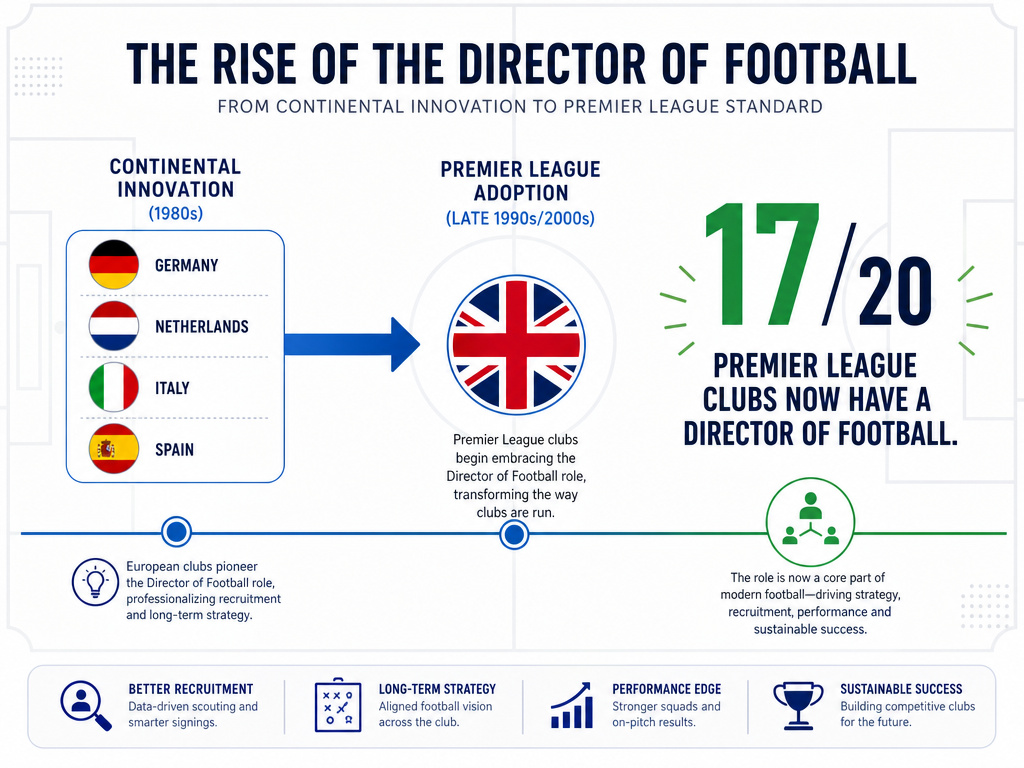
The role was created by some progressive clubs in continental Europe at some point in the 1980s. Clubs in Germany, Holland, Italy and Spain created the sporting director role in the mid-1980s.
Clubs in England started adopting a similar strategy in the late 1990s and early 2000s. The shift began in the late 1990s and early 2000s as the financial stakes grew. Today, it’s the norm. As noted by the Football Collective, at the last count, 17 of the English Premier League’s 20 clubs had a director of football or its equivalent.
The role’s evolution mirrors the sport’s transformation into a global, data-driven business. It’s no longer enough to have a charismatic manager; you need a strategic executive building a club that can sustain success across multiple managerial tenures.
Frequently Asked Questions
What’s the difference between a director of football and a head coach?
The director of football is a long-term strategist and executive responsible for the entire football operation, including transfers, contracts, and academy alignment. The head coach is primarily focused on the short-term: training the first team, selecting tactics, and picking the lineup for the next match. The director builds the squad; the coach uses it.
Do all football clubs have a sporting director?
No, but the vast majority of elite clubs do. The 17 out of 20 Premier League clubs statistic shows its near-universal adoption at the top level. Smaller clubs or those with a very specific, owner-driven model might not, but they are increasingly the exception.
Who has the final say on signings, the sporting director or the manager?
It depends entirely on the club’s agreed structure. In a clear hierarchy, the sporting director has the final say within the agreed budget and philosophy, but will always work closely with the manager. A signing that the head coach actively doesn’t want is almost never forced through, as it undermines the entire relationship. The process is designed to be collaborative.
What qualifications do you need to be a sporting director?
There is no standard certification. The role values a blend of skills: deep football knowledge, understanding of how football transfers work, negotiation experience, financial acumen, and exceptional man-management. Proven success in a related field, whether as a player, scout, analyst, academy manager, or football executive, is the primary qualification.
Can a sporting director fire a head coach?
Yes, and they are often central to that decision. Since they are responsible for the long-term vision and typically involved in the hiring, they also assess whether the head coach is delivering on that plan. However, the final decision usually rests with the CEO or the club ownership board, with the sporting director providing the key recommendation.
The Bottom Line
Think of a sporting director as the club’s head of football engineering. Their success isn’t measured by one trophy, but by whether the club has a clear identity, a sustainable financial model, and a pipeline of talent that survives any single manager’s departure.
That’s where the multi-year plan lives. And the real test of their work isn’t the table in May, but the strength of the foundation they leave behind for the next person, whoever they are, to build upon.
