
Football Rebounders Pros and Cons: A Balanced Guide
This post contains affiliate links. As an Amazon Associate, we earn from qualifying purchases.
Football rebounders offer solo practice, proven neuromuscular benefits, and sharpened reaction time, but they come with real downsides: potential overuse injuries, inconsistent realism, and significant trade-offs in portability, stability, and space. The choice between a board and a net depends entirely on whether you need a fast, consistent return for ground skills or a cushioned, aerial return for volleys and goalkeeping.
The Journal of Sports Sciences found measurable improvements in reaction time and ball control after just four weeks. That’s a specific, tangible benefit you can bank on. But the same body of research carries a warning about repetitive use without variation, which is where the cons start to stack up. Considering football rebounders pros and cons is key to a balanced training approach.
This guide compares board and net rebounders for each skill, covers practical issues like a 23-pound board that might need extra support, and helps you determine if a rebounder is a worthwhile purchase or will just take up space.
Key Takeaways
- A 2021 study in the Journal of Sports Sciences confirms rebounders can improve reaction time and ball control, but a 2019 injury prevention review cautions against repetitive use without motor variability.
- Choose a board rebounder for fast, consistent ground-pass and first-touch repetition; choose a net rebounder for cushioned, aerial returns ideal for volleys and goalkeeper training.
- Stability is not guaranteed, even water-filled models like the RXTR Pro Coach can shift on hard passes. However, sources disagree on the need for additional stabilization: the VEVOR board is described as heavy-duty enough on its own, while the RXTR Pro Coach must be filled.
- Store your rebounder away from direct sun and dry it before packing to prevent material rot, as even weatherproof claims have limits in humid climates.
- Sources disagree on the ideal age for net rebounders: HackkSoccer states they are best for U12 through adult, while Elite Champions Coaching notes that compact 100x100cm nets suit juniors. This means you must check the specific model’s size against your player’s age and strength.
The Science Says: Do Rebounders Actually Work?
The research on football rebounders pros and cons is specific, not speculative. A 2021 study in the Journal of Sports Sciences tracked players using rebound nets two to three times a week. After four weeks, they recorded “small to moderate improvements in reaction time and ball control accuracy.” That’s the pro argument, quantified. The mechanism is straightforward: repetitive ball handling under time pressure improves neuromuscular coordination and foot-eye reflexes.
A 2021 Journal of Sports Sciences study found four weeks of rebounder training, two to three times weekly, produced small to moderate improvements in reaction time and ball control accuracy. This is the primary evidence for the tool’s effectiveness in solo skill development.
But the “cons” side has its own research-backed footnote. The Sports Injury Prevention Journal (2019) reviewed the same training tools and issued a caution. It noted that rebounder use “without adequate motor variability might amplify injury risk in amateur players.” In plain terms, hammering the same pass, with the same foot, from the same spot, for thirty minutes straight isn’t training, it’s a recipe for an overuse strain. The benefit depends entirely on your analysis of the football rebounders pros and cons and how you use it.
So, are they any good? The science says yes, for specific, time-bound skill sharpening. They are not a substitute for varied, game-realistic training with opponents and teammates. Think of a rebounder as a drill, not a match.
Board vs. Net: The Choice That Defines Your Training
This isn’t an aesthetic preference. A board and a net return the ball in fundamentally different ways, and each excels at training different skills. Getting this choice wrong is how a well-intentioned purchase gathers dust.
A board rebounder is a rigid, angled panel, usually made from HDPE plastic. You strike it, and the ball comes back fast and at a predictable angle. A net rebounder uses a tensioned mesh in a frame. The ball sinks into the net before being launched back, resulting in a slower, more cushioned return where the angle can vary.
| Training Goal | Board Rebounder | Net Rebounder |
|---|---|---|
| First Touch & Ground Passes | Excellent. The fast, consistent return forces sharp technique. | Good, but the slower pace allows more reaction time. |
| Aerial Control & Volleys | Limited. The ball rarely pops back into the air. | Excellent. An angled net can loft the ball back perfectly for volley practice. |
| Return Consistency | Very consistent angle every time. | Varies with net tension and strike angle. |
| Best For | U10 through adult players focusing on fundamentals. | U12 through adult, especially goalkeepers and strikers. |
The HackkSoccer comparison table makes the decision binary. If your player needs hundreds of crisp, first-time passes and controlled touches, the board is the tool. The feedback is immediate and unforgiving, a bad touch is a bad touch. For developing a sharp first touch, this is the most efficient solo tool available.
If the training need is aerial, crossing, volleying, shot-stopping, the net is the only option. The board can’t replicate that lobbed return. This is why many goalkeeper-specific drills are built around net rebounders. The choice isn’t about quality; it’s about matching the tool to the one skill you’re trying to isolate and improve.
The Practical Downsides: Space, Stability, and Setup
The marketing shots show a player effortlessly passing in a sunny garden. The reality often involves wrestling with a water hose, measuring your driveway, and hoping the thing doesn’t topple over.
First, space. A board rebounder typically needs a compact 5 feet of clearance. A typical net rebounder frame requires 10–15 feet minimum. That’s a big difference for a backyard or garage. Before you buy, pace out the area. A net rebounder in a cramped space is frustrating and potentially dangerous.
Second, stability. Here’s where sources disagree, and you need to know both sides. The VEVOR Soccer Rebounder Board weighs 23 lbs / 10.4 kg, and its manual states it is “heavy-duty enough, no need for ground nails or sandbags.” Conversely, the RXTR Pro Coach Football Rebounder must be filled with water or sand for stability, with the manufacturer advising to fill “at least half of its capacity.”
Where this goes sideways: Assuming a “heavy-duty” board won’t move. A talkSPORT review of the RXTR Pro Coach found that even when half-filled with water, “heavier passes caused it to move backwards slightly.” On certain surfaces, you might need to ensure the rebounder is adequately filled.
Portability has a clear weight threshold. Net World Sports states rebounders under 10kg are relatively easy to carry; much heavier feels awkward. The 10.4kg VEVOR board is an example of a rebounder near the 10kg mark. The RXTR Pro Coach, when filled, is listed in reviews as a “Con” specifically for being difficult to transport. If you plan to move it often, follow the under-10kg rule.
Safety, Storage, and Longevity
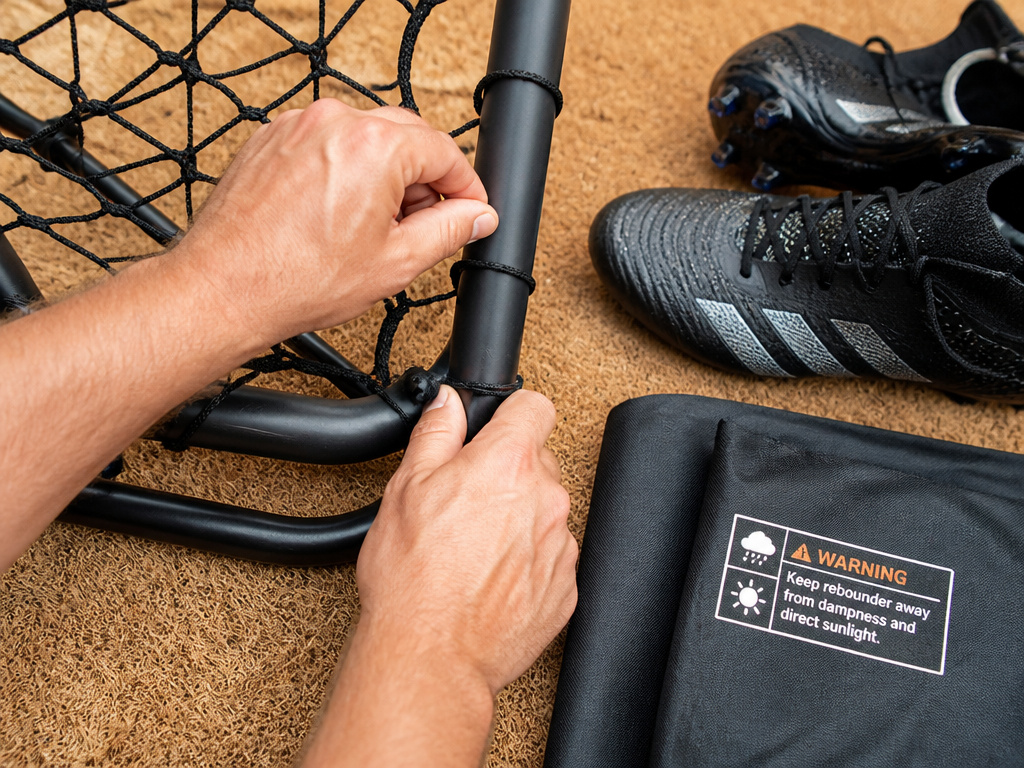
A rebounder is a piece of sports equipment, not a toy. The VEVOR manual explicitly states, “Sports equipment (soccer boots, football gloves, etc.) should be worn during use.” Playing in socks or sandals on a damp surface is asking for a slip or a stubbed toe.
The long-term cons often relate to care. Even durable nets require proper care. Net World Sports advises users to store rebounders away from direct heat and sunlight and to dry the net and frame before packing it away to prevent any form of rot or mildew. Leaving a wet net bunched up in a bag can lead to damage. Similarly, the VEVOR manual warns: “Do not place in a damp environment.” Proper storage is essential for the product to last.
Before you start: Ensure you have a flat, clear surface free of debris. Wear proper football boots for grip. If using a water/sand-filled model, place it on grass or a non-slip mat to prevent scratching hard surfaces and to improve stability.
For board rebounders, the material is generally tough, but rough handling can damage it. The wear point on nets is often the connections or the mesh itself. A quick visual check for damage before each use is advisable.
Who Should (and Shouldn’t) Use a Rebounder?
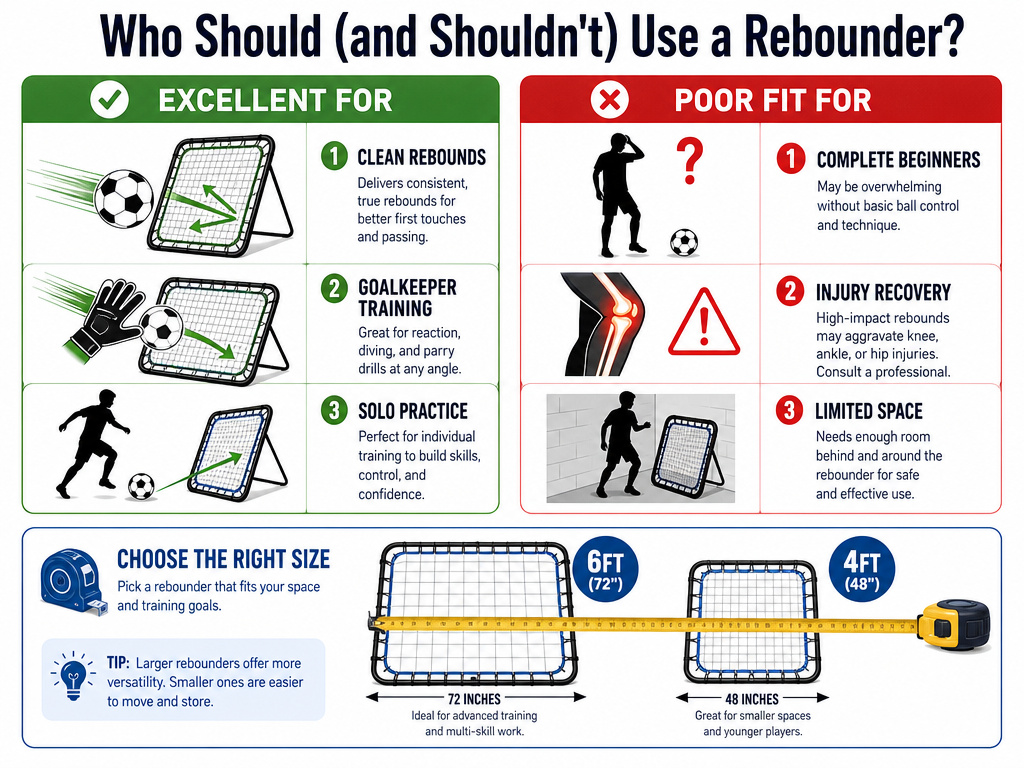
The benefits are not universal. This is where the pros and cons get personal.
Rebounders are excellent for:
- Players with solid basic technique looking for high-repetition polishing.
- Goalkeepers using angled nets for reflex and distribution drills.
- Solo trainers without consistent access to a partner or wall.
Rebounders are a poor fit for:
- Complete beginners. Without a foundation of basic technique, the repetitive motion can ingrain bad habits.
- Players recovering from lower-body overuse injuries (knees, ankles, hips). The unilateral, repetitive striking can exacerbate problems.
- Those with very limited space. Using a rebounder in a space that’s too small forces unnatural, abbreviated movements.
There’s also a disagreement on age suitability. HackkSoccer states net rebounders are best for age U12 through adult. However, Elite Champions Coaching notes that compact 100x100cm nets suit juniors, which is a point of disagreement with other sources that recommend nets for U12 and up. This means a compact net rebounder might be suitable for a younger junior player, while a full-sized net is designed for older players. Always check the physical dimensions, not just the age label.
Board vs. Net Rebounder: Which Material is Best?
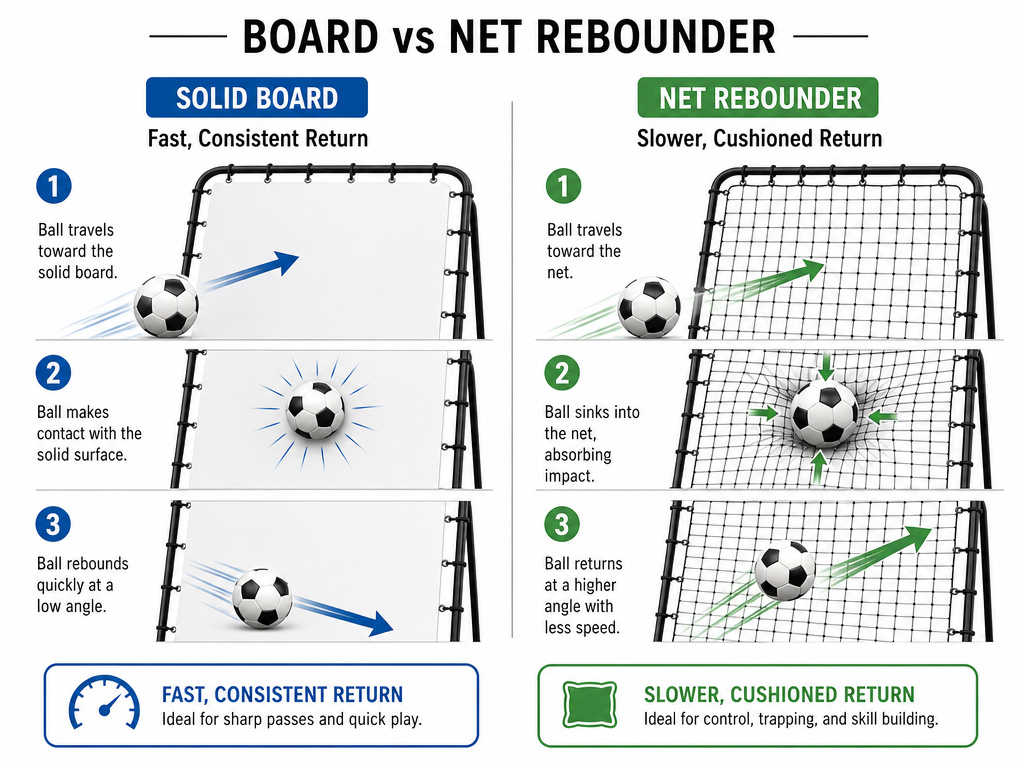
Board rebounders provide a fast, immediate, and very consistent ball return, making them excellent for sharpening first touch and ground passes. However, they are limited for aerial ball work. Net rebounders offer a slower, cushioned return that varies with net tension and strike angle, which is excellent for lofting the ball back for volleys and aerial control. Boards are typically more compact and lightweight for easy movement, while net frames are larger, often require assembly, and need more space. For training younger players, compact net sizes can be suitable according to some sources, while boards are generally recommended for players U10 and up by other sources. Consider your primary training focus and available space when choosing between the solid surface of a board or the forgiving net.
Frequently Asked Questions
Are football rebounders any good?
Yes, for specific, repetitive skill development. Research in the Journal of Sports Sciences shows they can improve reaction time and ball control. Their value is in giving you hundreds of extra touches in a focused session, not in replicating the unpredictability of a real game.
What is the downside of rebounding?
The main downsides are the risk of overuse injuries from repetitive motion, the space and stability requirements (some need sand/water filling), and the fact that the return can be less game-realistic than training with a partner. They also require proper storage to avoid weather damage.
Is a rebounder board or net better?
It depends on your training goal. A board is better for fast, consistent ground passes and first-touch drills. A net is better for aerial returns, volleys, and goalkeeper training. For most youth players working on core passing and control, a board delivers more value per rep.
Who should not use a rebounder?
Beginners still learning basic technique, players with existing lower-body overuse injuries, and anyone without a flat, clear space that meets the rebounder’s minimum size requirements should avoid them or use them with extreme caution under guidance.
The Bottom Line
A football rebounder is a drill, not a magic bullet. The pros, solo practice, measurable neuromuscular gains, sharpened reactions, are real and backed by research. The cons, injury risk, space needs, setup annoyances, and a potential lack of realism, are just as tangible.
If you’re buying one, let the skill decide. Need a crisper first touch and sharper passing? Get a board rebounder. Working on volleys or goalkeeping? A net rebounder is your only choice. Ignore the age labels and measure the actual footprint against your available space. And no matter what the manual says, be prepared to weigh it down or secure it. That moment of frustration when it slides back with every powerful pass is when good training equipment becomes a nuisance.
Ultimately, its worth is determined by use. A rebounder used for twenty minutes of focused drills, two or three times a week, is a fantastic investment. One that sits assembled in the corner of the garage is just a reminder of a plan you didn’t follow. Buy for the training you will actually do, not the training you imagine.
