
History of the World Cup Match Ball
This post contains affiliate links. As an Amazon Associate, we earn from qualifying purchases.
A World Cup match ball must meet the strict FIFA Quality Programme standards: a weight of 410-450g, a circumference of 68-70cm, and an inflation pressure between 0.6 and 1.1 bar. Its history is a journey from hand-stitched, water-logged leather to thermally bonded, sensor-equipped spheres, driven by television, synthetic materials, and a relentless, sometimes controversial, quest for aerodynamic perfection.
That weight and pressure range is the rulebook. What happens on the pitch is a different story. A ball that meets every spec can still fly like a knuckleball or drop like a stone if its surface is too smooth, and the players will tell you all about it. The real history isn’t just a list of names and panel counts; it’s the tension between lab-tested perfection and the chaotic, wet, windy reality of a match, a tension that defines the history of the World Cup match ball.
What follows is the story of that tension in the history of the World Cup match ball. We’ll start with the inconsistent, host-made balls of the early tournaments, move through Adidas’s era-defining standardisation, and arrive at today’s connected, data-streaming designs. You’ll see where the science worked, where it famously backfired, and why the ball is now as much a piece of broadcasting technology as it is a piece of sporting equipment.
Key Takeaways
- The 1930 final used two different balls. Argentina’s Tiento and Uruguay’s T-Model, one per half, highlighting the complete lack of standardisation in the tournament’s early days.
- Adidas’s 1970 Telstar, with its 32 black-and-white panels, wasn’t just iconic; it was the first ball designed for television visibility, marking the start of the ball as a broadcast commodity.
- The controversial 2010 Jabulani ball was criticised by players for its unpredictable flight, a direct result of its smoother, 8-panel surface, a case where lab-tested “perfection” conflicted with on-pitch feel.
- Modern ball development, like the 2.5-year testing of the 2014 Brazuca with over 600 players, is a massive, global operation aimed at avoiding past failures and managing commercial partnerships.
- The latest evolution is the sensor-equipped match ball, like the 2026 Trionda, which provides real-time data to officials, turning the ball itself into an active participant in refereeing decisions.
The Pre-Adidas Era (1930-1966): Laces, Leather, and Local Production
Watch a clip from a 1950s match. The ball looks heavy, almost sluggish. That’s because it was. Before Adidas took over as sole supplier in 1970, World Cup balls were produced by local manufacturers in host nations, leading to wild inconsistencies in quality, materials, and performance. There was no standardised procedure, and the technology was rudimentary.
The 1930 final is the perfect example of this chaos. Unable to agree on a single ball, Argentina and Uruguay used one each per half, the Argentine Tiento first, then the Uruguayan T-Model. Uruguay came from behind to win 4-2 after the switch, and while you can’t credit the ball alone, the legend of its influence was born. These were lace-up leather spheres that would absorb water and become significantly heavier in the rain.
Where this goes sideways: Using a leather ball in wet conditions. A dry ball might weigh 410g, but after 20 minutes of rain, it could soak up pounds of water, turning a crisp pass into a dead-weight slog and making heading a genuine health risk.
Innovation was slow but tangible. The 1934 Federale 102 replaced leather laces with softer cotton ones. The 1950 Superball Duplo T was a breakthrough as the first World Cup ball without laces, using an internal valve. The 1958 Top Star was selected from 102 unbranded submissions in FIFA’s first blind-test selection process, a move towards objectivity. Yet, consistency was still a dream. While the official ball selected for the 1962 World Cup was the ‘Crack’, it was so disliked by European teams that 100 of the popular 1958 Top Star balls were shipped over and used when it was decided the Crack was not up to the task.
| Era | Example Ball (Year) | Key Innovation | Notable Quirk |
|---|---|---|---|
| Lace & Leather | T-Model (1930) | Standard 12-panel leather construction | Final played with two different balls |
| Early Refinements | Superball Duplo T (1950) | First valve-inflated, lace-free ball | Introduced consistent air retention |
| Selection Experiments | Top Star (1958) | Chosen from 102 blind submissions | 24-panel design became a European favourite |
| Material Advances | Challenge 4-Star (1966) | 25-panel design; extensive pre-tournament testing | Produced in white, orange, and yellow for visibility |
The move from a craft object to a standardised product was inevitable. Television was becoming the dominant way to watch the game, and a brown ball disappearing against a muddy pitch on a black-and-white screen was a broadcaster’s nightmare. The stage was set for a single manufacturer to take control and redesign the ball for a global audience.
The Adidas Era: Standardisation and Synthetics
Adidas’s partnership with FIFA, beginning in 1970, didn’t just provide a reliable supplier. It redefined the match ball as a branded, technologically evolving centrepiece of the tournament. The primary goal shifted from basic functionality to optimising performance for players and visibility for the new, all-important television audience.
The 1970 Adidas Telstar is the most important ball in history. Its 32-panel design (20 white hexagons, 12 black pentagons) wasn’t just aesthetically striking; it was engineered for TV. The high contrast made the ball easily trackable on black-and-white sets, turning it into a global icon. It’s a fact few realise: only 20 Telstar match balls were supplied for the entire 1970 tournament. Today, far more balls are used in a single match.
The 1978 Tango Durlast introduced a new design pattern. But the real revolution was under the surface. The 1986 Azteca was the first fully synthetic, polyurethane-coated match ball. This was the death knell for leather. Synthetic materials didn’t absorb water, maintained a consistent weight, and offered better durability. The ball was now a sealed, predictable object.
Technical Snapshot: The shift to synthetic materials involved layered construction. A ball like the 1994 Questra was enveloped in a layer of polystyrene foam for a softer touch, while the 1998 Tricolore used an advanced syntactic foam and “under glass print” technology to improve durability and colour longevity.
Adidas’s era can be broken into clear technological phases, moving from visual standardisation to material science to aerodynamics.
| Phase | Defining Balls | Primary Innovation | Player Impact |
|---|---|---|---|
| Visual TV Era | Telstar (1970), Tango (1978) | Black/white TV visibility; iconic triad pattern | More predictable than leather, but still variable |
| Synthetic Revolution | Azteca (1986), Etrusco Unico (1990) | Waterproof polyurethane coatings; internal foam layers | Consistent weight in all weather; faster off the foot |
| Aerodynamic Quest | +Teamgeist (2006), Jabulani (2010) | Thermal bonding; reduced panel counts for smoother surface | Extreme consistency in theory; often controversial in practice |
A change in equipment changes the skills the game requires. The introduction of synthetic balls changed the game’s dynamics. The quest for a “perfect” sphere reached its zenith with the 2006 +Teamgeist, whose 14 thermally bonded panels made it within one percent of a perfect sphere. This scientific idealism, however, was about to collide with the messy reality of physics and player preference.
The Aerodynamic Revolution and Its Discontents (2006-Present)
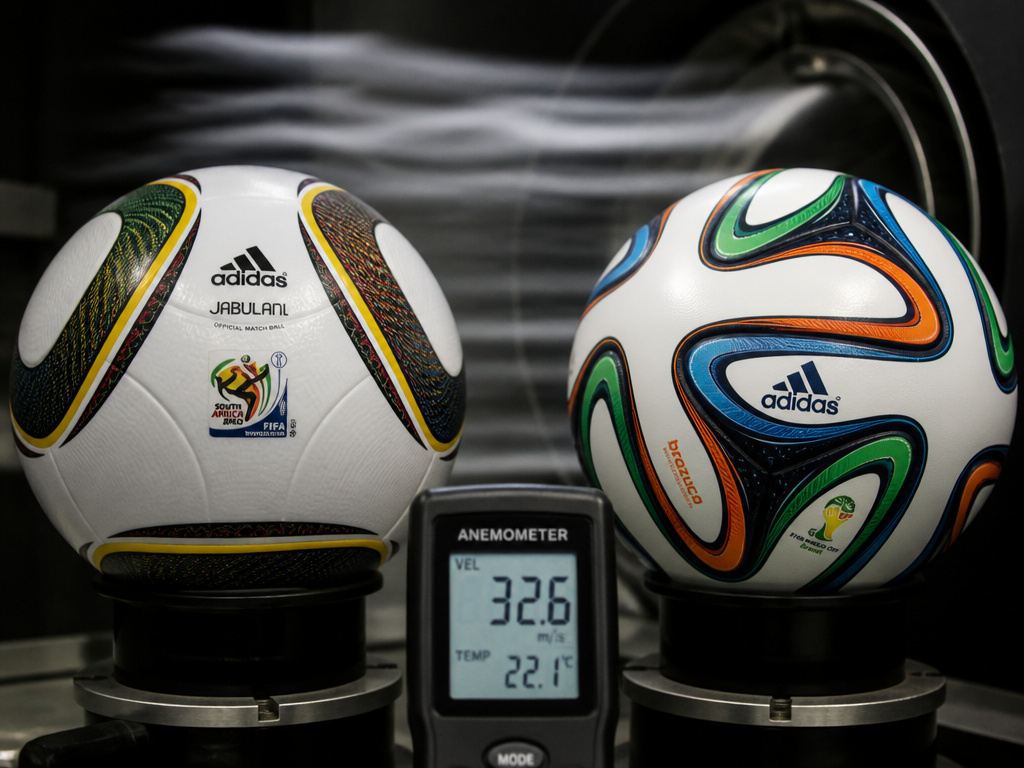
If the synthetic era was about controlling the ball’s weight and water resistance, the last two decades have been a single-minded pursuit of perfect flight. The method: reduce seams. The theory: fewer, thermally bonded panels create a smoother sphere, which should fly straighter and truer. The reality, as goalkeepers and strikers will tell you, has been complicated.
The 2006 Adidas +Teamgeist was a shock. Fourteen panels, bonded together, no stitching. It was tested by the Sports Technology Research Group of Loughborough University and hailed as a marvel. It was rounder and more waterproof. But it was also harder, with a distinctive thud off the boot that some players never loved.
Then came the 2010 Jabulani. With just eight thermally bonded 3-D panels, it was the smoothest yet. Adidas touted its ‘Grip n Groove’ technology. The science said it was perfect. Players widely criticised it for its unpredictable flight; Spain’s goalkeeper Iker Casillas called it ‘rotten’, and scientists concluded its smoother surface caused unstable flight. Adidas, however, countered that the Jabulani underwent six months of testing and cited praise from its sponsored players.
Common mistake: Believing a smoother ball is always better. The Jabulani proved that a completely seamless surface can lack the micro-turbulence needed for stable flight at high speeds, making it wildly unpredictable in the air, a free-kick taker’s dream and a goalkeeper’s hell.
The backlash was so severe it changed the development process. For the 2014 Brazuca, Adidas conducted over 2.5 years of testing with more than 600 players and 30 teams across 10 countries. They also used an identical bladder and carcass to the widely praised UEFA Euro 2012 Tango 12 ball, opting for a trusted core in a new 6-panel shell. The result was a ball almost universally accepted by players. The name itself, chosen by a public vote of over one million Brazilian fans, showed how the ball had become a marketing and cultural touchstone as much as a piece of equipment.
This period reveals a core tension. The ball is developed in labs and wind tunnels, but it’s judged on grass in the rain. The England FA’s 2014 contract with Nike even prevented the national team from using the official Brazuca competitively until just weeks before the tournament, highlighting how commercial deals could interfere with preparation for the sport’s biggest stage.
The Connected Ball and the Future
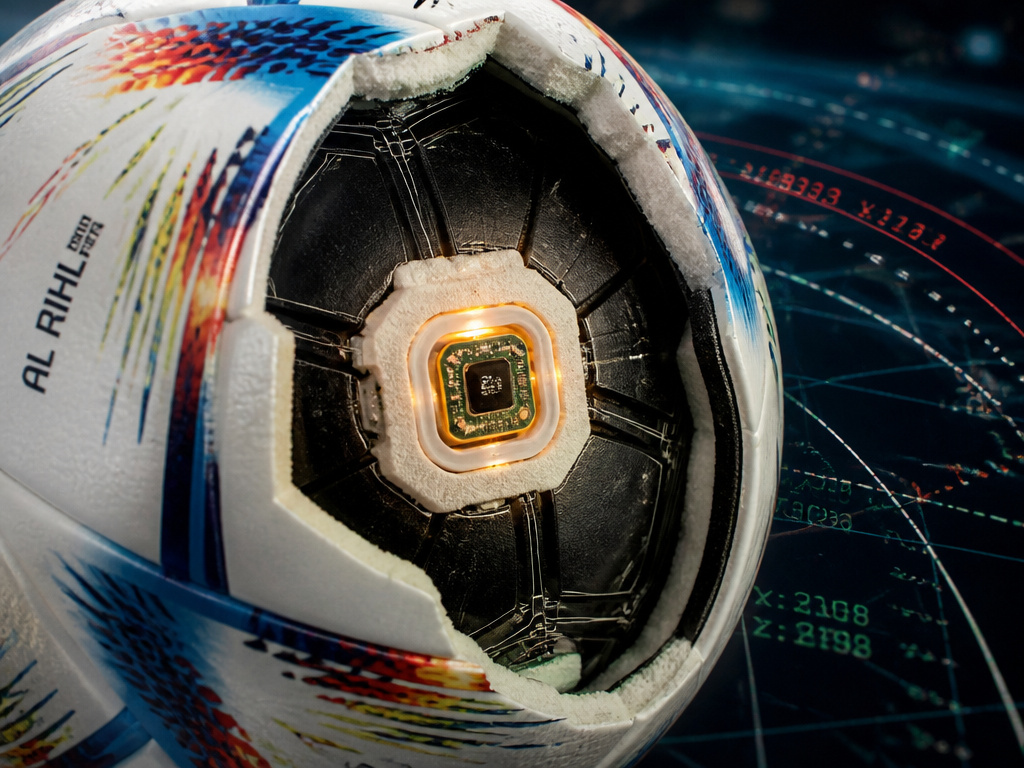
Today, the evolution has entered a new phase: the ball as a data hub. The 2022 Al Rihla was the first official match ball created with water-based glues and inks, a sustainability milestone. More significantly, it featured Connected Ball Technology, a motion sensor embedded in the centre.
This isn’t just a gimmick. The sensor provides real-time data on kick point, speed, and spin to video match officials, aiding in offside calls and verifying goal-line incidents. For future balls like the 2026 model, this technology is expected to be central, helping officials by detecting minute touches. Two Al Rihla balls even went on a suborbital mission on a SpaceX Falcon 9 booster before the 2022 tournament, a stunt that perfectly captures the ball’s journey from leather craft to space-age tech.
The development focus is now threefold: 1. Aerodynamic Refinement: Continuing to tweak panel shape and surface texture for stable flight.
- Data Integration: Making the ball a reliable source of objective match data for officiating and broadcast.
- Sustainability: Reducing environmental impact through materials and adhesives.
The modern match ball is a high-stakes product. Its development cycle is long, its testing extensive, and its commercial value immense. It must satisfy physicists, please the world’s best players, comply with billion-dollar kit deals, and tell a story about the host nation. That it works as well as it does is a minor miracle.
Frequently Asked Questions
What was the first synthetic World Cup ball?
The first fully synthetic, polyurethane-coated World Cup match ball was the Adidas Azteca in 1986. It replaced the last traditional leather ball, the 1982 Tango España, and changed the game by being fully waterproof and maintaining a consistent weight.
Why was the 2010 Jabulani ball so controversial?
Players, especially goalkeepers, criticised the Adidas Jabulani for its unpredictable, knuckling flight path. Its extremely smooth, 8-panel surface lacked the micro-turbulence needed for aerodynamic stability at the high speeds of professional free-kicks and long passes, making it difficult to judge and catch.
How are World Cup balls tested today?
The process is exhaustive. Following the Jabulani controversy, testing for the 2014 Brazuca involved over 600 players and 30 teams across 10 countries over 2.5 years. Balls are tested in different climates, altitudes, and conditions by professional clubs and national teams to ensure consistent performance and gather player feedback before final approval.
What does FIFA Quality Programme mean?
The FIFA Quality Programme is the governing body’s official standard for match balls. To be approved for a World Cup, a ball must meet strict criteria for weight (410-450g), circumference (68-70cm), pressure retention (0.6-1.1 bar), rebound, and water absorption. It’s the baseline guarantee of performance.
What is the newest technology in World Cup balls?
The latest innovation is embedded sensor technology. Balls like the 2022 Al Rihla and 2026 Trionda contain a motion sensor that provides real-time data on speed, spin, and touch points to video match officials, aiding in precise offside and goal-line decisions.
Before You Go
The history of the World Cup match ball is a map of football’s priorities. It started with basic, local necessity, was reshaped by the demands of television, transformed by material science, and is now being redefined by data. The lesson isn’t that technology always improves the game, the Jabulani proves otherwise. It’s that every change, from removing a lace to adding a sensor, shifts the balance of skills on the pitch.
So, the next time you see a free-kick dip or a long pass hold its line, remember the object itself is part of the story. That flight path was decided as much in an Adidas lab in Scheinfeld as by the player’s foot. The beautiful game’s most essential tool has become one of its most complex pieces of engineering. And honestly, for a simple sphere, that’s a pretty remarkable journey.
