
Match Ball vs Training Ball in Football: How to Choose
This post contains affiliate links. As an Amazon Associate, we earn from qualifying purchases.
A match ball is built to a certification standard for consistent performance in official games, using materials and construction that prioritize flight, touch, and shape. A training ball is engineered for durability and cost-effectiveness, designed to withstand hundreds of practice sessions on various surfaces. For most teams, the right answer is a mix: one or two match balls for games and final preparation, and a squad set of durable training balls for daily work.
The whole distinction isn’t about good versus bad. It’s about two different jobs. One job is to perform with absolute predictability for ninety minutes under a referee’s inspection. The other job is to survive being kicked against a fence two hundred times a week without going out of round or blowing the budget. This is the essential difference between a match ball vs training ball in football.
What follows is a breakdown of the specs you can actually measure, the construction arguments that brands are having right now, and a straightforward plan for fitting both balls into a real team’s kit bag. We’ll start with the labels you see on the ball itself.
Key Takeaways
- Match balls carry a FIFA Quality mark (Pro, Quality, or Basic) verifying they pass standardized tests for weight, sphericity, and pressure loss.
- Training balls use thicker, textured outer panels and butyl bladders for longevity, while match balls favor thinner, smoother casings and often latex bladders for a responsive feel.
- On grass, a premium match ball lasts 8-12 weeks under heavy match use; a durable training ball can last 6-12 months of daily practice.
- For a typical squad, budget for 1-2 match balls and 8-10 training balls. Use the match balls only for games and the final pre-match session.
- Check your league rules. State league or NPL match days often require at least a FIFA Quality ball, while grassroots football almost never does.
What Is a Match Ball? What Is a Training Ball?
The labels on the ball tell you what it’s built for. A match ball’s purpose is verified by an independent test house.
A match ball is any football that meets a defined performance standard for use in organized competition. The global benchmark is the FIFA Quality Programme. Balls marked ‘FIFA Quality Pro’ are mandated for top professional matches. Those marked ‘FIFA Quality’ are for all other professional matches. The entry-level ‘FIFA Basic’ standard (which replaced the older International Matchball Standard, or IMS) is the minimum mark for a match ball.
The FIFA International Matchball Standard for a Size 5 ball requires a weight of 410-450g, a circumference of 68.0-70.0 cm, and a maximum sphericity deviation of 1.8%. It must not lose more than 25% of its pressure after 72 hours.
A training ball has a different job: repetition. Manufacturers like Decathlon state their training balls are “developed so every age category has just the right ball for training.” The goal is durability across countless sessions. While a model like the Decathlon Machine-Stitched Training Ball still checks sphericity against the ≤1.8% FIFA Basic rule, it isn’t submitted for the full battery of certification tests. Its construction choices, thicker materials, machine stitching, are all about surviving daily punishment.
The Construction Breakdown: Materials Matter
Open any product page and you’ll find a materials list. This is where the real trade-offs live, not in marketing copy.
| Component | Typical Match Ball | Typical Training Ball | Why It Differs |
|---|---|---|---|
| Outer Casing | Thinner Polyurethane (PU) | Thicker TPU/PU or PVC | Match: for soft touch & flight. Training: for abrasion resistance. |
| Panel Construction | Thermal bonding or hand-stitching | Machine stitching | Match: smoother seam for consistent aerodynamics. Training: faster, cheaper, durable. |
| Bladder | Often Latex | Almost always Butyl | Match: softer, more responsive feel (loses air faster). Training: superior air retention. |
| Foam Backing | Varied, often multi-layer (e.g., 4.5mm hyperfoam) | Single layer or simpler foam (e.g., EVA) | Match: cushions impact for better control. Training: reduces cost, maintains structure. |
At the highest level of the game, the details matter. The Mitre Ultimatch ball uses a 0.6mm PU outer and a 4.5mm hyperfoam backing. That thin outer gives a player a clean, immediate connection. The Decathlon Training Ball, in contrast, uses a main part of 70% Ethylene Vinyl Acetate and 30% Thermoplastic Polyurethane, a tougher, more forgiving blend.
Where sources disagree: The optimal bladder for a match ball. Guide to Football states butyl bladders are “the more common choice for match play” due to pressure retention. Meanwhile, some coaching guides and retailers state match balls use latex bladders for a superior, softer feel, while other sources like Guide to Football state butyl bladders are the more common choice for match play due to pressure retention.
This isn’t a trivial debate. A latex bladder changes the sound of a strike, a deeper, softer thud compared to the harder pop of a butyl bladder. It also changes the feel on a volley. If your league’s match ball uses latex and you only train with butyl, you’re practicing with a different tool.
The Real Performance Differences

You don’t need a lab to feel the difference. It shows up in the first five minutes of a session.
A match ball feels lighter off the foot. A clean strike travels farther with less perceived effort. The surface is smoother, sometimes glossier, which affects swerve and how the ball skids on a wet pitch. A training ball feels heavier, more substantial. It’s predictable and sturdy, but it won’t ping off your laces with the same liveliness.
The numbers from testing explain why. We can compare two Decathlon balls, one from each category.
- Decathlon Hybrid 2 Match Ball (FIFA Quality): In lab tests, this ball lost 9% pressure in 14 days and scored 7.75 in a rebound test. It scored 1.4 in a standardized water absorption test.
- Decathlon Machine-Stitched Training Ball: Its tested pressure loss is ≤15% after 72 hours at 0.8 bar. It’s built to resist wear, not to top a rebound chart.
These specs translate to real-world consequences. That lower water absorption score means a match ball won’t get as waterlogged and heavy in the rain. The tighter rebound tolerance means it bounces consistently, whether it strikes the pitch near the center circle or the penalty spot.
Common mistake: Using a brand-new match ball for a rainy Tuesday training session on artificial turf. The abrasive surface will scuff the thinner casing in weeks, and the latex bladder will need pumping up halfway through. You’ve just burned through a premium resource on a job a £30 ball was built to do.
Sensory reality matters here. A worn-in training ball has a specific sound when you whack it, a dull, solid thump. A match ball, even when brand new, has a crisper, more resonant connection. Listen for it.
When Do You Actually Need a Match Ball?
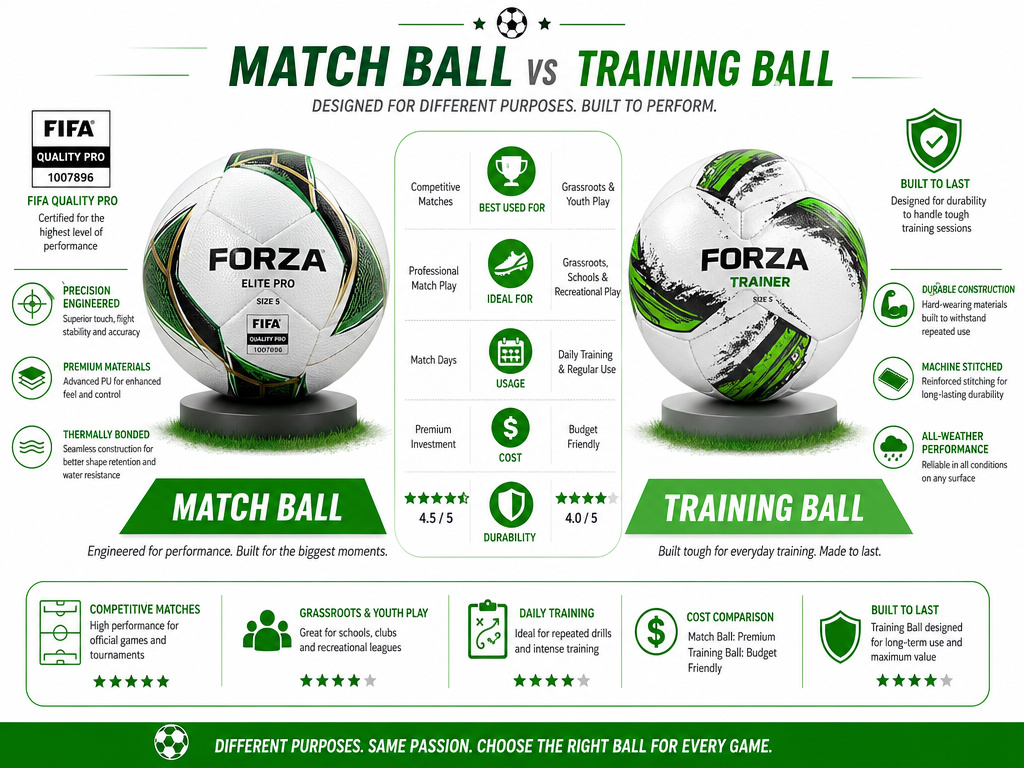
The answer depends entirely on the level of football you’re playing and the rules you’re playing under.
For competitive, sanctioned matches, the requirement is usually clear. An Australian coaching guide recommends match balls for “State league, NPL match days, representative squads, and finals.” These are environments where player technique is mature enough to benefit from the consistent flight, and where competition rules often mandate a certification mark.
For grassroots, youth, and recreational football, the case weakens dramatically. The Australian coaching guide recommends training balls for “U10-U13 training and weekly grassroots matches,” though some manufacturers market balls for both match and training use. The technical benefit of a £120 ball is invisible to a child who is still mastering basic striking technique. The financial risk, replacing a ball chewed up on hard ground, is high.
| Scenario | Recommended Ball Type | Primary Reason |
|---|---|---|
| FIFA / Confederation Matches | FIFA Quality Pro (Mandatory) | Competition regulation. |
| Senior Professional / NPL Matches | FIFA Quality or Quality Pro | League rules & performance expectation. |
| Grassroots Adult League Matches | Training Ball or FIFA Basic | Cost-effectiveness & durability. |
| U16+ Team Training (Pre-Match Session) | Match Ball (same as used in games) | Muscle memory & feel adaptation. |
| Daily Team Training (All Ages) | Durable Training Ball | Volume, cost, and surface durability. |
| Individual Practice | Quality Training Ball | Builds strength; saves wear on match balls. |
My rule of thumb for the match ball vs training ball in football is simple. If the league doesn’t require a specific certification, a training ball developed for training is almost always the smarter buy. The performance gap a teenager or weekend warrior will notice is negligible compared to the lifespan gap.
Team Budgeting and Lifespan Reality

We should consider how balls wear out and what that does to a club’s budget. This is where the “one ball for everything” idea falls apart.
An Australian coaching guide provides concrete numbers. On grass, a match ball lasts 8-12 weeks under heavy match use. A training ball lasts 6-12 months with daily use. The gap widens on hard surfaces: 2-4 weeks for a match ball versus 3-6 months for a training ball.
A typical Australian club squad needs 1-2 match balls + 8-10 training balls.
That formula works because it separates the tools. You protect your limited, expensive match balls for the moments they’re designed for. You buy training balls in bulk because they’re consumables, meant to be cycled through. Spending £1500 on ten premium match balls for daily training is a fantastic way to blow a season’s equipment budget by October.
The part nobody mentions: A ball’s lifespan is mostly about surface abrasion. Artificial turf is a giant sheet of sandpaper. A glossy, thin-paneled match ball will be scuffed to a matte finish within a month of training on it. The textured, tougher skin of a training ball laughs at the same surface.
Navigating Conflicting Advice on Construction
You’ll hear strong opinions on panel counts and bladder types. In fact, brands are arguing about this too, which means there’s no single right answer.
The Panel Count Debate: Is fewer panels better? Decathlon argues its 24-panel Hybrid 2 Match Ball design provides “better stability” than traditional 32-panel balls. Select Sport, however, promotes the “32 Dual Bonded panels” of its Numero 10 ball to “ensure a straight flight through the air.” Both are making performance claims for different designs. For a player, the difference is subtle, fewer seams mean a slightly smoother surface for striking.
The Hybrid Ball: Can one ball do both jobs? Some brands market balls for “match and training.” The Select Numero 10 training ball uses a butyl bladder. The Optimum Sport Matrix Match Football is for “match play and high-intensity training” and uses a latex bladder, which some sources associate with match balls for a softer feel. These are compromises. They might be perfect for a serious amateur team that plays and trains on good grass, but they won’t be as durable as a pure training ball or as performance-optimized as a top-tier match ball.
When you’re comparing specific models like these in the match ball vs training ball in football debate, ignore the marketing category. Look at the spec sheet: bladder type, panel construction, and outer material. That tells you what you’re really getting.
What are some specific ball models and their uses?
Manufacturers produce distinct lines for different levels of play. For match use, a ball like the Decathlon Hybrid 2 carries a FIFA Quality mark, uses a polyurethane outer and a bladder of 70% Dry Rubber, 30% Bromo Isobutylene Isoprene Rubber, and features a 24-panel design marketed for better stability. In contrast, their Machine-Stitched Training Ball is explicitly developed for training sessions, using a main part of 70% Ethylene Vinyl Acetate, 30% Thermoplastic Polyurethane and a bladder of 9.5% Synthetic Rubber, 19.0% Talc, 35.5% Dry Rubber, 15.5% Bromo Isobutylene Isoprene Rubber, 20.5% Carbon Black. Other brands like Select offer a Numero 10 training ball with 32 dual-bonded panels for a straight flight, while Optimum Sport markets balls like the Classico for both match and training on various surfaces. The key is to match the ball’s stated purpose and any official certification to your intended use, whether that’s a weekend final or daily practice.
Frequently Asked Questions
Can I use a match ball for training?
You can, but you’ll shorten its lifespan dramatically, especially on artificial turf or hard ground. The thinner casing and latex bladder aren’t built for that kind of punishment. It’s like using a chef’s knife to chop firewood. Use a match ball in the final session before a game to get used to the feel, but do the bulk of your work with a training ball.
What does FIFA Quality Pro mean?
FIFA Quality Pro is the highest certification tier in the FIFA Quality Programme. Balls with this mark have passed the most stringent independent tests for weight, circumference, sphericity, rebound, water absorption, and shape retention. They are required for top professional matches like the Champions League or World Cup.
Are expensive match balls worth it for a kid?
Almost never. For children under 13, skill development revolves around repetition and confidence. A durable, size-appropriate training ball is the perfect tool. The nuanced flight and touch of a premium match ball are irrelevant at that stage, and the risk of damaging an expensive ball is high. Save the investment for when their technique can actually benefit from it.
How often should I pump up my football?
It depends on the bladder. A ball with a latex bladder (common in match balls) may need topping up every 1-2 weeks. A ball with a butyl bladder (standard in training balls) can hold pressure for a month or more. Always follow Law 2, which states the ball must be pressurized to between 0.6 and 1.1 atmospheres (8.5-15.6 PSI) at sea level. Use a pump with a gauge.
What’s the difference between thermal bonding and stitching?
Thermal bonding uses heat and glue to fuse panels together, creating a seamless surface. It’s the standard for high-end match balls as it provides the smoothest aerodynamics. Stitching (machine or hand) uses thread. Machine stitching is durable and cost-effective, making it the go-to for training balls. Hand-stitching is a premium, durable method found on some high-quality match and training balls.
Before You Go
So, should you buy a match ball or a training ball? For most of us involved in the game, coaches, parents, casual players, the answer is the training ball. It’s the workhorse. It’s the tool that gets the job done 90% of the time without fuss or financial drama.
Invest in a match ball only when the context demands it: your league requires it, you’re playing at a level where that 10% performance edge matters, or you simply want to experience the best feel the game has to offer. And when you do, protect that investment. Keep it for the pitch and the final walkthrough.
The beauty of it is that both types serve the same beautiful game. One gives you the Sunday polish, the other gets you through the muddy, glorious grind of every other day of the week. Get the balance right, and you’ll never waste money or sacrifice preparation again. What’s the oldest ball still in your kit bag, and what stories does it hold?
