
Football Ball Sizes Explained: How to Choose the Right One
This post contains affiliate links. As an Amazon Associate, we earn from qualifying purchases.
Football ball sizes are defined by specific weight, circumference, and pressure ranges set by the International Football Association Board (IFAB) in Law 2. For senior play, a Size 5 ball must be 68–70 cm around, weigh 410–450 g, and have a pressure of 0.6–1.1 atmospheres. Youth sizes (3 and 4) scale down proportionally for safety and skill development, with official ‘light’ ball categories recommended for younger age groups.
That pressure range of 0.6–1.1 bar for a Size 5 is where the ball’s entire feel lives. A guide to football ball sizes explained would note this critical pressure variation. Pump it to the top end for a tour-level match and it pings off the foot like a rock. Leave it at the bottom for a kids’ session and it feels heavy and dead. The difference is not subtle, and it changes how every player touches the ball.
What follows is a breakdown of the three things that actually define a ball size in a football ball sizes explained guide: the official IFAB Law, the stricter FIFA certification marks that govern pro play, and the practical choices for youth development. This guide explains the specs you can trust, the disagreements between rulebooks, and the one pressure-gauge habit that stops a ball inflated to the correct pressure from feeling wrong.
Key Takeaways
- The official IFAB Law 2 defines a Size 5 match ball as 68–70 cm circumference, 410–450 g weight, and 0.6–1.1 atm pressure — but for top-tier competitions, FIFA Quality Pro certification requires a tighter tolerance of 68.5–69.5 cm.
- For youth safety, many follow FIFA’s age-specific recommendations, which include ‘light’ ball categories (e.g., a Size 5 light at 350–380 g for U13s), though these specific categories are not found in the main IFAB Laws of the Game.
- Always check ball pressure with a gauge; a ball at 0.8 bar feels and behaves completely differently than one at 1.1 bar, affecting touch, flight, and impact force.
- A wet ball can absorb water, increasing its mass and significantly raising impact forces, which is why referees can swap them during play.
- For most training, a durable training ball offers better value and longevity than a replica match ball, which is built for precision, not repeated pavement kicks.
Official Size 5 Specifications: IFAB vs. FIFA
The rulebook answer in any football ball sizes explained is clear. The testing standard is stricter.
IFAB Law 2 is the absolute baseline for any match. It states a senior ball (Size 5) must have a circumference of 68–70 cm, a weight of 410–450 g at kick-off, and an air pressure of 0.6–1.1 atmospheres at sea level. That is the law. Any ball within those ranges is legal for play.
But for any competition you have actually heard of, that is just the starting line. FIFA runs the FIFA Quality Programme, a separate, brutal testing regime that balls must pass to earn a certification mark. There are two main tiers, and their limits are narrower than IFAB’s.
| Standard | Circumference | Weight | Rebound (20°C) | Pressure Loss (72h) |
|---|---|---|---|---|
| IFAB Law 2 | 68.0 – 70.0 cm | 410 – 450 g | Not specified | Not specified |
| FIFA Quality | 68.0 – 70.0 cm | 410 – 450 g | 125 – 155 cm | Max 20% |
| FIFA Quality Pro | 68.5 – 69.5 cm | 420 – 445 g | 135 – 155 cm | Max 15% |
A ball must successfully pass seven tests to earn the FIFA Quality mark. The tests are tougher than the conditions in a normal game, checking roundness, water absorption, and shape retention after a simulated beating.
That rebound test is a perfect example. A FIFA Quality Pro ball must bounce between 135 and 155 cm when dropped from 2 meters. A standard FIFA Quality ball can bounce as low as 125 cm. That 10 cm difference is the gap between a ball that feels lively and one that feels a bit dead — and it is measured in a lab under controlled conditions.
The takeaway is simple. For a Sunday league match, a ball meeting IFAB Law 2 is fine. For any serious competition, look for the FIFA Quality Pro or FIFA Quality stamp on the valve or panel. It is your guarantee the ball has been through the wringer and will behave consistently.
Youth Football Sizes: Age Charts and ‘Light’ Ball Categories
Youth sizes are about safety and development, not just shrinking the adult ball. The standard numbering is straightforward: Size 3 for the youngest, Size 4 for juniors, Size 5 for everyone over about 13.
But the chart most parents see only tells half the story. FIFA publishes specific youth recommendations that include official ‘light’ ball categories. These are not just smaller; they are deliberately lighter to reduce impact force, a crucial factor for heading safety in developing players. This is a key piece of guidance that does not appear in the main IFAB Laws.
| Age Group | Recommended Size | Circumference | Weight | Notes |
|---|---|---|---|---|
| U9 | Size 3 or Size 4 Light | 60–62 cm or 63.5–66 cm | 280–310 g or 290–320 g | Lighter weight aids control and safety. |
| U11 | Size 4 Light or Size 4 | 63.5–66 cm | 350–390 g | Transitional phase; light ball still recommended. |
| U13 | Size 4 or Size 5 Light | 63.5–66 cm or 68–70 cm | 350–390 g or 350–380 g | Size 5 light introduces adult size with reduced mass. |
| 13+ | Size 5 | 68–70 cm | 410–450 g | Standard adult match ball specifications apply. |
Common mistake: Moving a child to a Size 5 ball too early because they are “big for their age.” The weight jump to 410g+ changes the game biomechanically, often encouraging poor heading technique and longer, less controlled passes as they struggle to manipulate the mass.
The logic is physical. A 2023 peer-reviewed study in Sports journal noted that for lower heading impact, “the lowest ranges of the official size 5 ball specifications may be recommended.” The youth ‘light’ categories formalize this, dialing the weight down while keeping the circumference close to the full-size feel. It is smarter player development.
When choosing a ball for a child’s age, the light ball options are worth seeking out. Some manufacturers produce them. They are not always on the front shelf, but they make a tangible difference in a kid’s confidence and safety.
Why Correct Size and Pressure Actually Matter
It is not pedantry. An over-inflated or waterlogged ball changes the game at a mechanical level.
First, pressure dictates feel. Pump a ball to the max 1.1 bar and it becomes hard, fast, and unforgiving. It skims off wet grass and flies further. At the minimum 0.6 bar, it is softer, slower, and easier to control but feels heavy and unresponsive on long passes. Most players and leagues find a sweet spot around 0.8 bar. This is why your guide to football ball pressure is a more important read than any shiny ball review.
Second, mass affects impact. The study from the NIH soccer ball characteristics study is blunt: “wet balls absorb water, increasing their mass and generating greater impact forces than dry balls.” A soaked Size 5 can absorb water, increasing its mass and potentially pushing it toward or past its legal weight limit. That is not just uncomfortable; it is a measurable safety issue, particularly for repeated heading. This is the formal, physical reason referees will swap out a waterlogged ball.
Third, consistency affects fairness. Law 2 exists so that both teams play with the same tool. A ball that loses shape or pressure during the match advantages no one and frustrates everyone. The FIFA Quality Programme tests for pressure loss (max 15% loss over 72 hours for Pro balls) to combat this. A cheap ball might look the same but can lose pressure rapidly, becoming a different object by halftime.
The official rules account for this. If the ball becomes defective during play, the restart depends on the situation; for example, if it happens at a kick-off, goal kick, corner kick, free kick, penalty kick, or throw-in, the restart is retaken. If it fails during a set piece like a penalty, the kick is retaken. The game stops because the fundamental tool is broken.
Football Construction: Match Balls vs. Training Balls
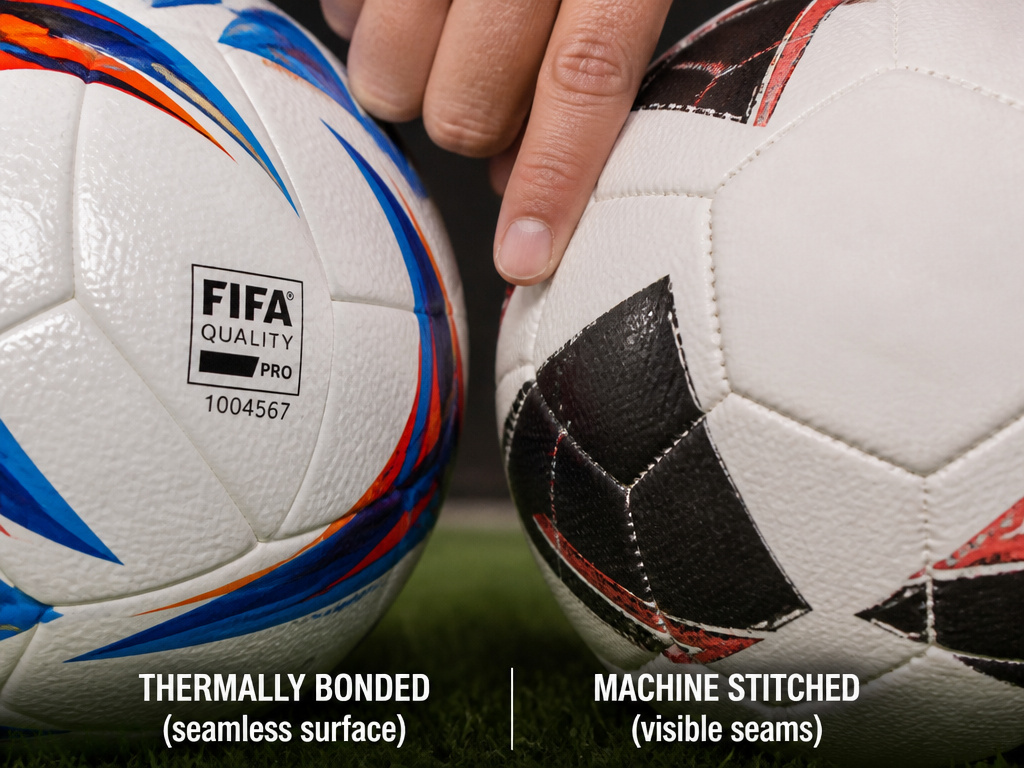
Not all Size 5 balls are built the same. The difference between a match ball and a training ball is the difference between a precision instrument and a durable workhorse.
A top-tier match ball is built for consistent performance in a 90-minute window. It typically features:
- Thermally bonded panels (fewer seams for a truer flight).
- A latex bladder (for a softer, more responsive feel).
- A multi-layer lining for shape retention.
- That all-important FIFA Quality Pro certification.
It feels incredible off the foot. It also costs a lot and will not last a month if you boot it against a concrete wall daily.
A training ball is built for longevity. It usually has:
- Machine-stitched panels (more durable seams).
- A butyl rubber bladder (far better pressure retention over weeks).
- A simpler lining.
- Often a FIFA Quality or no certification mark.
It feels a bit harder, a bit more predictable, and will survive hundreds of hours on all surfaces. This is the core of the match ball vs training ball decision. For 95% of players, a high-quality training ball is the smarter buy. It is the difference you can feel in your wallet and in the ball’s lifespan.
The types of footballs extend to other formats too. A futsal ball is size 4 but has about 30% less bounce, making it stick to the hard court. A beach soccer ball is softer and lighter to be kinder on bare feet. They are specialized tools for their sport.
How to Choose the Right Football
Ignore the replica hype. Start with the job.
For match play in any sanctioned competition, the choice is made for you. The ball must bear a FIFA Quality Pro, FIFA Quality, or FIFA Basic mark. Your league will often specify which. This rule is mandatory. Check for a FIFA Quality Pro, FIFA Quality, or FIFA Basic stamp.
For serious team training, where you want to replicate match feel, aim for a FIFA Quality ball. It hits the balance of performance and cost. Our roundup of the best footballs for training always leans toward these durable, consistent performers.
For youth development and casual play, prioritize safety and appropriate size. Use the age chart, but consider the ‘light’ ball options if available. A Size 4 or Size 3 from a brand like Mitre that uses a soft, durable outer coating will last through a season of enthusiastic kicks.
For individual practice against a wall or on concrete, durability is everything. A durable training ball is fine. The goal is repetition, not perfect flight.
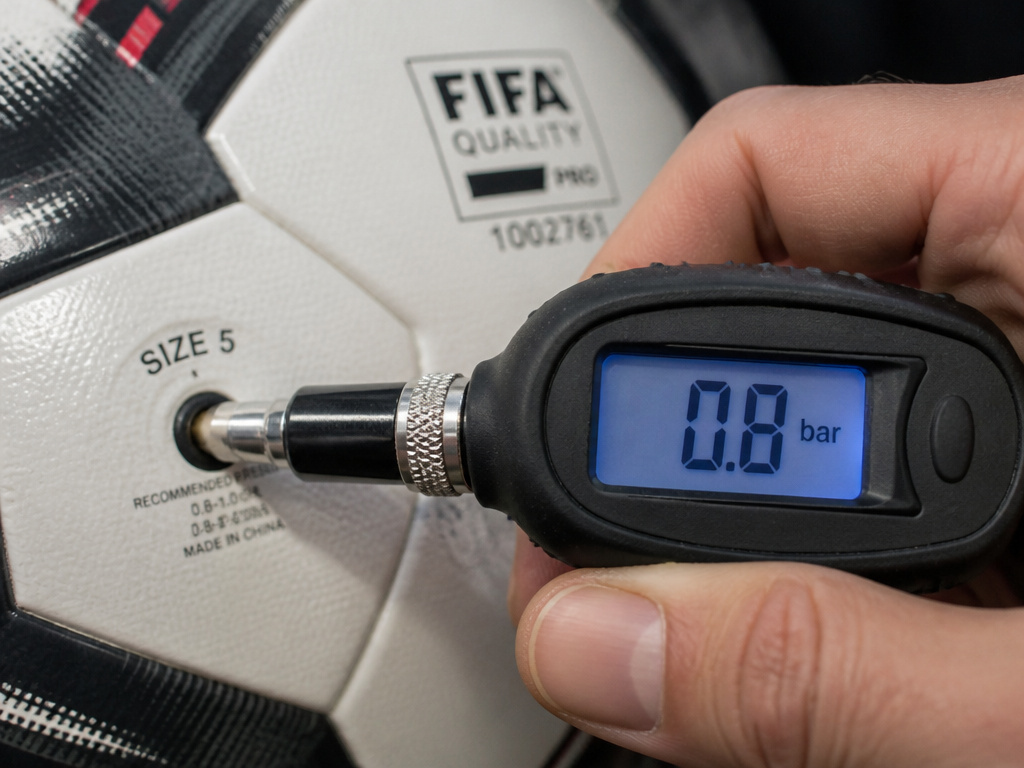
One universal rule: buy a pressure gauge. The PMC peer-reviewed sports science study explicitly recommends “the regular use of ball pressure gauges as an inflation pressure monitoring tool.” A ball at the correct pressure is a better ball. It is that simple.
What size football for youth players?
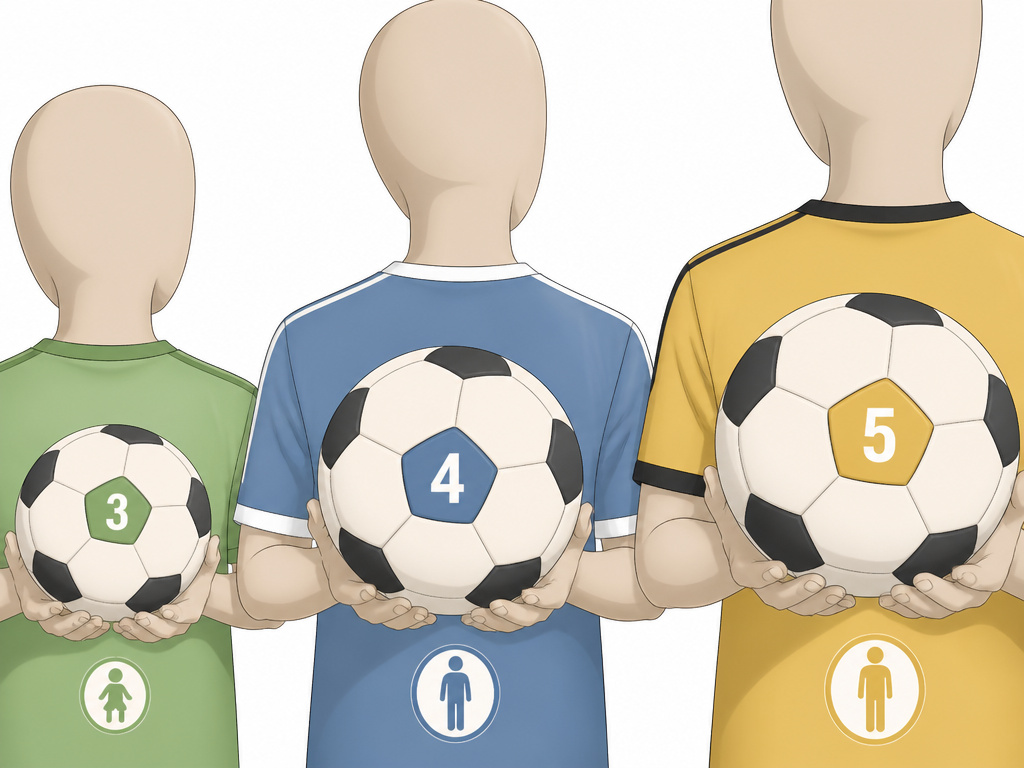
The core IFAB Laws of the Game do not specify different ball sizes for different youth age groups, but governing bodies like FIFA provide detailed age-based recommendations. Instead, governing bodies like FIFA provide recommendations for youth development. These recommendations often suggest using smaller, lighter balls for younger players to help with skill development and safety. For example, they may advise using a Size 3 or a lighter Size 4 variant for younger children, moving to a standard Size 4 or a lighter Size 5 for older youth, before transitioning to the full adult Size 5. The goal is to match the ball to the player’s physical capabilities. Practical guidance is to check with your local league or national association, as they will have specific rules for the competitions they organise.
What size football does high school use?
For high school-aged players and official competitions, the standard ball is a Size 5. According to the IFAB Laws of the Game, a Size 5 ball for senior play must have a circumference between 68 and 70 centimeters and a weight between 410 and 450 grams at the start of a match. National associations may require balls used in their competitions to bear an official FIFA Quality Programme mark, which indicates the ball has passed rigorous laboratory tests. These FIFA certification tests, for either the FIFA Quality or top-tier FIFA Quality Pro mark, enforce even stricter limits on circumference, weight, sphericity, and rebound performance than the basic laws require.
What size football do NFL and pro leagues use?
The highest levels of professional football, including international matches organised by FIFA and its confederations, use a Size 5 ball. The IFAB Law sets the baseline specifications, but professional competitions mandate the highest certification standard. Balls must bear the FIFA Quality Pro mark. To earn this mark, a ball must pass seven demanding laboratory tests under conditions tougher than a normal match. For a Size 5, the FIFA Quality Pro limits are stricter than the basic law: circumference must be 68.5 to 69.5 cm, and weight must be 420 to 445 grams. No commercial advertising is permitted on these match balls, except for specific competition and manufacturer logos.
Frequently Asked Questions
What is the difference between a Size 4 and Size 5 football?
Size 5 is the standard adult match ball (68–70 cm, 410–450 g). A Size 4 is a youth ball (63.5–66 cm, 350–390 g) used roughly from ages 9 to 12. The Size 4 is not just smaller; it is deliberately lighter to suit a child’s strength and reduce impact forces, making it safer and more controllable for skill development.
Can a Size 5 football be used for under 12s?
Officially, no for matches, and it is not recommended for training. FIFA guidance suggests a Size 4 or even a Size 5 light (350–380 g) for U13s. A full 410g+ Size 5 ball is too heavy for most children that age, promoting poor technique and increasing the risk of injury from heading or awkward kicks.
What does FIFA Quality Pro mean on a football?
It is the highest certification a football can earn. It means the ball has passed FIFA’s most demanding laboratory tests for weight, circumference, sphericity, rebound, water absorption, pressure loss, and shape retention. Balls with this mark, like many best size 5 balls, are mandated for top professional competitions like the UEFA Champions League.
How much should I inflate my football?
The Laws of the Game allow a range of 0.6 to 1.1 atmospheres (8.5–15.6 psi) for a Size 5. Most players and teams find a sweet spot around 0.8 bar (11.6 psi). This offers a balance of responsiveness and control. Always use a pressure gauge for accuracy; the feel-by-hand method is notoriously unreliable.
Is a futsal ball the same size as a football?
No. A futsal ball is a specialized tool. While it is similar in circumference to a Size 4 football (62–64 cm), it is heavier and, crucially, has about 30% less bounce. This low bounce is what allows the ball to stay on the hard court for the controlled, technical game of futsal. The differences between a futsal ball and a football are significant.
Before You Go
One rule that reframes the whole topic: if you are buying a ball for a child who is small for their age or just starting out, go down a size from the standard chart. A nine-year-old struggling with a Size 4 will blossom with a Size 3. The confidence they gain from being able to properly control and strike the ball outweighs any minor size discrepancy.
The specs and certifications matter for fairness at the highest levels. But for the rest of us, the right ball is the one that feels good, lasts more than a few weeks, and encourages more time playing. That is usually a well-made training ball, kept at the right pressure, and chosen for the foot that is going to kick it.
